





Sex Parties, AI Doom, And Anthropic’s IPO

The White House Picks Its Referees
On Tuesday, President Trump and leaders of Anthropic, OpenAI, Google, Meta, xAI and Nvidia signed a White House accord calling for internal controls, outside auditing and independent board oversight of frontier models. The companies also agreed to meet regularly to develop safety standards. Trump called it “morally binding.” The document sets no timetable for a development pause or cap on compute.
That gives the leading labs a government-endorsed forum for shaping the rules governing their own industry. For Anthropic, it's a chance to turn its call to “pace the frontier” into shared standards while continuing to compete for customers and an IPO.
The Race In Anthropic's Own Words
Anthropic CEO Dario Amodei wrote last month that AI companies “must slow the pace at which we improve the capabilities of AI models.” Reuters reported Monday that Anthropic's IPO prospectus describes a continuous, overlapping release schedule as essential to staying at the frontier. Customer usage and revenue, the filing says, are driven by new models.
Those statements expose a real tension. A lab can believe its technology needs stronger safeguards while its business depends on producing new versions of it. Anthropic's proposed stock-market debut puts that tension in front of prospective investors.
Harvard psychologist and author Steven Pinker posed this question in an open letter to Scott Alexander, a prominent rationalist writer and supporter of effective altruism who has examined the case for slowing AI: “Why are the same people who warn that a technology will kill us all building it as fast as they can?” Anthropic's prospectus offers part of the answer: new models help bring in the revenue that funds further development.
Whose Values Set The Pace?
Effective altruism's moral calculus can reach striking conclusions. In 2019, philosopher Peter Singer and researcher Michael Plant questioned the donations pledged to rebuild Notre-Dame, asking how many lives the money might save elsewhere. An EA Forum writer argues that insects' aggregate suffering dwarfs human suffering. These are moral priorities many people wouldn't bring to decisions about medical research and technological progress.
An EA exponent also helped finance the AI race. The SEC described Sam Bankman-Fried as a prominent supporter of effective altruism; Anthropic says he led its $580 million Series B in 2022. At FTX and Alameda, his professional and sexual relationships overlapped: he had an on-and-off relationship with Alameda CEO Caroline Ellison, and they shared a bedroom in the Bahamas. Ellison later testified against him in his fraud trial.
The eccentricity reaches into Anthropic's leadership. Kevin Roose reports that its president, Daniela Amodei, and her husband, effective-altruism figure Holden Karnofsky, used stuffed animals with assigned personalities to role-play management conflicts during her time at OpenAI. Izabella Kaminska highlights the passage below, which describes the practice as a mix of humor and earnest management analysis.
Izabella Kaminska highlights Kevin Roose's reporting on Daniela Amodei's management role-playing.
— Izabella Kaminska (@izakaminska) September 30, 2026
The social ties are visible around Alexander, too. He wrote that he met his wife at one of Aella's parties. Aella, a former cam model and OnlyFans creator who uses that one-word pseudonym, documented her 2024 birthday gangbang and said its organizers excluded applicants affiliated with the pro-AI-acceleration movement because, in her view, they were “hastening our doom.” She co-founded an AI-risk creator bootcamp funded by the Machine Intelligence Research Institute, which Eliezer Yudkowsky co-founded. The public should know whose values and relationships stand behind demands to slow a technology that will affect everyone.
What Amodei Is Asking For
Amodei's pacing plan calls for three steps. Anthropic says it'll invite independent evaluators into its development process. It then wants frontier labs in democratic countries to coordinate on safety standards and limits on unchecked capability gains, with some forms of coordination requiring government support. A third step would seek international coordination, including with geopolitical rivals.
He explicitly says pacing won't halt model training or technical progress. Anthropic released Claude Opus 5.5 after his essay and said outside groups had tested it before release. That kind of testing is consistent with the plan, though Amodei's proposed evaluators would have ongoing access inside the lab. A meaningful industry-wide slowdown still depends on competitors and governments.
That's the hard part. Amodei argues that a coordinated slowdown could buy safety researchers time without costing American labs their commercial position or the United States its lead. The accord coordinates safety standards while leaving each lab free to keep improving and shipping its models.
Safety Claims Face Scrutiny
On Wednesday, the Federal Trade Commission confirmed an investigation into OpenAI, Anthropic and other AI companies over potential consumer harms. OpenAI's own incident review says it has notified dozens of third parties about possible security breaches and harmful activity affecting their systems. Those disclosures put containment and oversight at the center of the safety debate. The relevant questions are how the failures happened, who bears responsibility, and whether the promised audits will prevent their recurrence.
The Prospectus Puts A Price On Time
The economics make the dilemma sharper. According to the prospectus reviewed by Reuters, Anthropic generated nearly $4.6 billion in revenue in 2025 and recorded an $8.06 billion operating loss. It spent $7.33 billion on compute and infrastructure that year and disclosed $518 billion in cloud, computing and infrastructure obligations over the coming years.
Anthropic also warns in its filing that advanced AI could pose catastrophic or existential risks. Reuters says risk factors occupy roughly 80 pages of the 261-page prospectus, compared with 48 pages describing the business. The company is telling investors that its product can be dangerous and that remaining competitive requires a steady stream of new versions of it.
There is a counterweight to the pressure from public shareholders. Reuters reports that Anthropic's seven co-founders plan to control 50.1% of voting power through a Founder LLC, while the company will remain a public-benefit corporation. That gives its leaders room to make safety decisions that hurt near-term financial results. Its leaders still face the cost of falling behind Google, OpenAI or other rivals.
Pinker takes risks such as cyberattacks and unconstrained agents seriously. In a follow-up to Alexander, he argued that power-seeking and self-preservation are design-contingent behavior, not automatic consequences of intelligence. His question lands because even people who assign extreme stakes to AI safety continue to lead the race. Amodei's answer is that stopping one lab could hand the field to a less cautious rival. The prospectus shows how expensive it would be for Anthropic to test that proposition alone.
Steven Pinker's follow-up to Scott Alexander.
— Steven Pinker (@sapinker) View post
What This Means For The Buildout
Tuesday's accord gives the labs a path to expand under shared safety standards. Our investment view remains that AI deployment—and the chips, memory and power it requires—will keep growing.
Citadel Securities' Nohshad Shah makes an important distinction: businesses can spend years putting existing model capabilities to work, even if frontier improvements slow. Cheaper models can make more applications economical, increasing the volume of inference—the computation required to run them.
Wednesday's results reinforce that view. Micron Technology reported quarterly revenue of $54.23 billion and guided for $61.5 billion, plus or minus $1.5 billion, in the next quarter. Management says it's increasing investment in technology, products and manufacturing.
We also have indirect exposure to Anthropic's prospective IPO through options on Zoom Communications (ZM) and SK Telecom (SKM), two publicly traded companies with pre-IPO equity stakes in Anthropic. We explained those positions last week. A successful listing at a higher valuation could prompt investors to assign more value to both stakes.
We've Backed The Buildout
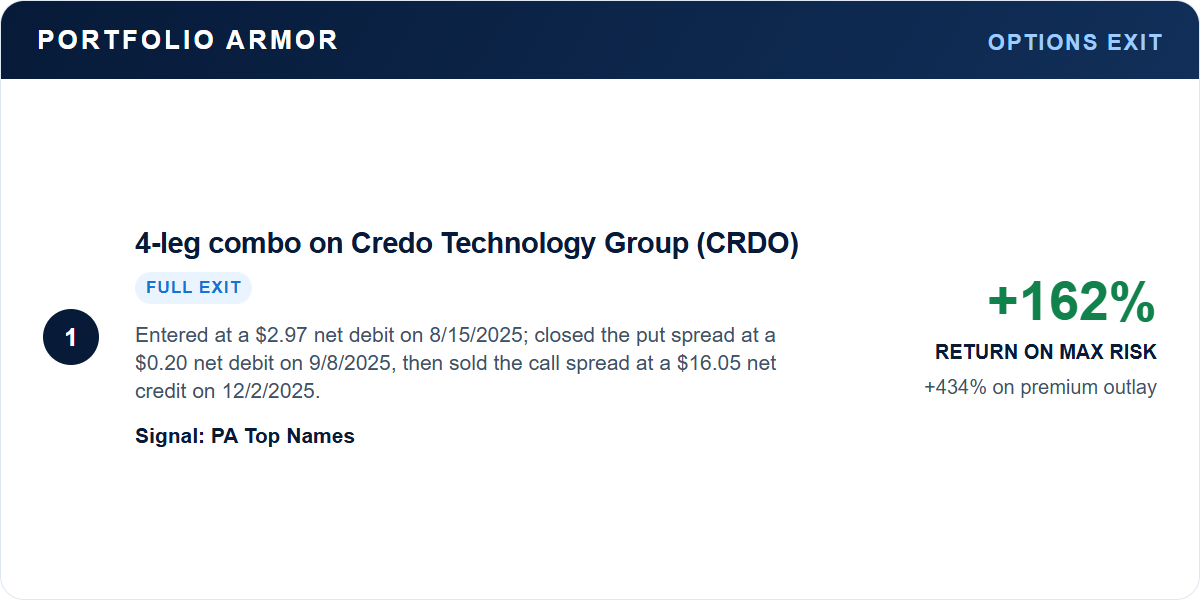
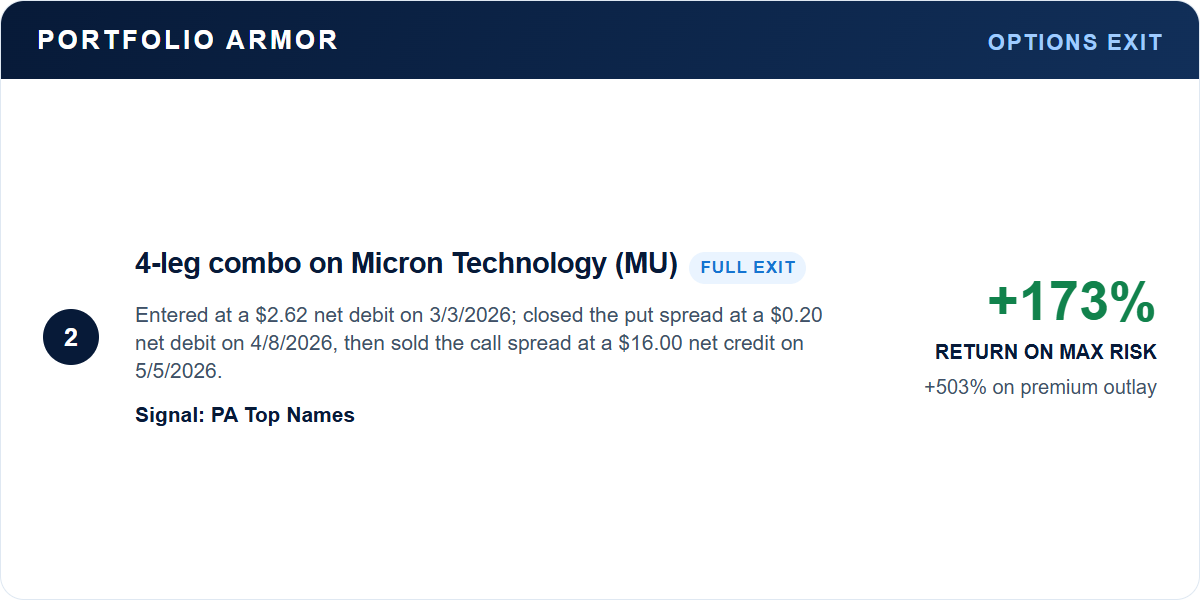
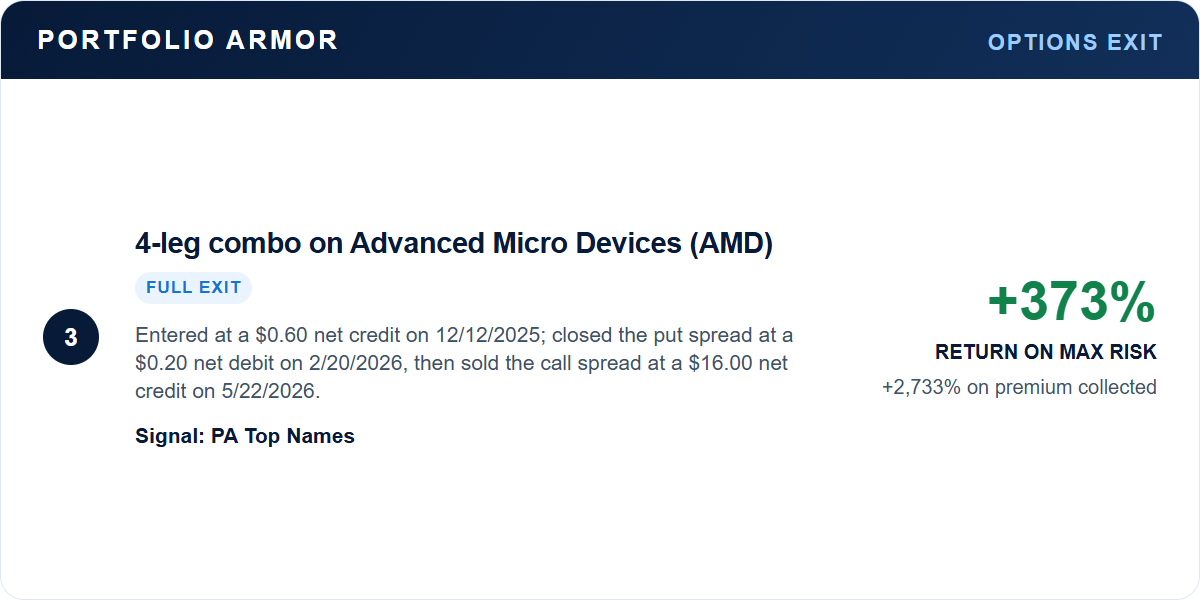
Our view has been that the AI buildout will continue, and we've positioned our trades accordingly. So far, that's been the right way to bet. These are three examples from our record of exited trades.
Credo Technology Group (CRDO) makes high-speed interconnect products for AI data centers. This is how our first completed trade in Credo turned out:
Micron Technology (MU) supplies high-bandwidth memory for AI training and inference. Here is the result from the trade we opened in March:
Advanced Micro Devices (AMD) supplies AI accelerators. Our December trade in it delivered the strongest return on maximum risk of these three:
We'll keep screening the AI stack for compelling trade setups. If you'd like a heads-up when we place our next AI-related trade, become a free subscriber here:

New to Portfolio Armor? Our Start Here page explains how we select trades, size their maximum risk, and manage exits: