





ARMS & THE CHIP
Before we march, let us define our terms, because the phrase “technological development“ is used by politicians, central bankers and venture capitalists with the same precision a drunk uses a lamppost: more for support than illumination.
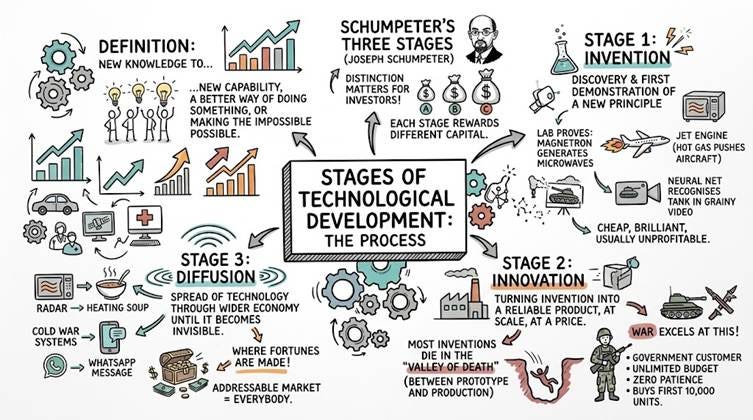
A technological development is the process by which new knowledge is turned into new capability, a better way of doing something, or a way of doing something that was previously impossible. Economists, following the Austrian Joseph Schumpeter, break it into three distinct stages, and the distinction matters for investors because each stage rewards a different kind of capital.
The first stage is invention: the discovery or first demonstration of a new principle. A laboratory proves that a magnetron can generate microwaves, that a jet of hot gas can push an aircraft, or that a small neural network can recognise a tank in a grainy video feed. Invention is cheap, brilliant and usually unprofitable.
The second stage is innovation: turning the invention into a product that works reliably, at scale, at a price someone will pay. This is where most inventions die, in what engineers call the “valley of death” between prototype and production. It is also exactly where war excels, because a government at war is a customer with an unlimited budget, zero patience and a willingness to buy the first ten thousand units before anyone knows whether the thing is profitable.
The third stage is diffusion: the spread of the technology through the wider economy until it becomes invisible. Nobody today thinks of radar when heating soup, or of Cold War nuclear command systems when sending a WhatsApp message. Diffusion is where fortunes are made, because it is where the addressable market becomes everybody.
Two further concepts complete the vocabulary. The first is dual use: a technology that serves both military and civilian ends. Nearly every important technology of the last century is dual use, which is why export-control lawyers are among the best-paid professionals of our age. The second is the S-curve: new technologies improve slowly at first, then explosively, then plateau. Wars have a habit of grabbing a technology sitting at the bottom of its S-curve and yanking it straight up the steep part.
Investors should add one more observation. In peacetime, technology is pulled by consumers: somebody wants a faster phone. In wartime, technology is pushed by the state: somebody needs to not die. Push is far more powerful, far less price-sensitive and far more inflationary. That is why wars are both technological accelerators and inflation engines, and why this newsletter will end with gold as well as microchips.

The Greeks: the first defence-industrial complex
The first state-funded weapons lab wasn’t in Los Alamos or Silicon Valley. It was in Sicily. In 399 BC, Dionysius I of Syracuse, bracing for war with Carthage, hired the best craftsmen in the Greek world, paid them lavishly and told them to invent something nasty. They delivered the catapult, a giant crossbow that out-shot any archer. Dionysius had found the recipe every defence budget has used since: bright people, bottomless funding and a reliable enemy.
Alexander’s successors upgraded to torsion artillery, catapults powered by twisted sinew and early engineering maths. Philo of Byzantium and Heron of Alexandria wrote siege-engine manuals so good that the Renaissance quietly copied them.
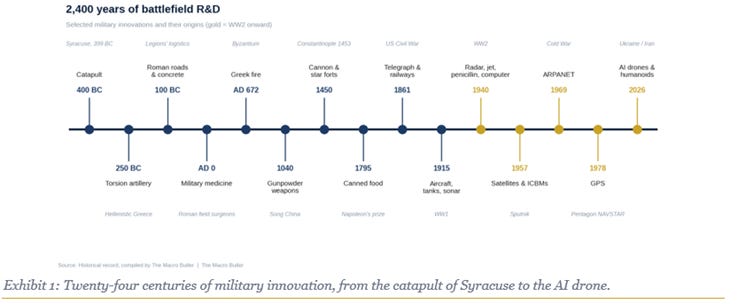
Archimedes spent his final years defending Syracuse against Rome, lifting Roman ships out of the water with his famous “claw“. The burning mirrors are probably a legend. His ending is not: the Roman general Marcellus ordered him spared, and a soldier killed him anyway. The generals already valued their scientists. The infantry was still catching...
Read more and discover how to trade it here: https://themacrobutler.substack.com/p/arms-and-the-chip
Visit The Macro Butler Website here: https://themacrobutler.com/
Join The Macro Butler on Telegram here : https://t.me/TheMacroButlerSubstack
If you want to be ready for what is coming visit The Macro Butler Website :
Join The Macro Butler on Telegram here : https://t.me/TheMacroButlerSubstack
Learn the principles behind:
📈 Investing & Portfolio Building
🌍 Economics & Market Cycles
💡 Smarter Financial Decision-Making
Whether you’re starting your investment journey or looking to sharpen your financial knowledge, The Macro Butler gives you the framework to think differently about money.
👉 Start Learning Now
https://themacrobutler.com/financial-academy/
You can contact The Macro Butler at info@themacrobutler.com

Disclaimer
The content provided in this newsletter is for general information purposes only. No information, materials, services, and other content provided in this post constitute solicitation, recommendation, endorsement or any financial, investment, or other advice.
Seek independent professional consultation in the form of legal, financial, and fiscal advice before making any investment decisions.
Always perform your own due diligence.