





AI's $20 Billion Accounting Scare

A Headline That Hit The Whole Stack
On Thursday, October 8th, a report that OpenAI had reached roughly $50 billion in annualized revenue, against earlier headlines of roughly $70 billion, helped send the AI trade sharply lower. Nvidia (NVDA) fell about 3%, Oracle (ORCL) nearly 6%, and CoreWeave (CRWV) nearly 8%.
The apparent gap was alarming: the company at the center of enormous infrastructure commitments seemed to be generating much less revenue than investors had understood. Zero Hedge covered the selloff as it unfolded.
But the subsequent reporting supplied an important explanation. The figures counted partner revenue differently. Meanwhile, one of the less obvious suppliers to the AI buildout was announcing orders for another generation of processors.
Two Ways To Count Revenue
CNBC reported that the earlier figure was $68 billion and included gross revenue from OpenAI's partners, helping investors compare it with Anthropic. The later $50 billion figure came from an investor presentation, according to a person familiar with the matter.
One measure includes partners' full sales; the other counts OpenAI's share. Axios attributed the roughly $20 billion gap to that distinction.
That presentation also reported 77% growth in the total revenue run rate during the third quarter and 107% growth in the enterprise run rate. Here's the reporting in one place:
| Reported measure | Figure |
|---|---|
| Earlier annualized figure, including gross partner revenue | $68 billion |
| End-of-September annualized revenue | ~$50 billion |
| Third-quarter total run-rate growth | 77% |
| Third-quarter enterprise run-rate growth | 107% |
The gap between the two headline figures therefore needs a reporting reconciliation before investors treat it as evidence of deteriorating demand. Annualized revenue extrapolates the current sales pace; it isn't revenue already earned over a full year.
Where The Financing Risk Is Real
The stronger bearish case concerns the price and financing of the buildout. Huge infrastructure commitments put pressure on customers to turn AI usage into enough cash to pay for the capacity. Rising sales can coexist with poor investment returns when too much is paid for that growth.
There was a concrete example late Thursday: Nvidia-backed Australian data-center operator Firmus abandoned its planned initial public offering after investors balked at the valuation. Zero Hedge's updated report, citing Bloomberg, said the company would pursue other funding options. A financing setback changes a project's ability to buy equipment. A change in revenue presentation answers a different question.
The Orders Behind The Headlines
Aehr Test Systems (AEHR) sells equipment that stresses semiconductor devices electrically and thermally to catch early failures. Its Sonoma platform tests packaged AI processors. As those packages become more powerful and complex, reliable testing becomes an increasingly important part of getting them into service.
On October 7th, Aehr announced ~$6 million in follow-on orders for its unnamed lead hyperscale customer's second AI processor. The systems and consumables are headed to a testing partner in Taiwan, with deliveries scheduled over six months. The customer's first processor is already in high-volume production; the second is expected to ramp in 2027.
That follows the record $41 million order Aehr announced in April for current-generation AI processors. The sequence is useful: production equipment for the existing device, followed by additional capacity for its successor. We've got an open position in Aehr.
We've Traded The AI Stack Before
Aehr's orders point to an AI buildout that's still generating business for its suppliers. We've been trading that supplier theme across the stack, with memory providing one profitable example.
Micron Technology (MU) supplies memory used in AI systems. Our daily Top Names stock ranking led us to the March 3rd entry we published:
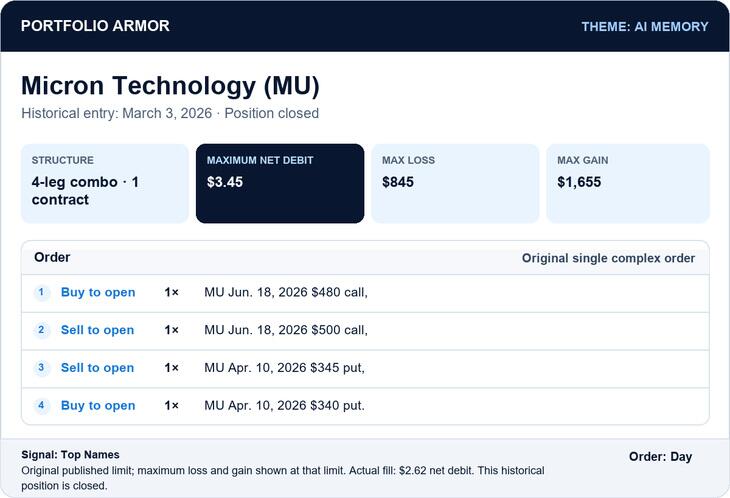
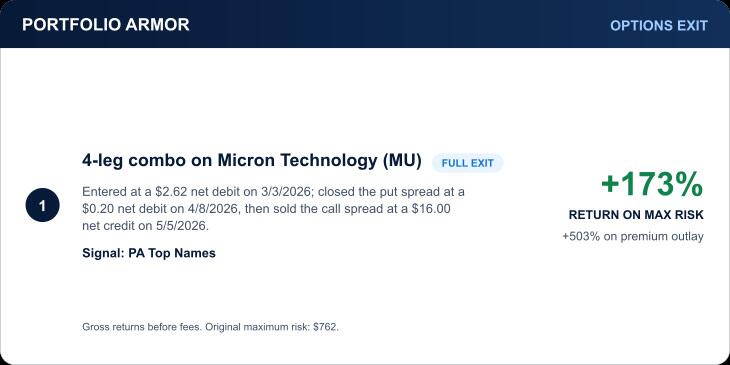
We entered at a $2.62 net debit, below our $3.45 maximum. We closed the put spread on April 8th and sold the call spread on May 5th, completing the trade:
The Next AI Setup
For investors in the AI supply chain, the next checks are concrete: order cancellations, delivery schedules, customers' access to funding, and suppliers' conversion of orders into revenue and cash. Those developments can change the earnings outlook. We’ll weigh them alongside the technical signals that govern our entries.
Thursday's selloff gives us a reason to revisit pricing across the stack. We'll look for companies with improving business evidence that also clear our quantitative screens, then assess whether the options offer an attractive payoff for the risk.
Want a heads-up when we place our next AI-related trade? Become a free subscriber for our public posts, or a paid subscriber for actionable alerts before we enter our trades:

New to our alerts? Our Start Here page explains how we select stocks, structure options trades and manage exits: