





The Bond Who Rolled Me
A household takes a mortgage and hopes to outlive it. A company issues a bond and is asked how it will repay. A government issues a bond, and nobody asks, because nobody intends to. The ten-year Treasury sold in 2016 did not die in 2026. It was reincarnated: new note sold, old holder paid, same debt in a fresh suit. Only the coupon, the date and the creditor changed.
Hence US public debt has fallen in barely a handful of years since 1945, Britain was still paying for the South Sea Bubble and Napoleon until 2015, and no living finance minister has ever proposed getting to zero. The polite word is rollover. When a private citizen does it, the word is Ponzi and the accommodation is provided by the state. The state’s edge is that it can conscript tomorrow’s taxpayers and print the currency. Real advantages. Not infinite ones.
The whole arrangement needs one thing: a buyer on every maturity date. In quiet times he is so reliable he is invisible. Pension funds must buy, banks must buy, foreign central banks must buy, and the home central bank mops up the rest. The auction clears and the minister goes to lunch. But read the promise again. The government has not promised to repay you. It has promised to find a stranger who will. A bond is not a claim on the state’s wealth. It is a claim on the next buyer’s nerve.

Debt is a revolving door, not a ladder. So, stop asking how much is owed and ask how much comes due, how soon, and at what price. Owe a fortune for thirty years at 1% and you sleep like a baby. Owe a modest sum by next Tuesday and you are one bad auction from the IMF’s waiting room. Mexico 1982, Russia 1998, Greece 2010: each was a rollover that failed to roll. The debt was the kindling. The refinancing was the match.
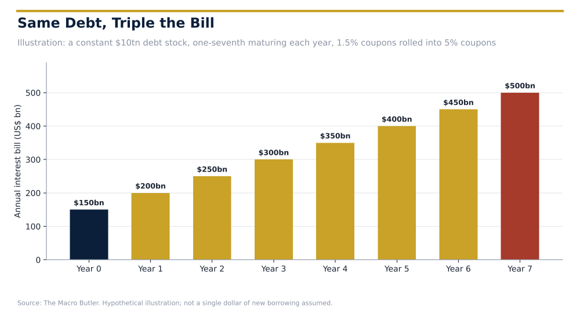
Here is the mechanism in its plainest form, and it deserves slow reading because it is the reason the interest expense of every Western government is going to keep rising for years regardless of what any politician promises. Suppose a government owes $10 trillion, all of it issued when money was nearly free, at an average coupon of 1.5%. Its interest bill is $150 billion a year. Suppose it then does something no Western government has managed in a generation: it balances its primary budget and borrows not one additional dollar. Suppose, finally, that one-seventh of the debt matures each year and that the market now demands 5%.
In year one, the bill is $200 billion. In year three, $300 billion. By year seven, when the last of the cheap bonds has been replaced, the same $10 trillion costs $500 billion a year to carry. The debt has not grown by a cent. The cost has more than tripled. And of course, the assumption of no new borrowing is a fantasy, because the extra $350 billion of interest must itself be borrowed, at 5%, which adds to the stock, which adds to the interest, which must be borrowed. Compound interest, which Einstein may or may not have called the eighth wonder of the world, is a wonder only to the party receiving it.
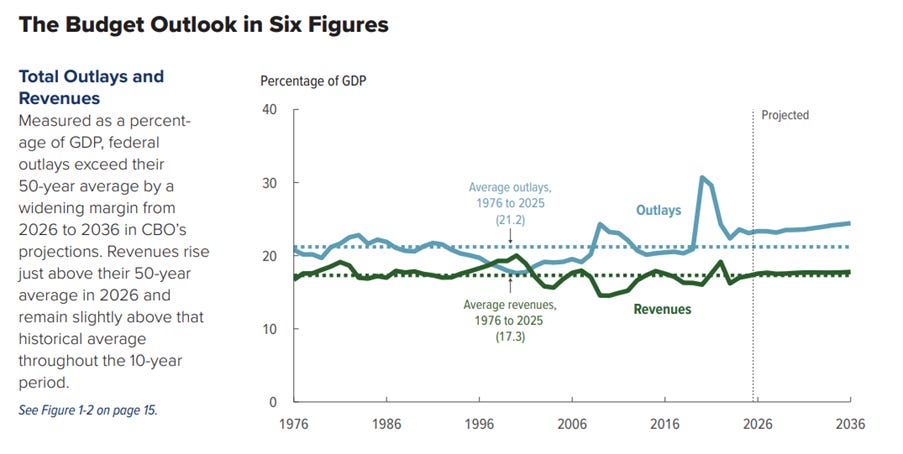
Now swap the illustration for the patient. America owes over $40 trillion. The CBO puts net interest above $1.0 trillion this year, 3.3% of GDP, against revenue of $5.6 trillion. Nearly one tax dollar in five is gone before a soldier, pensioner or pothole sees a cent, and interest has outspent the Pentagon since fiscal 2024. The CBO, paid to stay calm, sees interest at 4.6% of GDP and debt at 120% by 2036, a post-1945 record. Those forecasts assume yields the market abandoned some time ago. The Treasury’s average rate still sits well below what it pays on new paper, so the repricing has barely reached the middle innings.
https://www.cbo.gov/system/files/2026-02/61882-Outlook-2026.pdf
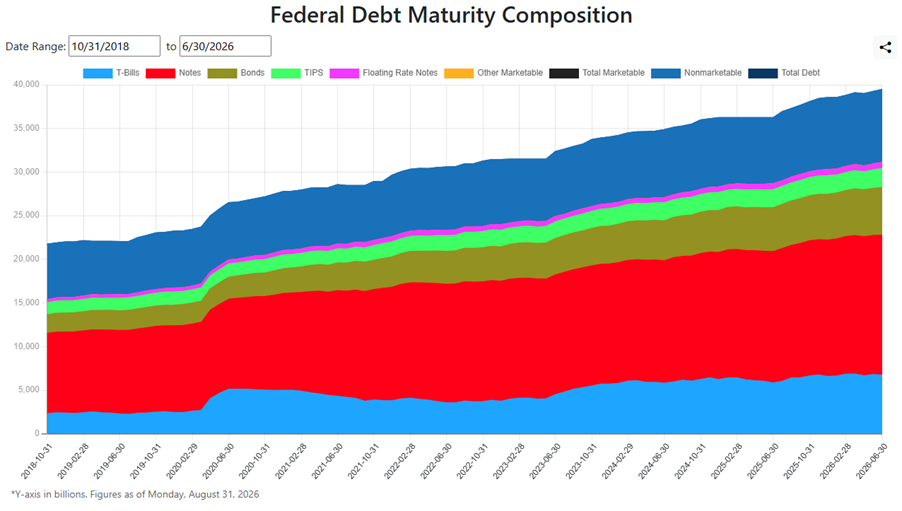
It gets better. Offered 1% for thirty years, the Treasury chose bills instead and still does. Roughly a third of marketable debt now falls due within twelve months, so every week is refinancing week. A corporate treasurer funding a thirty-year asset with ninety-day paper gets fired. A sovereign doing the same is praised for “debt management flexibility”.
https://www.ustreasuryyieldcurve.com/debt-maturities
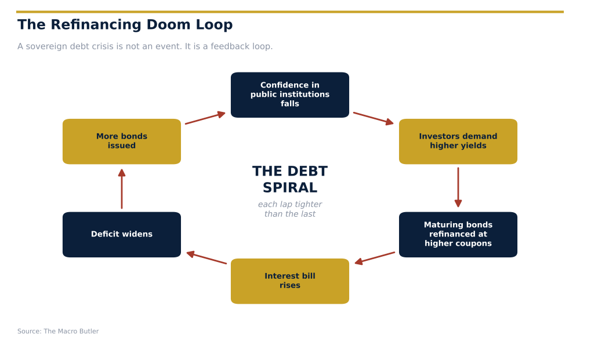
The Refinancing Doom Loop is what economists call adverse debt dynamics and what everyone else calls a spiral. Higher yields raise the interest bill. The higher bill widens the deficit. The wider deficit requires more issuance. More issuance into a market that is already nervous requires a higher yield to clear. The IIF, not an institution given to melodrama, used the phrase vicious cycle in its September Global Debt Monitor, noting that G7 borrowing costs are at their highest since mid-2008 and that advanced economies paid more than $3.3 trillion in interest on their traded government bonds last year. That is more than the world spent on defence, more than it spent on artificial intelligence, and more than it spent on clean energy. The rich world now pays more for its past than it invests in any version of its future.
There is a threshold in this arithmetic that every emerging market finance minister learns in his first week and every Western one has forgotten. When the interest rate on the debt exceeds the growth rate of the economy, the debt ratio rises on ...
Read more and discover how to trade it here: https://themacrobutler.substack.com/p/the-bond-who-rolled-me
Visit The Macro Butler Website here: https://themacrobutler.com/
Join The Macro Butler on Telegram here : https://t.me/TheMacroButlerSubstack
If you want to be ready for what is coming visit The Macro Butler Website :
Join The Macro Butler on Telegram here : https://t.me/TheMacroButlerSubstack
Learn the principles behind:
📈 Investing & Portfolio Building
🌍 Economics & Market Cycles
💡 Smarter Financial Decision-Making
Whether you’re starting your investment journey or looking to sharpen your financial knowledge, The Macro Butler gives you the framework to think differently about money.
👉 Start Learning Now
https://themacrobutler.com/financial-academy/
You can contact The Macro Butler at info@themacrobutler.com

Disclaimer
The content provided in this newsletter is for general information purposes only. No information, materials, services, and other content provided in this post constitute solicitation, recommendation, endorsement or any financial, investment, or other advice.
Seek independent professional consultation in the form of legal, financial, and fiscal advice before making any investment decisions.
Always perform your own due diligence.