





Faith Accompli
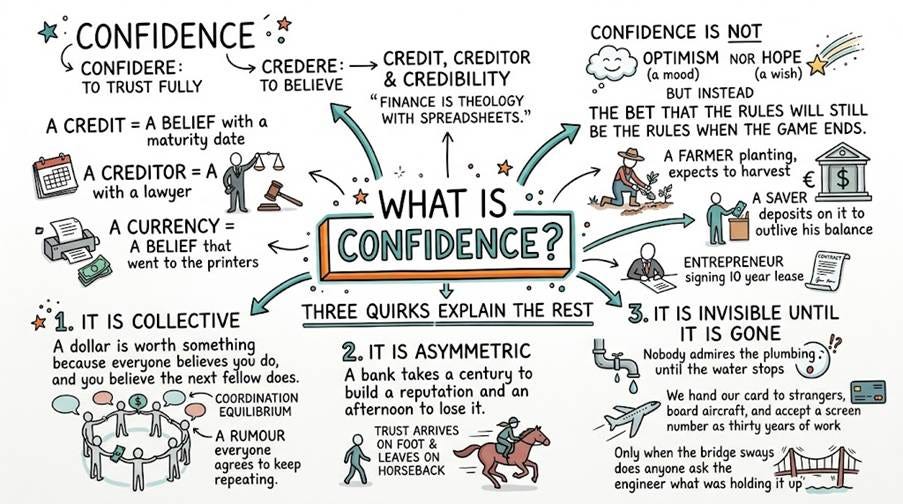
Confidence comes from the Latin ‘Confidere’, to trust fully. Its cousin credere, to believe, gave us credit, creditor and credibility, which tells you everything: finance is theology with spreadsheets. A credit is a belief with a maturity date. A creditor is a believer with a lawyer. A currency is a belief that went to the printers.
Confidence is not optimism, which is a mood, nor hope, which is a wish. It is the bet that the rules will still be the rules when the game ends. The farmer plants because he expects to be the one harvesting. The saver deposits because he expects the bank, the currency and the courts to outlive his balance. The entrepreneur signs a ten-year lease on the touching assumption that the tax code in year ten will still recognise him.
Three quirks explain the rest.
It is collective. A dollar is worth something not because I believe in it, but because I believe you do, and you believe the next fellow does. Economists call this a coordination equilibrium. The Macro Butler calls it a rumour everybody has agreed to keep repeating.
It is asymmetric. A bank needs a century to build a reputation and an afternoon to lose it. Trust arrives on foot and leaves on horseback, and no minister has yet managed to renegotiate the transport.
It is invisible until it is gone. Nobody admires the plumbing until the water stops. We hand our card to strangers, board aircraft built by people we will never meet, and accept a number on a screen as thirty years of work. Only when the bridge sways does anyone ask the engineer what was holding it up.
Keynes called it “animal spirits” and filed it under mysteries. It is simpler than that: confidence is the public’s running tally of promises kept. And nobody issues more promises than the stat.

Private confidence is retail. Public confidence is wholesale. Every mortgage, pension and unpaid invoice rests on a handful of public promises: that courts enforce contracts, that the currency roughly holds its value, that the taxman takes what the law says rather than what the Treasury fancies, that the statistics are honest, that elections change the management, and that the police answer to the law and not to the minister.
An institution is simply a promise that outlives its author. A king’s word dies with the king, or sooner if he sleeps on it. A constitution, a central bank charter, an independent court, a land registry: all are devices for handcuffing tomorrow’s office-holder to today’s commitment. Trusting institutions is therefore not the same as liking government. One may loathe the referee and still accept the scoreline, provided he is not wearing one team’s shirt.
That trust has been leaking for two generations. In the mid-1960s roughly three Americans in four trusted Washington to do the right thing most of the time. Today it is about one in five, and Congress polls in the low double digits on a good day. Courts, press, health authorities, universities and the central bank have each spent credibility they inherited rather than earned. No single election or party did this, which is the bad news. A mood can be voted out. A trend cannot.
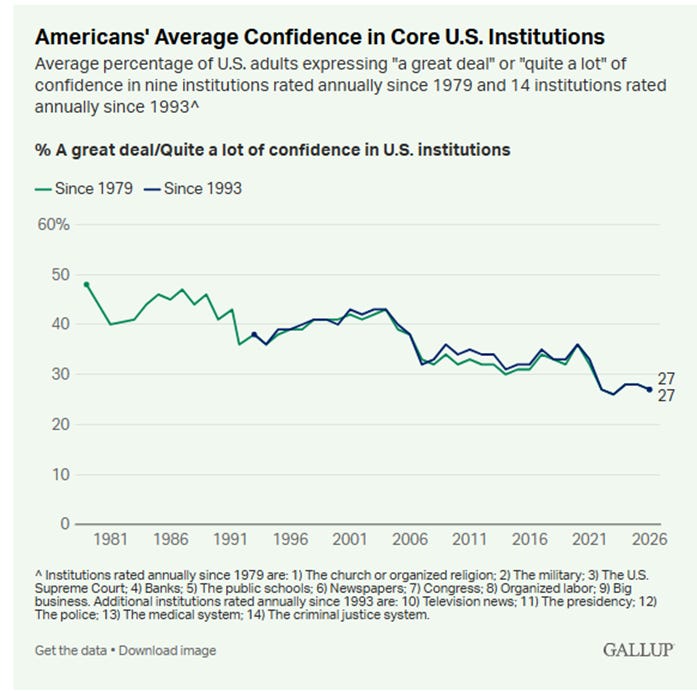
https://news.gallup.com/poll/712436/confidence-institutions-remains-near-time-low.aspx
The recipe never varies. An emergency arrives and the rules are suspended, temporarily, for excellent reasons. The emergency leaves; the suspension stays for dinner. The independent central bank starts financing the Treasury. The statistics agency tweaks its methodology in a direction that happens to flatter the incumbent, and the public renames the index the CPLie. Justice pursues enemies with more stamina than friends. Each step is defensible. The sum is fatal, because the public does not audit the reasoning. It merely notices the referee has scored.
Confucius was asked what a government needs: food, arms and the confidence of the people. If one must go? The arms. And another? The food, for men have always died, but a state without its people’s faith cannot stand. Twenty-five centuries on, the modern state has reversed the list with admirable thoroughness: arms first, subsidies second, and confidence assumed to come free with the package.

If confidence is the raw material of prosperity, the rule of law is the mine. The phrase is used so often by people who mean so little by it that a definition is overdue.
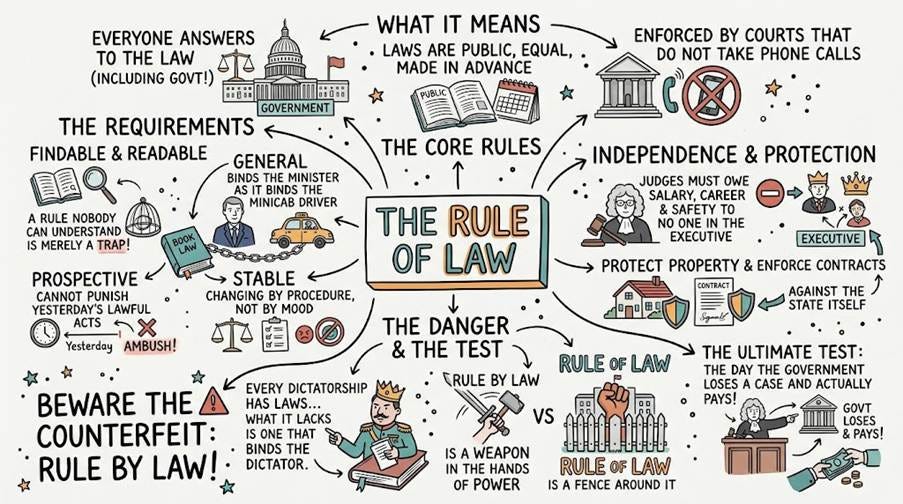
The rule of law means everyone, the government most of all, answers to laws that are public, equal, made in advance and enforced by courts that do not take phone calls. The law must be findable and readable, since a rule nobody can understand is merely a trap. It must be general, binding the minister as it binds the minicab driver. It must be prospective, because punishing yesterday’s lawful act with today’s statute is not law but ambush. It must be stable, changing by procedure rather than by mood. Its judges must owe their salary, career and safety to nobody in the executive. And it must protect property and enforce contracts, above all against the state itself.
Beware the counterfeit: rule by law. Every dictatorship has laws, usually lots of them, lovingly drafted and enthusiastically enforced. What it lacks is one that binds the dictator. Rule by law is a weapon in the hands of power. Rule of law is a fence around it. The statute book will not tell you which you have. The day the government loses a case and actually pays will.
Note what is not on offer: good laws, low taxes or wise rulers. The only promise is that tomorrow will be run by rules rather than whim, and that nobody rewrites them at half-time for the benefit of whoever holds the whistle. A modest promise, and the most valuable asset a country can own, because it turns uncertainty, which cannot be priced, into risk, which can.
That is the whole game. An investor can live with almost any rule he knows in advance. A forty per cent tax can be modelled; a tax of twenty or eighty depending on next year’s politics cannot. A tariff schedule can be planned around; a tariff posted on social media on Friday and deleted on Monday can only be feared. Freeze one sovereign’s reserves and every other sovereign learns that reserves are held at the custodian’s pleasure, as readers of “SWIFT & Punishment” will recall. Each measure may be perfectly legal. Together they announce that the rules are now a variable, and capital treats variables the way...
Read more and discover how to trade it here: https://themacrobutler.substack.com/p/faith-accompli
Visit The Macro Butler Website here: https://themacrobutler.com/
Join The Macro Butler on Telegram here : https://t.me/TheMacroButlerSubstack
If you want to be ready for what is coming visit The Macro Butler Website :
Join The Macro Butler on Telegram here : https://t.me/TheMacroButlerSubstack
Learn the principles behind:
📈 Investing & Portfolio Building
🌍 Economics & Market Cycles
💡 Smarter Financial Decision-Making
Whether you’re starting your investment journey or looking to sharpen your financial knowledge, The Macro Butler gives you the framework to think differently about money.
👉 Start Learning Now
https://themacrobutler.com/financial-academy/
You can contact The Macro Butler at info@themacrobutler.com

Disclaimer
The content provided in this newsletter is for general information purposes only. No information, materials, services, and other content provided in this post constitute solicitation, recommendation, endorsement or any financial, investment, or other advice.
Seek independent professional consultation in the form of legal, financial, and fiscal advice before making any investment decisions.
Always perform your own due diligence.