


America's greatest financial advantage may also be its biggest blind spot
Americans rarely question the currency they use.
They earn in dollars, save in dollars, invest in dollar-denominated assets, and measure their wealth against the same currency.
For much of the world, however, money isn't quite so straightforward.
Currency depreciation, exchange-rate volatility, and dependence on foreign capital can influence everything from household savings to the price of imported necessities.
The difference isn't simply economic stability. It's that Americans live at the center of a global monetary system built around their own currency.
And that advantage may have created a blind spot in how Americans understand financial risk.
The dollar's extraordinary privilege
The U.S. dollar isn't just America's currency. It's the currency much of the world uses to conduct business.
Chart 1: Global foreign exchange reserves by currency
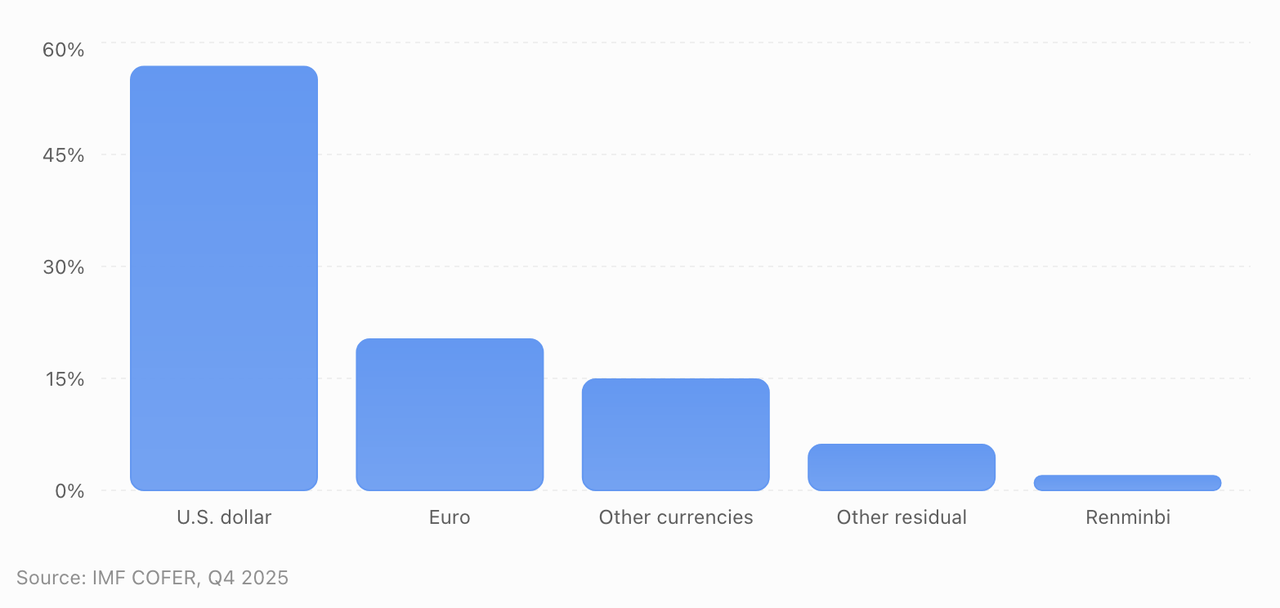
According to the Bank for International Settlements, the dollar was involved in 89.2% of all foreign exchange transactions in April 2025.[1]
Meanwhile, the International Monetary Fund reported that dollars represented approximately 56.8% of global allocated foreign exchange reserves at the end of 2025.[2]
This dominance provides the United States with advantages other countries cannot easily replicate.
American businesses can conduct substantial international trade in their domestic currency, reducing exchange-rate exposure. Global demand for dollar-denominated financial assets also supports deep U.S. capital markets and can help reduce financing costs.
But perhaps the greatest advantage is psychological.
Americans rarely have to think about their currency from an outsider's perspective.
What happens when your savings depend on another country's currency?
Imagine operating a business in a country whose currency is rapidly losing value against the dollar.
Your employees are paid in local currency, but imported machinery, energy, or raw materials may be priced in dollars.
Even without a change in the underlying cost of those goods, a weaker domestic currency can make them substantially more expensive.
The same problem affects households.
Savings that appear stable in local currency may lose international purchasing power. Foreign travel becomes more expensive. Imported products consume a larger share of household income.
And businesses carrying dollar-denominated debt can face increasing repayment burdens as their local currency weakens.
Chart 2: The dollar's value against other currencies
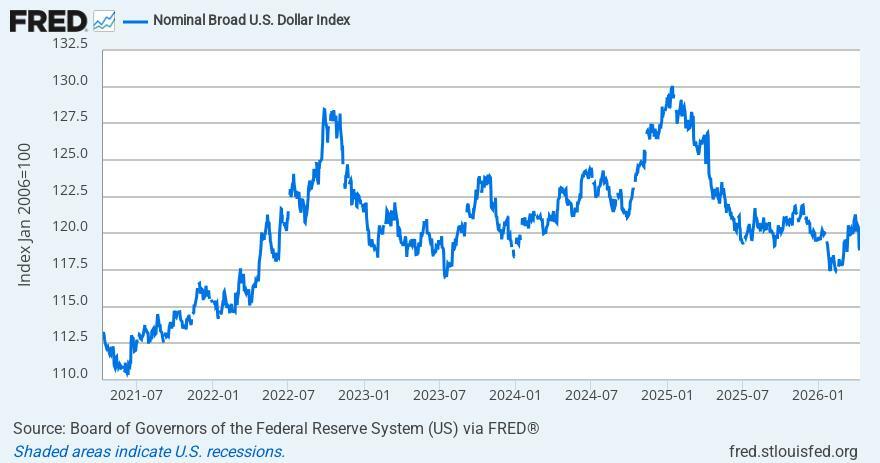
These vulnerabilities help explain why governments accumulate foreign exchange reserves.
The Federal Reserve Bank of St. Louis describes reserves as a financial safeguard against disruptions to international payments, capital flows, and other economic emergencies. [3]
For Americans, currency risk is often viewed as something that happens elsewhere.
For millions of people around the world, it's an ordinary consideration when making financial decisions.
Could the dollar's strength be hiding America's vulnerabilities?
Reserve currency dominance creates advantages, but it doesn't eliminate economic risk.
A strong international demand for dollars doesn't guarantee that those dollars will maintain their purchasing power domestically.
Chart 3: The dollar's purchasing power at home
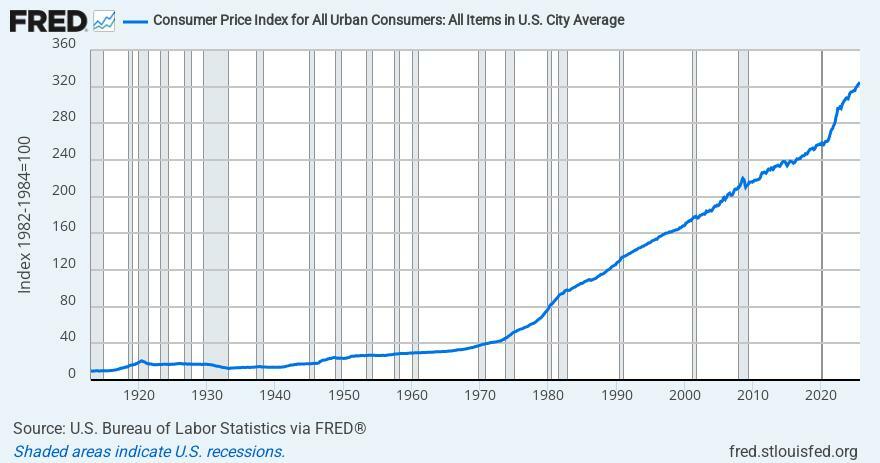
Nor does global reliance on U.S. financial markets make federal deficits, rising debt-service costs, or inflation irrelevant.
The Federal Reserve's 2025 analysis of the dollar's international role acknowledges that growing concerns about U.S. fiscal conditions and policy uncertainty have raised questions about the currency's long-term position.[4]
Yet replacing the dollar would be extraordinarily difficult.
A competing reserve currency needs more than economic size. It requires liquid financial markets, trusted institutions, international accessibility, and sufficient assets for global investors to hold.
These advantages have helped sustain dollar dominance even as the international monetary system evolves.
The question isn't whether the dollar is about to disappear. It's whether its continued dominance encourages Americans to underestimate the risks that remain.
What would change if Americans viewed money like the rest of the world?
Investors often focus on whether their portfolios are growing in dollar terms.
But a rising account balance doesn't necessarily mean an equivalent increase in purchasing power.
A broader perspective considers what those dollars can buy, how economic conditions affect their value, and whether wealth depends too heavily on a single currency or financial system.
That doesn't mean abandoning the dollar or predicting its collapse.
It means recognizing that financial security looks different depending on where someone lives and which currency they depend on.
For Americans, the dollar's global status has long been a source of stability and convenience.
The greatest blind spot may be assuming that privilege makes currency risk someone else's problem.
In the latest Gold Exchange Podcast, Ben Nadelstein speaks with American Gold Exchange president Dana Samuelson about how investors around the world approach monetary uncertainty, why American attitudes toward precious metals differ, and what changing global conditions could mean for gold and silver.
The conversation offers a perspective that investors accustomed to thinking exclusively in dollars may find worth reconsidering.
Watch the full conversation on YouTube or listen on Spotify below.
Sources
[1] https://www.bis.org/media-releases/20250930-global-fx-trading-hits-96-t…
[2] https://data.imf.org/en/news/imf%20data%20brief%20march%2027
[3] https://www.stlouisfed.org/open-vault/2026/feb/us-dollar-role-as-reserv…
[4] https://www.federalreserve.gov/econres/notes/feds-notes/the-internation…