


Macro Butler’s Monthly Meditation : Ships, Chips, Hips
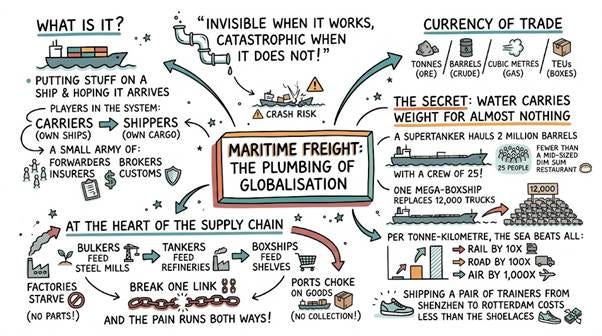
Roughly four-fifths of everything humanity trades by volume travels by sea. The phone in your pocket, the coffee in your cup, the iron in your car and the crude in its tank all spent weeks on a ship whose name you will never know. Maritime freight is the plumbing of globalisation: invisible when it works, catastrophic when it does not.
Maritime freight means putting stuff on a ship and hoping it arrives. Carriers own the ships, shippers own the cargo, and a small army of forwarders, brokers, insurers, bankers and customs officers take a cut in between. Each trade counts in its own currency: tonnes for ore, barrels for crude, cubic metres for gas and TEUs for boxes.
Its secret is simple: water carries weight for almost nothing. A supertanker hauls two million barrels with a crew of 25, fewer people than a mid-sized dim sum restaurant. One mega-boxship replaces 12,000 trucks. Per tonne-kilometre, the sea beats rail by ten times, road by a hundred and air by a thousand. Shipping a pair of trainers from Shenzhen to Rotterdam costs less than the shoelaces.
So the sea sits at the heart of every supply chain. Bulkers feed the steel mills, tankers feed the refineries and boxships feed the shelves. Break one link and the pain runs both ways: factories starve while ports choke on goods nobody can collect.
Some 112,500 ships, carrying 2.44 billion tonnes between them, squeeze through a handful of straits: Malacca, Hormuz, Bab el-Mandeb, Suez, Panama, Gibraltar, the Bosphorus and the Danish Straits. Hormuz carries a fifth of the world’s seaborne oil and LNG, and the Red Sea route about 30% of its containers. Globalisation is an ocean with eight doors, and someone always has a key.
https://www.openpr.com/news/4598329/maritime-freight-transport-market-analysis-highlights-growth

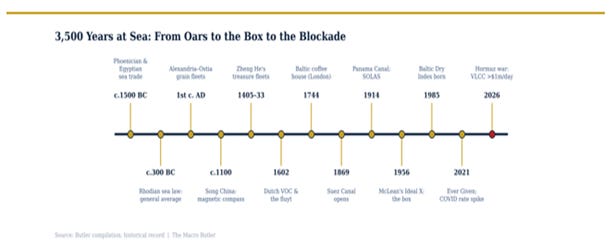
People were shipping cargo before they could spell it. By the second millennium BC, Egyptians sailed the Red Sea to Punt for incense and gold, while Minoans and then Phoenicians stitched the Mediterranean together with cedar, copper, tin, wine, dye and glass. The Phoenicians founded Carthage and Cadiz as trading posts and, legend has it, invented the alphabet to keep the books. Accountants have run the world ever since.
The Greeks wrote the first maritime law. Under the Rhodian Sea Law, if cargo went overboard to save a ship, everyone who benefited shared the loss. This “general average” survives today in the York-Antwerp Rules, which makes it perhaps the oldest financial engineering still in use. The Athenians added the bottomry loan, repayable only if the ship arrived. That was insurance and leverage in one contract, about 2,000 years before Wall Street claimed the idea.

https://insuranceranked.com/business-insurance/lex-rhodia-rhodian-sea-law
Rome made shipping a matter of state. Grain fleets from Alexandria to Ostia fed a million mouths, and an emperor who let the bread ships fail was soon a former emperor. Ostia was the Rotterdam of its day. When the sea lanes frayed in the fifth century, Rome’s cities shrank with them. The lesson: an empire lasts only as long as its supply chain.
In the East, Song China was steering by magnetic compass by around 1100. Its junks had watertight bulkheads, a safety feature Europe took centuries to copy. From 1405 to 1433, Admiral Zheng He took seven treasure fleets as far as Arabia and East Africa. Then the Ming court scrapped the fleet and stayed home. It was the most expensive “work from home” decision in history.
In Europe, Venice and Genoa ran the Mediterranean with state convoys, while the Hanseatic League ran the North Sea and Baltic out of Lübeck, Hamburg and Bergen. Portugal rounded the Cape of Good Hope in 1488, and da Gama reached India in 1498, cutting the Venetian and Ottoman middlemen out of the spice trade. Columbus had already joined the hemispheres in 1492. Within a century, Potosí silver was sailing via Manila to China: the first global supply chain, and the first time China ended up with everyone else’s silver.
Then the Dutch made it a business. The VOC, founded in 1602, was the world’s first listed company, financing its fleets with tradeable shares. Its workhorse, the fluyt, carried more cargo with fewer crew than its rivals: a 17th-century bulk carrier. Britain replied with the Navigation Acts, reserving colonial trade for British ships. These were the grandfather of every cabotage law, the Jones Act included. Protectionism, like shipping, is older than the steam engine.

https://www.hetscheepvaartmuseum.com/voc
Shipping finance was born over coffee. Edward Lloyd’s coffee house, open by 1688, drew marine underwriters and grew into Lloyd’s of London. In 1744 the Virginia and Baltick Coffee House began matching cargoes with ships. It became the Baltic Exchange, whose freight indices still settle billions in contracts. Caffeine, it turns out, has underwritten more risk than any central bank.

https://www.lr.org/en/about-us/who-we-are/our-history/edward-lloyd-coffee-house/
Then steam freed ships from the whims of the wind. Brunel’s iron-hulled, propeller-driven SS Great Britain (1843) showed the way. The Suez Canal (1869) cut the London–Bombay run by about 40% and made sail on Asian routes obsolete almost overnight. Panama followed in 1914, the same year the Titanic’s sinking produced SOLAS, the first global safety convention. It took an iceberg to get regulators moving. Two world wars then made the strategic point bluntly: U-boats nearly starved Britain twice, and America won the shipping war by building more than 2,700 Liberty ships. Wars are won by generals and logisticians, but logisticians don’t get statues.
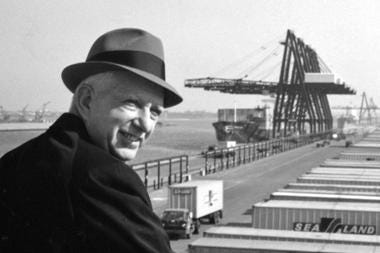
On 26 April 1956, trucking entrepreneur Malcom McLean sent a converted tanker, the Ideal X, from Newark to Houston carrying 58 metal containers. Loading loose cargo then cost about $5.86 per ton; McLean’s boxes cut it to roughly 16 cents. Standardised by the ISO in the late 1960s, the container eliminated armies of dockworkers, slashed pilferage, enabled seamless ship–rail–truck transfers and made it economical to manufacture a product in one continent and sell it in another. Without the box there would be no Shenzhen, no just-in-time manufacturing and no ‘Made in China’ on the bottom of your coffee mug.
Scale followed. The first purpose-built container ships carried around 1,000 TEU; today’s largest, such as MSC’s Irina class, exceed 24,000 TEU. Supertankers swelled after the 1967 closure of the Suez Canal forced oil around Africa, the same closure that trapped fifteen ships, the ‘Yellow Fleet’, in the Great Bitter Lake for eight years. Flags of convenience in Panama, Liberia and later the Marshall Islands allowed owners to minimise taxes and crew costs, and China’s accession to the WTO in 2001 turned the trans-Pacific into the busiest highway on earth.
https://americanbusinesshistory.org/malcolm-mclean-unsung-innovator-who-changed-the-world/
The pandemic showed what happens when a system is built for efficiency and not for resilience. Container rates rose about sevenfold from 2019 to their September 2021 peak. In March 2021 the Ever Given parked sideways in the Suez Canal for six days, holding up $9–10 billion of trade a day: the world’s most expensive parallel-parking failure. From late 2023, Houthi attacks pushed most carriers around the Cape, adding 10–14 days to Asia–Europe voyages. Then on 28 February 2026, the US–Iran war turned Hormuz from a chokepoint into a war zone.
Today the industry is doing three things at once:
· Digitising: AI routing, digital bills of lading and satellite tracking.
· Decarbonising: ammonia, methanol and LNG ships now make up over half of new orders by tonnage.
· Militarising: naval escorts, war-risk zones and sanctioned dark fleets.
History has come full circle. The Phoenicians also sailed with one eye on the cargo and the other on the pirates. Only the pirates’ toys have improved.

Before choosing a ship, a shipper chooses a service. Freight is categorised first by how cargo is…
Since January 1, 2026, The Macro Butler Monthly Meditation has become a subscribers-only edge.
Unlock the framework, understand the signals, and learn how to trade it—subscribe here to gain access.
https://themacrobutler.com/monthly-meditation/
Join The Macro Butler on Telegram here : https://t.me/TheMacroButlerSubstack
Learn the principles behind:
📈 Investing & Portfolio Building
🌍 Economics & Market Cycles
💡 Smarter Financial Decision-Making
Whether you’re starting your investment journey or looking to sharpen your financial knowledge, The Macro Butler gives you the framework to think differently about money.
👉 Start Learning Now
https://themacrobutler.com/financial-academy/
You can contact The Macro Butler at info@themacrobutler.com

Disclaimer
The content provided in this newsletter is for general information purposes only. No information, materials, services, and other content provided in this post constitute solicitation, recommendation, endorsement or any financial, investment, or other advice.
Seek independent professional consultation in the form of legal, financial, and fiscal advice before making any investment decisions.
Always perform your own due diligence.