


BUY NOW…PRAY LATER…
In 1950, a 29-year-old American with a high-school diploma, one job and one wife could walk into a Levittown sales office, sign for a house priced at roughly two years of his income, and move in before his first child learned to crawl. He did not need a co-signer, a side hustle, a parental gift, or an app that splits his groceries into four interest-free instalments.
In 2026, his grandson is 40 before he buys his first home, the house costs five years of household income, two salaries are needed to service it, and one in four of his peers who use Buy Now Pay Later has financed bread, milk and eggs with it.
Yet the EYIs on Wall Street will tell you that America has never been richer. GDP per capita sits at a record. Consumer spending is at a record. The stock market is at a record. Debt, naturally, is also at a record.
The Macro Butler would like to propose a simple test, which we shall call the Grandfather Test: can one ordinary income buy, in the same number of working years, the same basket of security your grandfather bought? If the answer is no, then whatever America has become, it is not more prosperous. It is merely busier, more indebted and better entertained.
This issue is about three words that politicians, central bankers and economists use interchangeably, and which are in fact three very different things: Prosperity, Affordability and Consumption. Confusing them is not an innocent error. It is the intellectual foundation of an economy that measures how fast the household spends, rather than how much it owns.

Three Words, Three Different Things
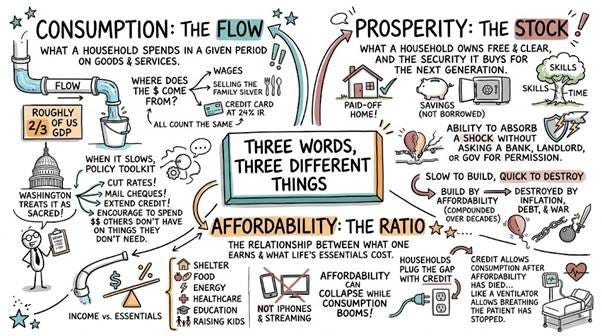
Consumption: the flow: Consumption is what a household spends in a given period on goods and services. It is a flow, like water through a pipe. It says nothing about where the water came from. A dollar of consumption financed by wages, a dollar financed by selling the family silver and a dollar financed by a credit card at 24% count exactly the same in the national accounts.
Consumption is roughly two-thirds of US GDP, which explains why Washington treats it as sacred. When consumption slows, the policy toolkit is always the same: cut rates, mail cheques, extend credit, encourage the household to spend money it does not have on things it does not need, to impress economists it will never meet.
Affordability: the ratio: Affordability is the relationship between what one income earns and what life’s essentials cost. It is a ratio, not a level. The essentials are not iPhones and streaming subscriptions; they are shelter, food, energy, healthcare, education and the ability to raise children. Affordability can collapse while consumption booms. In fact, it often does, because the household plugs the gap between stagnant purchasing power and rising essential costs with credit. Credit allows consumption to continue after affordability has died, in the same way that a ventilator allows breathing to continue after the patient has stopped trying.
Prosperity: the stock: Prosperity is the stock of what a household owns free and clear, and the security that stock buys for the next generation. A paid-off home. Savings that are not borrowed. Skills. Time. The ability to absorb a shock without asking a bank, a landlord or a government for permission. Prosperity is slow to build and quick to destroy. It is built by affordability, compounded over decades, and it is destroyed by inflation, debt and war, usually in that order.
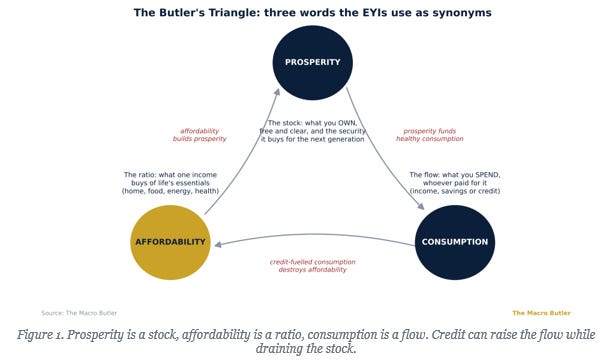
A nation can consume more every year while becoming less prosperous, provided it borrows to do so. It can show rising GDP while affordability falls, provided prices rise faster than wages for the things that matter and slower for the things that do not. And it can declare victory over poverty by pointing at cheap televisions while its young cannot afford a roof. Consumption measures appetite. Affordability measures freedom. Prosperity measures what is left when the party ends.

The American story since 1945 is not a straight line of rising living standards. It is four distinct regimes, each with its own relationship between the three words.
Act I (1945 to 1971): The Golden Age of affordability
America emerged from the Second World War as the only major industrial economy not reduced to rubble. It owned roughly two-thirds of the world’s monetary gold, ran the world’s largest trade surplus and printed the world’s reserve currency, convertible into gold at $35 an ounce under Bretton Woods. Wartime rationing had forced households to save. Personal saving rates in the mid-1940s were above 20% of disposable income, because there was nothing to buy. When the war ended, that pent-up savings met a flood of civilian production, and the result was the greatest affordability boom in modern history. The GI Bill of 1944 offered veterans low-cost mortgages with little or no down payment and paid for millions of college educations. The long-term, fixed-rate, fully amortising mortgage, pioneered by federal housing policy in the 1930s, became the default. Suburbs, highways and single-income households followed.
In this regime the three words moved together. Wages rose with productivity. Essentials became cheaper relative to income. Consumption grew because income grew, not because credit grew. Prosperity, measured as ownership, exploded: homeownership jumped from 44% in 1940 to 62% by 1960.
Act II (1971 to 1982): The Great Inflation and the first reset
On 15 August 1971, President Nixon closed the gold window. The dollar stopped being a claim on gold and became a claim on the good faith of Washington. It was the largest currency reset of the twentieth century, delivered on a Sunday evening television broadcast, and sold to the public as a temporary measure. Fifty-five years later, it is still temporary. The decade that followed delivered two oil shocks, the end of the Vietnam War, double-digit inflation and a stock market that lost more than half its value in real terms. Mortgage rates peaked above 18% in 1981. Affordability collapsed, not because houses became more expensive in real terms, but because the cost of financing them became punitive and wages could not keep up with the price of energy and food.
This is the first lesson of the post-war era: when a currency is reset, the bill is paid by the household that saves in it.
Act III (1982 to 2008): The credit Supercycle
Paul Volcker broke inflation with interest rates near 20%. What followed was a 26-year bull market in bonds, falling interest rates and an explosion of credit. Globalisation and the entry of China into the World Trade Organisation in 2001 exported deflation in manufactured goods to American shelves. This is the act where the three words began to diverge. Consumption soared, financed by credit cards, home-equity loans, auto loans and, ultimately, subprime mortgages. Goods became cheaper; essentials did not. Healthcare, education and housing rose much faster than wages. Two incomes became the norm, not because women suddenly discovered careers, but because one income no longer bought the Grandfather Test basket. Homeownership peaked at 69% in 2004, driven not by affordability but by liar loans. Prosperity was being borrowed from the future, and the future was about to send the invoice.
Act IV (2008 to 2026): Financial repression and the affordability crisis
The Global Financial Crisis was answered with zero interest rates, quantitative easing and bailouts for the institutions that caused it. Asset prices rose. Wages did not keep pace. Those who owned assets became richer; those who rented them became poorer. The pandemic repeated the playbook on steroids: trillions in stimulus, a housing boom, and then the worst inflation in four decades in 2022.
By 2026, the triangle had broken. Consumption is at record highs. Affordability, by almost every measure that matters, is at or near its worst level since the 1980s. Prosperity, measured as broad ownership, is stagnant at best: the homeownership rate today is roughly where it was in 1970.
And this year added a war. The US-Israel strike on Iran on 28 February 2026, the disruption of the Strait of Hormuz and the blockade of Bab el-Mandeb have sent a fresh energy shock through every grocery bill on the planet. Under Fed Chair Warsh, policy is on hold at 3.75%, which is to say that real rates offer savers no protection against the CPLie they are told to believe.

If you want a single indicator of prosperity in the American sense, it is not GDP, the S&P 500 or consumer confidence. It is the family home. For most American households, the home is the only meaningful store of wealth they will ever own. It is shelter, savings account, pension and inheritance, all in one.
In 1940, just 43.6% of American households owned their home. By 1960 it was 61.9%. That 18-point surge in two decades is the statistical fingerprint of the Golden Age: rising real wages, cheap long-term fixed-rate credit, abundant land and a federal government that wanted veterans to own, not rent.
Since then, almost nothing. The rate reached 64% by 1980, peaked at 69% in 2004 on the back of subprime fraud, fell back to a post-crisis trough...
Read more and discover how to trade it here:
If you want to be ready for what is coming visit The Macro Butler Website :
Join The Macro Butler on Telegram here : https://t.me/TheMacroButlerSubstack
Learn the principles behind:
📈 Investing & Portfolio Building
🌍 Economics & Market Cycles
💡 Smarter Financial Decision-Making
Whether you’re starting your investment journey or looking to sharpen your financial knowledge, The Macro Butler gives you the framework to think differently about money.
👉 Start Learning Now
https://themacrobutler.com/financial-academy/
Debt juggling. Shutdown tightropes. A clown car of promises. And markets swing like the trapeze. 📉📈
Most investors panic. Those who Learn to Earn grab popcorn and enjoy the show. 🍿
Front-row seat: The Macro Butler Financial Academy, now $50/month for everyone. Subscribe here: https://themacrobutler.com/financial-academy/
When the circus comes to town, the wise man sells the tickets.
You can contact The Macro Butler at info@themacrobutler.com

Disclaimer
The content provided in this newsletter is for general information purposes only. No information, materials, services, and other content provided in this post constitute solicitation, recommendation, endorsement or any financial, investment, or other advice.
Seek independent professional consultation in the form of legal, financial, and fiscal advice before making any investment decisions.
Always perform your own due diligence.