


The Seduction Of Market Bounces On The Way Down
Submitted by QTR's Fringe Finance
Just wanted to offer up a quick lesson this morning because every time the market stages one of these violent next-day bounces like it had yesterday (NASDAQ was up about +3.7%), I find myself dealing with the same giant brained geniuses telling me my bearish outlook is wrong and the worst is over.
It’s not just the usual collection of social media NPCs who suddenly become market strategists after one green day. It’s the talking heads on financial television, too, breathlessly celebrating the rebound and assuring everyone that buyers are back, confidence has returned, and the market has finally found its footing.

Market participants, definitely thinking for themselves
Apparently, a single day of rising stock prices is all it takes to erase whatever problems sent the market plunging in the first place.
Consider a NASDAQ that gets absolutely crushed by -5.5% one day like it did last week, only to come roaring back +3.7% the next like it did yesterday. The second day feels spectacular.
It feels like Jensen smoking a post-coital cigarillo with Alice Huang. You feel like king of the world. Screens are glowing green and the bulls are practically taking victory laps. “Eat a dick, bears,” retail traders who were in diapers when Lehman went bankrupt will say.
But here’s the problem people for some reason don’t notice: the market is still down almost 2% over those two days. The rebound hasn’t erased the damage. It has merely made investors feel better about it. And that distinction is worth carefully noting because if you repeat that exact pattern over any meaningful period of time, the market doesn’t recover. It collapses. That’s the point of this little PSA I’m putting out this morning.
A Quick Exercise…
Let’s start with an index trading at 7,500. For hypothetical purposes, we’ll just call it the P&S 500.
On Monday, it falls -5.5%, bringing it down to 7,087.50. On Tuesday, it rallies +3.7%, bringing it back to 7,349.74. Two days of extraordinary volatility, including a massive relief rally, and the index has still lost 150 points, or almost exactly 2%.
Now imagine that same two-day pattern repeating. Every down day is followed by an impressive rally. Every rally brings fresh excitement, new bullish predictions, and another round of declarations that the bottom is in. Yet every two-day cycle leaves the index approximately 2% lower than where it started.
Here’s what happens if that pattern continues, assuming 252 trading days per year.
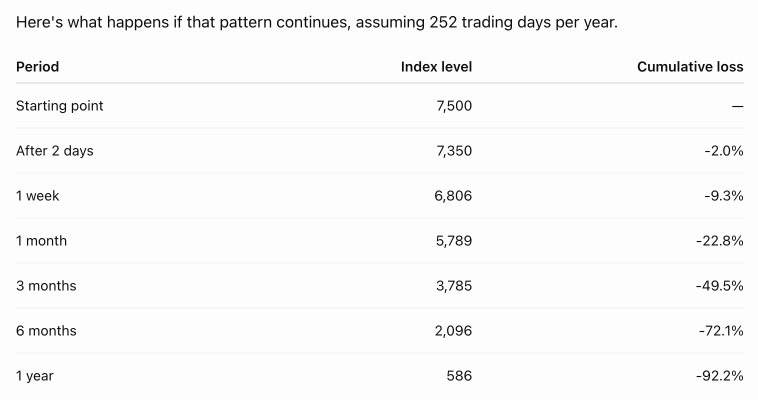
These are hypothetical calculations, not a prediction that the index will follow this precise pattern. Obviously it won’t. But the arithmetic illustrates something that the daily cheerleading conveniently ignores. A market can experience an endless series of spectacular rallies while simultaneously destroying an extraordinary amount of wealth.
In this example, the index loses nearly half its value in three months despite rallying +3.7% every other trading day. By six months, almost three-quarters of its value is gone. Its a pedestrian and simple observation…but one no one seems to remember.
The point isn’t that every rally is meaningless or that markets can’t recover from severe selloffs. It’s that the size of a one-day bounce tells you remarkably little about the health of the underlying trend. A 3.7% rally might look fantastic on television, but it doesn’t change the fact that the index is still substantially lower than it was two days earlier.
The seduction of the next-day bounce is largely psychological, and recency bias is at the center of it. Investors have a remarkable tendency to...(READ THIS FULL ARTICLE 100% FREE HERE).
--
QTR’s Disclaimer: Please read my full legal disclaimer on my About page here.