




Sponsored Content
AI Doesn’t Have a Capital Problem, but Lacks Usable Power
JPMorgan Global Research recently raised its forecast for global AI-related capital expenditure to $5.5 trillion through 2030 in its midyear outlook, up from $5.1 trillion a few months earlier. Hyperscaler capital spending alone is projected at $650 billion this year and more than $1.1 trillion in 2027. Whatever else the AI buildout is short of, it is not short of capital.
The main thing that’s lacking is electricity. Elon Musk warned us earlier this year when he said that the industry is close to producing "more chips than we can turn on." JPMorgan’s aforementioned report noted that more data centers would already be coming online if the power were there to run them.
In 2026, energized land is a significant binding constraint. And there’s a group of companies that spent the past decade acquiring sites with power under contract, substations built, and interconnects already in place. Singapore-based Bitdeer (NASDAQ: BTDR) released its June 2026 operations update this week, and it shows how the company is positioning itself to solve the problems created by these binding constraints.
Bitdeer mined 990 bitcoin last month, up 388% from what it mined in June 2025. Self-mining hash rate reached 73.0 EH/s, against 16.5 EH/s a year earlier, across 243,000 machines. Add hosted and other proprietary capacity and total hash rate under management comes to 86.1 EH/s. A further 15.9 EH/s of company-owned rigs run through co-mining arrangements in third-party facilities, up from 10.0 EH/s in May.
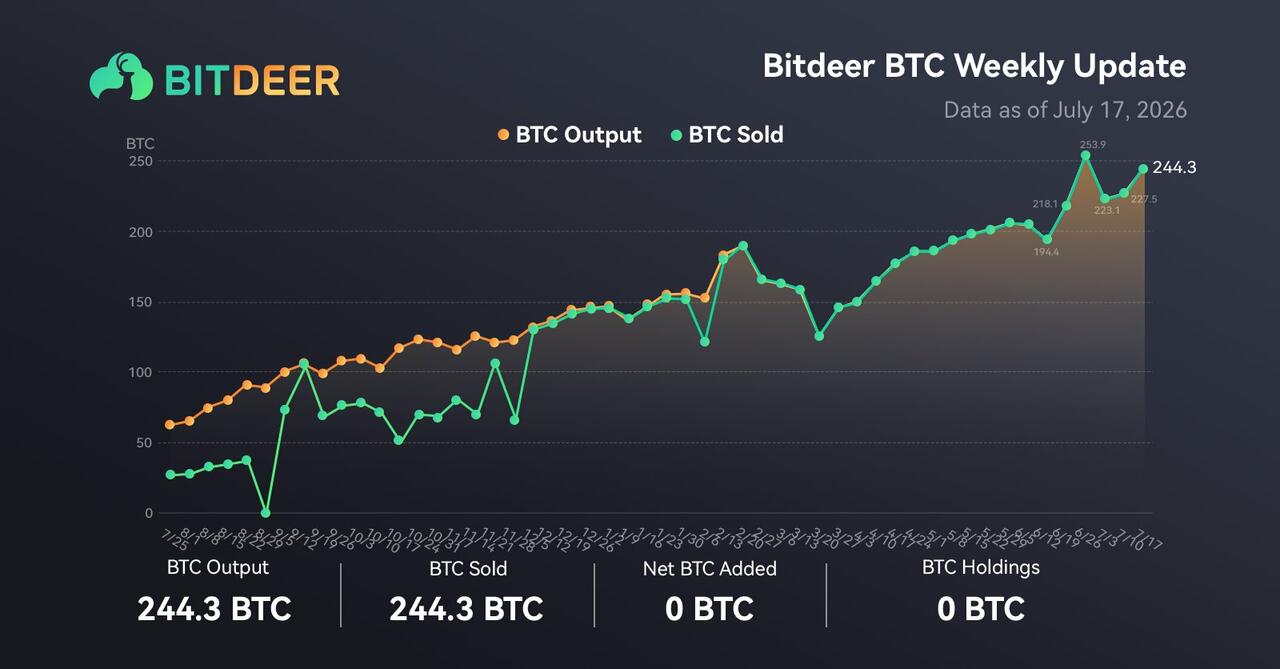
Most of that hardware Bitdeer designs and builds itself, including in a new manufacturing facility in Sparks, Nevada, scheduled for completion by year-end. By owning both the machine and the site, Bitdeer can have greater control over deployment costs. And that platform now spans 3 GW of electrical capacity across four continents, of which 1,797 MW is energized today, and a further 1,228 MW sits in the pipeline, spread across Texas, Ohio, Tennessee, Washington, Norway, Bhutan, Ethiopia, Canada, and Malaysia.
On the AI data center side of things, the clearest sign of progress came in June: the lease for Tydal, Norway has been executed, although still subject to conditions and not yet effective. Tydal accounts for 225 MW across two phases, converting from crypto to colocation. Colocation is a different business from mining, built on contracted, long-dated revenue from tenants rather than exposure to hash price, and Tydal is the first site where Bitdeer's version of it becomes concrete. Elsewhere, Knoxville, Tennessee has begun conversion design work on its first 37 MW, and dismantling of the crypto data center at Wenatchee, Washington started in March to make room for a GB300 cluster. The 563 MW at Rockdale, Texas remains under active evaluation for AI use.
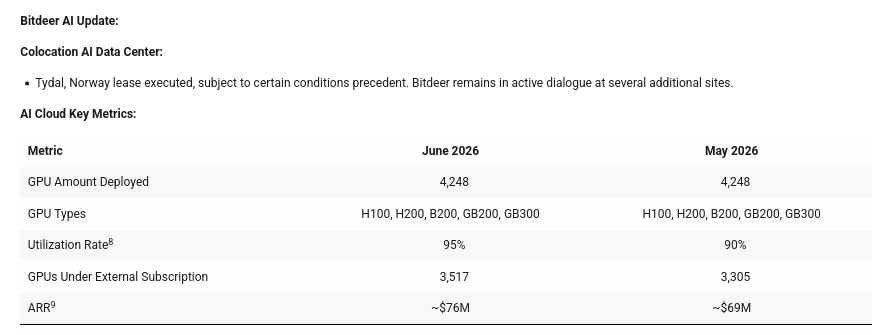
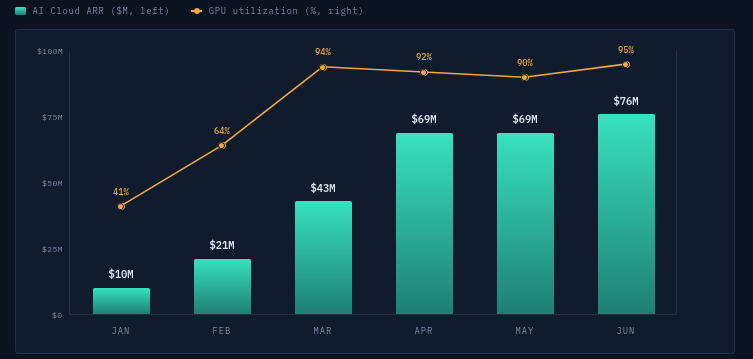
Besides the colocation business, Bitdeer runs its own AI cloud. Annualized recurring revenue reached approximately $76 million at the end of June, up from roughly $69 million a month earlier. Utilization climbed to 95% from 90%, and GPUs under external subscription rose to 3,517 from 3,305, all of it on the same 4,248 deployed GPUs. During the month, the company also signed a ten-year lease for 21.7 MW of IT capacity in Malaysia, with handover expected in the first quarter of 2027.
The pattern worth watching is not miners abandoning Bitcoin for AI. It is miners using Bitcoin mining to monetize power while they determine which sites can support higher-value compute. Bitdeer is pursuing both paths simultaneously: rapidly expanding its mining fleet while converting selected locations for AI cloud and colocation.