




Sponsored Content
The AI Pivot Is Getting Real for Miners
Nearly every publicly traded Bitcoin miner has announced some version of the same plan: redirect some of the power toward AI and HPC. The logic is hard to argue with. AI training and inference are bottlenecked less by the supply of chips than by the electricity to run them, and miners spent the previous decade quietly assembling exactly what the buildout now needs: interconnected sites, energized substations, industrial cooling, and contracts for cheap, long-dated power. Hyperscalers are now signing power agreements years in advance and still landing at the back of multi-year grid-interconnection queues. The companies that already hold energized capacity are, on paper, sitting on the scarcest input in technology.
But announcing a pivot and executing one are very different things, and the market is finally starting to tell them apart.
That’s why the monthly operating updates from companies like Bitdeer (NASDAQ: BTDR) are worth reading closely. The Singapore-based company is among the larger publicly listed miners in the world, and its May update demonstrates how the energy-to-AI thesis actually converts into revenue.
First of all, there’s the bulk of how the company monetizes its massive energy capacity. Bitdeer mined 921 BTC in May, up roughly 370% year over year, with self-mining hashrate reaching 70.2 EH/s (against just 13.6 EH/s a year earlier). Some treat the mining business as a leveraged bet on the Bitcoin price, but, in practice, Bitdeer is treating it as the engine that funds the transition to AI/HPC.
But what makes Bitdeer different than most of its peers is that the company is vertically integrated: it designs its own chips (including its new rigs built for more profitable cryptocurrencies). No other public miner can control its own chip roadmap and repurpose it the way Bitdeer is doing.
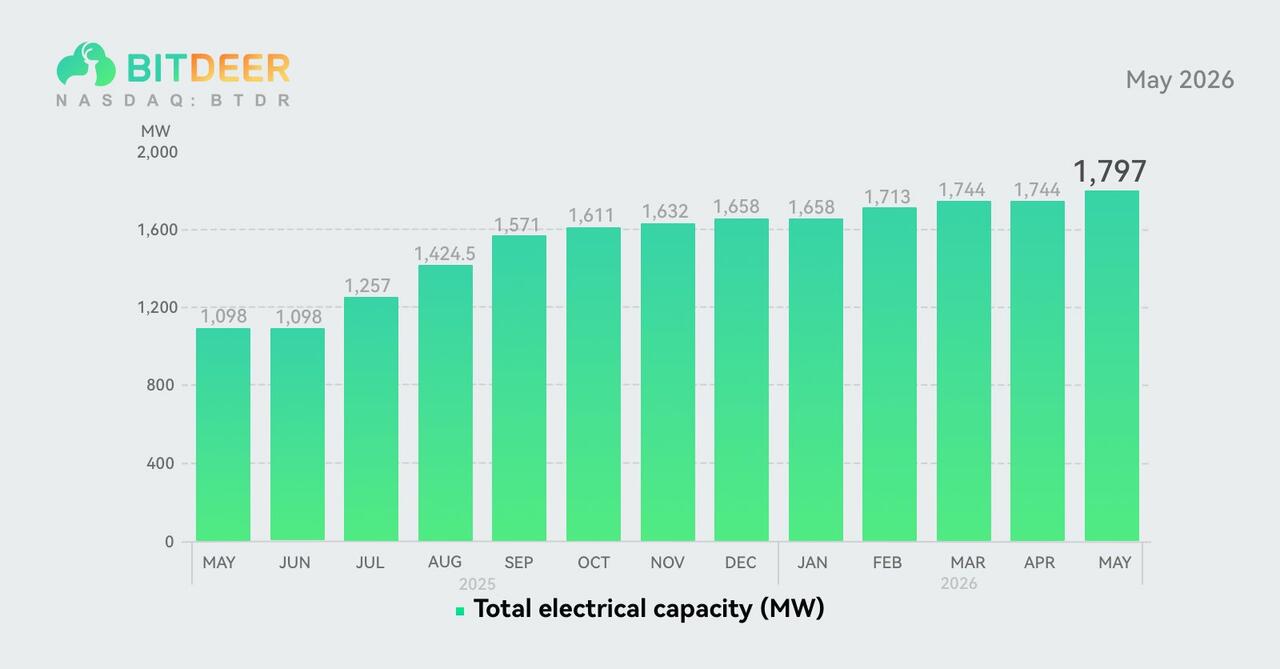
Furthermore, Bitdeer now controls roughly 3 GW of electrical capacity across four continents. That includes Rockdale, Texas (563 MW), Jigmeling and Gedu in Bhutan (500 MW and 100 MW), Massillon, Ohio (174 MW), and additional sites in Norway, Ethiopia, and a newly broken-ground 101 MW project in Fox Creek, Alberta. Roughly 1.8 GW is already energized, and only a handful of companies can compare to Bitdeer’s unique position in this regard.
The company started converting that capacity into AI products before most of the other Bitcoin miners did. Its AI cloud unit reported annualized recurring revenue of about $69 million at 90% utilization, and in May, it brought two NVIDIA GB300 NVL72 clusters into production.
A large colocation lease that would turn owned megawatts into years of contracted revenue is currently in advanced negotiation for its most advanced site in Tydal, Norway. Michael G. Potter, Bitdeer’s Chief Financial Officer, talked about Tydal as “the most visible proof point of our strategy to convert owned power into long-duration contracted revenue across our 3 GW global portfolio”.
🎥In the cold north, power flows like water, as digital infrastructure begins to breathe with the landscape.
— Bitdeer (@Bitdeer) May 21, 2026
Built not only for today’s compute, but for the intelligence of tomorrow — where energy, cooling, and AI converge as one.#AIInfrastructure #DigitalInfrastructure… pic.twitter.com/hjjzV6lth4
For companies like Bitdeer, coming out the other side of this transition means converting a crypto site to colocation without waiting years for a fresh interconnect. At the end of the day, the AI buildout has run into a physical infrastructure. As capital keeps flooding toward compute, those who already own the substations, the interconnects, and the gigawatts have a real edge.