




Sponsored Content
AI’s Energy Crunch May Be A Blessing For Energy-Rich Miners
For years, the market treated bitcoin miners as little more than leveraged proxies on the price of BTC. But that’s changing, because these companies do not simply mine bitcoin. They control large amounts of electrical capacity—an increasingly important input for energy-intensive computing.
As revealed in its February 2026 update, Singapore-based Bitdeer is now among the largest publicly listed Bitcoin miners in the world. Last month alone, the company mined 705 Bitcoin, a 541% increase compared to February 2025, while pushing its total hashrate under management to 79.1 EH/s.
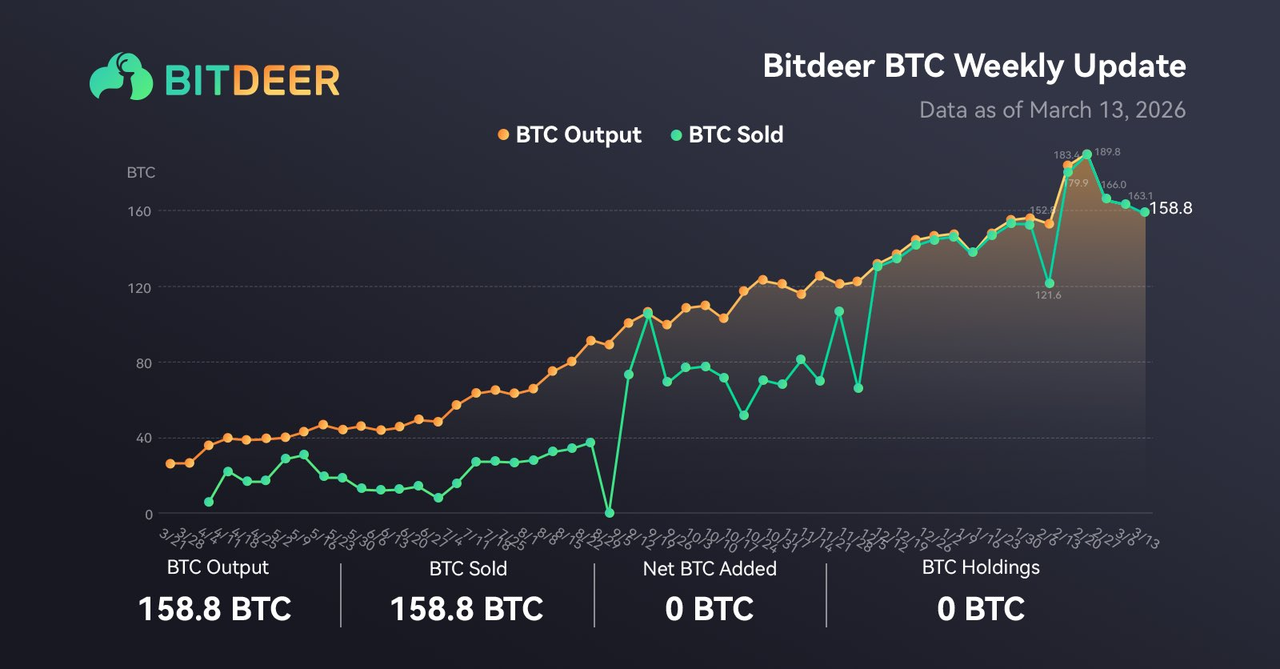
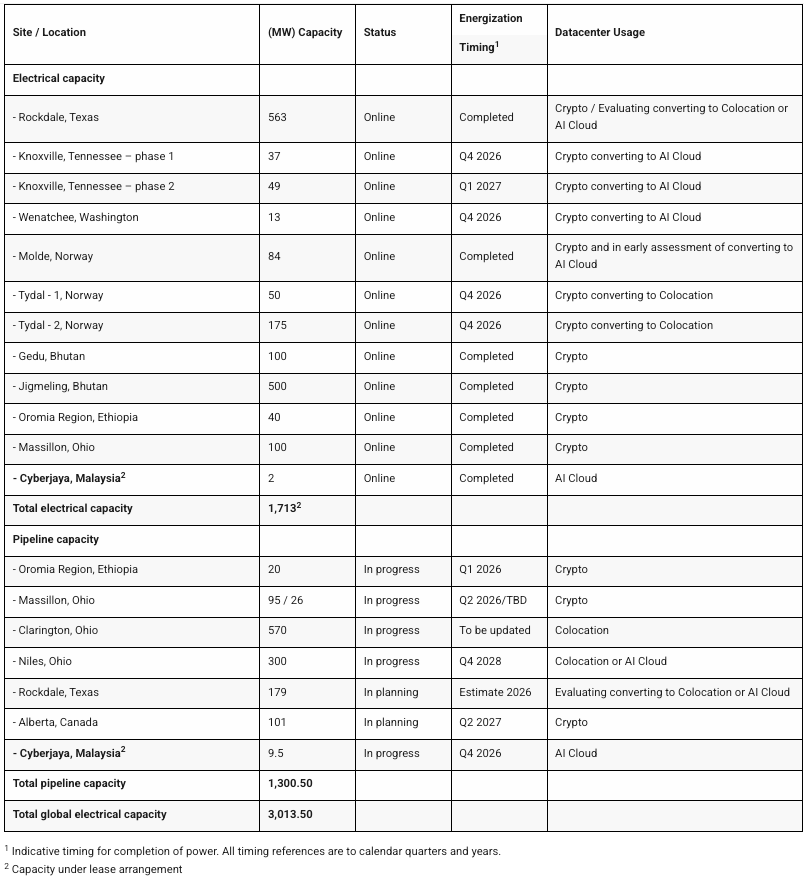
But there is another important figure some may overlook about Bitdeer: 3,013.5 MW of global electrical capacity across online and pipeline sites. Controlling power at that scale allows for monetization via bitcoin mining while also creating potential opportunities with both AI cloud customers and colocation counterparties.
Bitdeer’s bitcoin mining engine continues to grow rapidly, with capital investments made in late 2025 continuing to drive momentum. More rigs are coming online, and management expects hashrate to keep growing in the near future. But this engine is not just about output; it can also function as a capital formation mechanism for infrastructure. Mining monetizes power early, incentivizes new site development, and creates a bridge to higher-value workloads later.
In effect, bitcoin mining bootstraps energy infrastructure, allowing the company to progressively allocate that infrastructure toward AI cloud and colocation as needed.
The company is proving this in real time, with its AI cloud business beginning to show visible commercial traction. As of February 28, Bitdeer reported 2,096 deployed GPUs and approximately $21 million in ARR. While AI cloud utilization currently sits at 64%, the company expects to reach full utilization by March, deploy additional GPUs, and raise hourly rates in response to strong customer demand.
What does it take to bring the @nvidia GB200 NVL72 into production? Behind it is a story shaped by coordinated logistics, infrastructure build-out, system integration, and commitment. This is how raw hardware transforms into intelligent power.
— Bitdeer AI (@Bitdeer_AI) January 15, 2026
Watch the full deployment video… pic.twitter.com/6o1R1VxMxk
And while the GPU figures are notable, another potential development could emerge from the company’s colocation discussions. In the update, Bitdeer said it is in advanced stages of negotiations with potential colocation tenants for Tydal, Norway, and Clarington, Ohio, among other sites. Tydal stands out in particular, with 225 MW of capacity already being converted from bitcoin mining toward colocation.
Amid the peaceful landscapes of #Norway, our data center operates with quiet strength and steady performance.🇳🇴
— Bitdeer (@BitdeerOfficial) July 2, 2025
Clean design. Solid infrastructure.🏗️#Nordics #DataCenters #TechInfrastructure #DataCenterDesign pic.twitter.com/y4vpqK94U7
A long-term colocation lease in Tydal could highlight the broader value of Bitdeer’s energy capacity. The company has a global footprint spanning the U.S., Norway, Bhutan, Ethiopia, Canada, and Malaysia. Some of those sites remain focused on mining, while others are being evaluated or actively converted for AI Cloud or colocation. That kind of optionality becomes increasingly valuable as demand for energy-intensive compute continues to rise.
Bitdeer operates major sites such as Rockdale, Texas (563 MW)—one of the largest bitcoin mining facilities in the world—as well as large operations in Bhutan, including Jigmeling (500 MW) and Gedu (100 MW). In North America, additional facilities include Massillon, Ohio (100 MW) and sites in Tennessee and Washington that are being evaluated for AI Cloud conversion. In Europe, Bitdeer operates in Molde and Tydal, Norway, where parts of the infrastructure are being converted toward colocation. The company also maintains operations in Ethiopia and Malaysia, with a development pipeline spanning Ohio, Texas, and Canada.
Bitdeer also designs and produces its own chips, making it one of the only public miners that is fully vertically integrated. This reduces dependence on external suppliers and gives the company more direct control over deployment timelines, machine economics, and fleet growth. By controlling the full chain—from hardware to power to compute monetization—Bitdeer benefits from economies of scale while maintaining the flexibility needed to adapt to a changing environment.
To label companies such as Bitdeer simply as bitcoin miners would be shortsighted. Bitdeer operates across several layers of the stack—energy infrastructure, AI compute, data center operations, and mining.
Few companies operate across mining, energy infrastructure, and AI compute simultaneously. As AI scaling faces physical constraints on power generation, firms with vast energy capacity are emerging as the industry’s new gatekeepers.