




Sponsored Content
BOTTLENECK BOYZ
The Polymarket Institutional Desk offers block trades on U.S. and international exchanges, institutional market maker relationships, and enterprise data services. Contact Brooke Rizzetto at institutional@polymarket.com for onboarding.
Doug O’Laughlin is the President of SemiAnalysis, the Substack-native semiconductor research firm whose analysts visit dozens of technical conferences a year to map every layer of the AI buildout.
The Oracle sat down with O’Laughlin to break down Polymarket’s biggest AI market and discuss why the leading labs may be sitting on their best models.
This interview has been edited for length. All answers are his own.
How does it make you feel when you see Twitter meme coin accounts suddenly rebranding as AI bottleneck guys? And how is SemiAnalysis different?
Let’s put it this way: they’re semiconductor bottleneck guys, but they couldn’t tell you what a semiconductor was two years ago. They don’t understand the difference between a CW and DW laser.
Me and Dylan were obsessed with this space when no one gave a shit about semiconductors, before the chip shortage. We came to the conclusion that it’s the most important technology ever invented, and that after the end of Moore’s law it would only become more important, because making it would become harder. That’s truly the entire bet of my career. In 2018, no one gave a shit about chips, and everyone was talking about software. Now the world’s totally opposite.
What’s our edge? We go to conferences, dude. 100 technical conferences a year. I’m not talking Dreamforce, where they’re playing Nickelback concerts. I’m talking an IEEE thing where they’re going through the specs of a new chip. We beat the concrete. If you really want to know the future, you’ve got to be deep in the sheets in a way that a casual person who isn’t devoting their life to it can’t get to.
Let’s pull up our big picture AI market: “AI bubble burst”. It resolves YES if three conditions are met from a list: Nvidia off 50% from its high, the semiconductor index down 40%, H100 rentals under $1 for five days, a major AI supplier collapsing, or OpenAI or Anthropic declaring bankruptcy.
I’m going to be honest, these are some garbage yeses. The bankruptcy one is pretty good. But a stock going down 40% from its all time high is kind of pathetic, honestly. That’s just saying the stock market goes down.
You need at least three of the qualifying events, though.
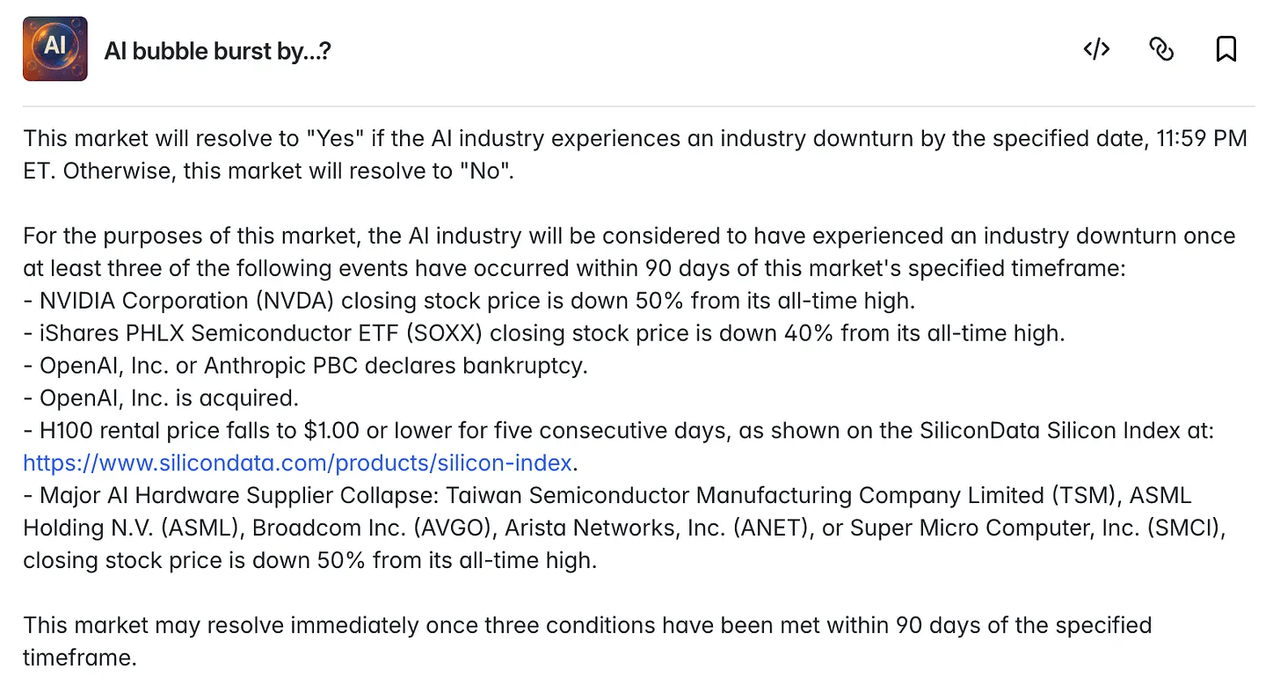
I know, but stocks went down about 30% on the deleveraging in August, and you can argue they had ripped to crazy highs first. Let’s do an intellectual experiment. In the next year, semiconductor stocks go up 10x, and then they go down 40% from the high. And you’re telling me the bubble burst? That’s a pretty shitty contract.
Semiconductors are cyclical, and they have a lot more volatility than the market. In 2022 they went down 45%. In 2025, during the tariff tantrum, they went down 40%. In 2020 they went down 35%, and in 2018, 20%. In 2008, 60%. In 2000, 67%. Honestly, 67% is a really good number. That’s usually a pretty strong bubble burst number.
There are only two stock-decline prongs, so a YES also needs something like the H100 rental condition or a major supplier collapse.
The H100 one is dog. People don’t appreciate depreciation. If you’re buying a 1990 car with a ten year useful life, odds are it doesn’t cost more than the scrap value of the car. At some point that happens to these chips. They physically break down after six or seven years.
The variable cost of running H100s is about 40 cents. But there’s a world where all the new chips coming online are better on a power performance basis, where you’d rather spend two bucks on a B200 than a dollar on an H100. These are depreciating assets. They should go toward zero as new technology comes out that’s way better than the last one. So the problem with the H100 rental prong is a lack of understanding about depreciation. Also, Silicon Data’s index is a little noisy, but that’s me personally.
And “major AI supplier collapse”: Super Micro going down 50% from its all time high? No doubt in my mind that can happen. It might have already happened, actually. Some of these suppliers, like Arista or even ASML, there’s a case where they go down 50% and the bubble doesn’t burst.
Put it in percentages. How likely is it this market resolves Yes without a bubble actually bursting?
Nvidia or the SOX goes down 40%, the H100 falls below a dollar for five days on pure depreciation, and one of the majors collapses. To be clear, that’s a soft market. It’s not a fucking strong market. But I wouldn’t call it a bubble burst. That would be a whimper, not a bang.
There is a case where the bubble doesn’t burst and three of these conditions are still met, and that’s like a 20 or 30% chance. It’s more likely that all of these things get met during the quote unquote bubble actually bursting. But you can hit these tail corners, especially with three distinct events, where the spirit of the contract never actually happened.
How would you write contract rules to truly capture an AI bubble collapsing? Like, it’s truly over.
I would probably do five years. I would do OpenAI or Anthropic goes bankrupt. And I would choose something like 67% off the all time high, with no reclaiming of all time highs within five or ten years. That’s a much more painful drawdown. 40% for the SOX is nothing.
Say the AI bear case comes true. AI stays a cool toy, enterprises never adopt it, and we realize we overbuilt like the railroads. Is that how this ends?
I was writing about railroads before it was cool, and people do not appreciate that in the railroad bubble there were three distinct build out phases: one around 1867 that boomed and busted, another around 1877, and pure financial speculation in the 1890s. There’s a chance, maybe more likely than not, that this build out has ramps and drops along the way. There’s a digestion period for a year and a half or two years, it feels like it’s all over, and then a new leg starts working again.
We’re also doing a lot more real shit than ordering a pizza online in 2000. And if the technology is widely diffused, it doesn’t happen in one big boom and bust. It’s a rolling digestion.
Data center moratoriums went from fringe idea to front page this year, and New York enacted a statewide pause in June. Are the moratorium markets priced right, and what would a broad pause do to the cycle?
I don’t have massive conviction on the pricing, but someone on my team tracks this intensely. There is a clear shift: Democrats are running against data centers, Republicans are running for them, and running against is clearly the more popular position. The last election was a CPI referendum, and the data center issue, through energy prices, is a subset of that. There’s a chance of a press release victory: someone campaigns on it, wins, starts the moratorium, and then the powers that be, meaning capitalism, create loopholes, and the original spirit of a hard pause fizzles out.
Here’s the ironic part: I’d argue a moratorium means the AI bubble doesn’t pop. There’s a demand line for AI that gets bigger every year, and a supply line going up every year, and we’re trying to figure out when supply overshoots demand. That’s when the glut begins. If you impose a giant data center moratorium, supply slows down massively, and I don’t think the demand stops. It elongates the cycle. Chip stocks take a breather, but they don’t go down 60 or 70%, because they’re still making money. Meanwhile AI gets better, enterprises keep adopting it, someone makes a new wonder drug, and all of a sudden there’s way more demand than supply again. It self corrects.
A bubble is wild, speculative inflation and then a quick collapse. Electricity took 40 years and inflated the entire time, and that made it not, quote unquote, a bubble. The analogy is you’re at a party, and leverage is your drinks. Two or three drinks and home early, the next day is okay. Twenty beers with the guys until 4 a.m., the next day is not okay. If the government says, hey guys, no more beers, it’s midnight, and you’ve had ten, the next day you’re hungover, but you’re not in the hospital. If politics slows this down, it’s healthier in the longer run.
Who’s winning among the big labs?
The phrase the Anthropic CEO likes to use is Cournot competition: multiple suppliers with a relatively fungible product, competing on the supply capacity they build. From that perspective, Anthropic is being rational, and OpenAI is super defensive, trying to catch back up. Their new model is a little smaller, probably cheaper to inference, and they’re more than willing to subsidize it. If Sol and Fable are equivalent models and one is half the price, it makes sense that you’d swap over. It would have been unthinkable last year that OpenAI would not be in the lead, and now they’re not.
[Note: this interview was recorded before the release of OpenAI’s Astra model]
Are we reaching the point where the best models aren’t releasable because they’re too dangerous?
I think that’s going to be one of the big narratives for the rest of the year. If the guys in the lead are not playing as hard as they can, how is that bullish at all? Maybe they have a better model, but they’re not going to release it. The government wants to review releases for safety reasons. And on the China versus US side, if you put out a new model, people try to distill it day one, so you give them a version you think is better for anti distillation. They’re willing to hold their punches because these guys aren’t suffering. Anthropic is essentially break even right now. People are having a lot of drama around the ARR deceleration, but part of that is because they’re not releasing new models. If you’re growing at a tremendous rate, break even, and in the lead, why press when you can train a better model and always have something in your back pocket?
Apple sat out the model race entirely. Smart?
It’s going to hurt them in the very long run. The biggest winner of the last cycle often misses the trends of the next, and that’s Apple. Once upon a time it was just IBM, and we don’t talk about IBM like we used to. If you just don’t play, you lose. I believe it’s more likely than not that Apple becomes less relevant. Apple is a much more financialized company than people appreciate. They buy back 100% of their free cash flow. It’s an equity bond. They make a crap ton of cash every year, use it to buy back shares, and have nothing left over to invent new things.
Some people say the 10 year Treasury rising is the real AGI indicator. Do you buy that? Are you a paperclip guy?
I’m not a paperclip guy, but half of my company is. What it’s clearly showing is a demand for capital that is real, and it is moving the big number, dude. The Fed doesn’t control the long end of the curve, and the 10 year and 30 year moves are in real terms, not nominal. Someone has massive conviction they can borrow capital and make a higher return than in the past, and the someone is the hyperscalers. I’ve been calling them gigascalers, because they’re the third largest issuer of bonds in the entire world: the United States, China, gigascalers. You’re watching capitalism’s speed limit say, if you’re going to do that, you’re going to have to pay more. And the issuers are saying, yeah, we think we’ll see the return.
What market do you want to see next?
AI for healthcare is going to be a big one. Just more “will AI cure a cancer by X year.” That would be cool, because I think it might.
Follow Doug’s work at SemiAnalysis on Substack, and on X @semianalysis_
Disclaimer
Nothing in The Oracle is financial, investment, legal or any other type of professional advice. All odds are time-sensitive and subject to change. Anything provided in any newsletter is for informational purposes only and is not meant to be an endorsement of any type of activity or any particular market or product. Terms of Service on polymarket.com prohibit US persons and persons from certain other jurisdictions from using Polymarket to trade, although data and information is viewable globally.