





Chinese Chipmakers Buy 3-Year Sanctions Buffer As Huawei Spearheads Domestic Juggernaut
Right now, Chinese open-weight AI models are on the cusp of dominating closed-weight US frontier models in both price and performance. All ten of the top open-weight models on Artificial Analysis’s spring Intelligence Index came from China-based labs, and the best sat just six points behind the leading closed model; Chinese models also passed American ones in token share on OpenRouter in early June. All of this - despite asymmetrical lack of access to bleeding-edge hardware vs. their US competition, which Washington has been engineering since October 2022.
The first round of export controls went after Nvidia’s best AI chips and the tools that make advanced chips; later rounds added high-bandwidth memory and more of the chip-printing machines made by ASML, the Dutch company with a near-monopoly on them. This year the White House loosened on chips, licensing H200 sales that Beijing then capped on its own, while Congress moved on the tools: a bill that cleared House Foreign Affairs in April would bar ASML from selling its most advanced remaining machines anywhere in China and require a license for every service call on the ones already installed.
So - since China still can't build the machines that make the chips, they've stockpiled three years' worth of critical machinery - buying time for one company to spearhead a domestic drive for AI independence.
On Monday the Financial Times reported that Huawei has taken the coordinating role in China’s drive to build those machines itself, investing across the supply chain and pushing domestic tools into chip plants such as SMIC, China’s largest chipmaker. At the center of the effort is a scanner built by Shanghai startup Yuliangsheng, the same class of machine the bill targets. It is being tested at SMIC and on Huawei’s own production lines, and one source told the paper that output will reach 12 units by the end of the year.
China’s two major memory-chip makers, CXMT and YMTC, have already bought enough ASML machines to cover their expansion plans for the next three years. Meanwhile, Yuliangsheng’s would-be domestic replacement prints wafers through projection lenses made by Germany’s Zeiss, which says it sells lithography optics to exactly one customer: ASML.
China’s memory makers have banked three years of Dutch machines, and the domestic replacement runs on German glass.
What's a Lithography Scanner?
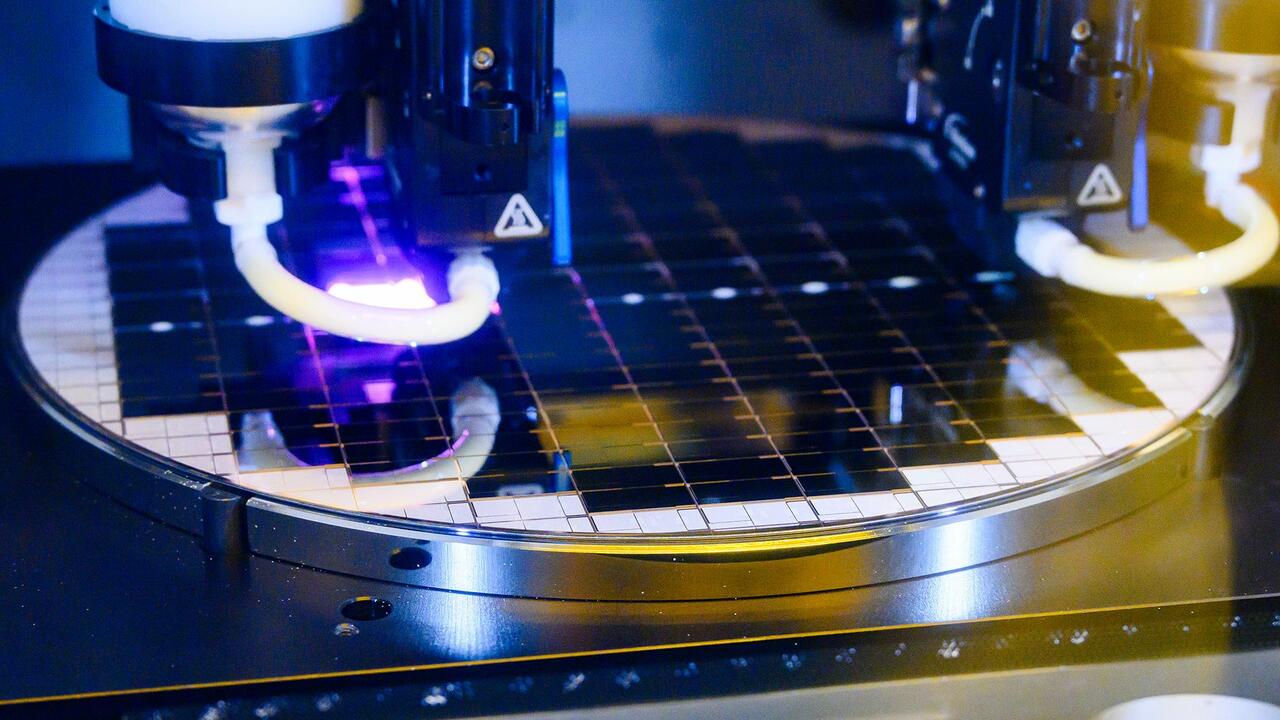
A chip is a pattern printed onto silicon with light. The machine that performs that printing is a lithography scanner. For the chips that matter to China’s AI buildout, the relevant machine is an immersion deep-ultraviolet scanner (DUV), which passes light through a thin film of water to print finer features. ASML makes nearly all of them; Japan’s Nikon is the only other major player.
ASML’s newer extreme-ultraviolet machines have never shipped to China. Immersion DUV tools have, by the hundreds. ASML’s China president said in late 2023 that nearly 1,400 ASML machines were already installed in the country, and that number has risen since. China bought $49.6 billion of chip equipment in 2024, or 42% of the world total, much of it purchased ahead of another round of export controls.
SMIC uses those DUV scanners with multi-patterning, a technique that prints the same layer in several passes, to produce 7nm-class chips without EUV. That is how Huawei’s Ascend accelerators are made, including the 160,000 Ascend 950DTs that DeepSeek is ordering for its Inner Mongolia data center, covered here last week.
Every Ascend still traces back to a Dutch scanner. The machine Huawei is project-managing is meant to replace it.
Huawei As Project Manager
Yuliangsheng was founded in 2022 and spun out of SiCarrier, a Shenzhen equipment maker that FT has previously reported has close technical and business ties to Huawei. Huawei denies any affiliation. Yuliangsheng’s immersion scanner has been in testing at SMIC since September 2025, targeting 28nm in a single pass and 7nm with multi-patterning. For now, it is being used on simpler chips while engineers refine it. AI accelerators are the stated destination.
Bernstein’s Lin Qingyuan told the FT that “Huawei is playing a project management role in China’s DUV push.” A prototype, he added, is of limited value without the thousands of vendors, fabs and customers needed to make it reliable at industrial scale. Huawei is trying to assemble that system.
Its corporate venture arm Habo and another Huawei-backed fund, Shenzhen Yuanzhi Xinghuo, have invested in suppliers working on the two components China still cannot make at the required level: projection lenses and light sources. Shanghai Micro Electronics Equipment, the country’s older state lithography house, is supporting Yuliangsheng with multiple prototypes, some built with foreign components and others used to test domestic substitutes.
The startup also sits inside a much larger state-backed effort. In late July, The Information reported that a Shanghai firm had begun mass-producing domestic immersion DUV tools, sending ASML down more than 8% intraday. Reuters identified the company as Shanghai Aishengna Electronic Technology Group. Founded in August 2023 with Rmb7 billion, or about $1 billion, in registered capital, Aishengna is backed by Shanghai Electric Holding and a Shanghai International Trust subsidiary and has absorbed teams from Yuliangsheng and SMEE. Corporate and recruitment records show that Aishengna and Yuliangsheng share a Shanghai address. Reuters had reported in December that China had also built an EUV prototype, though production remains years away.
German Glass?
A DUV scanner contains tens of thousands of parts spread across roughly a dozen major component groups. According to the FT’s sources, Chinese suppliers remain behind in two of the hardest: the projection lens and the light source.
- The Lens: Yuliangsheng’s projection lenses come from Zeiss - which told FT that it sells lithography optics only to ASML, which owns 24.9% of the unit - a stake it bought for €1 billion in 2017, and ASML’s filings describe Zeiss SMT as its single supplier of optical columns.
Huawei is now backing a would-be replacement. Fujian Zhiqi Photonics was spun out of optical-materials maker Castech in 2022. Yuanzhi Xinghuo paid Rmb100 million for 37% of the company in 2023, implying a valuation of roughly Rmb270 million, or about $40 million. Castech, which grew out of a Chinese Academy of Sciences institute, has disclosed both ASML and Huawei as customers.
- The Light Source: Japan’s Gigaphoton and ASML subsidiary Cymer dominate that market. Beijing RSLaser, also backed by Habo, has supplied light sources for SMEE’s older machines and is developing one for the 28nm tool. Lin’s assessment to the FT: building a light source is easy, building one that runs stably at high power is not.
The Fabs Vote With Dutch Inventory
While SMIC has bought Yuliangsheng’s machines and is testing them, it still uses ASML tools for production. Meanwhile CXMT and YMTC have stocked enough ASML DUV equipment to cover three years of expansion.
ASML’s CFO Roger Dassen said in July that China would remain at roughly 20% of 2026 sales, down from 33% in 2025 but on a larger base. ASML raised full-year guidance to €43-45 billion the same day. Its servicing and upgrade business, Installed Base Management, generated €2.76 billion in the second quarter alone.
Lin’s read is that Chinese DUV has improved substantially but still lacks the full backing of domestic fabs, much as ASML’s own rise depended on years of work alongside TSMC. The stockpile gives SMIC, CXMT and YMTC three years of expansion without running an unproven domestic scanner in production. It also delays, by the same three years, the production-line learning Lin says the prototypes need.
The MATCH Act
On April 2, a bipartisan House group introduced the Multilateral Alignment of Technology Controls on Hardware (MATCH) Act, H.R. 8170, a bill built to close the remaining gaps in US restrictions on chipmaking equipment sold to China and to make the Netherlands and Japan, home to ASML and Nikon, match them on a deadline. The original version was broader. A substitute offered later that month stripped out several controls but, according to Reuters, kept a countrywide restriction on sales of ASML immersion DUV machines to China. It also kept restrictions on foreign equipment sales to CXMT, YMTC and SMIC facilities already barred from using US tools.
The MATCH Act would also require licenses to service equipment in covered facilities, including calibration, spare parts, software updates and field support, although the revised draft dropped the original policy of denying those applications. The introduced text gave allied supplier countries 150 days to match US controls; Reuters reported that the substitute retained a deadline for allied negotiations before unilateral US controls would follow. House Foreign Affairs approved the substitute 36-8 on April 22. A Senate version, S.4281, remains in Banking. Neither has had a floor vote.
Immersion tools need specialized maintenance roughly every six months, often performed by ASML engineers on site in China. A three-year stockpile covers a sales ban. It does not cover a servicing restriction, which would put every six-month service visit inside a covered facility behind a Commerce license.
Lin’s closing point to the FT is that US restrictions could actually speed up China’s progress by forcing local fabs to work with local suppliers. Huawei can coordinate the suppliers, fund the missing components and put prototypes in front of SMIC. What it cannot easily do is make a fab abandon a proven ASML scanner while Dutch inventory is still available. The one party that could is Congress, and its bill has not had a floor vote.
The remaining constraint is the machinery underneath China’s models. DeepSeek’s chip order runs into Huawei’s memory shortage. Huawei’s Ascend chips run through SMIC’s ASML scanners. The domestic scanner intended to replace them still relies on a Zeiss lens acquired on China’s secondary market. And CXMT, the memory maker at the top of Aishengna’s delivery list, has just bought enough ASML equipment for three more years. Three years is the time Huawei has to make the domestic scanner work.