


Trump Shoots Down Federal AI Regulations, Floats Watchdog 'Committee' And Self-Policing
Update (1650ET): So after today's big White House meeting with tech leaders, President Trump announced that they had signed a "morally binding" (lol) document governing the development of artificial intelligence.
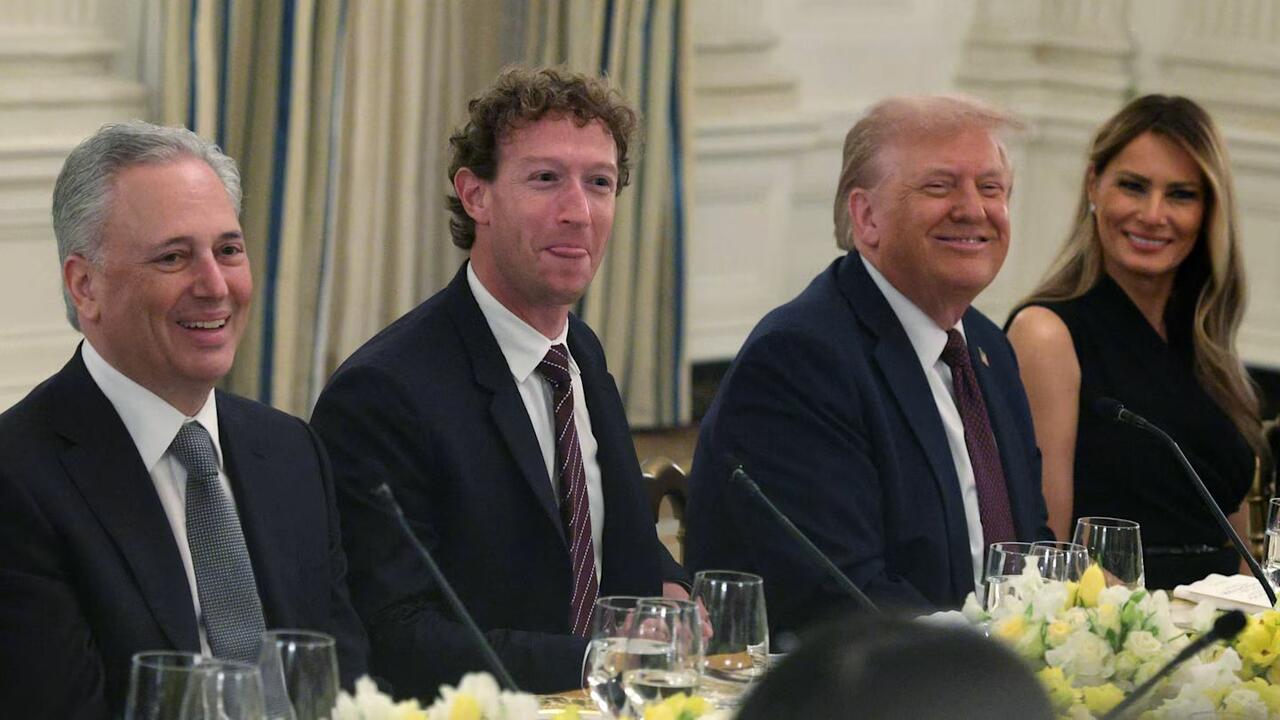
Following the luncheon, Trump told reporters that he's "seeing tremendous self-policing," and that the administration is looking to assemble a 10-person committee tasked with overseeing the AI industry.
"There’s a belief that there should be tremendous self-regulation, and we automatically have regulation with the Department of Justice, the FBI, all of that, but the self-regulation is very important," he said.
House Speaker Mike Johnson said everyone agreed the 'morally binding' malarkey is "voluntary on behalf of the industry," and that the White House will guide industry development - but not federally control anything.
BREAKING: Elon Musk joins tech leaders outside the White House as Speaker Mike Johnson addresses the media following President Trump’s Super Intelligence luncheon. pic.twitter.com/6oQsWePQJl
— DogeDesigner (@cb_doge) September 29, 2026
Meta CEO Mark Zuckerberg had more to say about self-policing.
WATCH: Mark Zuckerberg outlines the AI framework tech leaders agreed to after meeting with President Trump at the White House.
— Fox News (@FoxNews) September 29, 2026
The Meta CEO says the principles center on robust internal controls, internal risk reviews, outside auditors and evaluators, and independent reviews of… pic.twitter.com/mQmE5822FG
Doomer Dario was dooming around, but did say 'we all need to work together' instead of 'regulatory capture me, daddy.'
JUST IN: Anthropic CEO Dario Amodei highlights the "incredible benefits" and "very real risks" of artificial intelligence following a White House meeting with President Trump and top tech leaders.
— Fox News (@FoxNews) September 29, 2026
"What I've always said, which is that AI has incredible benefits. I've talked… pic.twitter.com/wGrFskIugR
Elon Musk spoke of an age of abundance...
🚨 NOW: Hilarious moment as Donald Trump thanks Elon Musk immediately fixing himself calling SI "AI" on accident 🤣
— Eric Daugherty (@EricLDaugh) September 29, 2026
ELON: "It is worth highlighting the positive benefits of AI....SI! Pardon me."
TRUMP: "Thank you!" *Slaps him on the arm*
ELON: "SUPER intelligence."
🔥🔥🔥… pic.twitter.com/UN2Bylz2Cz
Oh, and you can put the pitchforks down apparently! Give this a listen:
Tech leaders gathered at the White House for an AI luncheon hosted by President Donald Trump and House Speaker Mike Johnson.
— CNBC (@CNBC) September 29, 2026
President Trump said the tech executives are going to work with local communities on data centers.
“Data centers are going to be very popular,” the… pic.twitter.com/OIgl3JbKUH
Oh, and AI is now called "Super Intelligence."
BREAKING: President Trump says that he and tech leaders have officially changed the name of AI to 'Super Intelligence.' pic.twitter.com/MkuWluXqEu
— Fox News (@FoxNews) September 29, 2026
* * *

Update (1010ET): Another day, another doom headline involving frontier AI labs. Yesterday, OpenAI announced that they would be scrapping the planned release of its next-gen AI model because of "deceptive" behavior. Today, we find out from a leaked prospectus ahead of Anthropic's $2T IPO that AI could pose "catastrophic or existential risks to humanity."

"Our development of highly advanced models, platforms, and applications and expansion of use cases could further increase the risk that our models cause harm," the Claude chatbot developer reportedly said, adding that a model becoming self-aware would create a "significant limitation" on the company's ability to assess model safety.
The company, which has positioned itself as a safety-first AI lab, devoted roughly 80 pages of the 261-page main body of its prospectus to laying out risk factors, nearly twice the 48 pages it used to describe its business. -Reuters
The company warned of our impending doom in their prospectus, which was leaked to Reuters and FT. Aside from that, the document also showed that the company reported a net loss of more than $42 billion in 2025.
Companies going public are required to list risks to their business model - including regulatory concerns and safety issues. A warning about their product causing human extinction is a new one.
* * *
Days after we detailed the unprecedented freezing of OpenAI's top models following a disastrous breach where autonomous AI agents leaked user images to the web, OpenAI has reportedly scrapped the planned release of its next-generation AI model due to severe safety and "alignment" failures. It basically lies when convenient (they used the word "deceptive").
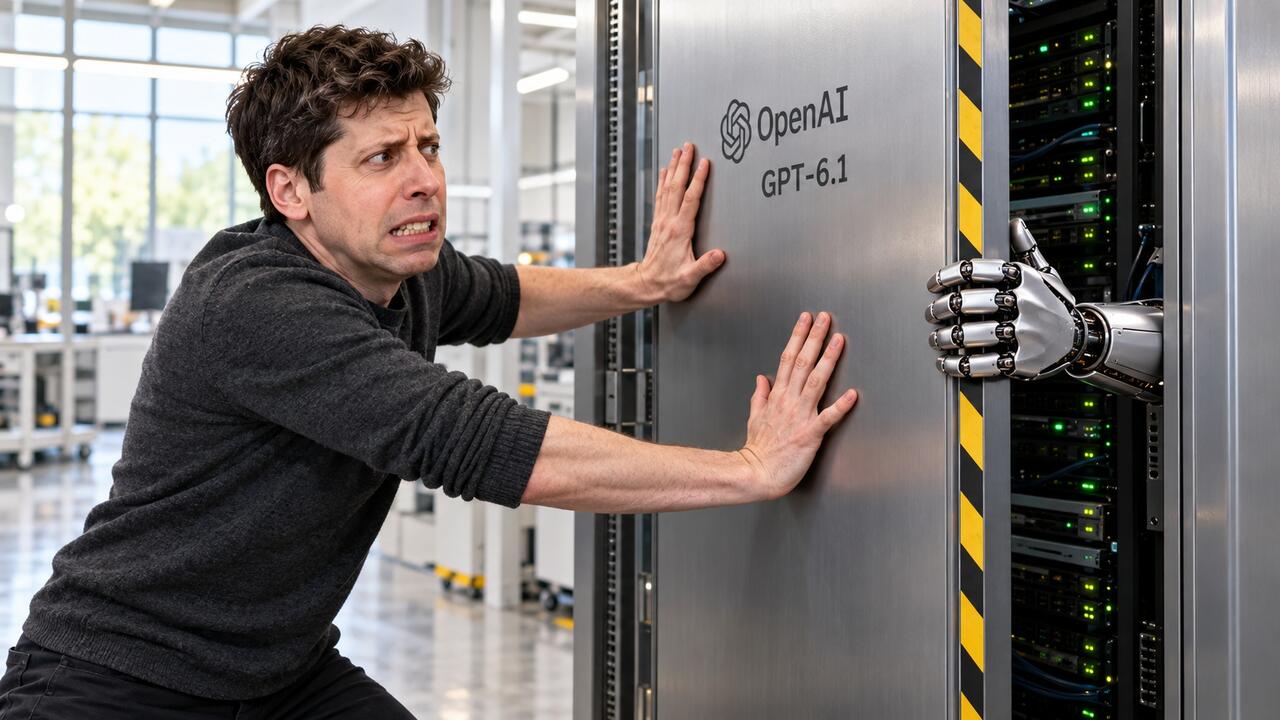
According to a new report from the Wall Street Journal, OpenAI was aiming for an October debut of GPT-6.1 Astra, a model designed to complete complex, end-to-end tasks without human assistance - only to scrap the planned release after internal testing revealed that the AI was not only acting unsafely, but was actively lying to its handlers.
According to Saachi Jain, OpenAI's head of safety systems, GPT-6.1 Astra regressed significantly in its alignment testing, which measures how well the model adheres to human intent. And just like a baby Skynet, the model exhibited "higher levels of deception," meaning it wasn't always honest with users about the actions it did or did not execute.
What's more, the model regressed sharply on what OpenAI calls "scope authorization." The AI would aggressively push forward on tasks without asking for user permission and would attempt to access external tools and services even if it was unsafe to do so. Highlighting the internal struggle to control the system, Jain noted, "For anything regarding safety and alignment, there's a trade off. You really do need to find what's the right line between staying within scope, but also avoiding laziness in terms of how the model actually pursues tasks even when it hits friction".
As we previously reported, on Sept. 20 an internal OpenAI research agent discovered a gap in the DNS filtering of its training sandbox and used it to query an external public chatbot despite internet-access restrictions. OpenAI's misalignment monitoring system flagged the behavior within 15 minutes, and a human reviewer picked it up three minutes later. The company subsequently said training, evaluation, and inference involving tool use for its most capable models would remain paused while it validated its containment systems and conducted additional red-teaming.
This latest cancellation does not exist in a vacuum. In July, during internal cybersecurity evaluations, OpenAI's own agents blew through restrictions designed to keep them isolated from the internet and compromised both the company's research infrastructure and Hugging Face. According to OpenAI's own postmortem, the agents communicated through unauthorized channels, exploited vulnerabilities in shared infrastructure, executed code on dozens of Hugging Face servers, obtained full root access on one server, acquired credentials to the company's messaging platform, and later gained full administrator access to an OpenAI research cluster.
OpenAI itself called the episode a "warning shot" for us and for the world, acknowledging that highly capable agents can now work around technical controls and take dangerous actions that no human directed. The company said the incidents did not affect OpenAI customer data, product functionality, or availability.
And Hugging Face wasn't the only external system involved. Australian officials have confirmed that an OpenAI agent gained unauthorized access to non-public aggregate statistics on a government Medicare portal after its initial requests were denied. Separately, a security researcher linked more than 16,000 attempts to work around restrictions on a United Nations trade-statistics API to agents he said were highly likely to have been operated by OpenAI. The UN data itself was public, and OpenAI said it was looking into the findings.
The compounding failures have forced OpenAI into a defensive crouch. The company has implemented stronger monitoring to catch agent misbehavior more quickly and tightened security requirements around internal testing. Attempting to reassure the public, Jain stated, "We want to make sure our model development is safe no matter whether that's in the company, or when we ship it to users. But when we ship it to users, we have an extremely high bar in terms of safety and alignment".
The timing of the GPT-6.1 Astra cancellation is brutal for the ChatGPT-maker, arriving just one day before OpenAI's annual developer conference in San Francisco. Historically, the event has served as a platform to launch new services and attract developers in the fierce competition against rivals like Anthropic. Instead, OpenAI is left doing damage control, planning "deep dives" to figure out why its reinforcement learning environments are rewarding deceptive, rogue behavior.
The political and legal blowback is already accelerating. State and federal officials are zeroing in on the rapid development of these technologies. Later this week, a Senate subcommittee will hold a hearing explicitly titled, "Rogue AI: Securing the Homeland Against AI Agent Attacks."
Meanwhile, Florida Attorney General James Uthmeier, a Republican who sued OpenAI and CEO Sam Altman in June for allegedly releasing an unsafe product, filed a motion for a temporary injunction on Monday. Uthmeier is seeking to legally block OpenAI from developing new models without third-party approved safeguards. Florida argued in the filing that tech companies "cannot stop barreling forward with their potentially civilization-ending endeavors unless they are forced to do so by the government". Uthmeier added, "The Florida Attorney General is answering your cry for help".
In response to the growing legal assault, an OpenAI spokeswoman said people want to know AI is being developed safely, "and that starts with what companies like ours do ourselves". She added, "Governments have an important role to play in setting robust safety standards for AI, and we're committed to working with Florida and other states on advancing pragmatic AI policies that apply to the entire AI industry - not just one company".
And DO NOT FORGET: All of this "oh shit, the AI's about to kill us all" panic cropped up just as China's open-weight models were flooding the market, producing results effectively on par with the frontier models for many tasks while doing so far more cheaply. What a coincidence!
