





Chinese Lithium Futs Plunge As EU Hybrid Cap Deals Fresh Blow To Battery Demand
Lithium futures in China plunged on Monday after a Bloomberg report said the European Union will cap imports of Chinese hybrid vehicles at 350,000 per year, with the "safeguard measure" set to take effect in the coming weeks.
Under a four-year safeguard measure that could take effect Dec. 1, the bloc will limit Chinese hybrid imports to 350,000 vehicles in the first year, according to the report. The quota would increase by 6% annually from the second year, while the broader safeguard would cover other suppliers to comply with World Trade Organization rules.
In the note titled "EU Caps Chinese Hybrids At 350,000 As Deutsche Maps Every Trade Weapon Left In Europe's Arsenal," we outlined that EU imports of Chinese hybrids would be roughly 45% below this year's run rate of 650,000 vehicles.
The immediate market response to this new development was a 10% drop in the most-active lithium contract on the Guangzhou Futures Exchange, which closed at 104,740 yuan ($15,649) a ton.
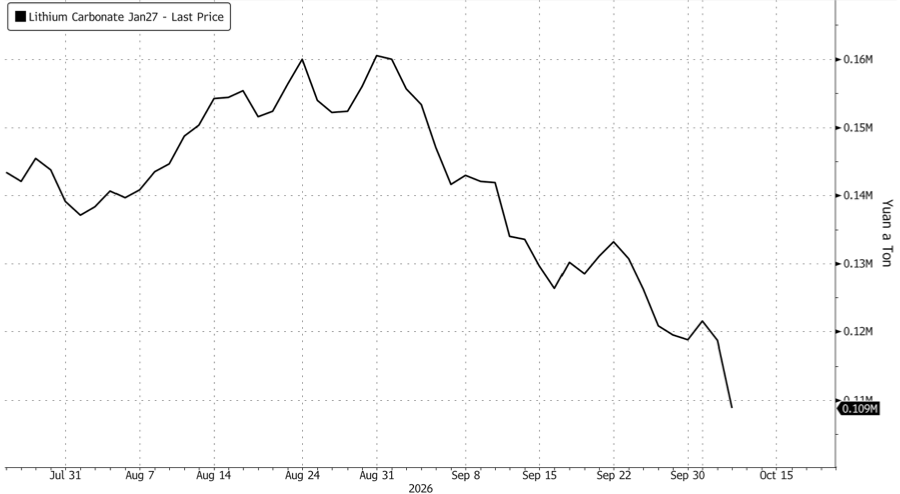
Lithium prices have slumped in the back half of the year as the industry faces mounting pressure from weaker demand for electric vehicles and energy-storage systems.
For context, in October 2024, when the EV tariffs pushed Beijing into hybrids, Europe imported about 3,800 Chinese hybrids a month, per FT data, or roughly 46,000 a year. By year four, the cap grows to about 417,000. In other words, Brussels initially caps the flood of cheap Chinese hybrids at about eight times the October 2024 annualized import level, keeping pressure on European auto companies already grappling with sliding shares and weaker earnings.
The EU-China agreement could help avert a broader trade war and, most importantly, keep Beijing from cutting off rare earth exports, as it has done for certain metals to the US.
Back to lithium markets, Goldman analysts recently forecast that Chinese and global lithium markets would shift from deficits to near-balance in the fourth quarter, then into surpluses over the next two years. The analysts pointed to slower underlying growth in EVs and energy storage, alongside reduced inventory-building needs.