





Jefferies Sets 9000 Target For Market: Everything Must Go Right
Authored by Lance Roberts via RealInvestmentAdvice.com,
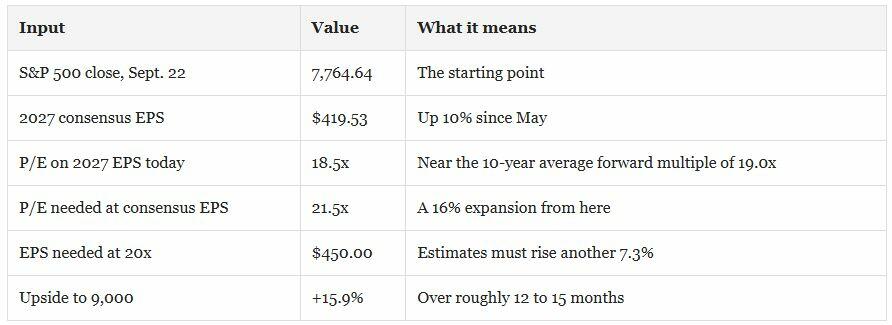
In this week's Daily Market Commentary, we flagged the growing chorus calling for 9,000 on the S&P 500. The most detailed version comes from Jefferies, which now sees 9,000 by the end of 2027. With the index closing at 7,764.64 on Tuesday, that's another 15.9% from here. Jefferies isn't alone, either. FactSet's bottom-up analyst target sits even higher at 9,261. In a matter of weeks, the S&P 500 9,000 target went from a bold call to the "consensus" view. That's exactly why it deserves a closer look.
What Jefferies' S&P 500 9,000 Target Actually Assumes
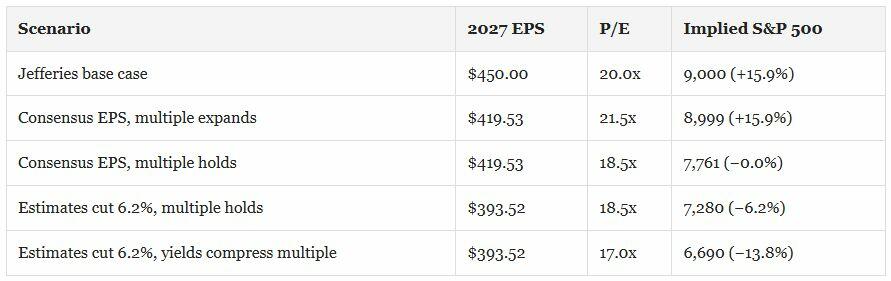
Jefferies' price target of 9000 certainly is encouraging, until you strip away the headlines and focus on the math. Price equals earnings times whatever investors will pay for those earnings. Jefferies spells out its math plainly: $450 in 2027 earnings per share at 20x. That assumes 20.8% earnings growth next year, on top of a 2026 estimate of $373 that already sits above the Street. Its bear case is 6,900, and its bull case is 10,500.
However, this is where it gets interesting. Consensus 2027 earnings currently sit at $419.53, up 10% from roughly $381 in May. At Tuesday's close, the market trades at about 18.5 times that number. Getting to 9,000 requires either a 16% expansion in the multiple or another 7% of upward revisions on top of the ones we've already had. Neither is impossible. Both require the current trend in estimates to keep running, and that's the assumption worth testing.
The Drivers Are Real, And They're Breaking A 90-Year Trend
Let me be clear about this: the bulls have the data on their side right now. According to FactSet, analysts expect S&P 500 earnings to grow 31.8% this year and 15.2% in 2027, on revenue growth of 9.1%. Net margins hit 17.0% in the second quarter, the highest since FactSet began tracking in 2009. Jefferies estimates that AI-exposed companies account for about 46% of index earnings, with growth of 60% this year slowing to 24% next year. Goldman puts AI infrastructure at roughly half of all S&P 500 earnings growth across 2026 and 2027.
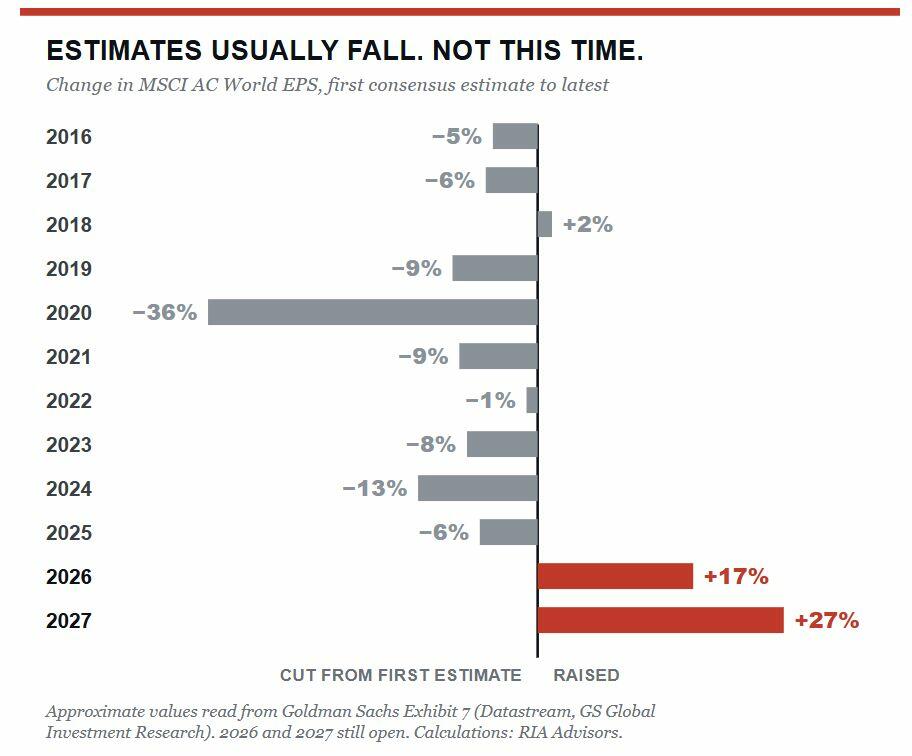
The more unusual part is the direction of the revisions. Wall Street almost always starts a year too optimistically and spends the next 24 months cutting. Goldman's chart of global earnings estimates clearly shows that. From 2016 through 2025, the final number landed below the first estimate in eight of ten years, and the other two were roughly flat. The 2026 and 2027 estimates are doing the opposite, running up roughly 17% and 27% from where they started. Such is the fuel behind every 9,000 targets on the Street. It's also the thing that has historically reversed with the least warning.
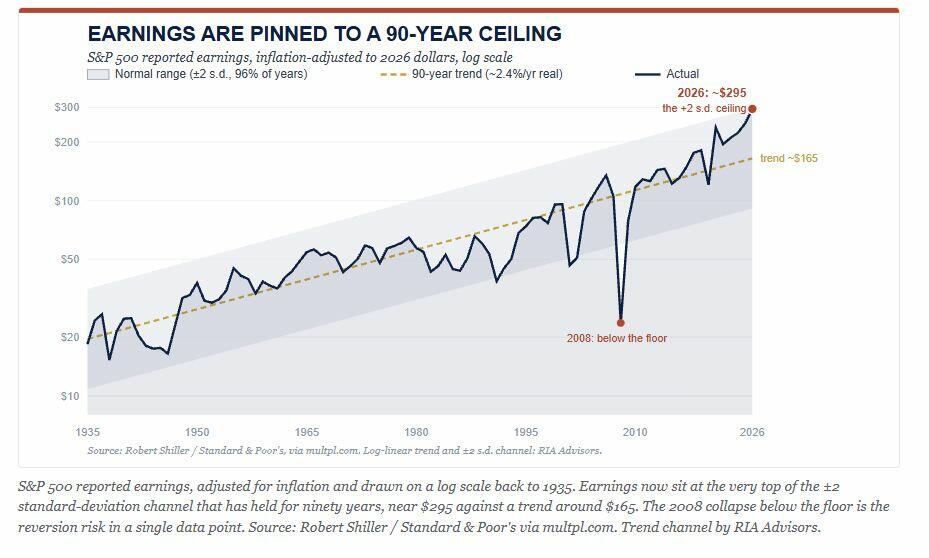
That push higher matters because of where earnings already sit. Two weeks ago, in This Time Is Different? Earnings And Price Break 90-Year Trends, we showed that corporate earnings had broken above a trend that had contained them for more than 90 years.
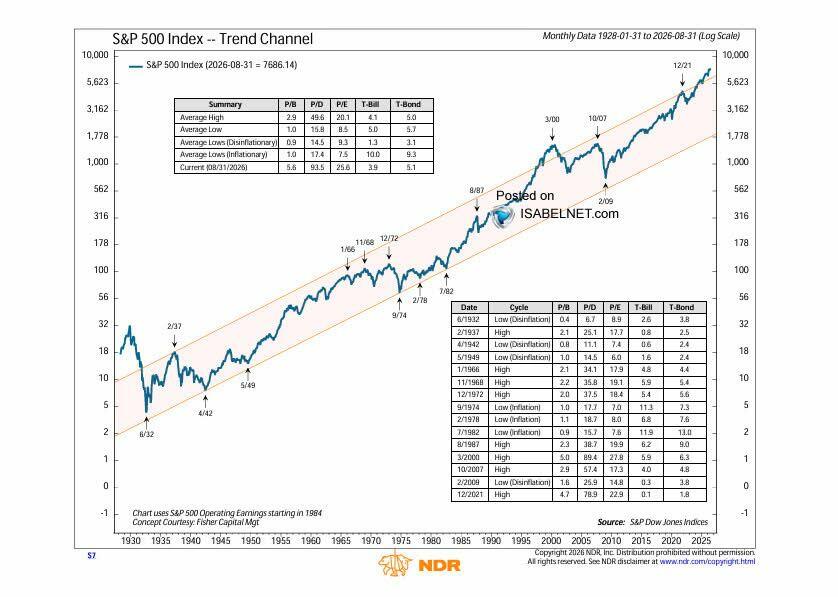
The S&P 500 also pushed above the upper limit of its long-term price channel, a level last reached in early 2000.
Our work on earnings mean reversion put forward estimates close to 50% above their long-term growth trend. Jefferies' $450 takes that gap to roughly 60%, and every upward revision widens a gap that has historically closed on the earnings side.
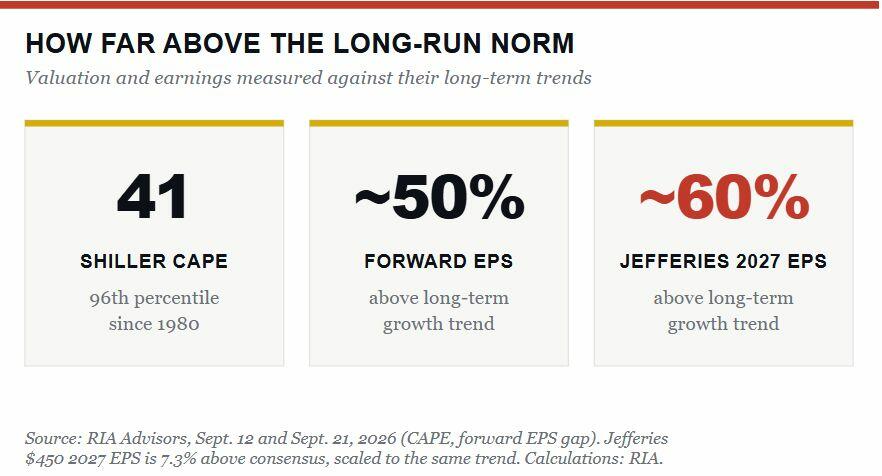
To wit, from that 90-year analysis:
"Whatever event causes the 'E' to revert towards its long-term mean, the 'P' will be repriced lower."
Here's What Could Undercut The Outlook
Someone will tell you the analysts have been right all year, so why fight them? That's a reasonable point. The issue is NOT whether earnings grow in 2027. They almost certainly will. The issue is whether they grow 15.2% while the market is already priced for it.
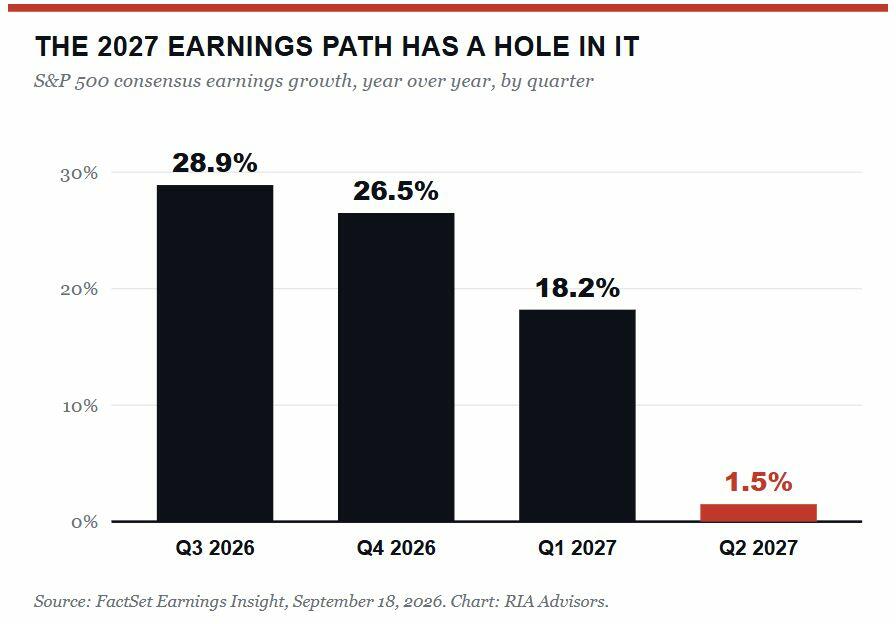
Let's start with the shape of next year's path. As of this writing, the consensus forecast has fourth-quarter earnings growing 26.5% and first-quarter 2027 earnings growing 18.2%. However, the second quarter drops to 1.5%. To hit the full-year 15.2%, the back half of 2027 has to average something close to 20% growth, at a point when the easy year-over-year comparisons are gone.
Secondly, margins are potentially problematic. FactSet already expects net margins to slip from 17.0% to 15.0% in the third quarter, against a five-year average of 12.4%. The 9,000 forecast needs margins to hold near a record, and records are where margins tend to mean-revert.
The third risk is how the AI buildout is being paid for. FactSet tracks hyperscaler capex near $800 billion this year, with free cash flow at or below zero for every major spender except Alphabet and Microsoft. Borrowing has risen from 9% of capex to 32%. As we discussed in AI Capex Depreciation Risk Is The Catch To Record Earnings, those servers are being depreciated over 5 to 6 years.
However, what if their real useful life is closer to 3 or 4? In that case, a much larger depreciation charge lands squarely in 2027 earnings. Then there's the consumer. Brent crude traded near $98 on Tuesday, up from $72 before the war in Iran started, and year-over-year crude consumption has already turned negative. That series has closely tracked real personal consumption, suggesting higher energy costs are eating into broader demand.
The Fed Isn't Coming To The Rescue This Time
Over the last fifteen years, investors learned that the Fed would cut if earnings stumbled. That reflex is gone. The FOMC raised rates by a quarter point to a target range of 3.75%-4.00% on September 16, and the vote was unanimous. Chair Kevin Warsh said the move "will deliver a timelier return to our target."
As we noted in Another Hike By Year End And No Cuts On The Horizon, the median dot now sits at 4.1% for both 2026 and 2027. In other words, one more hike this year and no cuts until 2028. The Summary of Economic Projections has core PCE inflation at 3.4% this year.
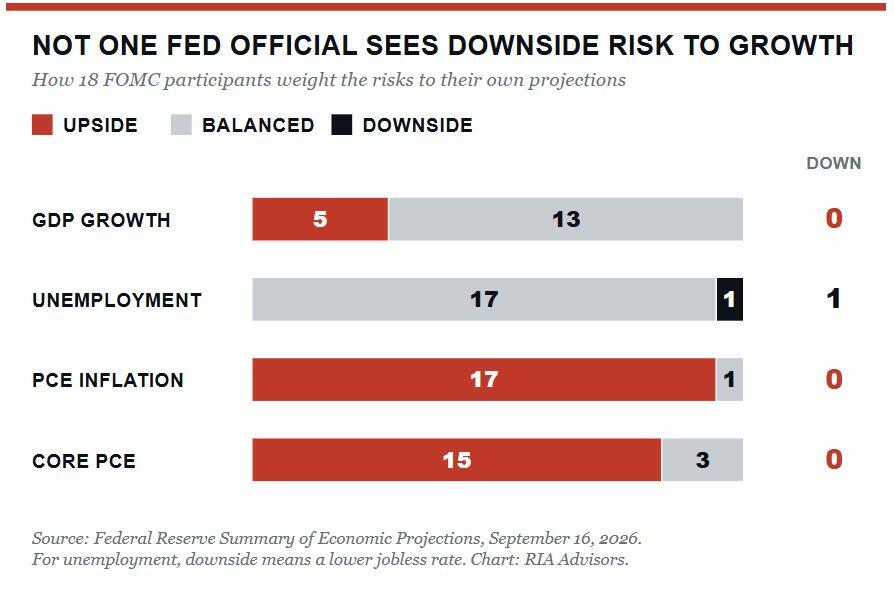
Look at how the committee sees the risks. Not one of the 18 participants sees growth weighted to the downside. Seventeen see inflation risks weighted to the upside. Such is the setup Bob Farrell's Rule #9 warns about: "When all the experts and forecasts agree, something else is going to happen." As we showed in the DMC, a coin flip has matched the committee's 12-month forecasting record since 2012. A committee this confident about growth and this worried about inflation isn't positioned to deliver "rate cuts" quickly if earnings disappoint.
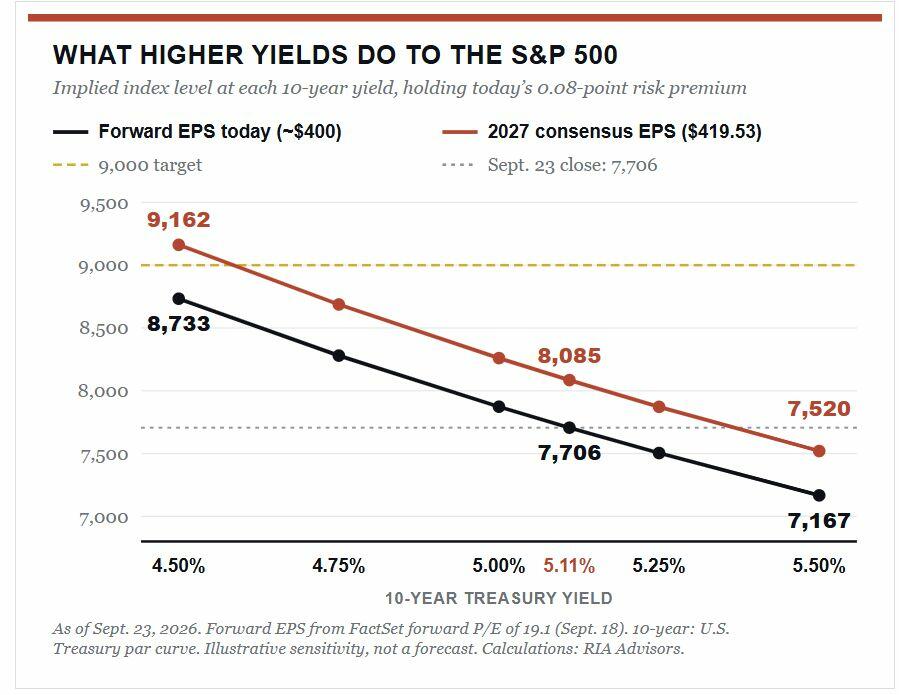
Rates are the other half of the valuation equation. The 10-year Treasury closed at 5.11% on Wednesday, the highest since 2007. The speed matters as much as the level. Goldman notes that stocks tend to struggle once the 10-year moves by about 30 basis points in two weeks or 50 basis points in a month. It's up 28 since September 9 and 37 since August 21. The Russell 2000, where rates bite first, fell 1.8% on Wednesday.
FactSet's forward P/E of 19.1 implies forward earnings near $400, an earnings yield of about 5.2%. Against a 5.11% 10-year, investors are being paid roughly 8 basis points to own stocks rather than Treasuries. At that premium, even 2027 consensus earnings need a 10-year near 4.6% to reach 9,000. The 6.2% cut in the table below is the average amount by which analysts have overshot final earnings, including recessions.
We can do some simple math and calculate implied S&P 500 returns based on various 2027 EPS levels and valuation multiples. As shown, math can become fairly brutal.
What Should Investors Do Now
None of this makes me bearish on the next few months. The trend is bullish, the index sits within a fraction of its record, and earnings momentum is positive. Fighting that tape has been a losing trade all year. What bothers me is how little room for error the S&P 500's 9,000 target leaves. It needs estimates to keep rising, margins to stay at records, AI spending to keep paying off, and rates to stop climbing, all at the same time. That's a lot of things that have to go right for another 15.9%, against a downside of 6% to 14% if only one or two of them go wrong.
This is why we continue to recommend staying invested while increasing the risk controls and discipline around the portfolio. The goal is to capture potential market appreciation if Jefferies' 9,000 target is achieved, without building a portfolio that depends on it. Practically, here's how that looks.
Markets rarely punish investors for missing the last 15% of a bull market. They punish investors who needed that 15% to be there.
As we wrote two weeks ago, position for the trend and prepare for the bend. Right now, the forecasts have stopped leaving room for anything to go wrong.
They usually do right before something does.
