





Hormuz Oil Flows Rebound To Two-Thirds Prewar Level As Iran's Grip Erodes, Attacks 19 Ships
Rory Johnston, a Toronto-based oil analyst and the founder of Commodity Context, an independent oil market research firm, wrote on X this weekend that oil shipments through the Strait of Hormuz have recovered to roughly two-thirds of prewar levels, driven by a surge in Saudi exports. This suggests that Tehran's leverage over the critical maritime chokepoint has eroded.
"Hormuz oil flows can't possibly be above 13 MMbpd bc crude is over $100," Johnston wrote in the post on Saturday, citing Kpler data.
He added, "Brother, if you had told an oil analyst in January that Hormuz flows were still down 7 MMbpd after >200 days of war, with the East-West pipeline hobbled, and oil was ONLY $100 they'd have looked at you like."
“Hormuz oil flows can’t possible be above 13 MMbpd bc crude is over $100!”
— Rory Johnston (@Rory_Johnston) September 26, 2026
Brother, if you had told an oil analyst in January that Hormuz flows were still down 7 MMbpd after >200 days of war—with the East-West pipeline hobbled—and oil was ONLY $100 they’d have looked at you like pic.twitter.com/e8TmiScFMQ
Saudi Arabia is driving the recovery. The kingdom's crude exports averaged 5.28 million barrels a day during September's first 23 days, the strongest pace since the conflict began, according to Bloomberg ship-tracking data. About 3.4 million barrels a day were loaded at Gulf ports, reversing the near-total retreat from those terminals earlier in the war.
Courtesy of Commodity Context ...
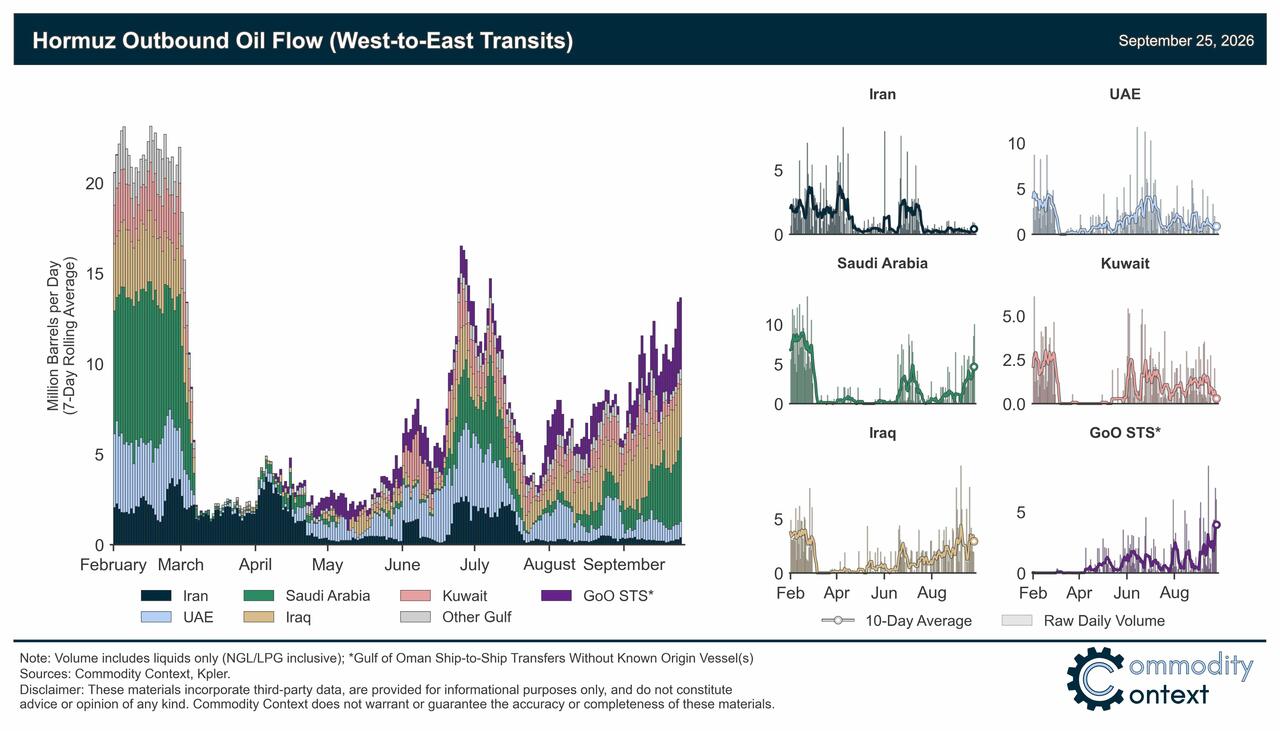
"Hormuz is no longer behaving like a chokepoint under effective Iranian control. Hormuz oil flows are now above 13.5 mb/d on a 7-day average," energy analyst Art Berman wrote on X, quoting Johnston's post.
Berman said, "The biggest increase is Saudi Arabia's Gulf loading surge. That changes the strategic picture. Iran can still attack ships, raise insurance costs and make the strait dangerous. But danger is not the same as control. The more oil that clears Hormuz, the more Iran's leverage shifts from blocking flows to merely imposing costs."
Doha-based QNB Financial Services wrote in a note to clients earlier today that "Qatar has ramped up liquefied natural gas tanker traffic through the Strait of Hormuz to the highest in more than two months, a sign it’s becoming more comfortable moving ships through the waterway."
Hostilities in the narrow strait continued for a second night, according to Bloomberg, citing reports from the semi-official Fars news agency that Iranian armed forces had targeted 19 ships attempting to use authorized routes in the waterway over the preceding 48 hours.
On Saturday morning, President Trump told reporters on the White House lawn that he had rejected an Iranian proposal for a seven-day ceasefire and was open to resuming attacks on the Islamic Republic after the midterms.
Reporter: Will you strike Iran after the midterms?
— Clash Report (@clashreport) September 26, 2026
Trump: I'm rejecting their deal. They want to make a deal where they open the Strait immediately because they're losing so badly.
They want to make a deal, and I think that's fine. I like making a deal, too, but that deal would… pic.twitter.com/87rKbDySLN
By Sunday morning, Bloomberg reported that Iranian Foreign Minister Abbas Araghchi was still waiting for a definitive US response through mediators Qatar and Pakistan, despite Trump's public dismissal of the seven-day plan.
The one major escalation risk that may emerge after the midterms is a renewed US bombing campaign, potentially accompanied by cyber operations against Iranian energy infrastructure such as Kharg Island. For energy markets already strained by a global refining crisis, the post-election period warrants close attention.