





Largest US Power Grid Is 6.8 Gigawatts Short To Ensure Reliability On Historic Data Center Boom
The largest US power grid failed for a third straight year to secure enough future supply commitments to ensure reliability for the future amid a historic boom in data center demand.
PJM Interconnection, the largest US power grid (Regional Transmission Organization), which serves 67 million customers in 13 states and Washington, DC, said its auction to procure power for the year starting June 2028 fell 6.8 gigawatts short of what it will need to guarantee system reliability during demand spikes, in a statement released Tuesday. The shortfall is equivalent to almost seven traditional nuclear reactors.

The result ramps up pressure on a grid that’s home to Virginia’s Data Center Alley, the biggest concentration of data centers in the US, and has borne the brunt of criticism for the struggle to manage the AI boom and sufficiently protect customers from soaring costs. Attention now shifts to an emergency procurement mechanism later this year that aims to shift the burden of ramping up power generation to hyperscalers.
6.831 Megawatt Shortfall
PJM Interconnection today announced the results of its 2028/2029 Base Residual Auction (BRA), which secured 138,318 MW of unforced capacity generation (UCAP) and demand response to meet projected electricity needs for the more than 67 million people across 13 states and the District of Columbia, which fall under the RTO's umbrella.
Regions under the Fixed Resource Requirement (FRR) acquired an additional 10,864 MW in UCAP, for a total of 149,182 MW in UCAP available to serve forecasted peak electricity demand, plus a reserve margin. UCAP represents a generation resource’s maximum output adjusted for its estimated ability to reliably perform at times of highest system risk. The capacity of the resources procured in the auction, plus FRR resources, is short of PJM’s reliability requirement by 6,831 MW, meaning that the committed supply is less than what would be required to meet the one-event-in-10-year reliability standard (and with electricity-guzzling data centers popping up almost daily these days, the one-event-in-10-year has become a daily occurrence).

This shortfall was not unexpected given the conditions PJM has been observing, including a shortfall of approximately 6,500 MW in the previous capacity auction (for the 2027/2028 Delivery Year). These most recent auctions were the first in PJM history in which the entire RTO fell short of the reliability requirement. PJM plans to seek FERC approval to hold a special “Backstop Procurement” in September to help address the near-term shortfall in electricity supply.
In coordination with the governors of all 13 PJM states and the Federal Energy Regulatory Commission, PJM established a price cap and floor, or collar, for four capacity auctions to protect both consumers and investors from market volatility. This was the third consecutive auction with the price collar.
The clearing price came in at the FERC-approved price ceiling of $325 per megawatt-day which will show up in users’ monthly utility bills; the price was a 2.5% decrease from the 2027/2028 Base Residual Auction cap of $333.44 per megawatt day.

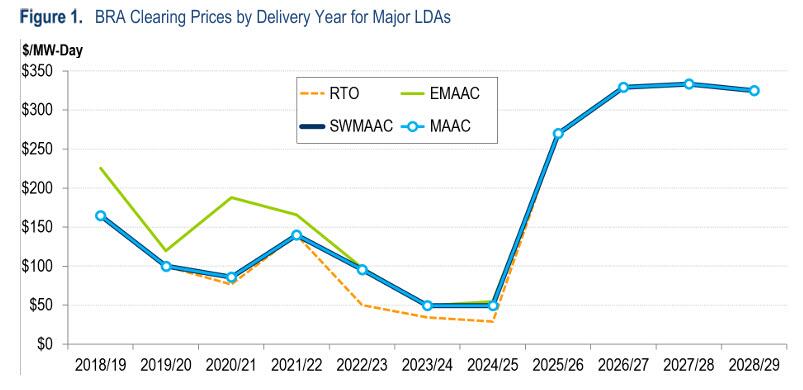
Costs would be even higher if not for the price cap first negotiated in 2024. While that has helped keep a (loose) lid on costs, PJM has been among those to say that the system also means there isn’t a sufficient price signal for producers to build new power generation.
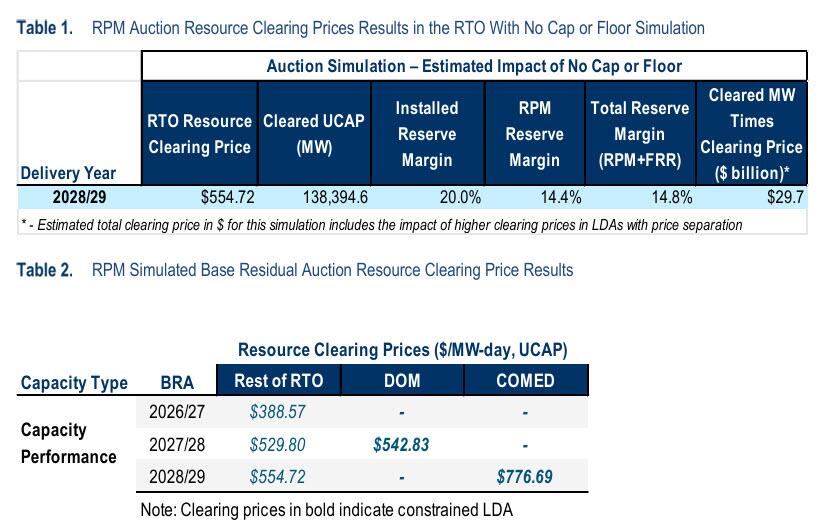
The table below from the PJM statement shows what prices would have been without a price cap. For 2028/2029, all prices cleared at $554.72 except the COMED LDA, which cleared at $776.69.
In other words, absent a regulatory cap, the price of electricity would be 70% higher ($554.72 vs $325).
Meanwhile, advanced technology providers of nuclear energy such as modular reactor companies Nano Nuclear and Oklo are just waiting for the green light to plug their energy sources into the grid.
Payouts to generators for the year starting June 2028 matched the last auction’s all-time high of $16.4 billion set in December, according to PJM (the total value does not equate to the total cost to load because load that is hedged through self-supply or bilateral contracts is not exposed to the clearing prices in the auction).
PJM power prices jumped 76% during the first quarter due to rampant demand from data centers, according to a report from Monitoring Analytics, the grid’s independent market monitor.
PJM CEO David Mills recently described such a situation as “untenable."
Commenting on today's auction, Mills said that “these auction results show that demand for electricity continues to grow faster than electricity supply. At the same time, PJM recognizes how this supply-and-demand imbalance impacts the reliability of the system and costs for consumers. We are working with government and industry leaders on multiple fronts to restore that balance by bringing on new generation as fast as possible and managing the growth of new load on the grid.”
As we have repeatedly warned when discussing just how little excess capacity there is in the US grid - with PJM already well below the critical reliability threshold - a searing heat dome earlier this month showed just how close the PJM grid is to reaching its limits, with power demand likely surpassing a record that had stood for over two decades. Without urgent action, the grid risks further deterioration with demand outstripping oncoming supply.
Next summer the Eastern seaboard will look like North Korea at night thanks to chatbots pic.twitter.com/NEY97pa1LB
— zerohedge (@zerohedge) May 6, 2026
PJM already was under intense scrutiny with data centers and power generators saying they are not being connected fast enough as consumer groups and politicians hammer the grid for spiraling power bills. Those concerns are likely to come to a head at a July 23 conference called by the Federal Energy Regulatory Commission to discuss grid governance.
The latest auction result, intended to guarantee enough capacity is available for the few hours in a typical year when demand peaks, will also put further onus of an emergency measure slated for later this year to fill the supply gap and ensure data centers pay. As Bloomberg notes, PJM has yet to submit its proposal for exactly how that will work, but the process is set to get underway in September after heavy pressure from the White House and state governors.