





America's Wile E. Coyote Moment
Authored by Matthew Piepenburg via VonGreyerz.gold,
When it comes to contextualizing the tech, bond, gold and policy headlines of Q4 2026, it's easier to foresee their pathway ahead by first looking backwards. Once understood, we mathematically realize that our problems are not in the future, they are right now.
The 1970s
Ah, the 1970s. It was an era of bellbottom jeans, checkered suits, wide ties, the music of ABBA and Saturday morning cartoons.
It was also the decade in which Nixon decoupled the dollar and ended the sound money hopes of America's founding fathers.
Backed by nothing but "full faith and credit," the USD began its slow but steady death by a thousand cuts of borrow and spend without limit or concern.
Free a golden chaperone, politicians and Fed Chairs of every political stripe could expand balance sheets and the M2 money supply with almost zero concern for the longer-term financial karma that always follows a bacchanalian debt spree paid for with dollars literally created out of thin air.
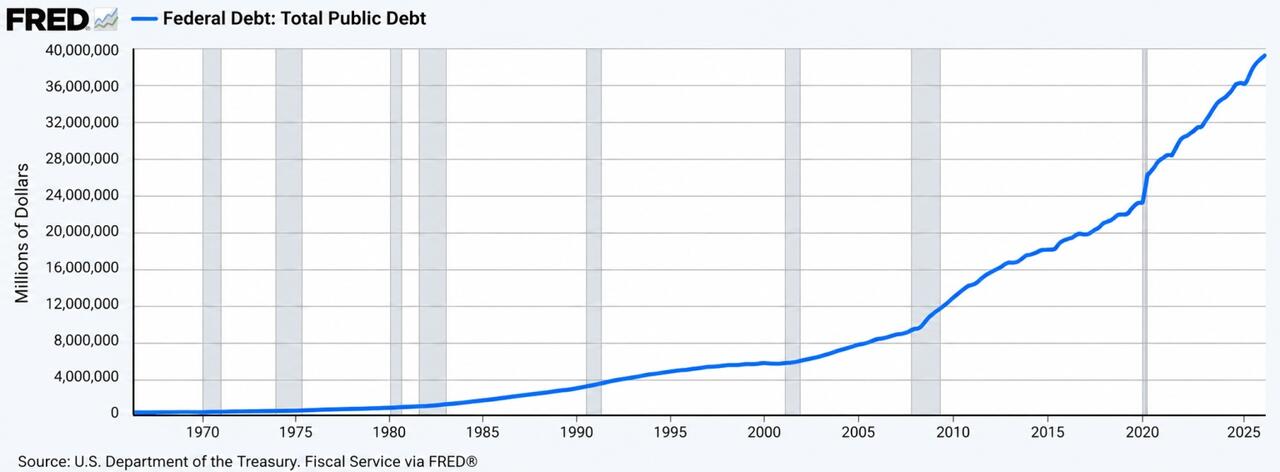
Government debt, at $238B in 1971, was no big deal to our so-called "experts."
Besides, any future debts could be easily paid at this dawn of generational fantasy, which Hemingway described as the "temporary prosperity" of excess money printing masquerading as careful policy.
A Time Without Foresight (or Restraint)
In short, no one in the 1970's was thinking of what it might be like by 2026 when that same government debt had skyrocketed from a couple hundred billion to over $40T.
Instead, post-1971 leadership, red or blue, focused on the next election cycle rather than the next generation's purchasing power.
As holder of the world reserve currency, DC enjoyed what the French Finance Minister of 1965 described as the "exorbitant privilege" of simply exporting its reserve currency and inflation to the rest of the world.
This may have been inherently unfair to the rest of that world, but as our then Treasury Secretary, John Connally, famously quipped: "It's our currency but your problem."
Buying Time with Funky Policies
To insure that "problem," we effectively forced OPEC to sell its oil in USD, and even made the producers of this oil spend large chunks of their revenues on our USTs. This made oil a critical sponge to absorb our reckless and inflationary spending.
As Mel Brooks would say, it sure was "good to be the king" - or at least King Dollar.
And just in case a rising gold price might otherwise embarrass our nothing-backed dollar, we also made sure in the mid-70s to create a price-fixing mechanism at the COMEX to legally manipulate the paper price of this far more precious and honest metal.
Yep. That was the 1970's.
What could possibly go wrong?
Well... just about everything.
Some fifty years later, we now see a world de-dollarizing, a petrodollar fracturing, missiles flying and the dollar emerging no longer as just the world's problem, but America's as well.
Back to the Future
Fast-forward to 2026 and the foregoing "exorbitant privilege" and "temporary prosperity" has devolved into what Hemingway also foresaw as this debt-n-spend fantasy's final endgame, namely the "permanent ruin of currency debasement and war."
Of course, there are defenders of American Exceptionalism who would take offence to words like "permanent ruin" from gold bugs just "selling their book."
After all, there's so much to save us. Just look at the record-high S&P. Look at technology. Look at AI. Look at the milkshake theory's immortal dollar. Look at all the Fed's brilliant PhDs and magical task forces. Look at stablecoins.
Ok. Let's look.
The Great AI Gambit
As for the S&P 500, it's nearing all-time highs, but 440 of its 500 companies are down more than 20% from their 52-week highs.
Rather than a stock market, we have a concentrated minority of tech monopoly powers holding the rest of the broken pack together with techy duct tape and memes of "this time is different with AI."
The core and leading big names in tech, namely Google, Amazon, Facebook and Microsoft, are part of the biggest AI circular financing and concentration risk gambit in the history of U.S. equity markets.
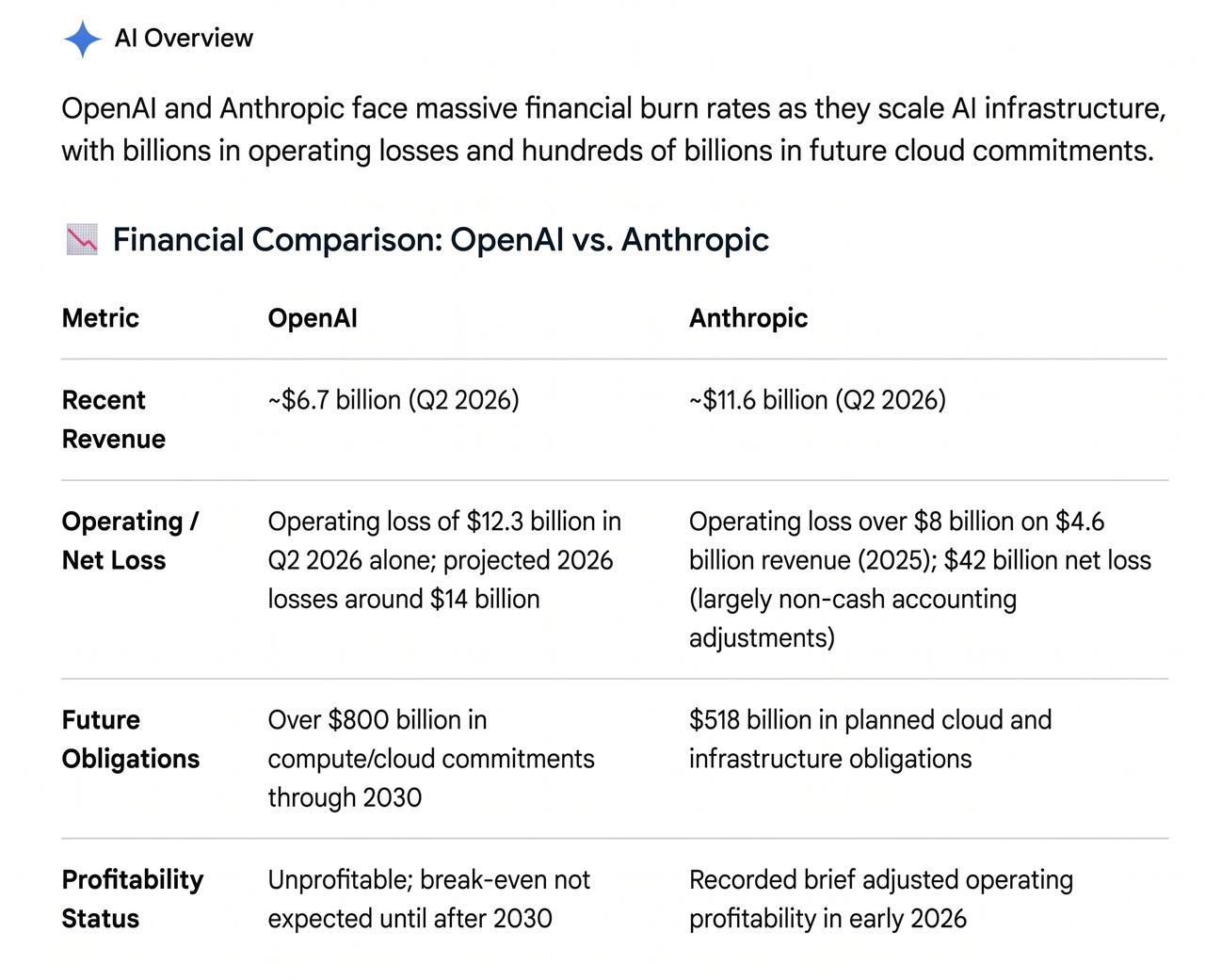
These hyper-scalers get 70% of their AI revenues from just two players, Anthropic and OpenAI, two profitless companies whose costs are billions greater than their revenues.
These two screaming examples of concentration risk are bleeding money at an historical scale. Even AI's own search results confirm the same:
From Concentration Risk to Circular Financing
And if you are wondering how Anthropic and OpenAI are funded, it's not from big VC names.
Actually, the bulk of their equity (over 700B in 2026 AI capex alone) is coming from the very same companies (Microsoft, Amazon, Google, SoftBank and Nvidia) they sell their un-moted software to...
Even more alarming, these same tech hyper-scalers which keep the two AI ships afloat are themselves burning cash at a record pace on data centers whose costs (and power problems) are killing their cash flows.
Given this circular, financed, uber-concentrated and just massive capex profile and daisy chain, AI is literally becoming too big to fail.
The very survival of our economy and stock market is now being gambled on a single AI play whose profitable future is anything but certain unless the government regulates a duopoly protective measure to keep China out of OpenAI and Anthropic's backyard, at which point the U.S. won't be getting rare earths from Asia any more...
NVDA to the Rescue?
But surely Nvidia's GPU sales will save the day, right? Its earnings are indeed impressive, and it just posted 110% revenue growth. Wow.
But if you look more carefully at Nvidia's 10Q form (and the notes behind it), you'll also see that 70% of its accounts receivables come from just five companies (listed above).
Do you see the circular concentration risk? Do you see the massive gambit the S&P is playing on the entire economy if this AI dice-roll (priced for perfection) doesn't go as planned?
For now, the great AI gambit has yet to play out. But the memory of tech bubbles transitioning from over-bought to over-sold is still very fresh in my dot.com-trading mind...
The Bond Market's Verdict
But if we move from a profitless AI, circular-financed, and grotesquely concentrated and uncertain U.S. tech bubble to a shattered U.S. sovereign bond market, the suspense is less severe in a nation running $2T in annual deficits.
In fact, when it comes to bonds, the verdict is already obvious.
As the great American bond king, Jeffrey Gundlach, so aptly described it: "We've hit peak lunacy" in our sovereign bond market.
With the 10Y UST yield crossing the 5% "uh-oh" Rubicon in a public debt backdrop of $40T, I see a death penalty for the dollar's purchasing power and a Treasury Secretary with zero parole options.
With Scott Bessent having recently added David Zervos and Judy Shelton to his "dream team," the set-up is now clear for some major changes - and desperation - ahead.
Meanwhile, DC mouthpieces like Kevin Warsh avoid direct answers as to how Uncle Sam can afford his interest expense or how we got to 5.25% yields by October when they were at 4.4% when he took office in June.
Yields rise as inflation rises, so the war in Iran, which has sent Brent crude to painful highs, is the most common explanation for how our pre-war yields of 3.9% have now crossed above the fatal 5%-handle.
But the real issue (i.e., criminal evidence) behind the rising shark fins of these rising yields lies in U.S. bond issuance at extreme levels at the same time demand for the same has hit extreme lows.
As more deleverage-focused nations dump our debt to support their currencies or buy spiking oil, those Treasury yields just keep rising - and will rise even higher once the USA confesses it's already in a recession.
The world's trust in an over-issued, distrusted, debt-soaked, and weaponized UST has fallen from incremental to exponential levels. The premium (i.e., rate) for U.S. IOUs will only continue to climb higher as our deficits do the same.
Signals: This Ain't Our Father's Bond Market
The post-2020 Treasury market is not what it used to be since 1980, and it won't be coming back. The once sacred Treasury market is mathematically broken, which means DC is objectively unhinged.
Between September of 2024 and January of 2026, the Fed, having failed to beat inflation via hawkish rate hikes in 2022 and 2023, then dovishly cut rates by 175 basis points.
In normal bond markets, such cuts are supposed to send yields down. Instead, yields went up across the entire duration range of the yield curve.
Such yield indicators may seem boring to those unfamiliar with bond market lingo while doom-scrolling their iPhones, but it confirms that the Fed has lost control of rates, and hence the cost of his unpayable sovereign bar tab.
And it gets worse.
Since 2000, we've seen 13 market corrections. And in the first 12 of those 13 corrections, the dollar always went up (on a DXY basis) by at least 8%. But on the 13th correction last April, when stocks lost 18%, the dollar, rather than go up, went down even as yields spiked.
That's not normal...
In this new abnormal, USTs sell off as stocks sell off, and the grossly over-produced (i.e., debased) USD, even in a rising yield setting, can't strengthen.
There is no safe-haven in the so-called "risk-free return" of a U.S. IOU which, when measured against honest rather the Fed-measured inflation, is nothing more than "return-free-risk."
In short, we are in a different bond regime. The old rules, correlations and tricks no longer apply.
Our bond market is openly broken.
The only way to bring these yields down to a survivable/payable level is either: 1) money printing to the moon; or 2) a massive debt restructuring, either of which option means further dollar destruction and hence screaming tailwinds for gold.
Credit Default Masquerading as a "Re-Structuring"?
As for "restructuring," the recent addition of Shelton and Dervos is telling.
Shelton, of course, understands the fall from grace of USTs. She knows that a gold-backed long bond has more credibility than a dollar-backed IOU for the simple reason that our debased dollar is now obvious (and embarrassing) to everyone, including those nations not showing up at our Treasury auctions.
But even a gold-backed 50Y UST is not gonna save the Treasury market. Too little, too late.
Like Gundlach, I feel the Fed and Treasury Dept will buy time with some serious YCC by issuing more debt from the short end in a desperate Operation Twist 2.0 attempt to compress yields on the long end.
But that's not working so well, is it?
And also like Gundlach, I believe the next desperate act could very likely involve a clever "restructuring" of our sovereign IOUs which boils down to little more than a constructive default on our debt.
That is, at some point down the road, and in the oh-so convenient name of "national security" (blamed, of course, on some foreign bad guy or black swan event), DC will simply announce an extension of bond maturities and a capping of bond coupons at 1%.
This, of course, will crush bondholders, foreign and domestic, as well as pension funds, insurance companies, money markets and the man on the street. It will also mean a massive price fall (and riot) in bonds and no global love for Uncle Sam's IOUs.
But hey, desperate times require desperate actions.
Under such "restructuring," DC would be forced to stop issuing debt and rebalance its budget. It would also mean a tanking USD, which is precisely what DC needs to inflate away its debt and gain some yardage in its trade deficit.
All Roads (Still) Lead to Gold
Thus, whether we mouse-click more trillions to save (self-fund) the bond market or restructure USTs with capped coupons, the net result either way is a neutered USD and hence a ripping gold price in the years to come, at least for those who can think that far ahead.
This further explains why central banks, which have been stacking the metal at an historical pace in 2026, now hold more gold than USTs.
They see the direction (and desperation) of the USD, and hence the direction of gold.
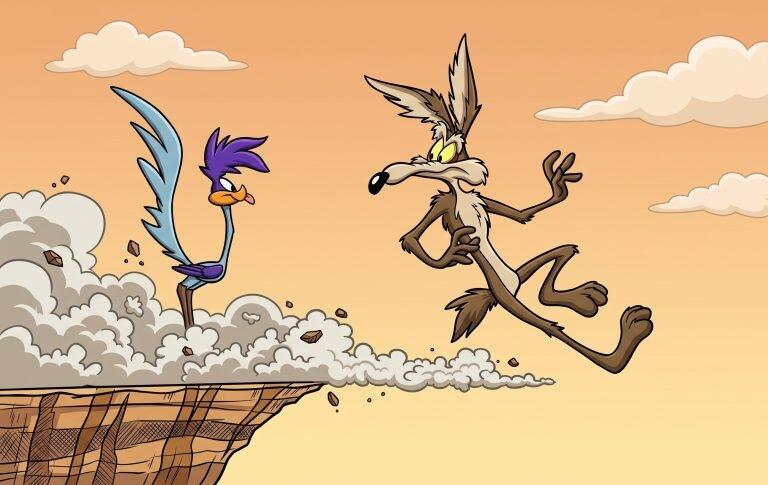
The Wile E. Coyote Moment is Now
Thus, as we watch the bond market die on a DC respirator while AI stocks gyrate in a profitless circle of over-investment and narrative changes which will most likely require government regulation to mote/protect the hyper-scalers and over-hyped AI providers from another 08-like catastrophe, I'm done warning of a broken U.S. credit and equity disaster on the horizon.
This is because the "Uh-Oh" moment is not coming; it's already here.
Based on the dispositive yet largely ignored signals from our anemic, concentrated and over-levered stock market; and based on our openly broken, unpayable bond market (not to mention the private credit time bomb) in search of a liquidity miracle or default policy that further debases our Greenback, the picture is clear.
Warsh, Bessent and Shelton are not going to save this credit market. Nor will Santa Claus or any other miracle trick. It's too late, folks.
In fact, the picture or image I have in mind takes me/us right back to the 1970's and those Saturday morning cartoons I alluded to above - and watched as a kid while Nixon and his successors set the current disaster in motion decades before I traded my first dot.com stock...
American credits, equities, monetary fantasies and ignored Main Street realities have already passed beyond the cliff. We now stare suspended above a fall that is no longer theoretical, but right below us.
Of course, in such moments, it's scary to look down, and thus almost no one does.