





Mali Govt Says Al-Qaeda Extremists In Region Receive Training, Drones From Ukraine
The Malian government announced on Thursday that militant groups with links to Al-Qaeda carrying out terror attacks in the country were trained and armed by Ukrainian specialists.
Fousseynou Ouattara, Vice President of the Defense Commission of Mali's Transitional Council, said authorities identified militants who received training in Ukraine to carry out operations using kamikaze drones produced by Kiev. "These young people are known, we have now added them to our lists, and we have their names," Ouattara said.

The militants fighting the Malian government belong to a Tuareg-led separatist group, the Azawad Liberation Front (ALF), and Jamaat Nusrat al-Islam wal-Muslimeen (JNIM), an extremist group linked to Al-Qaeda.
He added that the militant groups are receiving fighters from Algeria, Mauritania, and Libya, as well as training from members of the French Foreign Legion and Ukrainian instructors.
France is allegedly supporting the ALF and JNIM following the Malian government's removal of French troops in 2022. In their place, private military contractors from Russia's Wagner Group were deployed.
After a May 2021 coup in Mali, the country's military junta officially demanded that France withdraw its troops "without delay." French troops had been present in Mali for nine years, allegedly to fight the Al-Qaeda-linked insurgency.
Mali was a French colony known as French Sudan before it gained independence as the Republic of Mali in 1960. However, France has sought to reassert its influence in Mali and in neighboring Burkina Faso and Niger, which are also former French colonies.
In September 2023, the military leaders of Mali, Niger, and Burkina Faso established the Alliance of Sahel States (AES), which established a partnership with Russia.
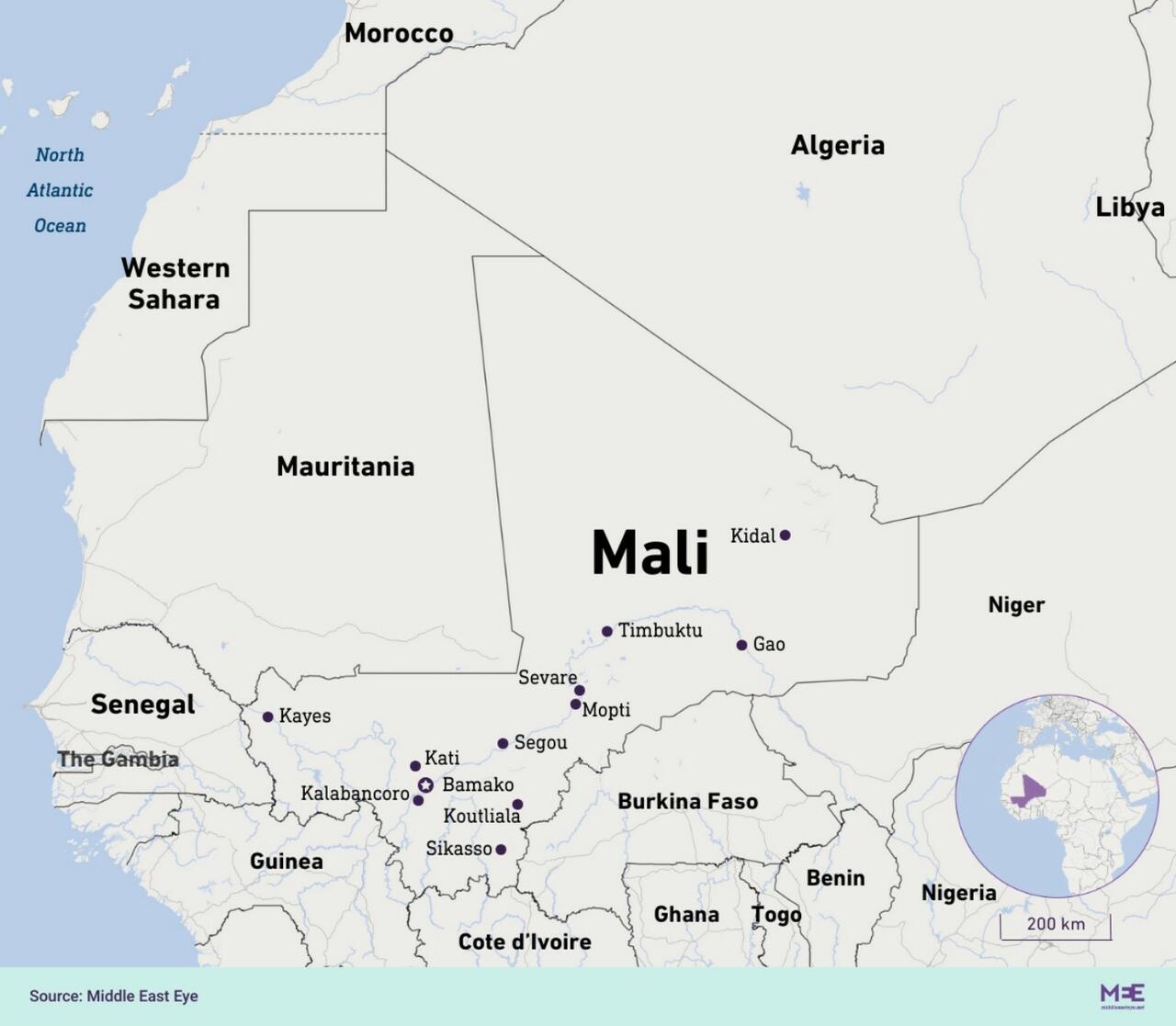
Fighting between the Malian army and the ALF and JNIM has escalated in recent weeks. On July 7, the Malian army released a statement saying that "more than 200 terrorists were neutralized during coordinated air and ground operations" conducted in the village of Anefis in the northern Kidal region. The army statement noted that the operation was conducted in response to attacks by armed groups on military positions.
On July 4, Mali's Ministry of Defense and Veterans Affairs announced that militant groups attacked army positions in Aguelok, Anefis, Gao, Kenioroba, Konna, Sevare, and Somadougou.
Clashes with the militants reportedly continue near Anefis, where a major Malian military base is located. On Wednesday, Russian Foreign Minister Sergey Lavrov and his AES counterparts held a meeting in which they condemned destabilization campaigns supported by Ukraine and France.
Russia and the AES agreed to expand military cooperation, with Moscow pledging additional support to strengthen the operational capabilities of the armed forces of AES nations.
The foreign ministers of Russia, Mali, Niger, and Burkina Faso described the recent militant attacks on AES countries as "barbaric and ignoble" acts threatening regional stability.
"The two sides firmly condemned such destructive actions aimed at undermining the sovereignty of the AES and regional stability," they said.
The ministers also acknowledged the efforts of troops from AES member states in repelling "terrorist attacks," as well as the contribution of Russia's African Corps to counterterrorism operations in the Sahel.
The Russia-AES meeting took place as French President Emmanuelle Macron visited Syria to meet President Ahmad al-Sharaa, the former Al-Qaeda and ISIS commander. During the 14-year war to topple former Syrian president Bashar al-Assad, France joined the US and its allies in supporting Sharaa's Nusra Front, which finally took power in Damascus in 2024.