





"Their Own Country": Quebec Elects Separatists Vowing To Break From Canada
Quebec's separatists are returning to government with a promise to take the province out of Canada, reopening a battle over the country's future while Ottawa is already locked in a trade war with Washington.
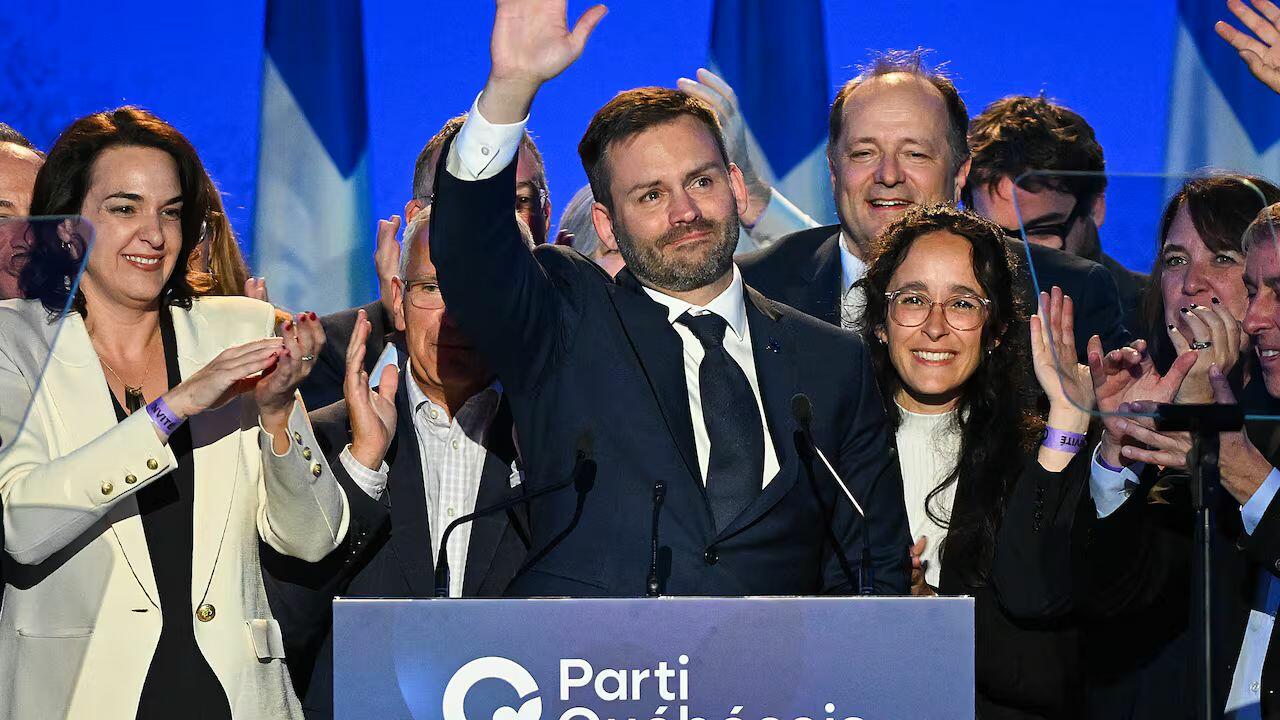
Monday's victory for the Parti Québécois puts the independence movement back in power for the first time since 2014. Its leader, Paul St-Pierre Plamondon, has promised another referendum on separation. And he used his victory speech to remind Canadians exactly what he intends to achieve.
"The courageous battle of Francophones to protect their language and culture will succeed when they have their own country," he said, according to Politico.
Hours later, writing in French, he framed the night less as a mandate for a breakup than as a recovery of confidence. The government, he said, would "extend a hand." He would be "the premier of ALL QUEBECERS, without exception." He closed with Gaston Miron: "It cannot always not happen."
Je veux vous partager l’immense sentiment de fierté qui m’habite. Les mots me manquent pour vous dire à quel point, ce soir, je suis fier d’être Québécois.
— Paul St-Pierre Plamondon (@PaulPlamondon) October 6, 2026
Ce qui me rend le plus fier, au terme de cette extraordinaire campagne que nous avons menée, c’est de voir que nous avons redonné le goût de l’avenir et le goût du Québec à des centaines de milliers de Québécois qui avaient cessé d’y croire. Juste ça, juste retrouver l’espoir et l’optimisme, ça fait vraiment du bien.
Aux quatre coins du notre grand pays, j’ai aussi vu des gens qui, malgré toutes les raisons du monde qu’on leur a servi pour les convaincre de céder à la peur, ont plutôt choisi l’espoir et le changement.
J’ai vu des Québécois qui ont fait le choix de croire en eux-mêmes, qui ont fait le choix de se faire confiance.
Être élu premier ministre du Québec est un énorme privilège et une énorme responsabilité, que je prends avec beaucoup de modestie.
Le Parti Québécois formera un gouvernement qui tendra la main. Je serai le premier ministre de TOUS LES QUÉBÉCOIS, sans exception.
Il y a quatre ans, lors de cette même soirée électorale, nous nous étions laissés sur les mots de l’un de nos plus grands poètes, Gaston Miron. Je vous avais dit que nous étions « arrivés à ce qui commence ».
Aujourd’hui, je veux à nouveau citer Gaston Miron, le cœur rempli d’espoir, en vous disant la chose suivante :
« Ça ne pourra pas toujours ne pas arriver. Nous entrerons là où nous sommes déjà, car il n’est pas question de laisser tomber notre espérance ».
For Prime Minister Mark Carney, the stakes extend well beyond a difficult relationship with another provincial premier. A government committed to leaving the federation will now have the premier's office and a public platform from which to make its case. Disputes over immigration, economic assistance and provincial authority could become arguments over whether Quebec belongs in Canada at all.
The timing compounds the problem. Alberta is also approaching a vote this month on whether to hold a separation referendum. The two movements have different roots, but both challenge Ottawa's effort to present a united country while confronting Donald Trump's tariffs.
That contrast was immediate on social media. One widely shared reaction congratulated Carney for a civil note to the new separatist premier, then asked why Alberta's signature campaign for its own vote has been treated as disloyalty.
⚜️?️??? : Mark Carney congratulates Paul St-Pierre Plamondon & the separatist Parti Québécois on their victory in the Quebec election last night.
— Bruce McGonigal (@bruce_mcgonigal) October 6, 2026
Albertans who collected the legally required number of signatures to have a referendum on Alberta separation, have been called traitors to Canada.
The Alberta referendum on Oct, 19th will be non binding. Unlike all the previous Quebec separation referendums.
If there ever was proof of how abusive Canada is to Alberta & how much of a double standard there is for Quebec, this is it.
Quebec has handed the separatists the opportunity to build support for a breakup. They still have to win that argument.
St-Pierre Plamondon's party took roughly 28% of the vote and 59 seats, five short of a majority in the 127-member National Assembly. Polls put support for independence at about 30%, according to the BBC. The incoming premier has a minority government and a central political objective most voters have yet to embrace.
That vote share is not a rounding error. It is, by one Montreal account, the lowest ever recorded by a party forming a Quebec government. The seat map tells the same fractured story: Liberals doubled their caucus, the Conservatives entered the National Assembly for the first time, Québec Solidaire held nine seats, and the outgoing Coalition Avenir Québec was wiped out.
The PQ won the election with just 28% of the popular vote — the lowest in Quebec history cultmtl.com/2026/10/the-pq…
— Cult MTL (@cultmtl) October 6, 2026
#polqc
Good morning! Quebec returned to the polls yesterday to elect members of its National Assembly. The sovereigntist Parti Québécois won the election, though short of an outright majority.
— Michael ? (@_JeanLannes) October 6, 2026
The second-place Liberal Party doubled its seat total from 2022, mainly through gains in the Montérégie and Laval regions. The Conservative Party will make its first appearance in the National Assembly, winning 19 seats from the Capitale-Nationale and Chaudière-Appalaches regions.
These gains came at the expense of the left-wing Québec Solidaire, which lost support in every region except Montréal. The governing Coalition Avenir Québec will no longer have any representation in the National Assembly. In 2022, the party won roughly 70% of the seats and 41% of the vote.
But the confrontation with Ottawa need not wait for a referendum.
St-Pierre Plamondon has vowed to resist federal pressure for increased immigration. He has also promised to "abolish the monarchy in Quebec," proposing to redirect funding from the lieutenant-governor's office toward social causes such as homelessness.
"We are going to do what we have to do to get the monarchy out of Quebec, repatriate those funds, and send them to social causes," he told reporters during the campaign.
The lieutenant-governor represents King Charles III and provides royal assent to provincial legislation. Trying to strip funding from that office would invite significant legal challenges, the BBC reported. St-Pierre Plamondon has said he is prepared for a legal battle.
Such a clash could give the separatists a way to argue that even Quebec's decisions about its own institutions remain subject to a constitutional arrangement it should escape.
That is the strategy anticipated by André Pratte, chair of the Quebec Liberal Party's policy committee. In an opinion column, he argues that the PQ will use confrontations with Ottawa to cultivate nationalist sentiment and demonstrate that federalism cannot serve Quebec's interests.
Pratte is a partisan opponent of the separatists. But the dilemma he describes is real enough: cooperation gives Carney an opportunity to show that Canada works; confrontation gives the PQ an opportunity to argue that it doesn't.
Canadians have seen how far that argument can travel.
Quebec rejected sovereignty in 1980 and again in 1995. The second referendum brought the country within a narrow margin of a vote for separation: the No side won 50.58% of valid ballots, prevailing by just 54,288 votes.
A future Yes victory would open a difficult negotiation rather than automatically create a country. Canada's Supreme Court held in 1998 that a clear majority on a clear secession question would create an obligation to negotiate. Quebec could not unilaterally dictate the terms of its departure.
For now, the immediate economic pressures give both governments reasons to cooperate.
An August 24 analysis by National Bank estimated Quebec's average U.S. tariff burden at roughly 11%, the highest among Canadian provinces, compared with about 6% nationally under the measures it examined. Its exposure to metals, manufacturing and forestry makes the trade conflict particularly painful.
Carney emphasized that immediate agenda on Tuesday, saying he had spoken with St-Pierre Plamondon about infrastructure funding and support for workers hit by U.S. tariffs, the Associated Press reported.
"This is not a time to wait for something a few years down the road. It's the time to act," Carney said.
He had already put the same offer in writing overnight, congratulating the premier-designate and steering the conversation toward tariffs, jobs, homelessness and housing. The referendum did not appear in the note.
Congratulations, Premier-designate @PaulPlamondon, on your election victory.
— Mark Carney (@MarkJCarney) October 6, 2026
Building a stronger Québec is core to our mission of building a stronger Canada. I look forward to working with you to support Québec’s businesses and workers impacted by tariffs, create more good jobs, work to end homelessness, and get more homes built across Québec.
Thank you, Premier @CFrechette, for your service to Québec and to Canada. We got a lot done together — from Churchill Falls to one of the largest infrastructure investments in Québec’s history. I wish you all the best in what comes next.
PM Carney speaks with reporters ahead of Cabinet meeting about the Quebec election: "It's a crucial time for Quebec. It's a crucial time for our country. This is not a time to wait for something a few years down the road. It's a time to act. It's a time for boldness."
— Scott Robertson (@sarobertson_) October 6, 2026
The PQ, meanwhile, must persuade voters that independence would improve their prospects while businesses are already struggling with uncertainty across the American border.
And the election that brought the separatists back was also a devastating repudiation of the government they are replacing.
The Coalition Avenir Québec, in power since 2018 after winning consecutive majorities, failed to win a single seat. Replacing François Legault with Christine Fréchette in April could not rescue it. Fréchette lost her own riding.
Voter fatigue, troubled health care reforms and bungled government investments helped destroy the CAQ's standing, Politico reported. The PQ, which won just three seats in 2022, capitalized on that collapse.
Quebec's fragmented five-party race allowed it to win with roughly 28% of the vote, a share the Globe and Mail described as the lowest ever for a winning party in the province's electoral history.
Still, there is a potential parliamentary path to a referendum. The left-wing, pro-independence Québec Solidaire won nine seats. Together with the PQ's 59, that would make 68, above the 64-seat majority threshold.
The provincial Liberals, who won 40 seats, have drawn a firm line. Leader Charles Milliard said they could support the incoming government on various issues, but "there is no way we will collaborate on a potential referendum," the BBC reported.
PQ supporters are pointing to the roughly 40% combined vote for their party and Québec Solidaire. But support for parties offering a range of policies cannot simply be counted as support for secession.
St-Pierre Plamondon has also pledged to wait until Trump leaves office before holding the referendum, saying it requires "conditions that allow for an informed and serene debate." That points to a possible vote in 2029 or 2030, provided his government survives long enough to deliver it.
Before asking voters to create a country, he will have to pass budgets, retain parliamentary support and run a province whose previous government was just annihilated at the ballot box.
Carney's task is to show that staying in Canada delivers for Quebec. St-Pierre Plamondon's is to persuade Quebecers that they need a country of their own.