





The AI Rally Trapdoor Just Swung Open Violently
Submitted by QTR's Fringe Finance
Last week, I wrote a piece titled “It’s Official: The AI Emperor Has No Clothes,” arguing that the artificial intelligence bubble was approaching the point where investors would be forced to confront the financial reality underneath years of hype, circular financing and absurd valuations.
A couple of weeks earlier, I had predicted that the AI bubble would begin to burst within the next six to ten months. My argument was that the equity market was still pricing in a technological utopia while the bond and credit markets were beginning to recognize that the infrastructure buildout had gotten wildly ahead of itself.
Less than two weeks later, the evidence supporting that thesis is piling up.
The catalyst for my September 29 article was the disclosure of Anthropic’s 2025 financial statements, which finally gave investors a meaningful look underneath the hood of one of the most celebrated companies in AI. Anthropic reportedly generated approximately $4.6 billion in revenue during 2025 while recording more than $8 billion in operating losses and spending $7.33 billion on compute and infrastructure alone. Perhaps most astonishingly, the company had reportedly committed to approximately $518 billion in future cloud, computing and infrastructure obligations.
I argued that these disclosures exposed the enormous disconnect between the revenue these businesses were producing and the hundreds of billions of dollars being committed to support their growth. Investors had spent years waving away concerns about profitability with the promise that AI would eventually change everything, but we were finally beginning to get the numbers necessary to determine whether the economics could support that promise.
And today, another enormous piece of that puzzle fell into place.
According to a new report from the Financial Times, OpenAI’s annualized revenue at the end of September was approximately $50 billion, roughly $20 billion below the $70 billion figure investors had been led to expect. Earlier reports had placed annualized revenue around $40 billion in August, and subsequent indications of growth exceeding 70% helped produce the larger estimate. New financial information reportedly puts the figure closer to $50 billion, while OpenAI declined to comment.
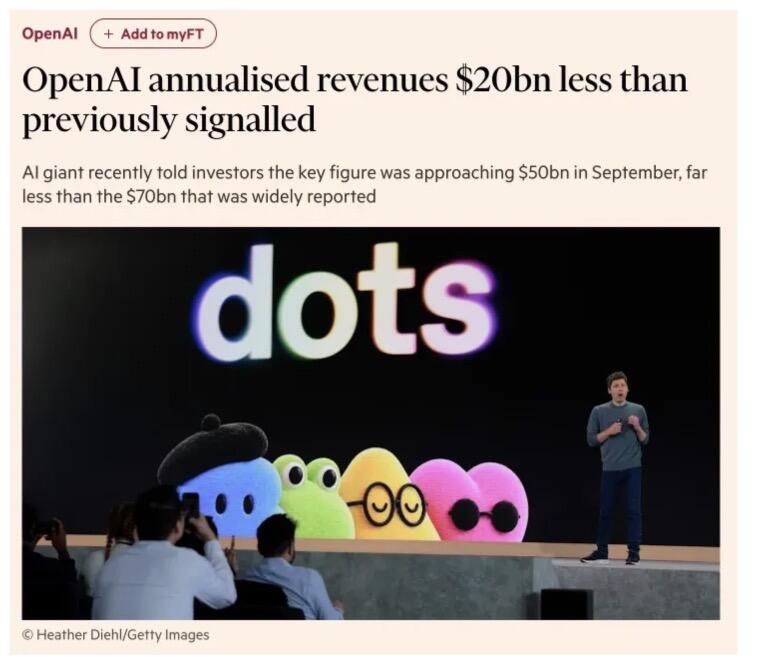
$50 billion in annualized revenue is still an enormous number, and the difference between an inferred revenue estimate and an actual reported run rate isn’t necessarily the same as missing formal guidance. But that distinction doesn’t eliminate the broader problem: expectations surrounding this industry have become so enormous that even extraordinary growth may not justify the amount of capital already committed to it.
This is the point I’ve been making for months. The problem isn’t that artificial intelligence doesn’t work or that nobody wants to use it. The problem is that Wall Street has constructed a financial fantasy around the technology that assumes practically unlimited future demand, extraordinary monetization, perpetually available financing and an uninterrupted willingness among investors to fund infrastructure projects whose eventual returns remain uncertain.
And nowhere is that problem more dangerous than at OpenAI, which sits at the center of what may be the most extraordinary financial circlejerk in modern market history, neatly displayed in this chart from Zero Hedge, who noted total that OpenAI has $1.5 trillion in commitments ahead of them:
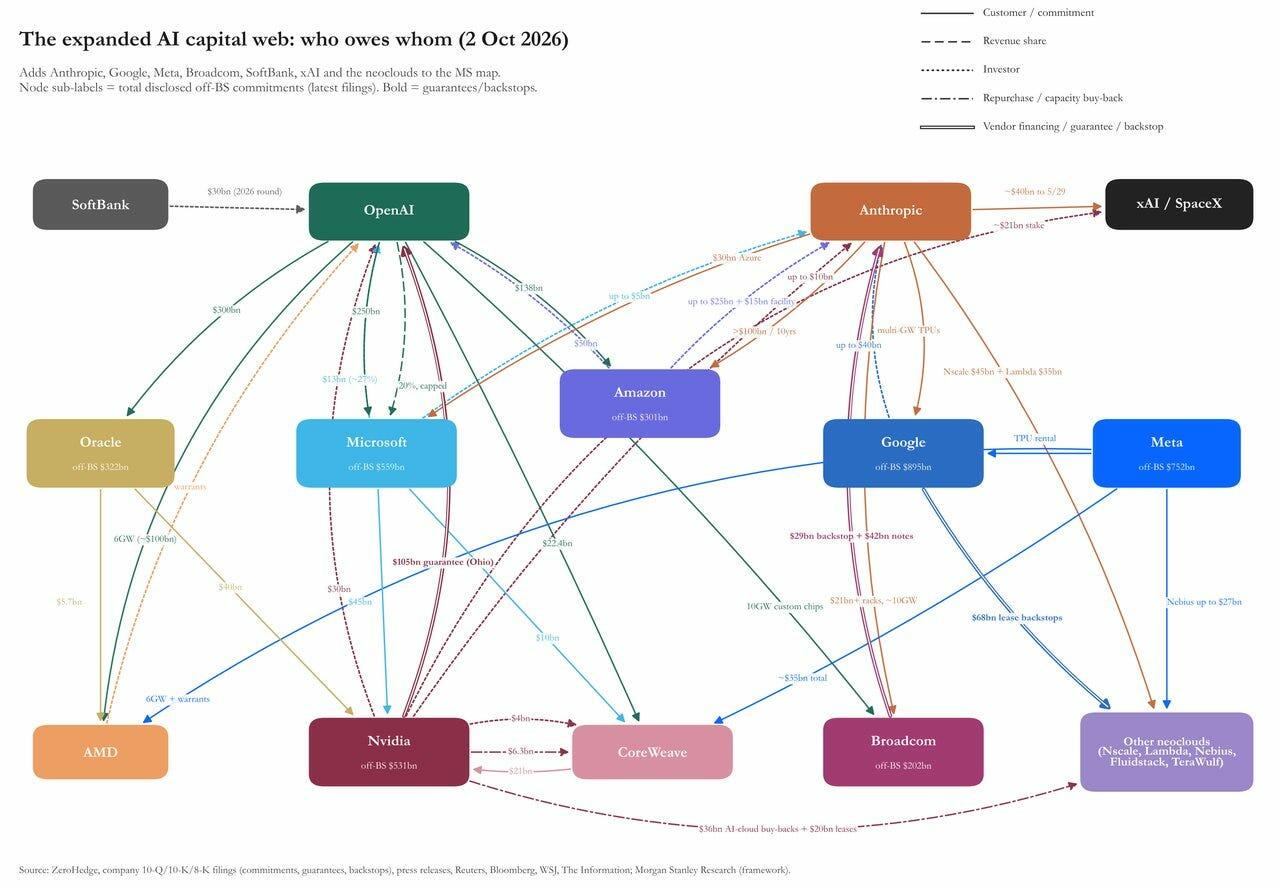
AI developers need enormous quantities of computing power, so they enter into massive agreements with cloud providers and infrastructure companies, which in turn purchase billions of dollars of equipment from Nvidia and other suppliers.
Infrastructure providers finance construction through debt, equity and increasingly complicated arrangements, while some of the same companies supplying equipment or infrastructure are also investing in the AI developers expected to purchase their products and services.
Money moves from investors to AI companies, from AI companies to infrastructure providers, from infrastructure providers to chipmakers, and sometimes from those chipmakers and their partners right back into the ecosystem. There are legitimate commercial transactions throughout this chain, but also extraordinary financial interdependence, with everybody using everybody else’s projected growth to justify their own spending.
This is where the trapdoor opens. If OpenAI’s revenue trajectory falls short of expectations, the implications extend far beyond OpenAI itself.
Infrastructure providers must reassess expansion plans, lenders must reconsider project creditworthiness, equipment suppliers must question future demand assumptions and investors who were previously willing to finance practically anything with AI attached to it may suddenly demand evidence of actual returns.
The same companies that spent years enthusiastically committing hundreds of billions of dollars to one another may eventually find themselves scrambling to collect payments, renegotiate contracts, reduce commitments and protect their balance sheets. We started seeing this last week with Oracle declaring a force majeure on a $165 billion data center project: Force Majeure Is Not A City In France
Everybody starts asking who owes whom, which obligations are enforceable and who ultimately bears the losses if projected demand fails to materialize. This is how a self-reinforcing investment boom becomes a self-reinforcing contraction, and it doesn’t necessarily matter how revolutionary the underlying technology is. A company can have a phenomenal product and still be a terrible investment, just as an industry can change the world while destroying enormous amounts of capital along the way.
And almost as if the market wanted to illustrate the point, another headline crossed the tape today: Nvidia-backed Australian AI infrastructure company Firmus is facing the possibility of postponing or abandoning its massive IPO after investor demand failed to materialize at the proposed valuation, according to Bloomberg.
Firmus had been attempting to raise as much as $5.5 billion at a valuation of approximately A$43.7 billion, or more than $30 billion in US dollars. The company closed its order book Thursday amid uncertainty over pricing and structure, with investors reportedly unwilling to support the original A$11 share price ahead of a planned October 23 debut.
The situation is particularly interesting because Firmus has the backing of Nvidia and Blackstone, precisely the names that until recently would have generated enormous excitement around practically any AI infrastructure investment. Yet investors are apparently beginning to examine the economics, debt, construction requirements and extraordinary valuations being assigned to projects that largely haven’t been completed.
🔥 85% OFF FOREVER IF YOU SUBSCRIBE TODAY: I am again offering an 85% discount to anyone that wants to become a Fringe Finance annual subscriber today. It’s a discount you can keep and stays applied for as long as you wish to remain a subscriber: Get 85% off forever
Reuters Breakingviews reported that Firmus had built only about 42 megawatts of its planned one-gigawatt capacity, while The Guardian reported that approximately 97% of the company’s revenue was tied to projects yet to be built. We are talking about a company seeking a valuation in the tens of billions of dollars, backed by some of the biggest names in technology and finance, whose future economics depend overwhelmingly on infrastructure that doesn’t even exist yet.
And suddenly investors are beginning to question whether they should pay the asking price. Imagine that.
The timing is remarkable. On the same day investors learn that OpenAI’s annualized revenue is materially below widely circulated expectations, a prominent Nvidia-backed infrastructure offering is struggling to attract sufficient capital at its proposed valuation.
These developments aren’t necessarily causally related, but they are consistent with the same underlying problem: the amount of money being committed to the AI future has become increasingly disconnected from the cash flows available to support it today.
And the credit markets have been screaming that this was coming.
In my September 29 article, I pointed out that the bond and credit markets were already recognizing risks that equity investors seemed determined to ignore. Oracle had issued a force majeure notice connected to its massive Project Jupiter AI data center development in New Mexico, highlighting the physical and logistical challenges involved in building infrastructure on this scale. Oracle subsequently maintained that the project remained on schedule, but the episode illustrated that these projects require actual electricity, land, equipment, financing and construction, none of which can be conjured into existence by an investor presentation.
Meanwhile, Oracle’s credit default swaps had surged, with yields on some of its long-dated debt moving above 8%. Apollo Chief Economist Torsten Slok had highlighted widening CDS spreads among hyperscalers, while LSEG data showed an explosion in credit default swap trading tied to major technology companies. Nvidia’s single-name CDS trading volume had reportedly increased from approximately $640 million during one six-month period to $6.9 billion during the next, while Broadcom’s volume climbed from roughly $1.5 billion to $8.2 billion.
As I wrote at the time, credit default swaps are insurance, and although increasing trading activity doesn’t automatically mean a collapse is coming, it does suggest investors are paying considerably more attention to credit risks surrounding the AI investment boom.
I’ve argued that the next six to ten months could mark the beginning of a significant unwind in the AI bubble, and nothing I’ve seen since making that prediction has persuaded me to change my mind. I don’t know which company will first materially reduce its commitments, which lender will decide it has had enough exposure or which enormous infrastructure project will finally be deemed uneconomic. But when an industry becomes dependent on perpetual access to cheap capital, ever-increasing valuations and increasingly ambitious revenue projections, the moment those assumptions change can be extraordinarily unforgiving.
The process often begins with skepticism and repricing, followed by the realization that contracts, commitments and financing arrangements were built around expectations that may never materialize on the original timetable. Eventually comes the scramble for liquidity, when everybody who thought they owned an enormously valuable asset discovers that everybody else is trying to sell or collect at the same time.
That is the trapdoor I’m worried about. The entire AI ecosystem has spent years celebrating one another’s investments, contracts, partnerships and projected revenues as though money circulating between the same handful of companies represents an inexhaustible source of genuine economic demand. Eventually, somebody outside that circle has to generate enough economic value to pay for the whole thing, and if that value doesn’t arrive quickly enough, the financial structure can unravel long before the technology reaches its full potential.
Less than two weeks ago, I wrote that the AI emperor had no clothes and wondered who would be the first to stand up and say it. Now the financial statements are coming out, revenue expectations are being revised, the IPO market is pushing back and the credit markets have already been sounding the alarm.
The technology may very well be revolutionary, but that doesn’t mean the price Wall Street has assigned to the revolution makes any sense.
And if I’m right about where we’re heading over the next several months, the most important question won’t be how much money everybody thought they were going to make from AI, but how much money everybody owes everybody else when the music stops.
QTR’s Disclaimer: Please read my full legal disclaimer on my About page here. This post represents my opinions only. In addition, please understand I am an idiot and very often get things wrong and lose money. I may own or transact in any names mentioned in this piece at any time without warning, meaning if I’m long I could sell or if I’m short I could cover at any time. Positions can change immediately. This is not a recommendation to buy or sell any stocks or securities, just my opinions. I often lose money on positions I trade/invest in. I may add any name mentioned in this article and sell any name mentioned in this piece at any time, without further warning.
I also may or may not own names I write about and are watching. Sometimes I’m bullish without owning things, sometimes I’m bearish and own things I’m bearish on. Just assume my positions could be exactly the opposite of what you think they are just in case. If I’m long I could quickly be short and vice versa. I won’t update my positions.
I cannot guarantee the accuracy of any or all facts and figures included in this article though I made an effort to get them right. I have been wrong before and will be wrong again, and encourage you to always double check, do your own research and speak to a licensed financial professional, which I am not.
Contributor posts, guest posts and curated posts have been hand selected by me, but have not been fact checked and are the opinions of their authors. They are either submitted to QTR by their author or reprinted under a Creative Commons license with my best effort to uphold what the license asks, or with the permission of the author.
Since 2026, I have been making an attempt to no longer actively trade as much as I once did (read my story here). In an attempt to lead a healthier lifestyle, I’ve also excluded myself from most fantasy sports, sports betting, online and in-person casinos and prediction markets.
My goal is for my investing/saving to be done by recurring contributions mostly to sector ETFs and a few select equities, trusted third parties who oversee my accounts, and advisors. Such advisors or funds, through individual equities, options, index funds, mutual funds, ETFs, or other securities, may have positions in, exposure to, or holdings of names mentioned herein that I know nothing about. Basically, it is possible I could own, have exposure to, or not own anything, at any point.
You are on your own. Do not make decisions based on my blog. I exist on the fringe. Again, I get shit wrong a lot, both in the market and in life, but am trying my best. If you see numbers and calculations of any sort, assume they are wrong and double check them. I failed Algebra in 8th grade and topped off my high school math accolades by getting a D- in remedial Calculus my senior year, before becoming an English major in college so I could bullshit my way through things easier. Hence, I am a writer. I write these posts after a couple beers sometimes. Many times I edit after my posts are published because I’m impatient and lazy, so if you see a typo, check back in a half hour. Thanks, you’ve been a great crowd and don’t forget to tip your servers.