


Bearish Beyond The 'Blue Wave' Bounce
Submitted by QTR's Fringe Finance
Well, the voters have spoken. Screamed, actually. And if last night’s election results were supposed to provide some kind of reprieve for the Trump administration, they did precisely the opposite. Democrats delivered a decisive, sweeping victory, taking control of both the House and Senate and flipping seats in places Republicans have considered safe for generations.
“Democrats are on track to win the largest House majority since 2008, when they won 257 seats,” Alicia Parlapiano of the New York Times wrote this morning.
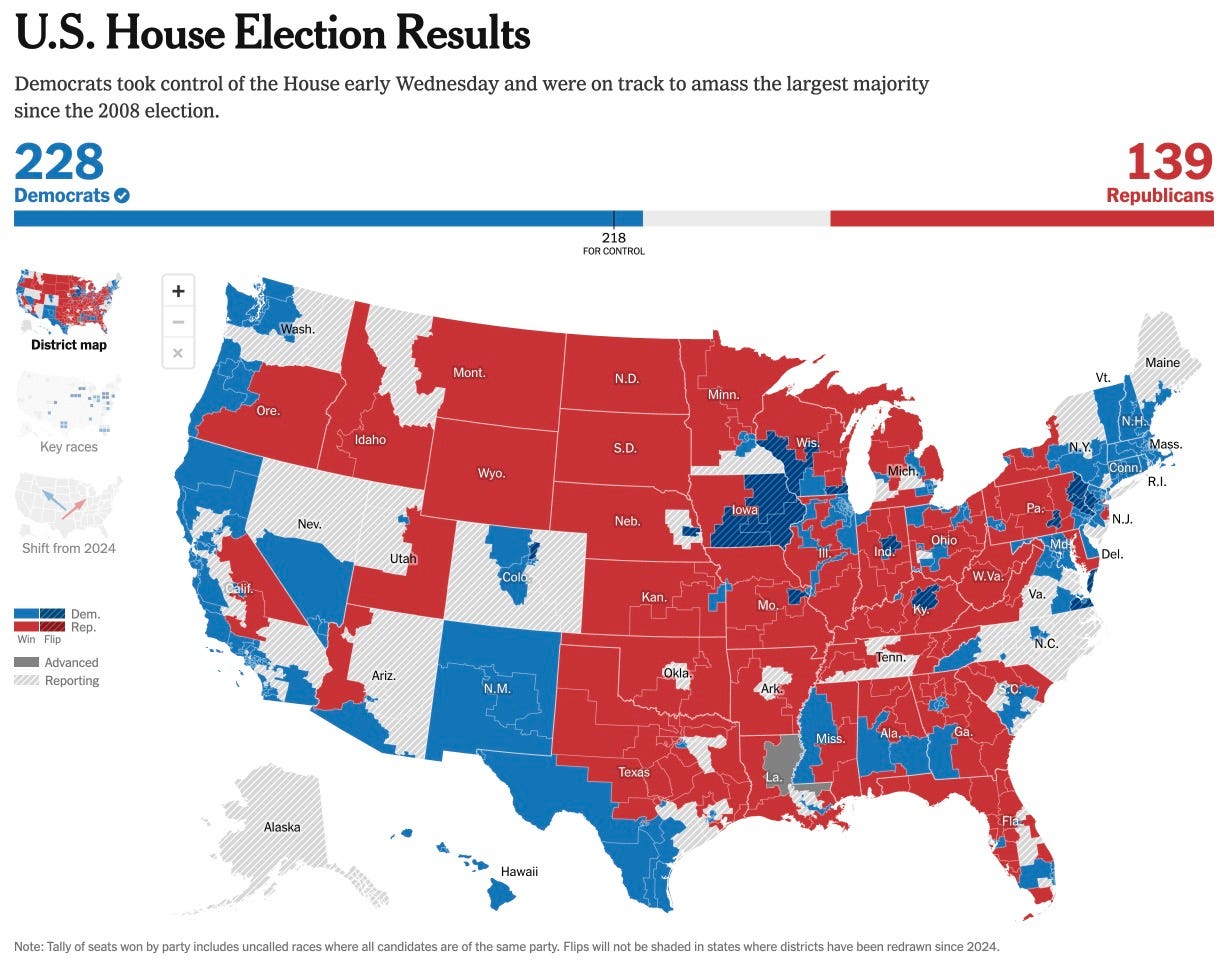
Chart: NY Times
Perhaps most remarkable was Texas, where Democrats captured the governorship and a U.S. Senate seat, an extraordinary political development in a state that has become central to the country’s energy, technology and industrial infrastructure.
The result is a Democratic Congress, a Republican president whose legislative agenda is now effectively on ice, and a political environment that looks dramatically different than it did 24 hours ago.
Whatever you think of the results politically, the implications for markets, regulation and corporate America are going to be significant, as I have been writing about for the last month.
The market’s initial reaction reflected exactly that. Nasdaq futures plunged more than 2% overnight as the scale of the Democratic victory became apparent, with investors suddenly confronting the prospect of a very different regulatory and political environment.
But in a remarkable reversal, futures have since clawed back their losses and, as I write this before the opening bell, are being quoted around 1% higher. That’s a roughly three-percentage-point swing in a matter of hours.
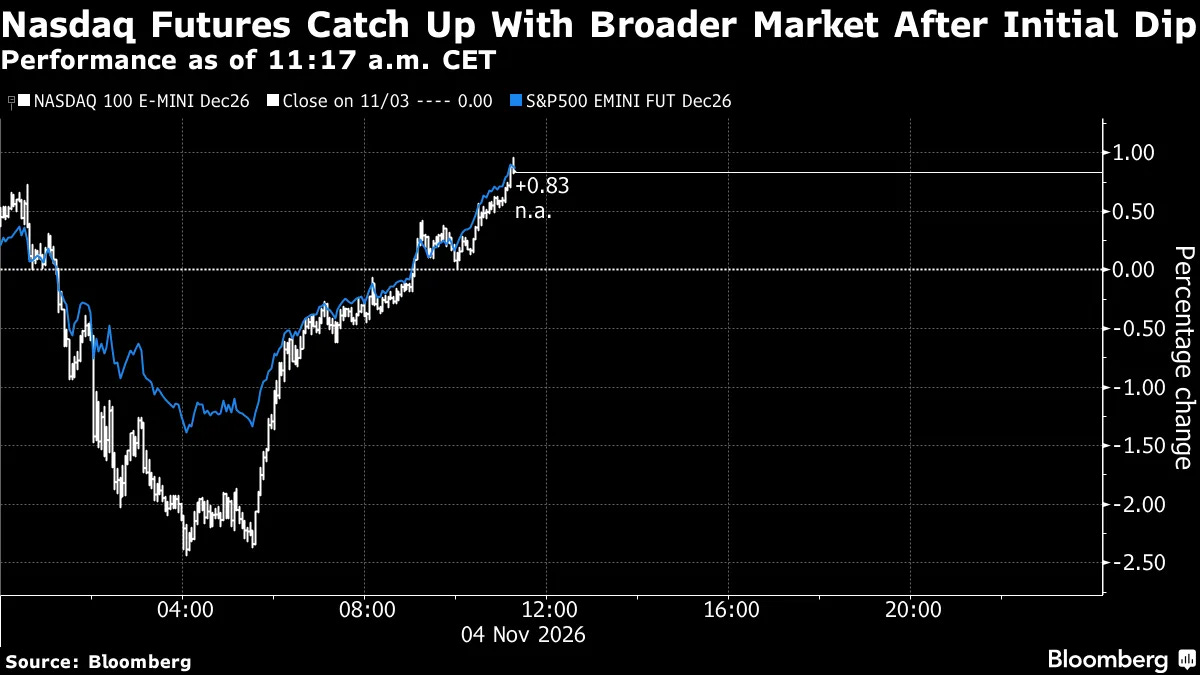
In other words, the market initially appeared to hate the results, then decided it loved them. Or, as I’ll explain, perhaps neither interpretation is entirely correct.
The initial selloff, in my opinion, was perfectly rational. In fact, it reflected many of the risks I’ve been writing about for weeks. Look at Texas, for example. A political transformation there could have enormous consequences for the data-center buildout, particularly as electricity demand, water consumption, infrastructure spending and local opposition have become increasingly contentious issues.
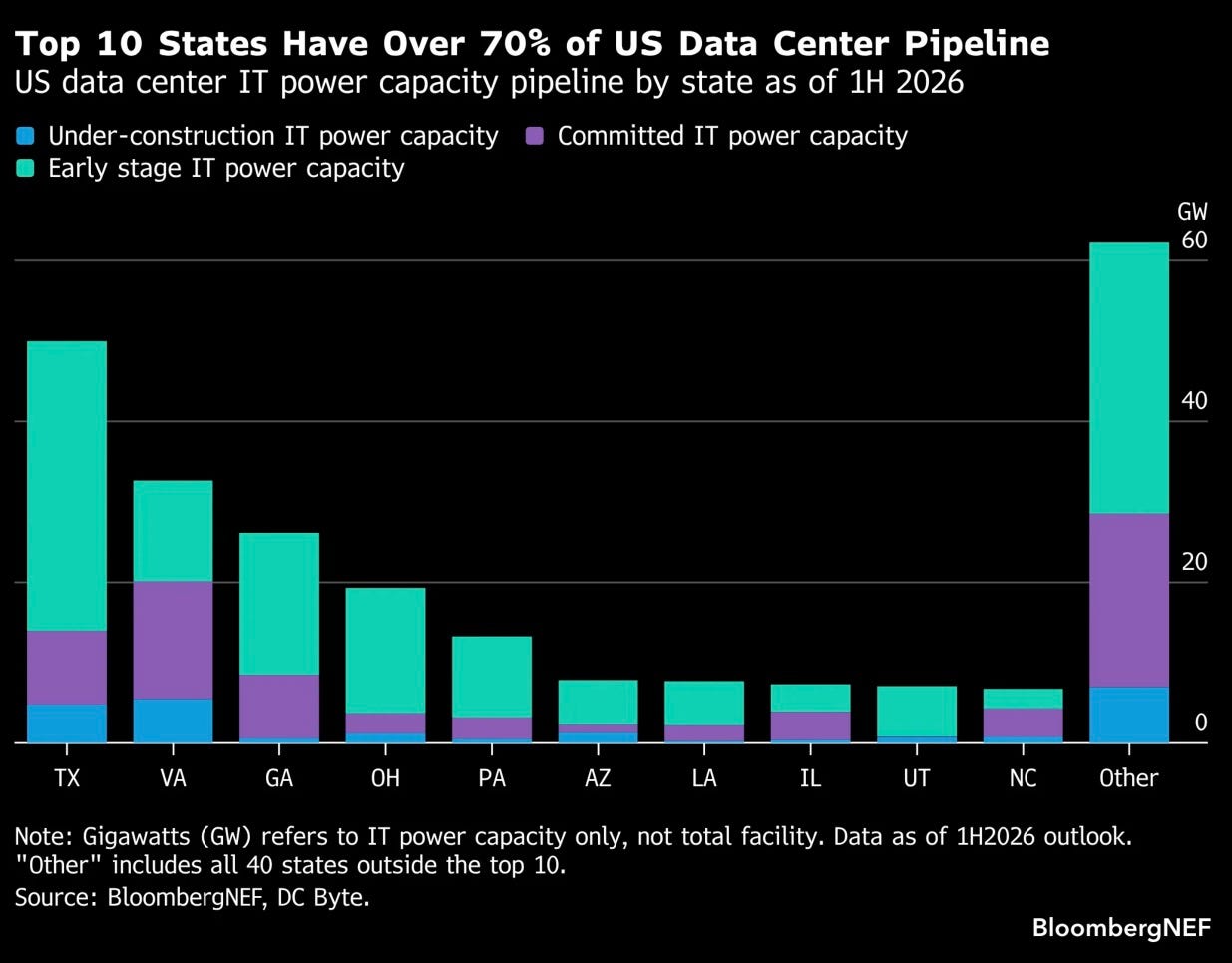
Charts: Bloomberg
Gordon Johnson of GLJ Research believes that roughly 13 gigawatts of announced Texas data-center projects could face delays under a Hinojosa administration, with many potentially pushed back 12 to 18 months if she follows through on her proposed permitting moratorium. Texas accounts for roughly a quarter of all U.S. data-center capacity expected to come online by 2030, making this no small development.
Importantly, Johnson notes that Abbott already imposed a permitting pause, but while investors expected that pause to be lifted following a December audit, Hinojosa could simply keep it in place.
As Johnson puts it, “Delay isn’t death, but it is a higher cost of capital, and that’s what the equities will feel first.” And with the AI trade already facing enormous capital expenditures, elevated financing costs and increasingly questionable returns, I think this is precisely the kind of additional headwind the market can ill afford.

The state has been one of the central pillars of the AI infrastructure boom, and a less accommodating political environment could make that buildout more expensive, more complicated and slower.
Then there’s Elon Musk, whose companies have benefited enormously from a favorable political and regulatory backdrop. I’ll get to him in a moment. Nationally, Democratic control of Congress introduces the prospect of more aggressive oversight of cryptocurrency, banking, private credit, technology and a host of other industries that have spent the last couple of years operating with considerably more political latitude than they might otherwise have enjoyed.
But before anybody starts celebrating this morning’s rebound as evidence that the election was bullish, I think it’s worth considering a different explanation. Johnson, in a note this morning, offered what I think is an excellent explanation for the market’s reversal:
Futures are higher this morning. Before anyone credits last night’s results, consider that this open was largely determined before a single vote was counted.
The VIX closed above 20 yesterday. That is not a market expressing a view. It is a market paying up to insure against a known, binary event with a fixed expiration. Event premium has a shelf life. Once the event resolves, the uncertainty being priced disappears regardless of the outcome, implied vol collapses, and the hedges come off. Dealers buy back their short deltas, vol-targeting strategies add exposure, and index futures get bid. This is plumbing, not conviction.
To put it plainly: stocks were going to open higher no matter who won. I’d be careful about building a narrative around a hedging unwind. The more informative signal comes once the vol crush has run its course, when price action has to stand on fundamentals rather than on the mechanical repricing of a risk that no longer exists.
I think he’s right to distinguish between a market mechanically unwinding its election hedges and a market suddenly deciding the future looks brighter.
When investors spend days buying protection against a known event, and that event finally passes, a significant amount of that protection becomes unnecessary. The resulting repositioning can push equities higher without a single underlying fundamental having improved. In other words, today’s rally may tell us a lot more about shorter term positioning than it does about longer term economic outlook.
There’s also the gridlock argument, which I expect bulls will spend much of today repeating. Historically, Wall Street has often welcomed divided government because it reduces the likelihood of sweeping legislative changes and introduces a degree of predictability. JPMorgan Asset Management highlighted ahead of the election that the S&P 500 has risen in the 12 months following every midterm election since 1950.
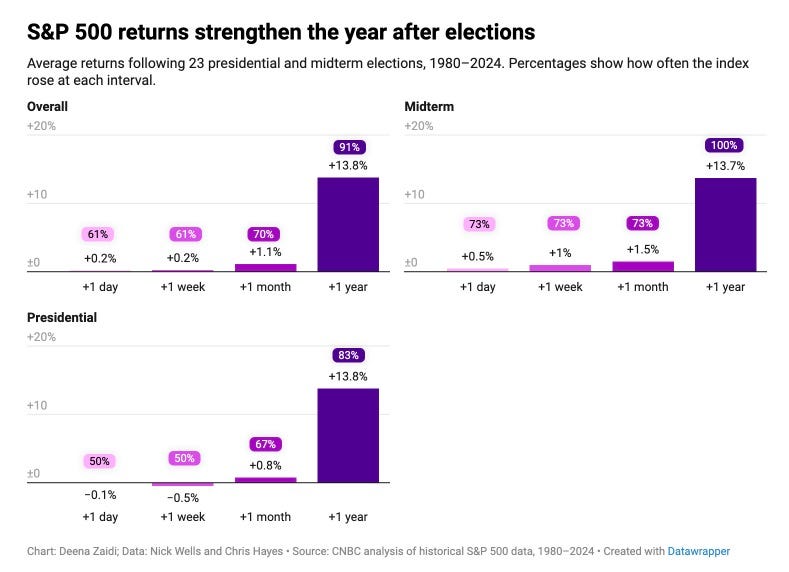
That’s a remarkable historical pattern, and one that will undoubtedly get plenty of airtime today. The conventional wisdom is that political gridlock is good for stocks because Washington is less capable of doing anything dramatic. But there’s a difference between a market benefiting from political stability and a market using political gridlock as an excuse to ignore deteriorating fundamentals. And I think this morning we’re seeing some of the latter.
As I’ve written over the last several days, volatility shouldn’t surprise anybody here. Markets don’t simply go straight down when a speculative cycle begins to cool. They rally, they squeeze shorts, they punish bears, they manufacture optimism, and occasionally they do all of those things in a single trading session. That’s the nature of the beast. So if today’s early enthusiasm turns into a full-blown relief rally, I won’t be particularly surprised.
But when the smoke clears over the next couple of days, I continue to expect equities to resume their downward trend. Nothing that happened last night changed the fundamental reasons I’ve been bearish. In fact, I think the election strengthened several of them. Here’s a couple of my key thoughts into the back end of this week…
The Fed Just Got Permission To Do Its Job
One of the most important implications of last night, in my opinion, is what it means for the Federal Reserve. Whatever degree of political influence or pressure existed over monetary policy heading into the election, I think that pressure has now been substantially weakened. There’s bi-partisan blame, now, if Fed action crashes stocks.
Kevin Warsh has considerably less reason to concern himself with appeasing Trump than he might have had before last night, assuming that was ever a factor in the first place. With Democrats controlling Congress and the political balance shifting dramatically, the incentives have changed.
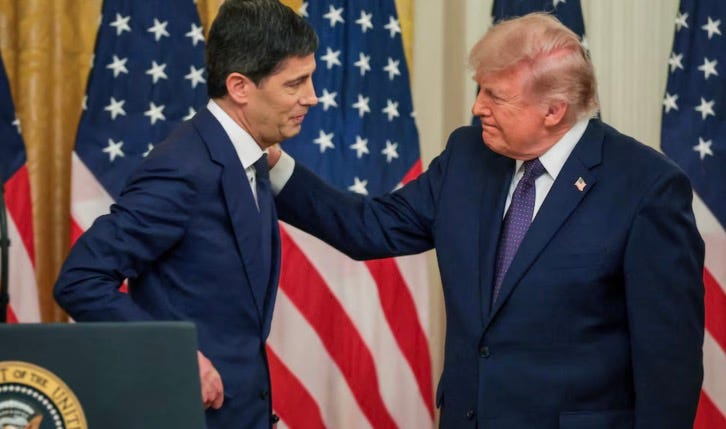
Put differently, this election may have given Warsh permission to actually do his job, to the extent he has been holding back. And if doing his job means keeping rates higher for longer because inflation remains a problem, then that’s exactly what I think markets should be preparing for.
The Fed doesn’t suddenly have to manufacture a friendlier monetary environment to accommodate the administration’s political ambitions. It can focus more squarely on inflation, employment and financial conditions.
Of course, Fed independence is supposed to exist regardless of who controls Congress. I’m talking about the practical political pressures surrounding monetary policy, not suggesting the Fed’s statutory mandate has changed overnight. As I’ve argued repeatedly, interest rates are one of the principal forces behind the AI trade beginning to crack: Bonds Are About To Crash The Stock Market
The entire AI infrastructure boom has been built around enormous capital commitments, increasingly aggressive spending assumptions and valuations that presume the cost of capital will eventually become more accommodating. Higher rates put pressure on every part of that equation. They make financing more expensive, reduce the present value of distant expected profits and force investors to ask harder questions about when hundreds of billions of dollars in AI spending will actually produce acceptable returns.
Now add a potentially less accommodating regulatory environment for data centers and a Democratic Congress more willing to scrutinize corporate behavior, and you have two additional catalysts working against an already vulnerable trade.
Rates were already doing damage. The election may have made the situation worse.
The Free-For-All May Be Coming To An End
Yesterday, I described the environment we’ve been living through as something resembling a corporate and political free-for-all. And I think last night’s election may mark the beginning of the end of that period.
Consider what we’ve watched over the last couple of years: politically connected companies and executives operating with extraordinary confidence, controversial pardons, crypto-related cash grabs, questionable securities disclosures, and a general attitude in certain corners of corporate America that the normal rules either didn’t apply or weren’t going to be enforced particularly aggressively.
I’m not suggesting every questionable action was illegal, or that every company benefiting from a friendlier administration did something wrong. But I am suggesting that the perception of political protection can encourage people to push boundaries they might otherwise respect.
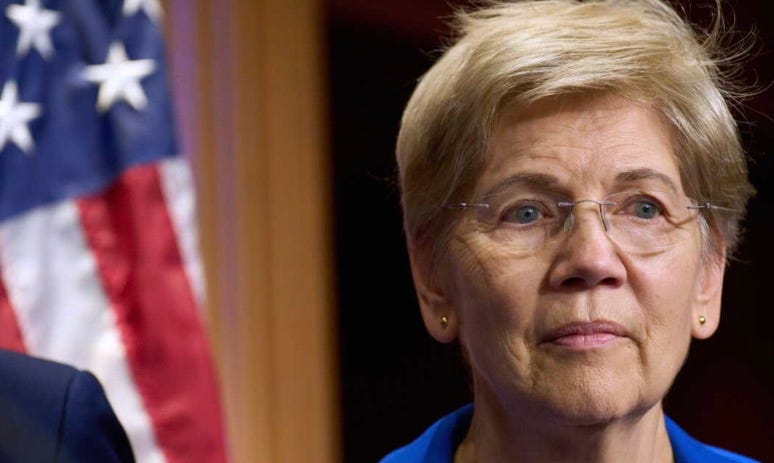
With Democrats controlling Congress, the threat of subpoenas, hearings, investigations and public scrutiny becomes substantially more credible. Companies that have been pushing the limits of disclosure requirements, regulatory compliance or political influence may suddenly become much more interested in coloring inside the lines.
Congress can’t simply rewrite every regulation overnight, and a Republican president will still have veto power. But oversight is a different animal. Congressional committees can investigate, demand documents, call executives to testify and create substantial political pressure without passing a single new law.
I think the psychological effect alone could be meaningful. The worst excesses of the free-for-all may already be behind us. Pardoning Trevor Milton, the Nikola guy? Launching World Liberty Coin and Melania coin? Adding unlimited leverage and infinite unregulated products to encourage gambling 24 hours a day? Calling for SEC reporting to be reduced to twice a year?
It won’t necessarily end tomorrow, and the regulatory changes may take years to play out. But the days of assuming that anything goes, provided you have the right political connections, may be drawing to a close. And if I’m right, that has enormous implications for certain sectors and certain very high-profile companies.
All Eyes On Musk
Love him or hate him, Elon Musk could be one of the most consequential corporate losers from last night’s election.
Consider the situation. Musk has built an extraordinary concentration of business interests in Texas, from Tesla’s manufacturing operations to SpaceX’s Starbase activities and the broader infrastructure supporting his companies. Now he’s facing a dramatically different political environment in the state, including a Democratic governor and a Democratic U.S. senator, neither of whom is naturally aligned with his political ambitions.
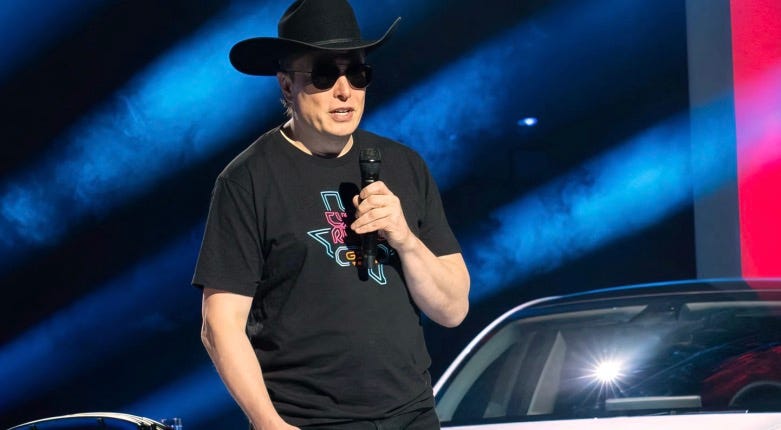
Tesla, SpaceX and Musk’s other ventures have enormous exposure to issues involving environmental permitting, energy infrastructure, government contracts, workplace practices, public subsidies and regulatory oversight. A more adversarial political environment doesn’t automatically mean those businesses are going to be punished. But it does mean their operations could face more scrutiny and less automatic political goodwill.
One auto industry observer believes the ramifications for Elon Musk could be far-reaching. He explores how renewed investigations into Tesla’s self-driving safety claims, scrutiny of SpaceX’s government contracts and Starlink operations, and potential obstacles to a SpaceX-Tesla merger could pose significant legal, financial and political risks to Musk’s empire (this is a great, free read).
Musk has been one of the most politically outspoken executives in the country. When an executive becomes that closely associated with one political faction, there is always the risk that a change in political power creates new complications for the businesses he runs.
As I’ve written for a very long time, I continue to believe there is an enormous amount of air in the valuations attached to Musk’s businesses, particularly Tesla. Those valuations have often reflected not just existing operations but extraordinary expectations for autonomy, robotics, AI and future businesses that remain difficult to value with any reasonable degree of certainty: SpaceX And The Limits Of Human Belief
A friendlier political environment may have helped investors overlook some of those questions. A more adversarial one could make them considerably harder to ignore.
If Washington and Texas both become more aggressive about scrutinizing Musk’s companies, I wouldn’t be surprised if they were among the first major corporate names to feel the consequences of last night’s results.
Winners & Losers: Sectors Where The Election Matters Most
Beyond AI and Musk, there are multiple other areas of the market where I think last night’s results could meaningfully change the investment calculus. Here’s my take on six different sectors, three negative, three potentially positive, heading forward from here: read it here.
The Election Didn’t Change My Bear Case
So where does all of this leave us? In essentially the same place I’ve been for weeks, only with a few additional reasons to be cautious.
I continue to believe the market is headed lower. Not because Democrats won, not because Republicans lost, and not because I have some ideological preference for one political outcome over another. I think the market is headed lower because valuations remain stretched, interest rates remain a serious problem, the AI capital-spending boom is increasingly vulnerable to scrutiny, and investors have spent far too long assuming that an extraordinarily favorable financial and political environment would continue indefinitely.
Last night’s election didn’t solve any of those problems. The AI trade now faces the prospect of more difficult data-center development and greater political scrutiny. Crypto faces a less accommodating Congress. Banks and private-credit firms face the possibility of renewed oversight. Musk’s companies face a potentially more adversarial political environment in both Washington and Texas. And the Federal Reserve, in my opinion, has less political reason than ever to bend over backward to accommodate a market addicted to cheap money.
Against all of that, the bullish argument seems to be that gridlock is historically good for stocks and that election-related hedges are coming off. Fine. Both of those things can be true.
85% OFF FOREVER IF YOU SUBSCRIBE TODAY: I am again offering an 85% discount to anyone that wants to become a Fringe Finance annual subscriber today. It’s a discount you can keep and stays applied for as long as you wish to remain a subscriber: Get 85% off forever
But neither makes an overvalued company fairly valued. Neither makes an uneconomic AI investment suddenly profitable. Neither eliminates the cost of capital. And neither guarantees that a market already showing signs of speculative exhaustion is going to resume marching toward all-time highs.
I wouldn’t be surprised to see today’s relief rally gather momentum, particularly as election hedges unwind and investors convince themselves that divided government is exactly what Wall Street needed. I also wouldn’t be surprised to see that enthusiasm reverse, perhaps even before the trading session is over.
As Gordon Johnson pointed out, the more revealing market signal may come after the mechanical unwinding of election risk has finished and investors are forced to evaluate the fundamentals again.
That’s the part I’m interested in…because when the smoke clears, I suspect investors are going to find themselves looking at the same expensive market, the same interest-rate problem, the same questionable AI economics and a considerably more complicated political environment for many of the companies that have led this bull market.
Democrats winning Congress and Washington grinding to a halt may be enough to manufacture a relief rally. But I don’t believe either will be the catalyst that carries this market back to all-time highs anytime soon.
And when this initial burst of post-election optimism burns itself out, I expect the market to get back to doing what I think it was already in the process of doing before the votes were counted…heading lower. God bless and have a great Wednesday.

QTR’s Disclaimer: Please read my full legal disclaimer on my About page here. This post represents my opinions only. In addition, please understand I am an idiot and very often get things wrong and lose money. I may own or transact in any names mentioned in this piece at any time without warning, meaning if I’m long I could sell or if I’m short I could cover at any time. Positions can change immediately. This is not a recommendation to buy or sell any stocks or securities, just my opinions. I often lose money on positions I trade/invest in. I may add any name mentioned in this article and sell any name mentioned in this piece at any time, without further warning.