





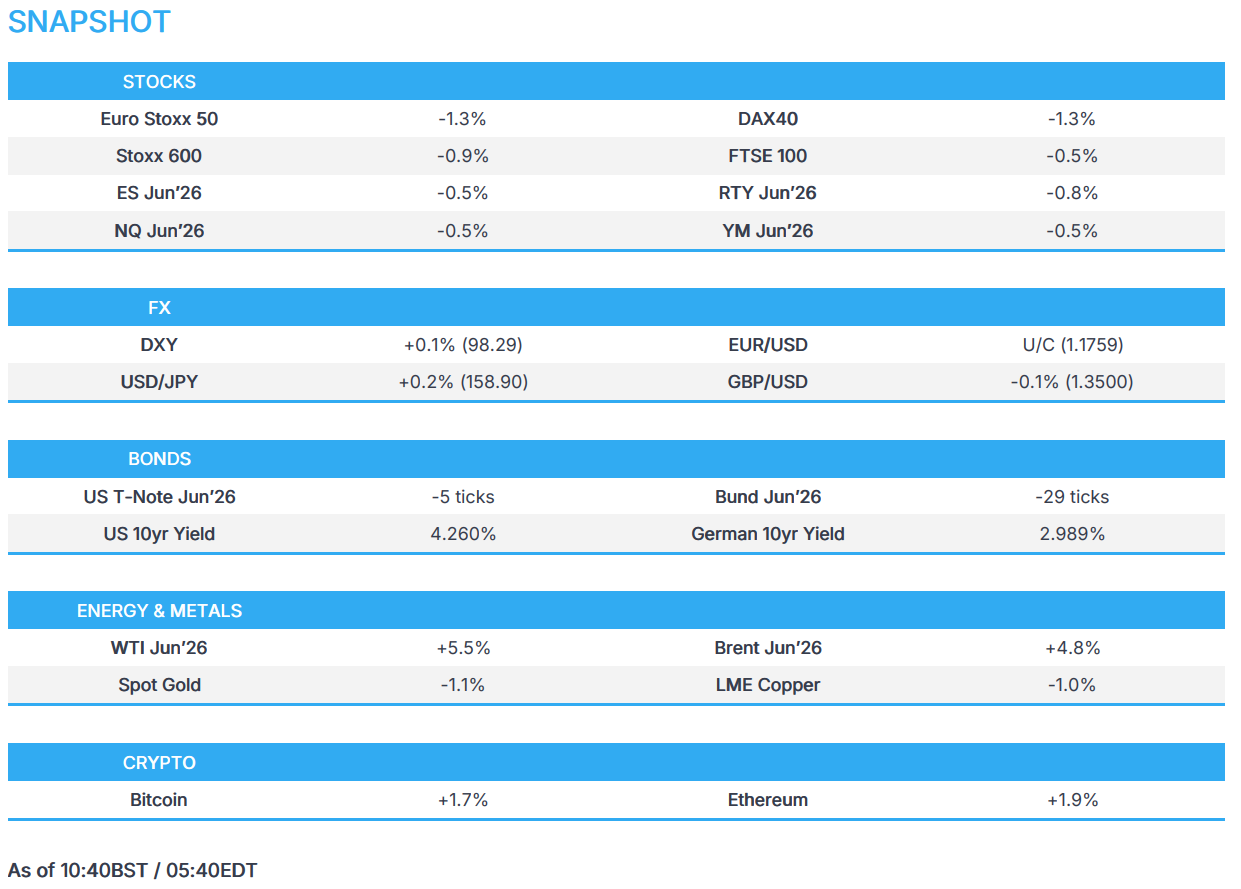
Brent trades either side of the $95/bbl mark, equity futures pull back from highs, bonds lower & DXY firms - Newsquawk US Market Open
- Iran reversed the brief reopening of the Strait of Hormuz and said the waterway had returned to “strict control” after accusing the US of not meeting its obligations and refusing to lift the blockade on Iranian ports, with at least three attacks reported on commercial ships following the re-closure.
- Pakistan Army Chief Munir spoke to President Trump and told him that the Hormuz blockade is hurdle to talks, according to a Pakistani security source cited by Reuters; Trump reportedly told Munir that he would consider his advice.
- Energy futures rise as US-Iran tensions escalated over the weekend.
- European bourses slip; US equity futures pull back from ATHs, GOOGL in talks with MRVL on two AI chips.
- DXY muted amid light data/speaker slate; JPY unreactive to tsunami reports, GBP weathers noisy politics.
- Fixed income pressured on renewed geopolitical tensions; Gilts lag as Rayner and Burnham hold a secret meeting.
- Looking ahead, highlights include Canadian Inflation (Mar), New Zealand NZIER Business Confidence (Q1), New Zealand CPI (Q1), BoC SCE (Apr). Comments from ECB’s Lagarde. Earnings from Cleveland-Cliffs.
Newsquawk in 3 steps:
1. Subscribe to the free premarket movers reports
2. Listen to this report in the market open podcast (available on Apple and Spotify)
3. Trial Newsquawk’s premium real-time audio news squawk box for 7 days
IRAN CONFLICT
- Iran reversed the brief reopening of the Strait of Hormuz and said the waterway had returned to “strict control” after accusing the US of not meeting its obligations and refusing to lift the blockade on Iranian ports, with at least three attacks reported on commercial ships following the re-closure, including Iranian gunboats firing on a tanker and an attack on a cargo vessel near the strait that damaged containers on board.
- US President Trump said on Saturday that Iran got “a little cute” by closing the Strait again, but added there were still “very good conversations” going on.
- US President Trump announced on Sunday an Iranian-flagged cargo ship named TOUSKA tried to get past the US naval blockade, but the Navy Guided Missile Destroyer USS SPRUANCE intercepted it in the Gulf of Oman and gave a warning to stop. The Iranian crew refused, after which the US Navy ship disabled the vessel by blowing a hole in the engine room. Trump added that US Marines have custody of the vessel, and they are seeing what’s on board. It was separately reported that Mehr News Agency claimed US forces fired on an Iranian merchant ship to force it to return to territorial waters, but were then forced to flee after the rapid response of IRGC naval units.
- US President Trump posted on Sunday that “Iran decided to fire bullets yesterday in the Strait of Hormuz – A Total Violation of our Ceasefire Agreement!”, while Trump stated that his representatives are going to Islamabad and will be there on Monday evening for negotiations.
- US President Trump said VP JD Vance, Special Envoy Witkoff and Jared Kushner will head to Islamabad, Pakistan, for fresh talks with Iran, and will arrive on Monday evening, according to a White House official.
- A US senior official said that if there is no breakthrough soon, the Iran war could resume in the coming days, and that the situation with Iran is at a critical point.
- Pakistan Army Chief Munir spoke to President Trump and told him that the Hormuz blockade is a hurdle to talks, according to a Pakistani security source cited by Reuters; Trump reportedly told Munir that he would consider his advice.
- Iran will send a delegation to a second round of talks with the US despite the latest escalation in the Strait of Hormuz, Anadolu Agency reported, citing two Pakistani sources.
- Pakistani Journalist Mallick posted "To my understanding, regardless of the statements and posturing, the second round of talks in Islamabad are to go ahead as per schedule and what is that schedule, only the parties know about the exact schedule."
- Iran parliament's national security and foreign policy commission head said the decision has been made to continue talks with US, but this does not mean negotiation at any cost; delegation may travel to Pakistan if positive signals received from the US
- Pakistan has intensified diplomatic contacts since Sunday with Washington and Tehran to ensure talks proceed as soon as Tuesday, AP reported.
- Iranian Foreign Ministry Spokesperson said no decision has been made regarding participation in the new round of negotiations, Al Araby reported; the past week witnessed numerous diplomatic developments focused on negotiations to end the war. He further said that if the US or Israel launches new aggression, Iran’s armed forces will respond accordingly; Tehran has not received any serious offer regarding lifting sanctions on it.
- Iranian lawmaker said he doesn’t expect any deal with the US and believes even if there is a ceasefire, it won’t last.
- Iran’s Supreme Leader said Iran’s navy is ready to inflict “new bitter defeats” on its enemies.
- Iranian Vice President Mohammad Reza Aref said the security of the Strait of Hormuz is not free, while he added it is impossible to restrict Iranian oil exports and, at the same time, pretend to provide free protection to others. Furthermore, he said "The choice is clear: either a free oil market for all, or risk incurring enormous costs that will affect everyone".
- Iran’s Deputy Foreign Minister said there will be no further in-person peace talks with the US until Washington changes its “maximalist” demands, while the official added Iran would not hand over its enriched uranium to the US. Furthermore, IRNA also reported that Tehran has not agreed to participate in a second round of talks.
- Iran’s Security Council said it is reviewing proposals made by the US in recent days, and Iran is determined to maintain control of the Strait of Hormuz until the war ends, while it was stated that Iran will not reopen the Strait as long as the US blockade of Iranian ports is in place.
- Iranian senior official said that significant differences remained between Iran and the US, including on nuclear issues and that serious talks are required, according to a report on Friday.
- Iranian Harat Khatam Al-Anbiya Central HQ spokesperson said the US attack on the Iranian commercial ship violates the ceasefire, and warned Iran will soon respond and retaliate to this armed piracy.
- Iranian sources told CNN that the Iranian delegation is expected to arrive in Pakistan on Tuesday, according to Al Hadath.
- Iran has yet to agree to another round of talks with the US, according to Iranian press. It was also reported that Iran’s Deputy Foreign Minister said Iran will respond with full force if they return to war, while Iranian state media separately reported on Sunday evening that Tehran was not currently planning to take part in new talks with the US.
- Iranian source said given US President Trump’s remarks about talks and the contradiction with what is actually unfolding between Iran and the US, they believe they are facing trickery by the adversary and are on the brink of a fresh wave of escalation, according to Al Jazeera.
- Iranian senior official denied US President Trump’s claims and said that Iran did not agree to halt uranium enrichment indefinitely, while they will not accept being an exception to international law.
- Pakistani media sources said gaps between the US and Iran have been narrowed in recent days, according to Al Hadath.
- More than 20 vessels passed the Strait of Hormuz on Saturday, which is the highest number since March 1st, according to Kpler data. It was separately reported that an Iranian oil tanker broke through the US blockade and entered Iranian waters, according to CCTV.
- N13 reported, citing an Israeli senior official, that Israel has a "red line" related to ballistic missiles; should Iran cross this red line, then Israel has no choice but to respond.
- IDF confirmed it carried out the first strikes against Hezbollah since the ceasefire and that the strikes were against Hezbollah operatives who violated the ceasefire understandings.
- UAE opened talks with the US about obtaining a financial backstop in case the Iran war plunges it into a deeper crisis, according to US officials cited by WSJ. Furthermore, it was reported that UAE informed Washington it will be forced to sell its oil in yuan if it is not supplied with enough dollars.
EUROPEAN TRADE
EQUITIES
- European bourses (STOXX 600 -0.9%) start the first trading week under pressure, as geopolitics continue to drive price action. Over the weekend, Iran (yet again) closed the Strait of Hormuz after accusing the US of not meeting its obligations, while an Iranian-flagged ship was struck by the US Navy. The DAX 40 is under the most pressure, while higher energy prices provide a floor for the FTSE 100.
- European sectors highlight the negative bias. Cyclicals such as Travel & Leisure, Autos and Banks sit at the bottom of the pile, while defensives such as Utilities outperform, with Energy also showing a strong performance amid the rise in crude prices.
- US equity futures are trading softer but to a lesser magnitude than European peers, with ES futures pulling back from its 7185.75 ATH but thus far finding support at the prior highs of 7,085.
- Click for the sessions European pre-market equity newsflow
- Click for the additional news
FX
- G10 FX are displaying a modest risk-off bias today, with DXY higher by a tenth and high beta underperforming after geopolitical escalation over the weekend (Please refer to the European opening news).
- USD is the best performer as the preferred haven during this conflict, with energy prices also elevated, around USD 96/bbl for Brent. The domestic calendar is light, DXY is likely to be catalysed by Middle East Updates. Note, the Fed entered its blackout window on 18th April ahead of its 29th April confab.
- GBP digests domestic political updates, with the Sun reporting that Manchester Mayor Burnham met with Former UK Deputy PM Rayner on Friday. This fuelled speculation that the two are plotting to overthrow PM Starmer, who is on a weak footing following the Mandelson revelations (PM speaks at 15:30 BST on Mandelson’s vetting). Fortunately for UK assets, few expect any movement from the Parliamentary Labour Party (PLP, the body with power to oust the PM), according to POLITICO. MUFG writes: "So far the negative impact on the pound has been limited, but UK political developments have the potential to trigger a sharper sell-off in the month ahead”. GBP prefers to focus on geopolitical developments with Brent +6-7% on the day. EURGBP trades 0.1% higher, while Cable is 0.1% lower.
- JPY is one of the worst performers in the G10 space as USD/JPY continues to creep towards the critical 160 level. In a note on Sunday, Barclays said it shifted its BoJ hike forecast to June from April, following harsh (For the BoJ) repricing at the beginning of last week amid a lack of hawkish commentary from Ueda. This morning, NHK reported a preliminary 7.4 magnitude earthquake off the north-east coast of Japan. A three-meter-high wave warning was issued for the northern region; no impact on Japanese assets.
FIXED INCOME
- Global fixed benchmarks are broadly in the red, given the recent surge in energy prices, after Iran shut the Strait of Hormuz over the weekend and fired at three commercial vessels. (Please see the Newsquawk feed for a full geopolitical overview). Now markets await potential second round talks between US-Iran – some reports have suggested both sides will be in the region on Tuesday. As it stands, newsflow on whether the talks will actually take place is mixed; the Iranian Foreign Ministry spokesman suggested that no decision has been made on whether the talks will happen. On the yield front, a clear bear flattening is seen in the curve; a bias which has continued to play out throughout periods of escalation between US-Iran.
- JGBs traded with mild gains overnight, bucking the trend seen across peers. Potentially just catching up to the considerable upside seen in fixed benchmarks on Friday (following the opening of the Strait), and also as traders price out the chance of an April hike at the BoJ. Senior rate strategist at SMBC said “the market's main scenario appears to be that a rate hike will be put off next week”, but he highlighted that Ueda could signal a shift in stance at April’s presser.
- USTs are off by around 7 ticks, and currently trade at the lower end of a 111-12+ to 111-18 range; but still holding around the mid-point of Friday’s range of 111-04 to 111-23. Essentially, markets have not entirely discounted the strength seen in US paper following Iran’s brief opening of the Strait. The US 2yr remains around 3.75%, which has proven to be a point of support for in the past week. US domestic docket ahead is particularly thin, with no US data/Fed speak scheduled.
- Bunds are lower by around 40 ticks, and trading towards the bottom of a 125.66 to 125.89 range. Once again moving at the whim of geopolitical developments/higher energy prices; the GE 2s10s is a touch wider once again, but residing near the lows seen on Friday. Geopols aside, focus has been on the ECB, where a few policymakers spoke over the weekend/late-Friday. Demarco and Kazaks suggested that they were comfortable with bets of two hikes this year, whilst Kocher warned against pre-emptive ECB rate action on uncertainty. Sticking with the ECB, a recent survey of monetary policy experts by the OMFIF suggested that former ECB member de Cos is the “most qualified candidate” in the race to succeed President Lagarde.
- Gilts lag vs peers. UK paper has continuously seen bouts of underperformance when oil prices rise, given its high dependence on external energy. But also adding to the downbeat narrative is domestic politics, with continued focus on PM Starmer’s future. The Sun reported that Manchester Mayor Burnham met with Former Deputy PM Rayner on Friday, which has fuelled rumours of the pair launching a leadership challenge. Gilts currently trade down by around 66 ticks and at the lower end of a 88.44 to 88.72 range.
COMMODITIES
- In geopolitics, Iran re-closed the Strait of Hormuz, stating it will remain under strict control and will not reopen while the US blockade of its ports continues, with multiple reported attacks on commercial vessels following the move. Tensions escalated after US Marines seized the Iranian-flagged cargo ship TOUSKA as it attempted to breach the blockade, while President Trump said a separate Iranian vessel was intercepted and disabled after ignoring warnings. Iran condemned the seizure as piracy and warned it would retaliate, as both sides accused each other of violating the ceasefire. Meanwhile, uncertainty persists around US-Iran talks, with Washington planning fresh negotiations in Pakistan, although Tehran has not confirmed participation and significant gaps remain, particularly over nuclear terms and control of the Strait. More recently, an Iranian Foreign Ministry spokesperson said no decision has been made regarding participation in the new round of negotiations. Elsewhere, the Pakistani Army Chief told US President Trump that the Hormuz blockade is a hurdle in talks, to which Trump responded that he would consider his advice.
- Oil jumped as a result, with Brent climbing back above USD 95/bbl, reversing most of Friday’s decline (currently in a USD 94.33–97.50/bbl range) after the waterway’s brief reopening. WTI June trades in a USD 86.46–89.60/bbl range. Upside has been facilitated by the aforementioned escalation, with additional support following comments from the Iranian Foreign Ministry spokesperson indicating no decision has yet been made on talks with the US. That said, gains are somewhat capped by ongoing efforts to bring the US and Iran back to the table ahead of the ceasefire expiry on Wednesday (UK time). European natural gas prices also rose, with Dutch TTF futures briefly moving back above EUR 43/MWh after Iran shut the Strait again.
- Spot gold and silver declined as the renewed disruption in Hormuz stoked inflation concerns tied to an energy supply shock and cast further doubt over efforts to end the conflict, with bullion slipping below USD 4,800/oz but currently off worst levels. Spot gold is trading in a USD 4,736–4,814/oz range.
- Copper retreated from its highest close since early February. Iron ore bucked the broader trend and rose overnight, with reports noting firm Chinese demand ahead of the May Day holidays and tight near-term supply. 3M LME copper trades in a USD 13,204.90–13,375.28/t range at the time of writing.
- Qatari sources say it may take up to five years to repair damaged gas facilities.
- Iraq reportedly resumes Southern Oil exports after a month-long halt due to Strait of Hormuz disruption, one tanker begins loading, according to four energy sources cited by Reuters.
TRADE/TARIFFS
- China's March rare earth magnet exports to the US fell 9.5% M/M and its rare earth magnet exports to Japan fell by 17.3% M/M.
CENTRAL BANKS
- BoJ is reportedly likely to keep rates on hold at April's meeting, Reuters reported citing sources.
NOTABLE EUROPEAN DATA RECAP
- German PPI MoM (Mar) M/M 2.5% vs Exp. 1.4% (Prev. -0.5%)
- German PPI YoY (Mar) Y/Y -0.2% (Prev. -3.3%)
- UK Rightmove House Prices Y/Y (Apr) -0.9% (Prev. -0.2%)
GEOPOLITICS
RUSSIA-UKRAINE
- Ukraine's Drone Force Commander says Russia's Tuapse oil refinery was struck overnight.
CRYPTO
- Bitcoin briefly tops USD 75k, while Ethereum slips back below USD 2.3k.
APAC TRADE
- APAC stocks were mostly higher as the region shrugged off the escalatory geopolitical headlines from over the weekend, including the re-closure of the Strait of Hormuz and attacks on several vessels by Iran, while US President Trump announced that the US Navy intercepted an Iranian-flagged vessel and blew a hole in the engine room after it attempted to get past the US blockade. This resulted in a spike in oil prices at the reopen and saw US index futures decline, although asset classes have faded the extremes as focus turns to talks in Islamabad, with President Trump sending negotiators for talks with Iran, although there is no confirmation yet on whether Iran will attend.
- ASX 200 traded little changed amid the mixed price action in commodity-related stocks and with financials subdued after NAB flagged a spike in impairments due to the Middle East conflict.
- Nikkei 225 rallied with the index briefly returning to the 59,000 level following the recent unwinding of April rate hike bets, and with the index unfazed by the rise in oil prices.
- Hang Seng and Shanghai Comp were higher amid earnings updates, but with further upside capped by a lack of macro catalysts, while the PBoC provided no surprises as it announced China's benchmark LPRs were maintained at their current levels for the eleventh consecutive month.
NOTABLE ASIA-PAC HEADLINES
- Earthquake with preliminary magnitude of 7.4 reported off the coast of Japan, with a tsunami warning issued, NHK reports
NOTABLE APAC DATA RECAP
- Japanese Tertiary Industry Index MoM (Feb) M/M -0.4% (Prev. 1.7%)
- New Zealand Balance of Trade (Mar) 0.698B (Prev. -0.257B)
- New Zealand Exports (Mar) 7.94 (Prev. 6.63)
- New Zealand Imports (Mar) 7.25 (Prev. 6.89)
Loading...