





Crude above USD 100/bbl as US-Iran talks stall on nuclear ambitions - Newsquawk EU Market Open
- The US delegation, led by Vice President Vance, left US-Iran talks in Pakistan to return to the US without an agreement after 21 hours of talks.
- US President Trump said the US Navy will begin the process of blockading any and all ships trying to enter or leave the Strait of Hormuz.
- US Central Command said it will begin implementing a blockade on all maritime traffic entering and leaving Iranian ports on April 13th at 17:00 Israeli time (15:00BST/10:00EDT).
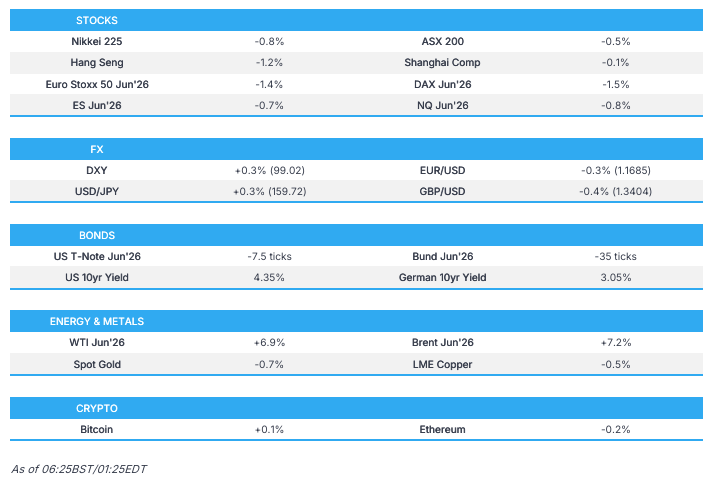
- Crude futures surged with Brent crude back above the USD 100/bbl level following the failure of US-Iran talks in Islamabad and with the US to begin a naval blockade in the Strait of Hormuz.
- APAC stocks declined; European equity futures indicate a lower cash market open with Euro Stoxx 50 futures down 1.4%, off worst levels.
- Looking ahead, highlights include US Existing Home Sales (Mar), OPEC MOMR (Apr). Speakers include ECB's de Guindos, RBA's Hauser & Fed's Miran. Earnings from Goldman Sachs & LVMH.
SNAPSHOT
Newsquawk in 3 steps:
1. Subscribe to the free premarket movers reports
2. Listen to this report in the market open podcast (available on Apple and Spotify)
3. Trial Newsquawk’s premium real-time audio news squawk box for 7 days
IRAN CONFLICT
- US delegation led by Vice President Vance left US-Iran talks in Pakistan to return to the US without an agreement after 21 hours of talks, while Vance said the US had sought an affirmative commitment Iran would not seek a nuclear weapon or tools to quickly achieve one, and the US left behind a “final and best offer”. Iranian Foreign Ministry spokesperson Baqaei said any success depended on the US refraining from excessive demands and unlawful requests, and negotiating with seriousness and good faith, while an Iranian report noted there was disagreement on several issues and that the Americans demanded through negotiations what they could not obtain through war.
- US President Trump said the US Navy will begin the process of blockading any and all ships trying to enter or leave the Strait of Hormuz, while he stated that the meeting went well and most points were agreed to, apart from nuclear, which was the only point that mattered. Trump also stated that at some point, we will reach an “ALL BEING ALLOWED TO GO IN, ALL BEING ALLOWED TO GO OUT” basis, but Iran has not allowed that by saying there may be mines somewhere, which is world extortion, and leaders of world countries, especially the US, will never be extorted. Furthermore, he said at an appropriate moment, the US is fully locked and loaded, and the military will finish up the little that is left of Iran, and warned that any Iranians who fire at the US or at peaceful vessels will be blown to hell.
- US Central Command said it will begin implementing a blockade on all maritime traffic entering and leaving Iranian ports on April 13th at 17:00 Israeli time (15:00BST/10:00EDT), although it would "not impede" vessels transiting the Strait of Hormuz travelling to or from non-Iranian ports. US President Trump later posted that "The United States to Blockade Ships Entering or Exiting Iranian Ports on April 13 at 10:00 A.M. ET."
- IRGC warned the approach of military vessels toward Strait of Hormuz is a breach of ceasefire, IRNA reported.
- US President Trump said it won’t take long to clean out the Strait and will have to re-examine NATO, which wasn’t there for the US, but he thinks numerous countries will be helping the US with this. Trump also stated that Iranians have not left the bargaining table, and he predicts Iran will give the US everything it wants. Furthermore, he said that prices for oil and gas will eventually be lower when this is over, and could be lower before the midterm elections, or maybe a little higher.
- US President Trump commented that Iran promised to open the Strait of Hormuz and they knowingly failed to do so, while he noted regarding talks that Iran is unwilling to give up its nuclear ambitions. Trump added that in many ways, the points that were agreed to are better than continuing the military operations to conclusion, but those points don’t matter compared to allowing nuclear power in the hands of ‘volatile, difficult and unpredictable people’. Furthermore, he reiterated that Iran will never have a nuclear weapon.
- US President Trump said very good things are happening in the Hormuz Strait and the blockade will be very effective, while he also commented that Iran is in very bad shape and will not have a nuclear weapon, as well as stated that the Iran ceasefire is holding well.
- US President Trump warned that China will have big problems if it ships arms to Iran, while the warning comes amid reports that China is preparing shipments of new air defence systems to Iran in the next couple of weeks that are to be hidden through shipments via third-party nations and shippers.
- US President Trump and his advisers are weighing resuming limited strikes in Iran, in addition to the US blockade, to break the stalemate in peace talks, according to WSJ citing officials and people familiar with the situation. However, it was also reported that the door remains open to a diplomatic solution with Iran, and a second round of talks could be held within days.
- US President Trump told The New York Post on Friday that US warships are being reloaded with “the best ammunition” to resume strikes on Iran if peace talks in Pakistan fail.
- White House officials said on Friday that doubts prevail in the White House and that President Trump believes that opening the Strait of Hormuz is unlikely anytime soon.
- Iranian President Pezeshkian said if the American government abandons its totalitarianism and respects the rights of the Iranian nation, ways to reach an agreement will certainly be found.
- Iran’s Foreign Ministry said that they reached an agreement on a number of points, but differed on two important issues and that talks were held in an atmosphere of mistrust, so it is natural that they should not expect to reach an agreement in just one session. It also stated that contacts and consultations between Iran, Pakistan and other friends in the region will continue, while Iranian press sources said that the Strait of Hormuz and nuclear rights were among the main points of contention.
- Iranian Foreign Minister Araghchi posted "In intensive talks at the highest level in 47 years, Iran engaged with U.S in good faith to end war. But when just inches away from "Islamabad MoU", we encountered maximalism, shifting goalposts, and blockade".
- Iranian Parliamentary Speaker Ghalibaf posted a picture of prices of gas near the White House, and commented, "Enjoy the current pump figures. With the so-called 'blockade', Soon you'll be nostalgic for $4–$5 gas."
- Iranian officials said US President Trump’s threat to mount a blockade of the Strait of Hormuz will have no effect on Iran.
- Iranian state TV said the US continued with extravagant demands during talks, and that the Strait remained a point of disagreement in talks, while Iran insists on keeping its military gains. Furthermore, it was stated that Iran is in no hurry for negotiations, and Iranian state TV reported that talks would continue on Sunday.
- Pakistan’s Foreign Minister said it is imperative that parties continue to uphold their commitment to the ceasefire and wants to express gratitude to the US and Iran for appreciating Pakistan’s efforts to help broker the ceasefire.
- Israeli PM Netanyahu said he wants a true peace pact with Lebanon.
- US officials said two US Navy ships crossed the Strait of Hormuz on Saturday, while Iran claimed it warned it would attack any military vessels that cross the Strait and that the US Navy vessels withdrew. It was separately reported that three oil supertankers (2 Chinese vessels and 1 Greek vessel) sailed through the Strait of Hormuz on Saturday, while two empty supertankers attempted to travel through the Strait of Hormuz on Sunday before making a last-minute U-turn as US-Iran peace negotiations broke down, according to Bloomberg.
- Qatar’s Transport Ministry announced the return of full navigation for all maritime vessels in its waters from Sunday.
- Sirens sounded in Kiryat Shmona, Northern Israel, according to SNN, while Tasnim also reported that Hezbollah conducted missile attacks on Israeli towns.
US TRADE
EQUITIES
- US stocks closed mixed, but rangebound on Friday, in which the Nasdaq 100 edged out slight gains, and the SPX closed lower by a couple of tenths, with sectors predominantly in the red, in which only Tech, Materials, and Discretionary were in the green, while Consumer Staples and Healthcare lagged. Middle East rhetoric once again dominated the tape, and all focus turned to the US-Iran talks on Saturday, despite the ever-ongoing differences between the sides, with the latest reports suggesting that Iran said talks with the US are to begin if 'preconditions are accepted', as there continues to be differing opinions regarding Lebanon and the Strait of Hormuz. Meanwhile, Trump told NYP that US warships are being reloaded with “the best ammunition” to resume strikes on Iran if peace talks in Pakistan fail. As such, WTI and Brent were choppy on Friday, but ultimately settled with losses.
- SPX -0.11% at 6,817, NDX +0.14% at 25,116, DJI -0.56% at 47,917, RUT -0.22% at 2,631.
- Click here for a detailed summary.
TARIFFS/TRADE
- China is to remove tariffs on all products imported from 53 African nations starting May 1st, according to Caixin.
- Spanish PM Sanchez said Spain wants to cooperate with China in all areas.
NOTABLE HEADLINES
- Federal Reserve is asking major US banks to provide details regarding their exposure to private credit amid a surge in redemptions, according to Bloomberg.
APAC TRADE
EQUITIES
- APAC stocks declined after the negotiations marathon over the weekend between the US and Iran in Pakistan ended without an agreement, as the sides remained at loggerheads over Iran's nuclear ambitions. Furthermore, US President Trump announced a US naval blockade on ships travelling through the Strait of Hormuz, while the US military said it would start a blockade of Iranian ports on Monday at 10:00EDT/15:00BST, but would "not impede" vessels transiting the Strait of Hormuz travelling to or from other countries.
- ASX 200 was dragged lower by underperformance in tech and miners, while energy was at the other end of the spectrum following a surge in oil prices.
- Nikkei 225 retreated amid headwinds from the higher energy prices, which weighed heavily on power companies and large manufacturers, while there were also recent suggestions from Japan's economy minister that BoJ policy to boost the yen could be an option to curb inflation.
- Hang Seng and Shanghai Comp followed suit to the losses in regional peers, with sentiment not helped by another meagre PBoC liquidity operation and with a mixed performance seen in tech stocks.
- US equity futures fell at the open as markets reacted to the failed US-Iran talks and Trump's Hormuz blockade.
- European equity futures indicate a lower cash market open with Euro Stoxx 50 futures down 1.4% after Euro Stoxx 50 futures closed with gains of 0.5% on Friday.
FX
- DXY strengthened amid the rise in oil prices and risk-off mood owing to the lack of agreement by the US and Iran in marathon talks over the weekend, while President Trump announced is to impose a US naval blockade in the Strait of Hormuz, which is set to begin today at 15:00BST/10:00EDT. This risks flaring up tensions, and he also warned that any Iranians who fire against them will be 'blown to hell', but separately noted the ceasefire is going well.
- EUR/USD slipped back beneath the 1.1700 handle amid the firmer buck and with headwinds from rising EU energy prices, while there was little reaction to Hungarian PM Orban's election defeat after 16 years in power, which is seen as a nod to Europe.
- GBP/USD struggled to hold on to the 1.3400 status amid pressure in cyclicals and despite reports that UK ministers are to introduce legislation that would allow them to align the UK with new Brussels regulations in areas such as food standards or carbon emissions.
- USD/JPY edged higher as it coat-tailed on advances in the greenback and as higher oil prices increase the headwinds for Japan's economy.
- Antipodeans declined amid the downbeat risk appetite, although the losses were stemmed by support in AUD/USD and NZD/USD at the 0.7000 and 0.5800 levels, respectively.
- PBoC set USD/CNY mid-point at 6.8657 vs exp. 6.8395 (Prev. 6.8654).
- Mexican Central Bank appointed Aldo Heffner Rodriguez as its new chief economist, effective Monday.
FIXED INCOME
- 10yr UST futures retreated with focus on geopolitics and as the oil price surge stoked inflationary concerns.
- Bund futures fell beneath the 125.00 level as the latest geopolitical developments in the Middle East propelled EU gas futures higher by double-digit percentages.
- 10yr JGB futures conformed to the downside in global peers with Japan's 10yr yield rising to its highest since 1997, although JGB futures are off their worst levels as the higher oil prices, the dampening effects on the economy and inflationary fears muddle the outlook for BoJ policy.
COMMODITIES
- Crude futures surged with Brent crude back above the USD 100/bbl level following the failure of US-Iran talks in Islamabad and with the US to begin a naval blockade in the Strait of Hormuz from Monday at 15:00BST/10:00EDT.
- Saudi Arabia restored the East-West pipeline to full pumping capacity of 7mln bpd.
- Japanese Economy Minister Akazawa said Japan will work closely with Asian nations to ease the oil bottleneck.
- India raised export duties on diesel and jet fuel amid the energy crisis with duties on diesel raised to INR 55.50/litre from INR 21.50/litre.
- Spot gold retreated amid a firmer dollar and surge in oil prices, but is well off the initial lows after rebounding from a brief dip beneath the USD 4,700/oz level.
- Copper futures declined following the lack of a breakthrough in US-Iran talks over the weekend, while reports also noted that President Trump and advisers are weighing resuming limited strikes in Iran, in addition to the US blockade, to break the stalemate in peace talks.
- Chile's Codelco copper production fell 9.8% Y/Y in February to 88.5k tons.
CRYPTO
- Bitcoin found some slight reprieve from the declines seen over the weekend and retested the USD 71,000 level to the upside.
NOTABLE ASIA-PAC HEADLINES
- Japanese Economy Minister Akazawa said BoJ monetary policy could be an option to curb higher prices by strengthening the domestic currency, according to Reuters.
- RBNZ Governor Breman said the central bank will soon announce steps to increase the transparency of monetary policy decisions.
GEOPOLITICS
OTHER
- US Southern Command said five narco terrorists were eliminated in strikes carried out on two vessels in the Eastern Pacific on Saturday.
- China unveiled policy measures to show goodwill to Taiwan following a meeting between Chinese President Xi and Taiwan’s opposition leader Cheng Li-wun, according to Bloomberg. In relevant news, Taiwan will carry out new drills in the coming weeks to ensure the island has access to vital supplies in the event of a Chinese blockade.
EU/UK
NOTABLE HEADLINES
- UK PM Starmer wants the power to sign the UK up to EU single market rules under plans that would avoid a normal parliamentary vote, with ministers to introduce legislation that would allow them to align the UK with new Brussels regulations in areas such as food standards or carbon emissions, according to The Times.
- UK Chancellor Reeves will set out plans to boost businesses’ competitiveness amid rising energy bills, while warning against large government borrowing, according to Bloomberg.
- S&P affirmed the UK at 'AA'; outlook stable.
- Hungarian PM Orban conceded defeat in the election after 16 years in power, with Peter Magyar set to become the next PM, as his Tisza party secured two-thirds of seats in parliament.
Loading...