





Fuel Price Shock Pushes Gas Cars Under 50% Of Global New-Auto Sales For First Time
By Tsvetana Paraskova of OilPrice.com
The share of gasoline cars in global vehicle sales fell below 50% for the first time ever as the Hormuz shock and the resulting record-high fuel prices accelerated the previously sluggish shift toward EVs outside China.
A few years ago, China blew past the threshold of 50% of all car sales being hybrids and EVs, and the share is now about 55%. But the rest of the world didn’t follow until the Iran war disrupted the fuel markets.
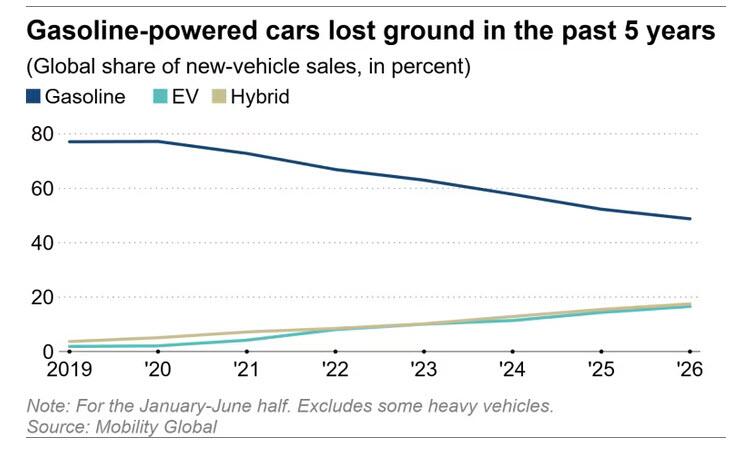
Global sales shares of EVs are far from the Chinese numbers, but the shift toward electric vehicles has been remarkably fast amid spiking gasoline and diesel prices, which pushed many consumers to choose EVs.
The surge in gasoline prices this year led to the first dip in the share of gasoline-fueled cars below 50%, ever, according to data by automotive data and analytics provider Mobility Global cited by Nikkei Asia.
Between January and June, sales of gas-powered vehicles, excluding hybrids, slumped by 10% from a year earlier, to 20.25 million cars, and their share of total global automotive sales fell by 3 percentage points to 49%, the data showed.
For years, the EV uptake in markets outside China was sluggish and lagging forecasts, but the Hormuz crisis, the $100 oil prices, and record diesel and gasoline prices pushed many consumers in Europe, South America, and Asia Pacific toward EVs.
Battery electric vehicle sales in Europe, including the UK, Switzerland, and Norway, surged by 52.2% in August from a year earlier as record-high gasoline and diesel prices prompted drivers to flock to battery and hybrid vehicles, data by the European Automobile Manufacturers’ Association, ACEA, showed last month.
BEV sales in Germany, the biggest car market in Europe, soared by 75% in August year-over-year, as gasoline prices in Germany hit an all-time high of 2.31 euros per liter, or the equivalent of about $10 per gallon.
EV sales in France, another major European market, more than doubled.
In Germany, where the government introduced a purchase premium for EVs from January 2026, sales are accelerating, an analysis by the German Institute for Economic Research, DIW, showed earlier this week.
One in every four passenger cars sold in Germany between January and August was a pure battery electric vehicle, while the share in August was even higher – one in every three passenger cars sold was a BEV, according to the analysis. This compares to an average of 19% in 2025.
Globally, electric vehicle sales have surged this year following the oil supply disruption in the Middle East and the second oil price shock in four years.
Following a subdued start to the year, EV sales jumped in the second quarter after the Middle East crisis slashed crude supply and hiked oil and fuel prices, the International Energy Agency (IEA) said in July in an update to its annual EV outlook.
EV sales rebounded sharply in the second quarter, rising by 35% compared with the first quarter “as the energy crisis sparked by the war in the Middle East brought fuel price volatility back into sharp focus,” the agency said.
EV sales in the second quarter reached record-high levels in 50 countries as drivers preferred electric vehicles amid soaring fuel prices.
In sizable car markets such as Brazil, India, Australia, and Vietnam, electric car sales roughly doubled between March and June compared with the same period in 2025, according to the IEA’s analysis in the report.
Moreover, as many as 90 countries saw annual growth in EV sales in the first half of the year.
The accelerating EV adoption that began with the spike in oil and fuel prices is set to remain a trend in the global markets and could push the share of EVs in the passenger fleet above earlier expectations, analysts at Wood Mackenzie say.
Challenges to accelerated adoption still remain, including the need for billions of U.S. dollars in investments in critical battery minerals supply and charging networks. Yet, the longer the Strait of Hormuz crisis roils global fuel markets, the stronger the case for EV adoption could become.