





Futures Rise As Oil Drops, Dragging Rates Lower
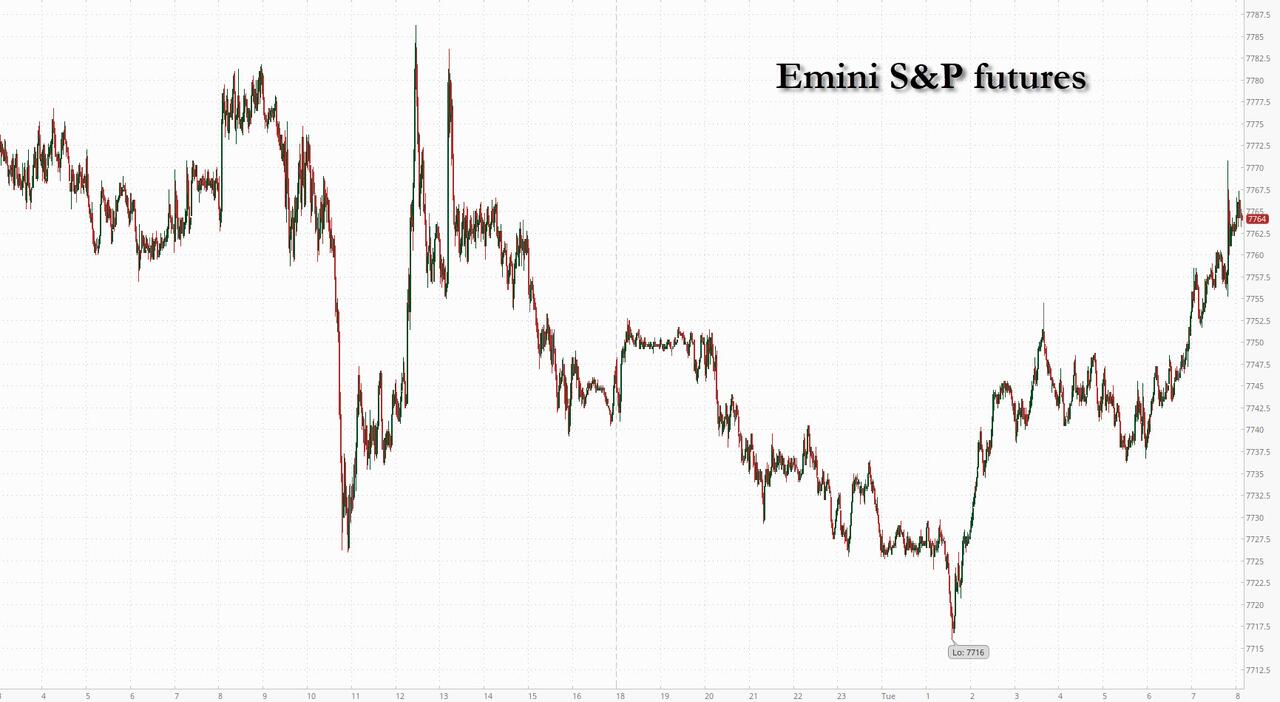
US equity futures have reversed earlier losses and trade in the green, near session highs, as bond yields drop across the curve, following a decline in oil which has also hit the dollar, despite lack of any tangible news out of Iran and as traders brace for the week’s first labor data following a neverending firehose of artificial-intelligence news and events. As of 8:15am ET, S&P futures rose 0.2% while Nasdaq futures gained 0.4%, as Mag7, semis, and memory stocks all see a mild bid while software is weaker; EU Semis are up more than 3% so we may see US get active as the market opens. The AI theme is also creating a bid across industrials and utilities; cyclicals leading defensives with notable weakness in Staples. Energy names are lower with crude prices. The commodities complex is mostly lower with gold seeing a moderate bid and some Ags higher. Oil is at session lows, down 2% as Saudi Arabia resumed flows through a key pipeline after comments from the Qatar Foreign Ministry on possible US-Iran solutions. Overall price action looks like a cautious re-risking with guarded optimism around a US / Iran deal. Today’s macro data focus is on JOLTS ahead of Friday’s NFP and another batch of Fedspeakers.
In premarket trading, Mag 7 stocks are mixed (Alphabet (GOOGL) -0.08%, Amazon (AMZN) +0.3%, Apple (AAPL) -0.4%, Meta Platforms (META) +0.8%, Microsoft (MSFT) -0.08%, Nvidia (NVDA) +0.6%, Tesla (TSLA) +0.3%)
- AAR (AIR) gains 5% after the aerospace and defense company reported adjusted diluted earnings per share and revenue for the first quarter that beat the average analyst estimate.
- Fair Issac (FICO), a credit score company, slumps 18% after Federal Housing Finance Agency Director Bill Pulte announced a move that makes it easier for lenders to adopt VantageScore. According to analysts, this will increase competition while pressuring Fair Issac’s market share and pricing power.
- FuelCell Energy (FCEL) rises 5% after Oppenheimer & Co initiated coverage of the fuel cell maker with a recommendation of outperform, expecting demand to stay “well ahead” of supply as it ramps up its production capacity.
- Iovance Biotherapeutics (IOVA) climbs 5% after boosting its revenue guidance for the full year.
- Monday.com Ltd. (MNDY) slips 1.8% after JPMorgan downgraded the software company to neutral from overweight, citing growth challenges for annual recurring revenue.
- Netflix (NFLX) inches 1% higher after Deutsche Bank upgraded the streaming-video company to buy, saying that concerns about engagement were overblown.
- Summit Therapeutics (SMMT) rises 16% after AstraZeneca announced an investment in the biotech to collaborate on new cancer medication.
- Uniqure (QURE) slumps 58% after saying that the benefits of its Huntington’s disease gene therapy drug AMT-130 were not as good after four years as they were after three years in a small trial — a result that could complicate its bid to get the treatment approved by US regulators.
In other corporate news, AstraZeneca is investing $2 billion in US biotech Summit Therapeutics to collaborate on a promising new cancer medicine; AMD agreed to acquire World Labs for $8.2 billion, gaining an AI startup founded by industry pioneer and researcher Fei-Fei Li; Vail Resorts anticipates a rebound in fiscal year 2027 above analyst estimates, based on a range of normal weather conditions and incremental cost savings.
Markets are finding their footing after a turbulent start to the week that saw volatile oil prices trigger selling across stocks and bonds. Among potential catalysts, traders will closely follow what emerges from a lunch meeting on AI safety risks between US President Donald Trump and industry leaders. A busy stretch of economic data also kicks off with the release of the August job openings report. Traders will parse remarks from six Federal Reserve speakers for clues on the rate outlook at a time when markets are pricing as many as four hikes over the next 12 months
For traders, the current backdrop is tricky to navigate. Mounting risks from oil prices and interest rates have prompted some investors to pause aggressively building positions and wait for a clearer signal to re-engage, according to Bloomberg. US long-term net asset inflows fell in August versus the previous month, driven by lower passive inflows, according to JPMorgan, citing Morningstar data. Equity inflows declined to $11 billion from $39 billion in July.
The AI trade is also getting more complicated. OpenAI scrapped the debut of its GPT-6.1 Astra model while it establishes stronger safeguards, while Anthropic warned of “existential risks to humanity” in an IPO prospectus, Reuters reported. Both will remain in focus today, with OpenAI’s DevDay in San Francisco, including Sam Altman’s keynote at 1 p.m. ET, and Anthropic and Nvidia CEOs due to attend a lunch with Trump to discuss AI risks.
“We’ve had some rather large moves over the last few days or so, and we’ll have the ultimate data trigger in the form of non-farm payrolls heading into Friday, so I think it makes sense for positions to be squared,” said Geoff Yu, a senior macro strategist at BNY. “Also worth bearing in mind it’s month-end, so there will be these passive transactions which are not aligned to data.”
Worries that AI may cause harm have also moved to the fore, leading some industry executives, including Anthropic PBC head Dario Amodei, to call for a slowdown in the technology’s development. As Amodei and others prepare to meet Trump, traders will also listen what OpenAI Chief Executive Officer Sam Altman has to say about the issue at the group’s annual developer conference. The ChatGPT chatbot owner is holding back a version of its Astra model to put stronger guardrails in place.
The impact of rising inflation was on display Tuesday when Australia’s central bank lifted borrowing costs to the highest level in about 15 years. In Spain, inflation moved further above the European Central Bank’s 2% target, reinforcing the case for higher euro-area rates.
Macro data include JOLTS and consumer confidence, which Bloomberg Economics expect to show muted labor demand and subdued household sentiment. There’s also half a dozen Fed speakers, including two closely watched voters. Barr, who called for additional rate hikes last week, is speaking on the economic outlook in Detroit, and Williams, who has said more work is needed to lower inflation, will deliver keynote remarks in Buffalo.
European stocks are benefiting from the drop in oil, with the Stoxx 600 up 0.4% as cyclicals outperform defensives. Sentiment was also lifted as investors pared bets on rate hikes from the European Central Bank, with Julius Baer Group surging after Swiss regulatory action against the bank ended. Here are the biggest movers Tuesday:
- Julius Baer surges as much as 8.8% to a new all-time high after Finma said the wealth manager must hold CHF250 million in additional capital, less than previously required, as it ended its enforcement procedure. The Swiss firm has also sought approval for a share buyback program.
- Vesuvius shares gain as much as 32%, the most since 1990, after the metallurgical engineering firm announced a cash-and-shares offer from RHI Magnesita
- Close Brothers shares rise 13% after the specialized lender reported full-year earnings that beat expectations. Costs came in better than forecast, while loan growth accelerated in the second half
- Hapag-Lloyd gains as much as 5.3% after the German container shipper raised its full-year guidance. JPMorgan attributed the boost to shipping rates remaining at elevated levels
- Hemnet gains as much as 5.9%, the most in two weeks, after the Swedish property listings platform announced a series of operational changes, including the introduction of two new free entry-level listing formats
- Pepco Group gains as much as 5.1% in Warsaw after the discount retailer reported an acceleration in like-for-like sales, increased its earnings guidance and unveiled a new buyback
- Legrand gains as much as 7.8%, the most since April 8, after the electrical device specialist updated its financial targets through to 2030 at its capital markets day in Singapore
- Lindt & Sprüngli’s participation certificates fall as much as 9%, the most since March, after cutting its full-year 2026 organic sales growth forecast to 0%–2% from a prior range of 4%–6%
- Rentokil shares fall as much as 2.4% after Morgan Stanley cut its recommendation to equalweight from overweight. Morgan Stanley says the US pest control “narrative is unravelling and may have peaked”
- Shares in French airports and highways operators drop in heavy trading after news that the government is considering increasing taxes on transport infrastructure in its 2027 budget
- Accelleron Industries sares drop as much as 4.3% as Barclays starts coverage of the turbocharger manufacturer with a “contrarian” underweight, giving the stock its only negative analyst rating
- Pharming drops as much as 6.7% after announcing that Fabrice Chouraqui will step down as Chief Executive Officer with immediate effect
Asian stocks headed for a second straight day of losses as a lack of progress in US-Iran talks to reopen the Strait of Hormuz kept oil prices elevated. The MSCI Asia Pacific Index declined as much as 1.2% before paring some losses. Financials tracked US peers lower and were the biggest drags among sectors on the regional benchmark. MediaTek’s 7.1% slide, which was the largest in two months and followed a recent run-up in the stock, also weighed on the gauge as Taiwan markets resumed trading after holidays. Most of the national benchmarks in Asia fell on Tuesday. In China, the CSI 300 Index ended little changed, while property stocks rallied after the nation’s cabinet said it will study new policies to stabilize the real estate market, promote employment and boost domestic demand in response to issues emerging in the economy. The CSI benchmark had slumped to its lowest level in more than a year on Monday. Here are the most notable Asian movers
- Jiangsu Hengrui Pharmaceuticals’ shares gain as much as 3.7% in Shanghai after it agreed to license obesity and diabetes drug HRS-1596 to Novo Nordisk in a deal valued at up to $2.6 billion, according to an HKEX filing.
- RoboTechnik Intelligent Technology Co. shares fell on their trading debut in Hong Kong in one of the city’s busiest days for new listings.
- Chugai Pharmaceutical shares fall as much as 2.8% to the lowest in about a month after the Japanese company said the clinical development of emugrobart for obesity will be discontinued.
- PT GoTo Gojek Tokopedia shares extend their drop by another 14%, following a similar decline on Monday that came after Indonesia Stock Exchange removed its 50-rupiah price floor.
- Guangzhou Automobile Group shares jump after the company announced plans to acquire a 50% stake in FAW Toyota through share issuance, according to a filing to Shanghai Stock Exchange.
- Akeso shares rise as much as 13% after AstraZeneca said it would invest $2b in Summit Therapeutics, a partner of the Hong Kong-listed company.
- UBTech’s shares drop as much as 4.8% in Hong Kong after JPMorgan downgrades to neutral from underweight, reflecting a more cautious stance on humanoid robot manufacturers.
Asia’s equity benchmark is now down 1.3% in September as rising oil prices, surging bond yields, volatility in high-flying AI stocks and growing odds for more rate hikes by the Federal Reserve have combined to sour sentiment. Even so, the index is up more than 20% in 2026, heading for a fourth straight annual gain. Meanwhile, Indian equities are breaking through a series of long-held technical support levels as a selloff gathers pace in a market once considered an emerging-market darling. The benchmark NSE Nifty 50 Index has fallen for seven straight weeks and broken through its 200-day moving average on a weekly basis for the first time in six years.
In FX, the Bloomberg Dollar Spot Index is gaining further ground, up 0.2%, pressuring EUR/USD lower toward its year-to-date low. Aussie dollar finds itself near the foot of the G10 leaderboard after a hawkish RBA hike was followed up by a more dovish tone from Governor Bullock.
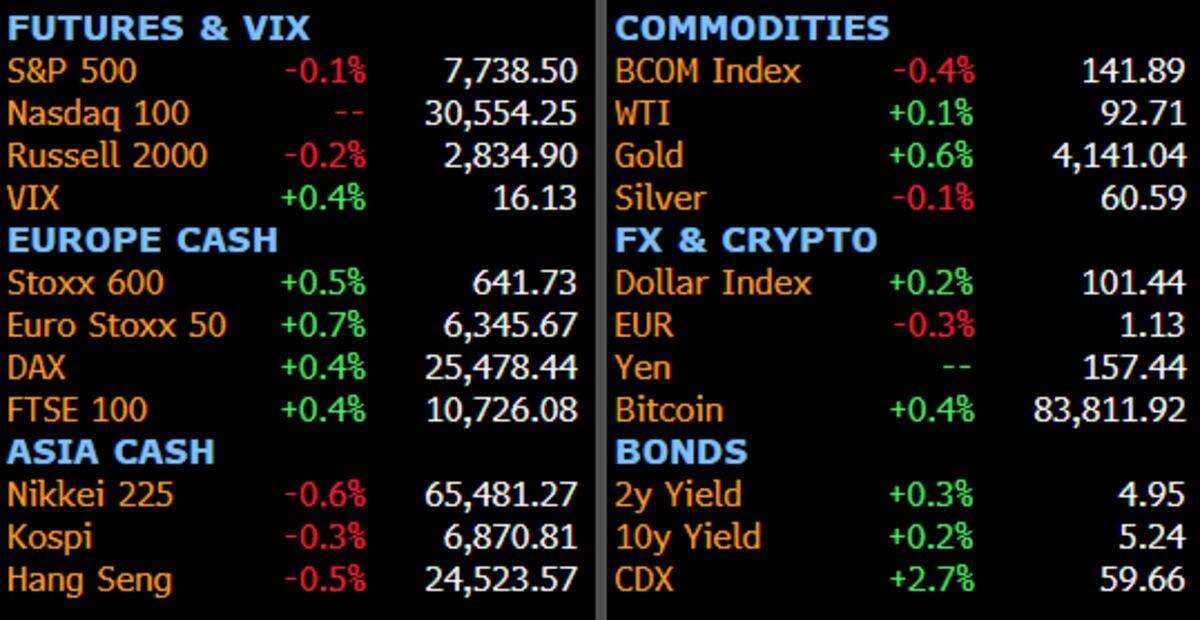
In rates, treasury futures are higher in early US session after erasing losses, with oil prices extending their retreat from Monday’s highs.US yields drop near session lows across the curve, with 10-year borrowing costs down 2bps to 5.21%. European yields are lower.US two- to 10-year yields are about 2bp richer with longer tenors lagging, steepening 5s30s spread by around 1bp on the day. 10-year is around 5.22% with bunds and gilts in the sector outperforming by 2bp and 3bp respectively. UK gilts outperformed European peers as markets waited for Prime Minister Andy Burnham to address the ruling Labour Party in Liverpool. Officials expect Burnham could signal he wants to begin a conversation about reforming the state pension to help pay for social care. IG dollar issuance slate includes a couple of names so far. Kroger was the sole issuer to tap the US primary market Monday, raising $1.5 billion while at least four others elected to stand down. Paramount is expected to announce the US dollar leg of a debt sale as soon as Tuesday after holding investor outreach Monday. US session includes consumer confidence gauge, JOLTs job openings data and comments by six Fed officials.
In commodities, WTI futures are on session lows, having added to losses after comments from the Qatar Foreign Ministry on possible US-Iran solutions. Brent crude is down 2% and trading around $104/bbl after advancing as high as $107.87/bbl in the European morning. There was no obvious news driver behind the dip but it follows a familiar recent pattern. Bitcoin is up 0.5%.
Today's US economic data slate includes July FHFA house price index and S&P Cotality home prices (9 a.m.), September consumer confidence and August JOLTS job openings (10 a.m.) and September Dallas Fed services activity (10:30 a.m.). Fed speaker slate includes Vice Chair for Supervision Bowman (11 a.m.), Governor Barr (12:40 p.m.), Chicago’s Goolsbee (1 p.m.), St. Louis’s Musalem (1:30 p.m.), New York’s Williams (2 p.m.) and Governor Waller (3 p.m.)
Market Snapshot
Top Overnight News
- Iran’s ability to choke off oil flowing through the Strait of Hormuz—and use that as leverage in talks with the U.S.—is breaking down, raising the risk it will resort to military escalation to bolster its position. WSJ
- Crude oil exports from key Middle East producers rebounded in September to 16.328 million barrels per day (bpd), the highest since the US-Israeli war on Iran started in late February, data from Kpler showed on Monday, as Saudi Arabia and the United Arab Emirates boosted exports. RTRS
- President Trump is willing to give Iran sanctions relief and release Iranian frozen funds in return for concrete Iranian steps regarding the nuclear program, U.S. officials say. But Trump took to Truth Social Monday evening to say such reports were "untrue." Axios
- Nvidia has held talks with insurance companies about shouldering the risks of lending against its chips as chief executive Jensen Huang pushes to unlock more demand for its semiconductors beyond Big Tech groups. FT
- China pledged more support for its slowing economy, including tapping unused local bond quotas and expanding central bank relending. Beijing will also subsidize interest payments for first-home mortgages. BBG
- A US import ban on certain Canadian motorcycles, alcoholic beverages and whey products took effect after Ottawa imposed retaliatory tariffs. The affected trade is relatively small at about $1 billion. BBG
- South Korea's Finance Minister said closely monitoring the bond market and will conduct treasury bond buyback if bond yields rise excessively: BBG
- Australia’s central bank has raised interest rates to the highest level in 15 years as the war in the Middle East fuels inflation and adds to economic uncertainty. The Reserve Bank of Australia on Tuesday increased its main borrowing rate by 0.25 percentage points to 4.6%, its fourth rate rise this year, as higher fuel prices fed into costs of goods and services. FT
- Japan’s 40-year government bond auction drew its strongest demand in six years as elevated yields lured investors back to the nation’s longest-dated debt, offering a potential reprieve to fragile global markets. BBG
- Spanish inflation rose for an eighth month in a row in September, accelerating beyond the eurozone average as its economy continues to outperform. WSJ
- September’s living up to its reputation for typically being the worst month for Treasuries. History suggests October will offer little relief, especially with the US-Iran war, fiscal concerns and a hawkish Fed. BBG
Iran Latest
- Iran's Foreign Minister Araghchi said Tehran discussed proposals with Qatari mediators to present to the US, and response is to be relayed to Tehran through Qatari mediators, adds conditions set by Supreme Leader must be met to reopen Strait of Hormuz. If the US wants a deal or peace, Iran has offered a solution. He will fly to Tehran in a few hours, and the Qataris will know how to reach us whenever they have the answer. Expects US response on Tuesday. Communications and messages exchanged by Qatari and Pakistani mediators have always been, but now they have taken a more serious form due to the plan presented by Iran.
- Iranian Foreign Minister Araghchi said Iran's positions have not changed and conditions for reopening the Strait of Hormuz are clear, while their position on other matters is clear. Hopeful the US' final answer will be conveyed via Qatari "by tomorrow".
- Iran's Foreign Ministry spokesperson Baghaei said media reported about the content of consultations with the Qatari mediator are baseless speculation, noting such accounts have no basis in reality and no discussion of the details of the issues took place.
- Iran Foreign Ministry Iranian delegation met with Qatar mediator on Monday afternoon at the UNGA, adds media speculation on Qatar talks is false and that there were no talks held on detailed issues with Qatari mediator. said:. Iran delegation will depart New York for Tehran on Monday night.
- Iranian MP Ebrahim Rezaei said no negotiations will begin until the US fulfils its commitments in the Islamabad understanding, while he stated that Iranian diplomats lack permission for bilateral or trilateral talks in the current situation. said:. US failed to release blocked funds after Islamabad deal.
- UN Secretary-General Guterres requested in a meeting with Iran's Foreign Minister Araghchi for a continuation of negotiations to achieve peace, according to Fars News Agency.
- US President Trump posted "Axios just released a story that “Trump” offered Sanctions Relief and Frozen Funds to Iran. This is untrue. I offered them NOTHING! Axios’ story, like most others, is a HOAX". Full post "Axios just released a story that “Trump” offered Sanctions Relief and Frozen Funds to Iran. This is untrue. I offered them NOTHING! Axios’ story, like most others, is a HOAX, used only for purposes of satisfying their Trump Derangement Syndrome. They should withdraw this fake story, IMMEDIATELY!".
A more detailed look at global markets courtesy of Newsquawk
APAC stocks were mostly subdued following the weak handover from Wall Street, where the major indices were pressured as oil prices and yields continued to climb, amid a slew of conflicting geopolitical headlines. ASX 200 traded rangebound with the index kept afloat for most of the session amid outperformance in the local tech, mining and materials industries, but with the upside limited after disappointing Household Spending and with mild pressure seen after the RBA hiked rates as expected and stuck to the hawkish script. Nikkei 225 underperformed and tested the 65,000 level to the downside, with the declines led by weakness in refiner and power-related stocks. KOSPI was choppy with the index ultimately dragged lower by the tech giants amid recent upside in yields, while South Korea's Finance Minister noted they are closely monitoring the bond market and will conduct a treasury bond buyback if bond yields rise excessively. Hang Seng and Shanghai Comp traded mixed with Hong Kong pressured amid weakness in some autonames and as fast fashion retailer Shein slumped after it reported its H1 oper. profit fell by over 50% Y/Y, while the mainland was resilient after the PBoC and government agencies issued guidance to expand capacity and improve the quality of China’s service sector through financial support, and China also asked local governments to pilot high-quality policies to boost consumption.
Top Asian News
- China has asked local governments to pilot high-quality policies to boost consumption, according to SCMP.
- Japan's Chief Cabinet Secretary Kihara said multi-layered Japan-China communication is important.
European bourses (STOXX 600 +0.5%) are broadly firmer this morning, with sentiment buoyed by increased hopes of US-Iran diplomacy – although uncertainty remains (see commodities for details). The energy complex has waned off best levels throughout the London morning, which has also helped lift the equities complex. European sectors hold a positive bias. Tech takes the top spot, reversing some of the pressure seen in the prior session. Industrials and Basic Resources complete the top three, with the latter rebounding from the pressure seen on Monday. To the downside, Food Beverage & Tobacco is joined by Energy and Optimised Personal Care.
Top European News
- UK PM Burnham has been warned by one of Britain’s largest unions that scrapping the triple lock on state pensions to help fund free social care for the elderly would be “electoral suicide” amid growing cabinet splits, reported The Times.
FX
- DXY is firmer after strengthening on Monday alongside higher US yields, with the Buck supported by elevated energy prices and continued Fed tightening expectations. DXY briefly rose from around 101.30 to above 101.38 in recent trade before paring slightly despite a dip in yields at the time, with the index currently towards session highs in a 101.17-101.44 range.
- EUR/USD is softer as the Dollar strengthens, with the pair extending below 1.1350 and trading towards the bottom of a 1.1343-1.1374 range. Spanish CPI printed hotter than expected at 4.9% Y/Y (exp. 4.7%, prev. 4.3%), with Core CPI also rising to 3.1% from 2.9%, although the data provided little support to the Single Currency.
- GBP is softer against the Dollar and trades towards the lower end of a 1.3227-1.3258 range. Sterling-specific newsflow centres on PM Burnham’s Labour conference speech later, where reports suggest he will edge the party closer towards rejoining the EU and signal an end to the pensions triple lock, although price action thus far remains largely driven by the firmer Dollar.
- JPY is broadly flat against the Dollar but outperforming most G10 peers, with USD/JPY trading around the middle of a 157.20-157.59 range. Japanese Finance Minister Katayama reiterated that the undervalued Yen is problematic and said Japan and the US agreed to bolster cooperation on FX after discussions with Treasury Secretary Bessent.
- Antipodeans underperform, led by AUD following the RBA. The Bank unanimously hiked rates by 25bps to 4.60% and retained the option of further tightening, but Governor Bullock subsequently struck a more dovish-than-usual tone, saying she hopes the four hikes delivered this year will be restrictive enough to slow inflation and that further hikes may not be needed if inflation comes down. AUD/USD fell from 0.7021 during the press conference to a 0.6973 low and remains close to session lows. NZD is also softer against the Dollar.
- Japanese Finance Minister Katayama said exchanged views on FX trends with US Treasury Secretary Bessent on Friday and agreed to bolster cooperation, adds we believe the undervalued yen, in general, is problematic. said:. Will continue close communications with US Treasury to ensure orderly Forex markets. PM Takaichi's administration is not reflationary. Closely monitoring bond markets. Interest rates are determined by markets. Will communicate closely with bond markets and conduct appropriate debt management policy. Will communicate closely with market participants while maintaining high sense of urgency.
Central Banks
- RBA Governor Bullock said inflationary pressures to last longer than expected; inflation is driven by domestic capacity pressures; Board will raise rates again if needed.
- RBA hikes the Cash Rate by 25bps to 4.60%, as expected with the decision unanimous, while it stated inflation remains elevated and some of the upside risks in August are materialising.
- ECB’s Kazimir said the rate hike was unavoidable, energy prices remain a key factor, and January repricing will be key for him; ECB needs flexibility, it has enough time.
- PBoC injected CNY 90.5bln via 7-day reverse repos and CNY 698.5bln in overnight reverse repos.
- PBoC set USD/CNY mid-point at 6.7411 vs Exp. 6.7177 (prev. 6.7399).
- Indonesia's central bank said rupiah weakens on higher global inflation and oil price risk., adds rupiah depreciation is due to worries about global inflation and fiscal risk amid high crude prices and interest rates.
Fixed Income
- A firmer start to the day, but the magnitudes vary significantly. USTs near-enough flat, awaiting an update on the geopolitical front; as it stands, Iran has suggested that a final response from the US could be presented to them by the US via Qatari mediators. Though, details on that remain light. Nonetheless, and despite relatively punchy (but familiar) Iranian rhetoric, energy has eased off highs across the morning.
- USTs flat in 104-08+ to 104-19 parameters. Aside from the above, the day features a handful of Fed speakers that may prove pertinent in addition to the latest JOLTS and confidence data stateside.
- Bunds firmer by around 20 ticks at the time of writing, a few ticks shy of Monday’s 119.71 peak thus far. Specifics for the space are a little light, no move to ECB speak or a handful of data points. Otherwise, focus remains on the energy complex, and particularly TTF which continues to ease but remains well above EUR 70/MWh.
- Gilts outperform, firmer by c. 50 ticks at best, but have eased modestly off the 84.44 peak across the morning. Outperformance comes ahead of the 14:00BST speech by UK PM Burnham at the Labour Party Conference. A speech that is expected to touch on a number of topics as part of his plan for the UK ahead.
- Particular focus will be on the triple lock, reports hint that he will open the door to an end to this in his speech, by signalling a review of it as part of the next Labour manifesto. Reporting that drives Gilts higher, as the fiscal cost of the commitment is already significant and is projected to increase markedly in the years ahead. However, it remains to be seen if there is the political/public appetite for this, and what measure(s) Burnham will have to provide to offset the hit to pensioners. For reference, projections for the lock suggest it will cost over GBP 15bln/yr in 2030.
- Italy sold EUR 6.5bln (vs exp. EUR 5.5-6.5bln) 3.95% 2032 and 4.00% 2036 BTPs.
- UK sold GBP 4.25bln 4.875% 2036 Gilt: b/c 3.34x (prev. 3.65x), average yield 5.383% (prev. 5.155%), tail 0.5bps (prev. 0.1bps).
- Deutsche Telekom (DTE GY) files to sell EUR 1.5bln three-parter.
- Japan sold JPY 300bln in 40-year JGBs; b/c 3.10x (prev. 2.82x), highest accepted yield 4.125% (prev. 3.865%). Price at the highest accepted yield 93.69 (prev. 98.68).
Commodities
- WTI Nov and Brent Dec futures are modestly firmer/flat but off earlier highs as traders continue to digest conflicting US-Iran developments (see below). WTI trades towards the lower end of a USD 92.44-94.74/bbl range, while Brent similarly sits near the bottom of a USD 97.62-100.28/bbl range, albeit both firmer intraday.
- Dutch TTF is softer, pulling back from earlier highs despite continued concerns around European energy security. The European Commission has asked member states to consider measures to reduce gas and electricity demand for as long as necessary. TTF is choppy but currently towards the middle of a EUR 71.65-73.10/MWh range.
- Precious metals are firmer as they attempt to recover some of Monday’s heavy losses, helped by the modest pullback in global yields this morning. Spot gold trades towards the upper end of a USD 4,113-4,149/oz range, although fundamentals remain against the yellow metal amid high energy prices and expectations of further Fed tightening. Spot silver is flat towards the middle of a narrow USD 60.29-61.03/oz range.
- Base metals are softer, with the complex remaining near recent lows amid subdued risk sentiment and ahead of China’s holiday period. 3M LME copper sits at the bottom of a USD 14,391-14,518/t range, while COMEX copper is lower by around 0.6%.
- In geopolitics, Iran expects a US response today to its latest proposal on reopening the Strait of Hormuz, although reports of Tehran showing flexibility on its nuclear position were denied by Iranian officials, while Trump also denied offering sanctions relief or frozen funds in return for nuclear concessions. This morning, Iran’s Parliament Speaker warned that if Iran cannot sell oil, no one in the region will sell oil, while an explosion was reported involving a commercial vessel in the Strait and Houthis reportedly attacked oil facilities in Yanbu. On the supply side, Saudi Arabia has resumed crude loading from Yanbu following partial repairs to the East-West pipeline.
- Gas production in Iran's South Pars Phase 11 reaches 1bln cubic feet, IRIB reported.
- Iraqi Oil Ministry announces the start of trial operations for the storage capacity project at the Nasiriyah gas depot, INA reported.
- EU Energy Commissioner Jorgensen said they do not want to relax methane rules, but rather to delay their implementation.
- Spanish Energy Minister said that Spain, Portugal and Luxembourg sent a letter to the Commission asking for a new renewable energy capacity. Spain wants the EU to consider measures to capture windfall profits from high energy prices. Spain is still waiting for a response to the proposal. Spain wants a permanent levy on the oil and gas industry to raise climate funds.
- Syria said gas pipeline fire between Al-Shola and Deir al-Zour caused by sabotage, while efforts underway to extinguish fire and fire stopped gas supply from Jbeissa plant to power stations.
- British government is said to be privately lobbying the Trump administration for an exemption should the US impose any diesel export ban, according to sources.
- IEA Chief Birol said Europe is one of the regions most exposed to the degrading diesel market, which the IEA is monitoring closely. IEA will discuss with member governments whether more strategic reserve releases are needed. IEA is discussing the situation with countries.
Trade/Tariffs:
- Nvidia (NVDA) and AMD (AMD) are lobbying US President Trump's administration to stop lawmakers from curbing exports to China, Politico reported citing sources; asking that lawmakers hold off on the China-related chip export restriction in the defence bill. The legislation in question has bipartisan support.
- US import bans on a range of Canadian products, including alcoholic beverages, dairy ingredients and some motorcycles, took effect as scheduled.
Geopolitics: Ukraine
- Estonian official said Russia was behind an arson attack on defence maker Milrem Robotics.
- Ukraine's air force reported guided bombs striking the Kharkiv region.
- Russian President Putin orders an increase in the size of the Russian army.
- FT reporter posted after a day of relentless drone attacks, Russia is now hitting Kyiv with a wave of ballistic missiles and several explosions have shaken Ukraine's capital in the last few minutes.
Geopolitics: Iran
- Iranian Parliament Speaker Ghalibaf said if Iran cannot sell oil, no one in the region will sell oil, and warns that if Iran’s security is not ensured, no infrastructure will be safe, ISNA reported.
- IRGC reiterates that Iran will never seek a nuclear weapon, Al Jazeera reported; reiterates conflict takes a different form and will bring new weapons to the field. Most of the American bases in the region have been destroyed and can no longer be used again.
- US Secretary of State Rubio tells Fox News Iran has threatened to attack our interests around the world and we are taking those threats very seriously, while he warned there will be repercussions if American interests are attacked.
- Iran Supreme Leader senior adviser warned that if Iran is attacked by the US again, the confrontation will expand to new fronts, according to Press TV.
- Iranian MP said before any negotiations, the US must accept Iran's conditions, reported Fars.
- An explosion was reported in the Strait of Hormuz, which is said to be a commercial ship attempting to pass through the southern route of the Strait, Fars reported citing Ambrey.
Other:
- Houthis reportedly attacked oil facilities in Yanbu on the Red Sea with a large number of ballistic missiles and drones; satellites showed several giant oil storage tanks at the Al-Mu'ajiz terminal in southern Saudi Arabia ablaze, Al Akhbar reported. According to an economic source close to the Ansar Allah movement, who spoke to Al-Akhbar, Sana'a forces have designated Aramco assets in Jizan, Najran, and Yanbu, valued at USD 100bln, as legitimate targets in the current round of fighting. This phase will be followed by the addition of strategic facilities of equal importance to Aramco's to their target bank.
- Intelligence sources say that Houthis expand target bank in Saudi Arabia, according to ILNA.
- N12's Lipkin reported that the commander of Hama's northern Gaza Strip brigade was "eliminated".
- US Treasury Department said Treasury Secretary Bessent met with Lebanon's PM today, while he urged Lebanon to disrupt Iran and Hezbollah networks.
- US Secretary of State Rubio told Lebanon's PM, we support a sovereign Lebanese state free from the harmful influence of Hezbollah and Iran. said:. Tripartite framework is the only way to achieve lasting peace between Lebanon and Israel.
- US Secretary of State Rubio urges Cuba to choose a different path and said the US will not tolerate threat to national security.
- Riyadh airspace experienced threat disruption and flight suspensions with planes held in holding pattern over Riyadh for about 20 minutes, according to SNN.
- North Korea said US approval for South Korea's nuclear submarine increases regional instability.
US Event Calendar
- 9:00 am: Jul FHFA House Price Index MoM, est. 0.1%, prior 0%
- 10:00 am: Sep Conf. Board Consumer Confidence, est. 89, prior 89.4
- 10:00 am: Aug JOLTS Job Openings, est. 7227.5k, prior 7271k
Central Bank Speakers
- 11:00 am: Fed’s Bowman Delivers Opening Remarks
- 12:40 pm: Fed’s Barr Speaks On Economic Outlook
- 1:00 pm: Fed’s Goolsbee Speaks in Moderated Discussion
- 1:30 pm: Fed’s Musalem Speaks on US Economy
- 2:00 pm: Fed’s Williams Gives Keynote Remarks
- 3:00 pm: Fed’s Waller Speaks on Payments System
DB's Jim Reid concludes the overnight wrap
The relentless bond selloff has shown no sign of easing, with a fresh rise in yields overnight as oil prices keep moving higher. The immediate driver was the weekend news that President Trump had rejected Iran’s proposal. So Brent crude was up +0.92% yesterday to $105.28/bbl, and this morning it’s up another +1.92% to $107.30/bbl. And as concerns have mounted about persistent inflation, that’s pushed yields up to multi-year highs once again. In fact, yesterday saw the 10yr Treasury yield (+7.6bps) close at 5.24%, and this morning it’s up further to 5.26%. So we’re not far off the 2007 closing peak of 5.29%, which would then be its highest level since 2002 if that’s surpassed. Moreover, yesterday started to see growing pressure on risk assets as well, as the S&P 500 fell -0.77%, whilst US and European HY spreads reached their widest levels since April.
Those oil moves were the main catalyst for the latest bond moves, as the weekend headlines made clear that both the US and Iran remained far from an immediate deal. After all, Trump said on Saturday that “They made a proposal but I rejected it”. And Iran’s foreign minister Araghchi said on Sunday that “we have no reason to come back to diplomacy and engage with this administration once again”. So when oil markets reopened again yesterday, that immediately drove a fresh jump.
To be fair, there were some signs of potential progress, as Iran’s foreign minister Abbas Araghchi met with mediators in New York yesterday, according to Iran’s ISNA. And later on, we saw similar reports by CNN and then Axios that Trump was open to sanctions relief and releasing frozen Iranian funds if there was “concrete” progress by Iran on the nuclear issue. So coupled with the news that Saudi Arabia has restored about half the flows through its East-West pipeline, this helped Brent pull back to flat on the day after trading as much as +4.5% higher. But then into the close, oil prices moved higher again as Trump denied the Axios story, while Iran’s Press TV claimed that reports of Iranian flexibility in nuclear talks were false.
Given all the rhetoric from both sides, investors have become more pessimistic since last week’s hopes about some kind of negotiated deal around the UN. In general, there’s been a growing awareness that hopes for a US-Iran deal have been repeatedly dashed in recent months, and that scepticism about the Strait of Hormuz reopening any time soon has led investors to price a longer period of high prices into next year. For instance, the December 2027 Brent future (+0.22%) closed at a new high of $80.29/bbl yesterday, and this morning it’s up again to $80.67/bbl. So for markets it wasn’t just a story about front-end prices yesterday, but a more protracted period of high oil prices stretching well into 2027.
This inflation momentum led investors to price in a more hawkish path for central banks, with growing expectations of a Fed rate hike at their next meeting. Indeed, as we go to press this morning, futures are pricing in a 73% chance of an October hike. And further out, markets are now pricing in the most hawkish path to date for the coming months, with 93bps of hikes now priced by the June 2027 meeting. Those moves came as Fed Governor Cook said that the labour market appears well positioned to handle higher rates, suggesting it is “roughly in balance and gradually improving.”
With markets pricing in more rate hikes and energy prices up yet again, that put even more pressure on Treasuries across the curve. Among others, the 10yr yield (+7.6bps) moved up to 5.24% by the close, leaving it not far away from its 2007 closing peak of 5.29%. Indeed, if it surpasses that milestone, it would then be the highest 10yr yield since 2002. Elsewhere, yesterday also saw the 2yr yield (+7.9bps) rise to 4.93%, the highest since 2024, and the 30yr yield (+5.6bps) rose to a new post-2004 high of 5.55%. And once again, it was real yields driving most of the increase, with 10yr real yields (+7.1bps) reaching a new post-2008 high of 2.89%.
Over in Europe it was much the same story, with yields also hitting multi-year highs across the continent. That included 10yr bunds (+4.1bps), which hit a post-2009 high of 3.64%, whilst 10yr OATs (+7.8bps) hit a post-2008 high of 4.77%, and 10yr gilts (+5.6bps) hit a post-2007 high of 5.42%. Moreover, there was also a widening in sovereign bond spreads, with the Franco-German 10yr spread up to a post-2012 high of 113bps. The last time it was that wide was just a few weeks before Mario Draghi delivered his famous “whatever it takes” speech that was seen as a turning point in the Euro crisis.
That backdrop also hit equities on both sides of the Atlantic, with the major indices generally moving lower. In the US, the S&P 500 (-0.77%) fell in a broad-based decline, with matters not helped by a larger fall for the Magnificent 7 (-1.72%). Nevertheless, some of the defensive sectors managed to post modest gains, including consumer staples (+0.40%), healthcare (+0.29%) and energy (+0.21%). Meanwhile in Europe, the STOXX 600 (+0.005%) inched up by less than a basis point, as strong gains for equities in the Netherlands, Austria and Greece helped to outweigh declines in the larger countries, with the DAX (-0.13%) and the FTSE 100 (-0.10%) both falling.
There were also signs of stress in other risk assets yesterday, as IG and HY credit spreads widened to levels last seen in April in both the US and Europe. So by the close, US IG (+2bps) and HY (+9bps) had both seen a notable jump, as had European IG (+3bps) and HY (+9bps). Moreover, that comes after US HY saw its biggest weekly widening last week (+27bps) since October last year.
This trend has generally continued overnight, with many indices in Asia lower this morning, including the Nikkei (-1.24%), the KOSPI (-0.93%) and the Hang Seng (-0.63%). The main exception to this is in mainland China, where the CSI 300 (+0.03%) and the Shanghai Comp (+0.08%) have posted very modest advances. Meanwhile, the rise in bond yields has also continued, with Japan’s 10yr yield (+0.8bps) up to 3.07% this morning. That said, despite the selloff, Japan’s 40yr government bond auction still attracted the strongest demand since 2020, with the bid-to-cover ratio at 3.1, up from 2.82 at the previous auction.
Otherwise overnight, the hawkish newsflow has continued, as the Reserve Bank of Australia delivered a 25bp rate hike, which takes its cash rate target to 4.60%. The move was expected by markets, and its statement said that “inflation is still too high” and they would be willing to raise “the cash rate target further if needed.” Meanwhile, Australia’s 10yr government bond yield is up +0.2bps this morning at a post-2011 high of 5.42%.
Looking at the day ahead, US data releases include the JOLTS report for August, the FHFA’s house price index for July, and the Conference Board’s consumer confidence for September. Otherwise, we’ll get UK mortgage approvals for August, and the European Commission’s economic sentiment indicator for the Euro Area in September. Then, from central banks, we’ll hear from the Fed’s Bowman, Barr, Goolsbee, Musalem, Williams and Waller, the ECB’s Kazimir, Nagel, Escriva, Cipollone, and the BoE’s Mann and Taylor.