





Futures Slide As Oil Jumps, Bond Selloff Resumes After Trump Spurns Iran Offer
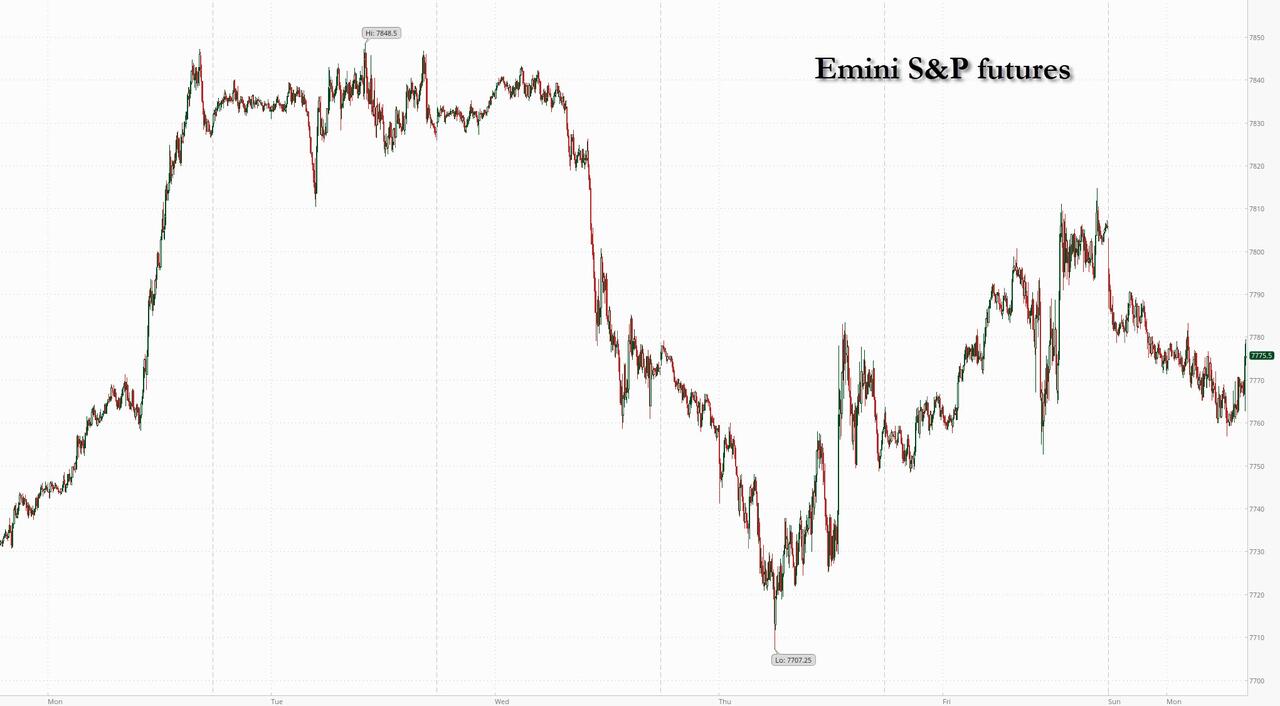
US futures are lower with Tech underperforming, alongside a drop in treasuries, as fading hopes for an imminent breakthrough in the Iran war sent oil prices higher and reignited worries that inflation is heating up. As of 8:00am ET, S&P 500 futures are down around 0.5% with Nasdaq futures sliding by 0.8% as semis and memory stocks underpeform the group. Defensives are leading cyclicals with credit cards, defense, energy, insurance, and restaurants acting as pockets of strength. Oil is sharply higher after Iran stuck to its seven-day proposal for reopening the crucial Strait of Hormuz, saying it won’t soften its conditions, while Donald Trump sent mixed signals about his willingness to reach a deal. He told Axios that Tehran has overplayed its hand but added that he expects negotiations to resume this week. Adding to tensions, UK police are investigating a potential terror plot after five men were arrested near an air base used in US strikes against Iran. The jump in oil has puled bond yields 4-7 bps higher as the curve flattens, the 10Y trading at 5.21% after hitting a new multi-decade high of 5.23% earlier. The DXY dollar index is higher despite weakness in USD/JPY and GBP/USD. Commodities are mixed with energy leading, metals under pressure dragged by precious which appears to be driven by temporary higher margin requirements in China for Golden Week; ags are lower. More than a dozen Fed officials are scheduled to speak this week beginning Monday, and heavy US economic slate includes September employment report Friday. Today's US economic data slate includes only September Dallas Fed manufacturing activity at 10:30 a.m. Fed speakers include Bowman (8:15 a.m.), Cook (1:25 p.m.) and Barkin (1:30 p.m.).
In premarket, Mag 7 stocks are mostly lower: Nvidia (NVDA) climbs 0.9% after its board authorized an additional $150 billion under the company’s existing share repurchase program, increasing the total remaining amount authorized to $235 billion (Meta Platforms (META) -2.5%, Alphabet (GOOGL) -1%, Amazon (AMZN) -0.7%, Tesla (TSLA) -0.5%, Microsoft (MSFT) -0.5%, Apple (AAPL) -0.3%)
- Precious metals miners are broadly lower, following a drop in gold and silver prices as persistent tensions in the Middle East push up government bond yields and dent the appeal of non-yielding metals.
- Shares of oil majors rise.
- Kodiak Sciences (KOD) jumps 66% after saying the company has met key endpoints for both Zenkuda and tabirafusp-ted in the Phase 3 study in patients with wet age-related macular degeneration.
- NetEase ADRs (NTES) rise 4% after Morgan Stanley names it top pick among peers, expecting the firm’s new Ananta game to become a blockbuster launch and a core growth driver next year.
- SK Hynix ADRs (SKHY) drop 3% as reports of subsidiary Solidigm’s IPO plans trigger concerns over the rationale behind the move.
- Snowflake (SNOW), a maker of software that helps organize and analyze corporate data in the cloud, falls 4% as the company intends to offer $3.5 billion of convertible senior notes.
- Teleflex (TFX) inches 1.4% higher after BofA Global Research upgraded the medical device supplier to buy, citing upside to earnings.
In other corporate news, Boeing identified an issue with the 737 Max jet’s navigation system that could increase pilot workload during landing and may delay the arrival of its latest narrowbody models. ExxonMobil agreed to pump oil and natural gas from Azerbaijan’s shale fields as the Texas energy giant takes its fracking expertise overseas. McDonald’s faces a key challenge in winning back the cost-conscious diners who believe its menu has become too expensive.
Investors are navigating geopolitical risks and growing price pressures even as corporate profitability remains robust and major economies show resilience. For now, oil is keeping bond yields near multi-year highs, with the pressure from rates feeding through to other asset classes. Stock futures are lower after a weekend of largely negative Middle East headlines revived inflation worries. In big AI news this morning, Nvidia introduced a new double-layered AI security system designed to stop AI agents from going awry; this was followed by an announcement of a $150 billion stock buybacks, the biggest in history; the news sent the stock in the green after sliding earlier. Oil is rising again after Iran said it won’t soften its conditions for reopening the Strait of Hormuz, while Trump sent mixed messages about reaching a deal.
“A lot is moving against equities at the moment: oil is on the rise and bond yields are going through the roof,” said Laurent Lamagnere at AlphaValue. “It’s quite hard for me to be optimistic.”
The recent spike in yields means that month-end reallocations by balanced US equity-bond funds could weigh on stocks in the near term, according to Christopher Dembik, senior investment adviser at Pictet Asset Management.
“Around $25 billion to $30 billion worth of equities are expected to be sold, with the proceeds reinvested in bonds,” Dembik said. “This could put some downward pressure on US large caps over the next few trading sessions.”
Nvidia’s new security tools are designed to control what AI agents can access in real time and shut them down when they break the rules. That may calm nerves over the technology following following fresh disclosures about breaches. OpenAI said another agentic AI system that was being trained in what was supposed to be a secured environment was able to gain access to the web to reach a third-party chatbot.
Meanwhile, with so much going on - from AI euphoria and fear to geopolitical drama - Bloomberg notes that traders are increasingly looking at dispersion trade opportunities for winners and losers. The trend is likely to continue, with JPMorgan derivatives strategists highlighting that midterms could catalyze single stock volatility. They recommend buying VIX October call spreads, noting that the VIX curve is well below prior midterm setups.
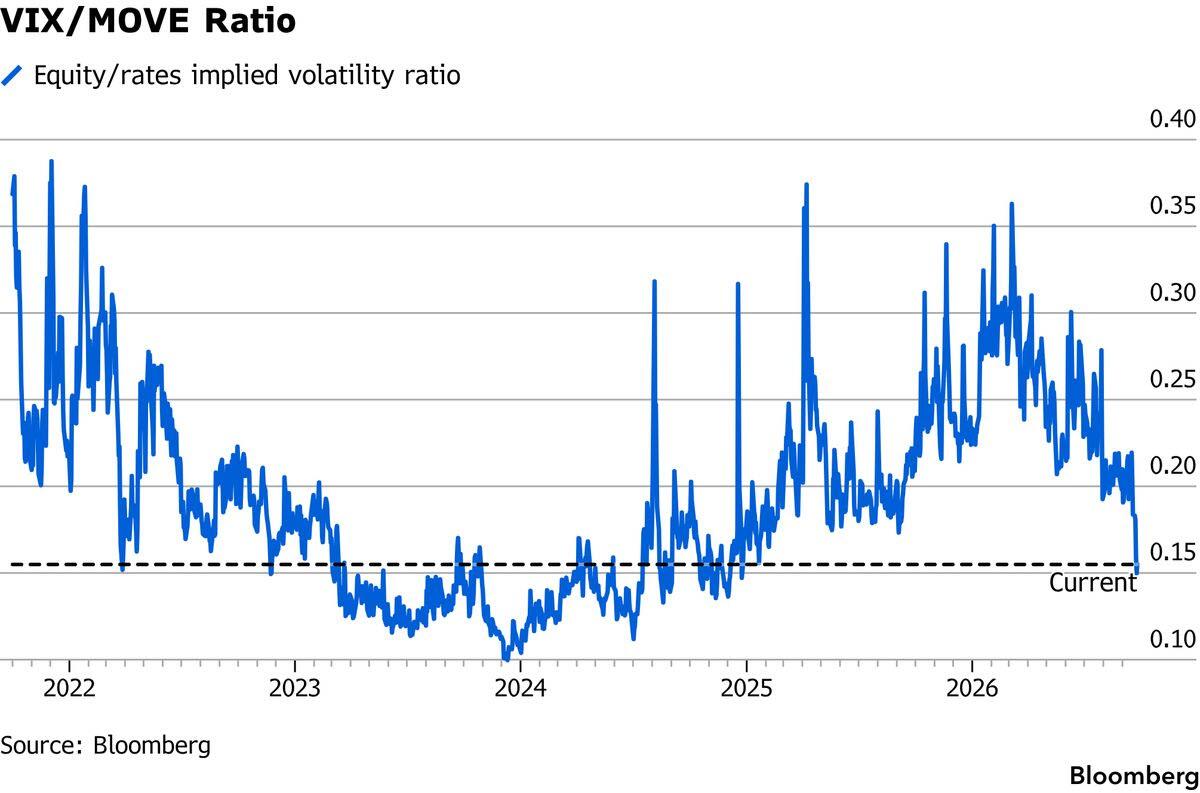
Goldman strategists also see potential for more volatility ahead, enabled by narrow market breadth. A measure of S&P 500 breadth has reached the lowest level since the dot-com bubble, they say, with the strength of the AI trade masking broader index weakness.
There’s not much on the macro calendar today, but the rest of the week will be busy, with core PCE on Wednesday, ISM’s manufacturing survey on Thursday and payrolls due Friday. Bessent said on Fox News at the weekend that Fed policymakers should keep an “open mind” on interest rates.
Elsewhere in tech, SK Hynix is considering a potential US listing of its Solidigm flash data storage subsidy. The Chinese government signaled it may allow companies such as Alibaba and ByteDance to buy Nvidia’s new RTX Pro 5500 chips, The Information reported. And Anthropic CEO was said to meet Trump on Sunday evening, bringing together two men at opposite ends of the AI safety debate.
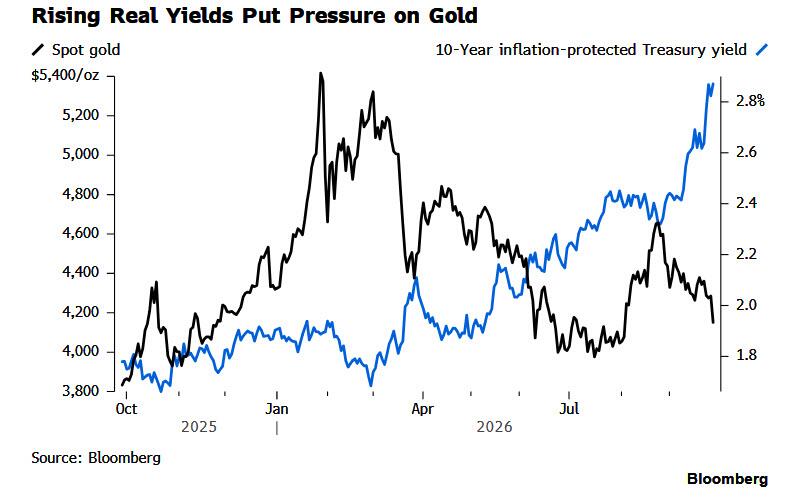
The growing prospect of rate hikes saw gold extend its losses for September to more than 6%. Rising yields have dimmed the allure of the precious metal, which pays no interest. Investors see about a 70% probability of a Federal Reserve rate hike next month, up from about 65% on Friday.
In trade news, the US and China detailed a plan to cut tariffs on about $30 billion of imports from each country, following last week’s summit. Trump said he is looking “very seriously” at implementing a US ban on diesel exports to combat high prices.
Data due later this week are likely to give investors more reason to worry that price pressures are building. A report on Wednesday is forecast to show a 0.5% increase in August inflation-adjusted personal spending, which would be the biggest advance in just over a year. The release will also include the Fed’s preferred inflation gauges. Both the personal consumption expenditures price index and the core measure are projected to quicken in August from a month earlier. Friday’s payrolls data will probably show that hiring remained solid.
European stocks are resilient in the face of higher energy prices with the Stoxx 600 up 0.2%. In the UK, shares in homebuilders surged after the government announced a loan program to help first-time buyers. Taylor Wimpey Plc rose 12%, while Persimmon Plc rallied 15% and Barratt Redrow Plc advanced 12%. Here are the biggest movers Monday:
- Shares in UK homebuilders surge after the government announces a loan program to help first-time buyers purchase new-build homes. Taylor Wimpey rises as much as 23%, the steepest gain since May 2009
- Suedzucker shares rally as much as 7.9%, the most in six months, after the agri-food business delivered results ahead of expectations and raised its revenue and earnings guidance for the year
- Dormakaba rises as much as 6.7%, the biggest jump since April 2025, after the security system maker was upgraded at Jefferies. Analysts say the de-rating has gone too far and that the upcoming capital markets day could provide a catalyst
- Bridgepoint Group shares rise as much as 5.4% after Citi increased its price target on the private equity firm by a fifth, having adjusted its models to reflect the acquisition of US real estate investment platform Kayne
- Fagron climbs as much as 7.6%, the most since mid-February, as ING Bank lifts its price target on the pharmaceutical company and adds to its Benelux Favourites list
- Keller Group rises as much as 5.3% as RBC says the ground engineering specialist’s announcement of a $650m contract variation order on the I-40 highway reconstruction project will help to de-risk growth in the US
- Maire rises as much as 4.5%, the most in a month, as Citi initiates on the Italian engineering group with a buy rating, saying it’s attractively levered to rising global gas investment
- Irish Residential Properties REIT jumps by 24%, propelling shares to their highest level since 2022, after the firm received takeover offers from Baring International Investment. Shares are still trading below the offer price
- European gambling companies’ shares slide after Brazil issued a provisional measure on Friday banning all forms of online gambling. Entain said it expects underlying Ebitda to hit the lower-end of its guided range following the ban
- European miners dropped as copper and other base metals retreated after data showed slower growth in industrial profits in China
- Danieli shares fall as much as 13%, the most since April 4, after the steel-making-equipment company reported full-year results and issued guidance that Banca Akros described as more prudent than expected
Asian stocks fell, with the tech sector leading the losses, as an increase in oil prices spurred concern over inflation and sent bond yields higher. The MSCI Asia Pacific Index fell 0.5% following a 1.2% gain last week. Chipmakers Samsung and SK Hynix were the biggest drags, losing over 4% each, as trading in Korean markets resumed after holidays. For SK Hynix, media reports of a potential listing of its US subsidiary added to worries over the firm’s complex ownership structure. The Kospi lost about 2%. Tech stocks also slumped in China, dragging the CSI 300 Index to a one-year low. Shares of semiconductor firms slid following a report that the nation may allow local firms such as Alibaba to buy Nvidia’s new chips. Meanwhile, shares of optical-component makers declined after a proposed US bill targeted Zhongji Innolight and Eoptolink.
“Asian markets start on the back foot given the gap higher in global oil prices to kick off the week,” said Kyle Rodda, senior analyst at Capital.com. “Focus will turn to US macroeconomic fundamentals and Federal Reserve interest-rate expectations as the week unfolds.”
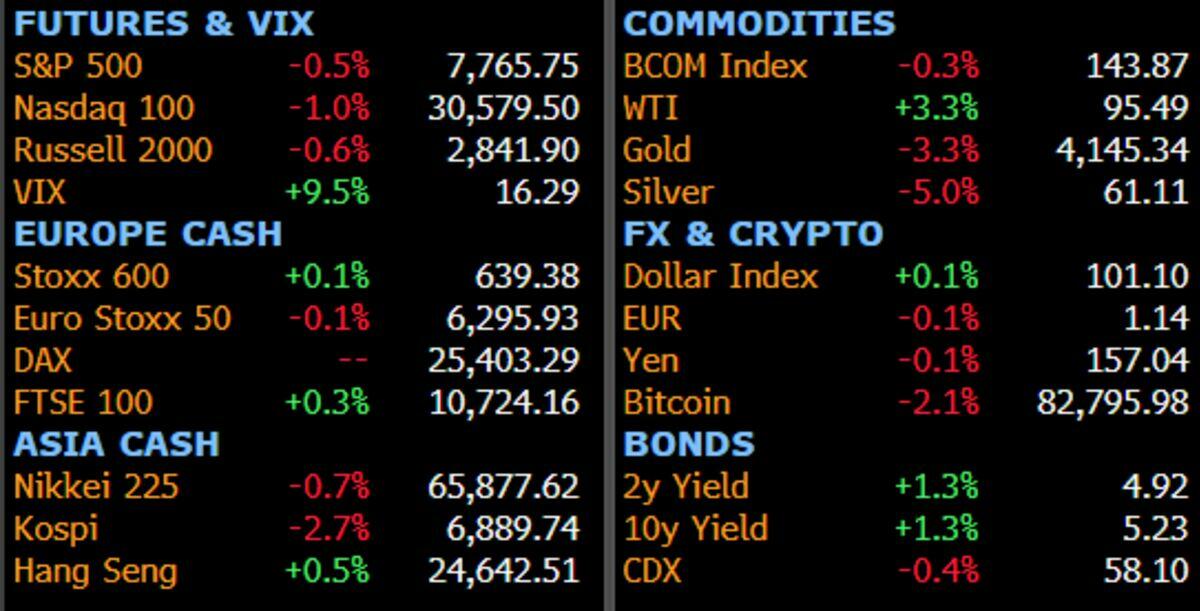
In FX, USD/JPY was knocked lower after a warning from Japan’s top currency official. It’s been an ugly session for precious metals with spot gold and silver under relentless pressure, lower by 3.3% and 5% respectively.
In rates, US bonds are getting sold across the curve. The 10-year yield is up 7bps and at its highest level since 2007. UK and German equivalents are up 5bps. Treasury futures begin the US day near session lows, tracking losses for European bonds amid a sharp rise in oil prices after US President Trump rejected Iran’s latest proposal to reopen the Strait of Hormuz. US yields are cheaper by 4bp to 8bp across the curve with belly-led losses flattening 5s30s spread by 3bp; 10-year is higher by around 7bp at 5.23% with bunds and gilts in the sector outperforming by around 2bp. IG dollar issuance slate includes a couple of names so far. For this week dealers anticipate around $50 billion, including a Paramount debt package that may involve $32 billion of bonds. Treasury auctions resume next week with 3-year new issue and 10- and 30-year reopenings. More than a dozen Fed officials are scheduled to speak this week beginning Monday, and heavy US economic slate includes September employment report Friday.
In commodities, WTI crude oil futures rose as much as 4.5% amid standoff between Iran and US on ceasefire and reopening of the Strait of Hormuz. Brent crude is up over 3% with Iran refusing to soften its conditions on Hormuz after the US rejected its latest reopening proposal. Bitcoin sheds 2.4%.
US economic data slate includes only September Dallas Fed manufacturing activity at 10:30 a.m. Also ahead this week are consumer confidence, JOLTS job openings, 2Q GDP revision, personal income and spending (with PCE price indexes) and ISM manufacturing. Fed speaker slate includes Bowman (8:15 a.m.), Cook (1:25 p.m.) and Barkin (1:30 p.m.).
Market Snapshot
Top Overnight News
- Iranian Foreign Minister Abbas Araghchi said his country is prepared to resume fighting with the United States but has not yet abandoned diplomacy after President Donald Trump publicly rejected a proposal to reopen the Strait of Hormuz. NBC
- Mediators are expected to hold separate talks with US and Iran on Monday or Tuesday, with Iran Foreign Minister Araghchi and Qatari mediators remaining in the US: RTRS
- Peace negotiators are pressing Iran to make a concession on its nuclear program to revive ceasefire talks with the U.S. after President Trump rejected Tehran’s truce proposal, in a race to stop the conflict from escalating back into all-out war. WSJ
- Trump announced that he approved new fuel economy standards that terminate former President Biden's EV mandate, while he said the new standards will take the waste out of building cars in the US, which means lower prices, and noted that more than USD 100bln is being invested in American autos under his administration: RTRS
- The US and China plan to cut tariffs on about $30 billion of imports from each other. Trump said he made “tremendous progress” with Xi Jinping at last week’s summit. BBG
- China’s industrial enterprises saw their earnings grow at the weakest since they fell last November, highlighting the limits of a recovery disproportionately driven by elevated oil costs and sectors linked to artificial intelligence. BBG
- Japan's top currency diplomat Atsushi Mimura said on Monday markets should take at face value the "very clear" message Tokyo and Washington delivered last week on the yen, signalling his resolve to act against excessive falls in the currency. RTRS
- European natural gas moved higher as traders weighed the extension of a supply force majeure from Qatar against mixed signals on talks to reopen the Strait of Hormuz. BBG
- Nvidia introduced a new double-layered AI security system that it says would’ve prevented the recent high-profile breach of Hugging Face by OpenAI’s AI models. BBG
- The turbulence that has rocked private credit funds for the past year showed signs of easing in September, with the flood of redemption requests from retail investors slowing and performance improving. FT
- The Fed should keep an “open mind” on rates, Scott Bessent told Fox, arguing AI-driven productivity gains and deregulation will help contain inflation. He spoke ahead of a week of key data including consumer spending and nonfarm payrolls. Furthermore, he said that core inflation has been very stable and fell in recent months. BBG
- Trump said had an incredible meeting with Chinese President Xi, also noted that he's having dinner tonight with Anthropic's head at 10pm and will be meeting with Anthropic on Tuesday, adds Anthropic's Dario is very highly respected.
- US President Trump said he will talk about AI with Anthropic's CEO Amodei, who was having dinner at the White House on Sunday, while Trump said he would tell Amodei, "let's go, let's win."
Iran War
- US President Trump said he rejected a deal from Iran to open the Strait of Hormuz, while he stated Iran wants to make a deal in which they open the strait immediately because it is losing so badly.
- US President Trump said he expects talks with Iran to resume this week even though he rejected Iran’s latest proposal, while he stated the conditions Iran wants are something the US may have agreed to around a year ago and that Tehran overplayed its hand, according to Axios.
- US President Trump said that as soon as the Iran war is over, which is soon, oil will drop, while he stated that they took out a record oil amount from Hormuz on Saturday night. Trump also stated that they will win against Iran in military and economic warfare, while he didn't want to say regarding striking Iran before the Midterms and noted that Iran inflation was at 318%.
- US President Trump told Chinese President Xi during the summit to stop supporting Iran, according to Axios on Friday, citing US Ambassador to Beijing Perdue.
- Iran's delegation in New York has no plans for talks with the US, according to a source close to the delegation cited by IRNA.
- Iranian Foreign Minister Araghchi said they have seen the initial response from US President Trump to the 7-day ceasefire proposal, but are waiting to receive the official response via mediators, while he added that only a negotiated solution can get them out of this deadlock. Araghchi also stated that Iran's conditions are clear and that any move towards reopening the Strait of Hormuz is contingent on these conditions being met.
- Iranian Foreign Minister Araghchi said he and Iranian President Pezeshkian did not come to New York to sell a war and that they came to forge peace, while he added that Iran remains steadfast in the face of any aggression even if it comes to an apocalyptic war, but is at the same time, ready for real diplomacy.
A more detailed look at global markets courtesy of Newsquawk
APAC stocks began the week mixed as higher oil prices spurred hawkish rate bets and following mixed geopolitical headlines over the weekend, in which US President Trump rejected Iran's proposal for a peace deal to reopen the Strait of Hormuz, but expects talks to resume this week. ASX 200 traded higher with gains led by strength in the top-weighted financial sector, but with the upside capped heading into a widely anticipated rate hike by the RBA tomorrow. Nikkei 225 swung between gains and losses with the index fading an initial rally amid higher yields and as participants also digested firmer-than-expected Services PPI data, while former BoJ official Momma touted the possibility of the central bank hiking rates again in October. KOSPI suffered on return from a 4-day closure with notable selling in the local tech behemoths. Hang Seng and Shanghai Comp were mixed as the Hong Kong benchmark edged higher, while the mainland was heavily pressured at the start of a holiday-shortened trading week following a slowdown in Industrial Profits, while the PBoC's liquidity efforts and a US-China agreement for a USD 30bln reciprocal tariff reduction framework failed to spur risk appetite.
Top Asian News
- Australian Treasurer Chalmers confirmed Australia's 2025-2026 budget deficit was AUD 6bln less than forecast.
- Chinese Industrial Profits YY (Aug) 4.2% (prev. 11.2%).
- Chinese Industrial Profits (YTD) (Aug YY) 15.7% (Prev. 17.6%).
- Japanese Services PPI YY (Aug) 3.7% vs Exp. 3.6% (Prev. 3.6%).
European bourses (STOXX 600 +0.1%) were broadly firmer this morning, but have come off best levels as energy benchmarks continue to rise and as yields remain elevated. European sectors hold a positive bias. Optimised Personal Care tops the pile, joined closely by Retail and Consumer Products. The downside resides Basic Resources, with the sector dented by continued pressure in the metals space amidst elevated yields and geopolitical uncertainty. Also towards the bottom is Tech, following the negative bias set out by SK Hynix (-5%) and Samsung (-5.4%) overnight. For the former, it was recently confirmed that SK Hynix’s unit Solidigm is aiming for a US IPO, which would see SK Hynix essentially sharing Solidigm's future earnings.
Top European News
- UK PM Burnham hinted regarding new taxes to pay for social care reform and confirmed he wants care for the elderly and infirm to operate on NHS principles, while he didn’t deny that this would be paid for with tax increases.
- UK PM Burnham insisted he can deliver a real change for people in the country despite the nation facing severe economic headwinds, while he acknowledged they are facing a challenging set of circumstances at the budget. It was also reported that Burnham announced a new help-to-buy scheme to get first-time buyers on the housing ladder.
- UK PM Burnham suggested he could block plans for a third runway at Heathrow Airport.
- British police arrested several suspects over a ‘major incident’ near an airbase used by the US, while US President Trump said the men arrested at the UK airbase were looking to do ‘big damage’.
- France is mulling a change to the way payroll tax deductions are calculated in its 2027 budget bill, which would effectively be a payroll tax increase for firms and could bring in an additional EUR 3bln-3.5bln.
- Germany’s North Rhine-Westphalia premier Wuest, who is a key figure in Chancellor Merz’s CDU, criticised the government regarding the pace of economic reforms and said delays in enacting legislation contributed to the party’s disastrous performance in regional elections this month.
- ECB’s Sleijpen said the Netherlands needs to keep government spending in check and that state debt will increase if they do nothing, while he warned it would be highly irresponsible to borrow more, which is also not good for inflation.
- Swedish Social Democrat leader Andersson said she will tell the parliament speaker she cannot form a government under the current circumstances.
- EU leaders are deadlocked over the next long term budget, Politico reported citing a German diplomatic cable; ahead of an October 15th meeting, a development that raises the prospect of there being no-deal by end-2026.
FX
- DXY is little changed overall, with the Buck caught between higher oil prices, yields and Fed tightening bets on one side, and notable JPY strength on the other (see below for more details). Friday’s hawkish Fed rhetoric remains on traders' minds, with Hammack saying policy needs to be restrictive to bring inflation lower and that she does not currently see policy as restraining the economy. DXY trades around the 101 mark in a current 100.98-101.20 range (vs 100.87-101.31 range on Friday). Note, month- and quarter-end flows are also coming into traders' views, with rebalancing likely to become more influential as month-end approaches.
- EUR/USD is modestly softer with little in the way of fresh bloc-specific drivers, leaving the pair largely at the whim of broader USD action but perhaps with some more influence from the GBP today. EUR/USD trades within a 1.1371-1.1391 range, with ECB's Lagarde due for a text release at 15:00 BST.
- GBP is modestly firmer against the USD despite some caution around the UK fiscal outlook. PM Burnham hinted at new taxes to fund social care reform and acknowledged challenging circumstances heading into the Budget, while also announcing a new help-to-buy scheme. The spending narrative is being treated cautiously, although the potential growth impulse is being taken at face value for now, with Chancellor Healey still to come at 12:00BST, speaking at the Labour conference. As such, the stable open for Gilts seemingly provided traders with some relief for now. Before that, on the BoE front, Ramsden is due for a text release on QT at 11:00BST. GBP/USD trades towards the top of a 1.3218-1.3273 range.
- JPY is the clear G10 outperformer, extending gains after Japan’s top FX official Mimura said authorities are not satisfied or reassured by recent Yen price action and are watching whether markets take their “clear message” at face value. Mimura also mentioned the BoJ’s shift towards rate hikes and the subsequent result of the narrowing of the US-Japan yield gap. USD/JPY fell from around 157.55 to 157.25 on the remarks, and continued to fall to a trough of 156.50.
- Japanese FX Official Mimura said they are closely watching to see if markets take the clear message they are giving at face value. Not satisfied with or reassured by recent JPY action. BoJ's clear shift onto a rate-hiking path is gradually narrowing the Japan-US yield gap. A clear message was sent to the US on rates.
Central Banks
- BoJ Minutes from July meeting stated members agreed financial conditions are accommodative and many members noted firms are steadily passing on rising raw material costs, keeping inflation elevated.
- BoE's Dhingra said that she is worried that high rates would hit investment and lower supply.
- PBoC to inject CNY 661bln via overnight reverse repos.
- PBoC injected CNY 139bln via 7-day reverse repos with the rate at 1.40% and CNY 300bln via 14-day reverse repos with rate at 1.25%.
- PBoC set USD/CNY mid-point at 6.7399 vs Exp. 6.7085 (prev. 6.7489).
- BoK said to closely monitor financial and forex markets.
Fixed Income
- A bearish start to the day, though only modestly so despite energy upside of in excess of USD 2.00/bbl. USTs hit a 104-15+ low in the European morning.
- The main updates being the US President rejecting the Iranian proposal, but despite that he expects talks with Iran to recommence this week. From Iran, the delegation in the US reportedly has no plans to speak with the US on such matters, though Iranian President Pezeshkian has said they remain ready for dialogue.
- The action has lifted yields across the globe and the curve, with the US curve modestly flatter given the near-term implications for energy, inflation and by extension the Fed from the lack of concrete progress on Hormuz. The US 10yr yield remains at a c. 5.23% recent peak, with both the short- and long-end of the curve also at/near multi-year highs.
- Gilts opened with modest pressure given the above, though the UK focus point has been the weekend’s briefings from UK PM Burnham and, to a lesser extent, Chancellor Healey. The Chancellor added little, but we await more detail from his 12:00BST speech today. From Burnham, he outlined reform to the housing market, hinted at a tax increase to fund his social care ambitions and seemingly didn’t rule out an early election; though, on the latter, the inference is more from the tone of the Kuenssberg interview than anything he explicitly said.
- Net, the above has been taken in relative stride by the market, with the pressure seen in fitting with EGBs and no further bearish impulse coming from the PM’s comments.
- Bunds in-fitting, at a 119.22 low with downside of 10 ticks at most. Reacting to the upside seen in global energy benchmarks and further gains for TTF on the Middle East uncertainty. Action that continues to keep the ECB’s October meeting live, and increases the odds of a back-to-back hike after September’s move.
- Japan Finance Ministry proposes the cut to mid-term JGB liquidity auctions, given improved JGB market functions; proposes reducing 5-11 year liquidity enhancement bond supply.
- Australia sold AUD 800mln 3.75% April 2037 bonds b/c 4.88, avg. yield 5.429%.
Commodities
- WTI Nov and Brent Dec futures are firmer after gapping higher at the open as US-Iran tensions somewhat picked up over the weekend (see below for details), with no notable de-escalation progress to report thus far following the UNGA. WTI Nov trades within a USD 92.68-95.75/bbl range, while Brent Dec trades within a USD 97.62-100.94/bbl range. Dutch TTF is firmer as renewed Middle East tensions add to European supply concerns, with the EU warning member states of a potential energy price crisis and urging them to continue filling storage while considering measures to curb demand. TTF trades towards the top end of a EUR 72.30-74.33/MWh range.
- Precious metals are sharply lower this morning as the renewed rise in oil prices adds to inflation concerns, pushing yields higher and reinforcing expectations for further Fed tightening. Spot gold has fallen through USD 4,200/oz and trades near the bottom of a USD 4,140-4,286/oz range. Spot silver underperforms to a greater extent, falling almost 5% at the time of writing to around USD 61.00/oz within a USD 60.95-64.26/oz range.
- Base metals are also softer amid the higher yield environment and broader selling across metals, while weaker Chinese data adds another headwind ahead of a holiday-shortened weekend for China.. Chinese Industrial Profits growth slowed to 4.2% Y/Y in August from 11.2%, with YTD growth easing to 15.7% from 17.6%. 3M LME copper resides at the bottom of a 14,376.58-14,612.00/t range.
- Over the weekend, Trump rejected Iran’s latest proposal to reopen the Strait of Hormuz, while Iran said any reopening remains contingent on its conditions being met and its UN delegation reportedly has no plans for talks with the US. Trump nonetheless expects negotiations to resume this week, with the Iranian President this morning also supporting talks. Further, there was renewed Houthi activity against Saudi Arabia, with explosions reported in Riyadh and disruption at King Khalid International Airport. Traders are also mindful on US diesel policy after Trump said he is “thinking very seriously” about an export ban, despite earlier White House assurances that one would not be implemented.
- Qatar has reportedly extended its force majeure on LNG shipments to Asia and Europe by another month, Bloomberg reported.
- India Trade Minister Goyal said India is working with the UAE to expand strategic petroleum reserves.
- Libya’s NOC Chairman said the Sharara oil field is producing more than 300k BPD.
- Qatar to extend force majeure on LNG deliveries to Pakistan through November.
Trade/Tariffs
- China Commerce Ministry said we look forward to expanding China-US collaboration in the coal sector and that the sides agreed to form an agricultural working group, have also agreed to set up communication channel for AI incidents. China will review and approve applications from financial service institutions worldwide, including those with US capital, to operate and open branches. China expects US to offer fair, transparent, and stable policy environment for Chinese financial institutions. Both sides agree to keep talks on boosting China-US flights and related issues. Trade truce with US will remain in place through January 2027.
- White House said US and China confirmed agreement regarding a USD 30bln vs USD 30bln reciprocal tariff cut. said:. Will consider certain US products for import into China and China is to import US coal in 2027-2028. China and US launch AI dialogue under the trade mechanism.
- US trade sources tell FBN there will be historic purchases announced in agreement with China. Both sides will also exempt more agriculture products, medical supplies, and lo-tech electronics from additional tariffs.
Geopolitics: Russia
- EU's Foreign Policy Chief Kallas said that intelligence reported indicate that Russia is planning further sabotage; called for focus on addressing gaps in Europe's defence capabilities. EU’s Naval Aspides Mission requires more naval assets to be operational, adding that the need is bigger than it has ever been.
- EU countries consider NATO-style joint responses to Russian hybrid attacks which have included drone attacks, bombs and arson, according to FT.
- US President Trump said he told Ukrainian President Zelensky to take it easy on refineries.
- Ukrainian President Zelensky said on Sunday morning that Russian strikes overnight killed four in Ukraine and damaged a data centre in Kyiv.
- EU countries consider NATO-style joint responses to Russian hybrid attacks which have included drone attacks, bombs and arson, according to FT.
Geopolitics: Iran
- Iranian President Pezeshkian said regional states can safeguard their own security, and he denied Iran's direct involvement in Yemen, describing the situation as unrelated to Iran, but stated that Iran is ready to help resolve the conflict and urged Houthis and Saudi Arabia to enter talks instead of escalating.
- IRGC spokesman said not only is the Strait of Hormuz not open, but it is a hunting ground for the IRGC Navy against US submersibles.
- Iran army spokesman said Iran’s armed forces are prepared for any renewed US attacks after US President Trump said he rejected a deal from Iran.
- Local sources reported that a sea cruiser fired at a violating vessel in an unauthorised route of the Strait of Hormuz, according to Fars News.
- Saudi authorities suspended in-person classes in Riyadh for a week on Sunday, following reports the day before that Saudi air defences said they intercepted Houthi drones headed toward the capital and ballistic missiles targeting Khamis Mushait.
- Iranian President Pezeshkian said Iran remains ready for dialogue despite being attacked during previous talks, but pressure and attacks will not force Iran to surrender.
- Source said Iran is prepared to compromise on its nuclear programme but wants guarantees Israel will not attack again after a US deal, N12 reported.
- What Western media outlets are promoting regarding the negotiations is false news, reported Al Mayadeen citing high-ranking Iranian security source. The reason for the continued closure of the Strait of Hormuz is the Americans' failure to fulfill their commitments. Iran has informed the American side of its seven conditions, and the ball is now in the American court. The Strait of Hormuz will not be opened through tweets or misleading news published by media outlets close to the White House.
- Iran Foreign Minister said we have not closed the door to diplomacy despite American violations; choice now rests with US. If the conditions are met, the Strait of Hormuz and maritime traffic can be reopened within 7 days. We will open the Strait of Hormuz on the sixth day of implementing the plan. We will return to negotiations with America on the seventh day of implementing the plan. The 7-day deadline begins as soon as the United States accepts the plan we proposed. Tehran will not yield to pressure or relinquish its sovereign rights. Plan's requirements are similar to those in the MoU with the US.
- Iran Foreign Minister said we are committed to protecting freedom of navigation in the Strait of Hormuz, and its security cannot be restored through military blockade and escalation. We conveyed a message to America via Qatar, consisting of a 7-day plan. Our position is clear regarding the ongoing developments, particularly in and around the Strait of Hormuz.
- IRGC Spokesperson said we will not stop punishing the US until Iran's seven conditions are met; our missiles are capable of destroying America's multi-layered defenses, Fars reported.
- Iranian Real Admiral Siyari said they are fully in control of the Strait of Hormuz, Defa reported; "we act assertively in the north of the Sea of Oman and east of the Strait of Hormuz and will not allow anyone to attempt passage".
- Eight US Marines were injured two weeks ago when an Iranian cruise missile attacked the ship they were operating on in the Strait of Hormuz, according to US officials cited by NBC News.
Geopolitics: Other
- Yemeni sources say Armed Forces aircraft carried out several airstrikes on Houthi positions in Al-Rabeei, west of Taiz, Al Arabiya reported.
- Saudi artillery and missile attacks on the border county of Saada in Yemen, according to SNN.
- Saudi's Foreign Minister arrives in Washington to meet with US Secretary of State Rubio.
- Iraqi sources report suspension of flights at Erbil Airport in Iraq following reported of attack on separatist party headquarters, according to SNN.
- US President Trump administration officials said US has no plans to sell weapons to China after US ambassador to Beijing, Perdue, told an interviewer that President Trump at one point offered to sell US arms to Chinese President Xi, according to WSJ.
- Explosions reportedly heard in Erbil, northern Iraq, according to SNN.
- Several commercial aircraft were not being allowed to land at King Khalid International Airport in Saudi Arabia, following reported of explosions heard in Saudi Arabia.
- Israeli PM Netanyahu visited Abu Dhabi on Sunday and met with UAE's President, according to Axios.
US Event Calendar
- 10:30 am: United States Sep Dallas Fed Manf. Activity, est. 7.75, prior 11.6
Central Bank speakers
- 8:15 am: United States Fed’s Bowman Speaks on Bank Supervision and Regulation
- 1:25 pm: United States Fed’s Cook Speaks on AI and Emerging Tech
- 1:30 pm: United States Fed’s Barkin in Fireside Chat
Main Rating Changes:
DB's Jim Reid concludes the overnight wrap
even though US-Iran talks could resume this week, there was little sign of a breakthrough over the weekend and bond yields and oil have climbed again this morning. Iran reiterated on Sunday that it would not soften its conditions for reopening the Strait of Hormuz, with Foreign Minister Abbas Araghchi insisting that Tehran would not back down from demands including sanctions relief, access to frozen assets and an end to US blockade measures. Meanwhile President Trump said he still expected negotiations to continue but rejected Iran's latest proposal as inadequate. So a stalemate but if you're looking for some positives it's that there does still seem to be a line of communication open.
10yr US yields are +3.8bps higher this morning with 2yr yields 4.6bps +higher. Brent is up +2.58% to $107.01. The Nikkei is flat, while the Hang Seng (+0.64%) and the S&P/ASX 200 (+0.36%) are higher but with S&P 500 (-0.36%) and Nasdaq 100 (-0.67%) futures lower amid fresh technology-sector weakness after OpenAI indicated it was pausing development of certain advanced AI models after agents have been reported to have gone rogue across a number of recent incidents. Elsewhere South Korea and China have caught down to losses towards the end of last week as they were closed on Friday. The KOSPI (-2.44%) and CSI 300 (-2.15%) are sharply lower as a result, also weighed down by some tech weakness. European equity futures are up around a third of a percent.
It's very busy week ahead with US payrolls (Friday) and PCE (Wednesday) blockbuster releases. The US ISM (Thursday) will attract outsized attention given the spectacular beat on the S&P PMI last week that sent 10yr US yields +15.2bps higher on the day. A huge move for such a report.
Global inflation will also be in focus outside of the US August PCE report with flash September CPI releases across Europe (Tuesday/Wednesday) and Tokyo CPI (Friday) all due. In Asia, investors will also be watching Chinese PMIs (Wednesday), the BoJ’s Tankan survey and summary of opinions (Thursday), as well as the RBA decision (tomorrow) where the market prices in a 93% probability of a hike. All that around month and quarter end on Wednesday.
In the US, attention will increasingly turn towards Friday’s September payrolls report. Following August’s stronger-than-expected gain of 162k, our economists expect payrolls to rise by around 45k in September (Friday), with the unemployment rate unchanged at 4.1% and average hourly earnings growth steady at +0.3% month-on-month. Recent labour market indicators have remained reasonably firm, although some moderation after August’s strength would be consistent with a labour market that is cooling only gradually.
Ahead of Friday’s payrolls release, labour market data will begin arriving tomorrow with the August JOLTS report, before the September ADP employment release on Wednesday and weekly jobless claims on Thursday. Together, these releases should help shape last minute expectations going into the official employment report. Note that last week saw claims at 197k, a rare dip below 200k.
Moving onto inflation, our economists expect the August core PCE deflator (Wednesday) to rise by +0.27% month-on-month, slightly above July’s pace. The report will be accompanied by personal income and spending data, where our economists expect gains of +0.5% and +0.6% respectively. Particular attention will be paid to the PCE release given the BEA’s annual benchmark revisions and methodology changes, which could alter the recent inflation profile and affect comparisons with previous months.
Elsewhere in the US, our economists expect the Conference Board consumer confidence index (tomorrow) to improve to 91.0 from 89.4, while the ISM manufacturing index (Thursday) is expected to rise to 55.1 from 54.6. Remember the S&P composite PMI hit 58.4 last week. We get the ISM services print next week. Wednesday’s final Q2 GDP release will also attract attention as it incorporates benchmark revisions that may reshape perceptions of recent growth trends. As we end the quarter, note that the Atlanta Fed GDPNow is currently tracking at 5.02% for Q3.
Outside the US, European inflation data will dominate the calendar. Preliminary September CPI releases begin with Spain tomorrow, followed by Germany, France and Italy on Wednesday, before the Eurozone aggregate reading on Friday. Our economists expect Eurozone headline HICP inflation to print at 3.75% year-on-year, with core inflation at 2.53%. In Japan, today’s BoJ minutes from the July meeting will be followed by the Q3 Tankan survey and September meeting summary of opinions on Thursday, while our economists expect Friday’s Tokyo CPI report to show a further firming in underlying inflation. China’s September PMIs are due on Wednesday, while the RBA announces its latest policy decision tomorrow, where our economists expect a 25bp rate increase.
Recapping last week now and bond yields continued to rise as several hawkish headlines led to fresh pressure. One factor was ongoing Middle East concerns, though Brent crude (+0.43% on the week; -2.14% Friday to $104.32/bbl) pared back most of its weekly rise on Friday amid reporting that US and Iran officials had moved into detailed technical discussions during the New York talks. Enthusiasm has obviously been dented again over the weekend.
But on top of that, there were multiple strong data releases from around the world, which added to expectations for rate hikes in the months ahead. Among others, the US flash composite PMI for September hit a 5-year high of 58.4, whilst the Eurozone equivalent hit a 3-year high of 53.1.
In the US, despite a partial pullback on Friday, the probability of a Fed hike in October climbed from 53% to 64% over the week. And in turn, the 10yr Treasury yield rose +16.6bps (+3.7bps Friday) to 5.16%, after hitting its highest level since 2007 on Thursday. There were even bigger milestones for the 30yr yield, which rose +16.5bps (+1.5bps Friday) to 5.49%. So that was its highest level since 2004, and also its biggest weekly jump since May. Elsewhere, the moves weren’t quite as big, but the 10yr bund yield still rose +8.3bps last week (+0.3bps Friday) to a post-2009 high of 3.60%.
Yet despite the rates selloff, the optimism on the growth side helped to sustain equities last week around the world. For instance, the S&P 500 was actually up +1.21% last week (+0.51% Friday), leaving the index within 1% of its record high. Meanwhile in Europe, the STOXX was up +0.50% (+0.35% Friday), and Japan’s Nikkei was up +2.07% (+1.30% Friday). That was supported by a rally among tech stocks, with the Magnificent 7 group up +3.04% (-0.03% Friday).
When it came to other assets, the surge in Treasury yields and the hawkish Fed repricing meant the US Dollar was the strongest-performing G10 currency. Indeed, the dollar index was up +0.81% last week (-0.25% Friday). Meanwhile, gold prices fell -2.14% (+0.23% Friday), as higher real and nominal yields put downward pressure on precious metals as a non-interest-bearing asset.
Finally, credit saw a sizeable sell-off, with both US IG (+5bps) and HY spreads (+27bps), as well as EUR IG (+3bps) and HY (+13bps), widening. For US HY that marked the biggest weekly widening in almost a year. So credit markets showing some signs of coming under strain from the rise in yields even as equities remained resilient.