





Futures Slide From Record As Oil Jumps On Hormuz Tanker Attacks, 30Y Yield Hits 2002 High
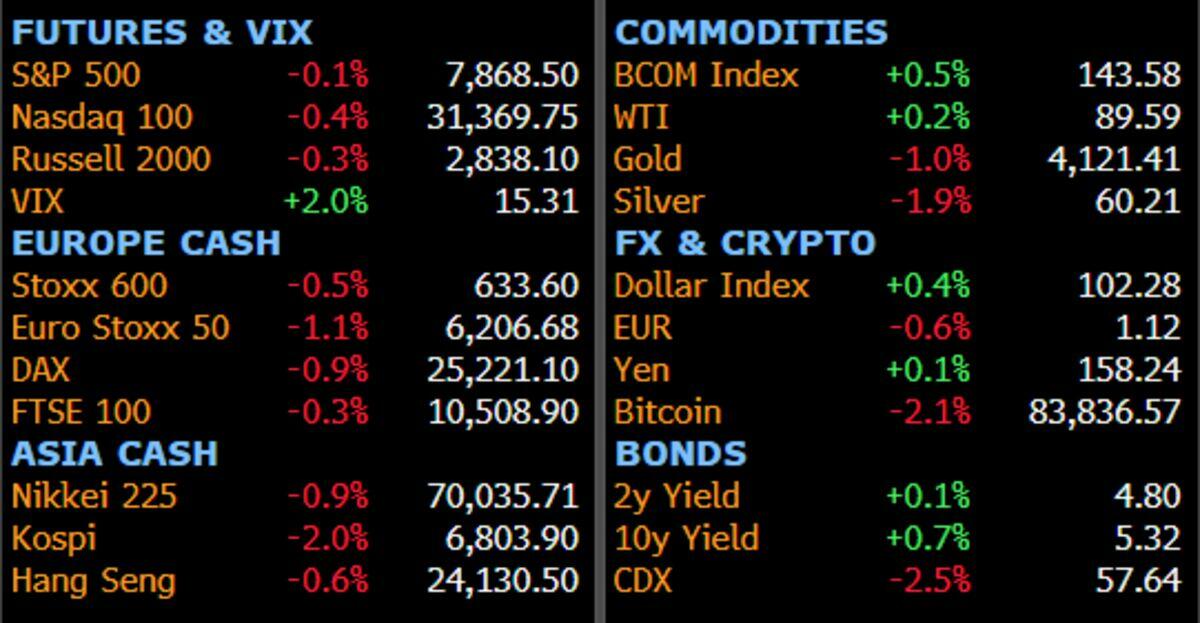
US equity futures are sliding from Tuesday's record close as oil climbs back above $100, global bond yields resume their ascent and the AI bubble debate makes an unwelcome comeback. As of 8:00am ET, S&P futures are 0.4% lower, trading around 7,844, while Nasdaq 100 and Dow futures drop 0.6%; small caps are also under pressure with Russell 2000 futures down 0.3-0.4% as usual. On Tuesday the S&P 500 rose 0.6% to close at a record high for the first time since August 13, its fourth consecutive advance and longest winning streak in about two months, with the Nasdaq 100 also closing at an all-time high. Premarket, the Mag 7 are mixed (Apple +0.4%, Tesla -0.8%) while Memory, Semis and Software are all lower as the AI theme sees some profit-taking following a slide in Korea's Kospi; Constellation Brands slides 4.7% after the Corona brewer reaffirmed guidance, Neogen jumps 11% on an earnings beat, and SpaceX falls 2% on a report it is seeking to raise $40 billion in a chip-backed SPV to buy Nvidia chips. The day's driver is once again oil: Iran has increased the pace of attacks on tankers in the Strait of Hormuz just as shipments through the chokepoint approach prewar levels, sending Brent up 1.4% to $101.94 and WTI up 0.7% to $90.02. That has pushed Treasuries lower, with the long end leading: the 30-year yield climbed 5bps to 5.70%, the highest since 2002, while the 10Y trades around 5.335%, up 5bps, and 2s10s is 4bps steeper. The Bloomberg Dollar Spot Index rose 0.3%, approaching its highest levels since June, as the euro slid to a 16-month low against the pound amid renewed French fiscal angst, with the OAT-Bund spread back out to 138bps. Gold dropped 1% to around $4,121 and silver fell 1.9% to $60.21, while copper is flat with Chinese buyers still away for Golden Week. Bitcoin is down 2.4% near $83,600. US economic data slate includes MBA mortgage applications (7am, -4.2%), September NY Fed 1-year inflation expectations (11am), FOMC minutes from the September 16 meeting (2pm) and August consumer credit (3pm). The Treasury sells $39 billion of 10-year notes in a reopening at 1pm.
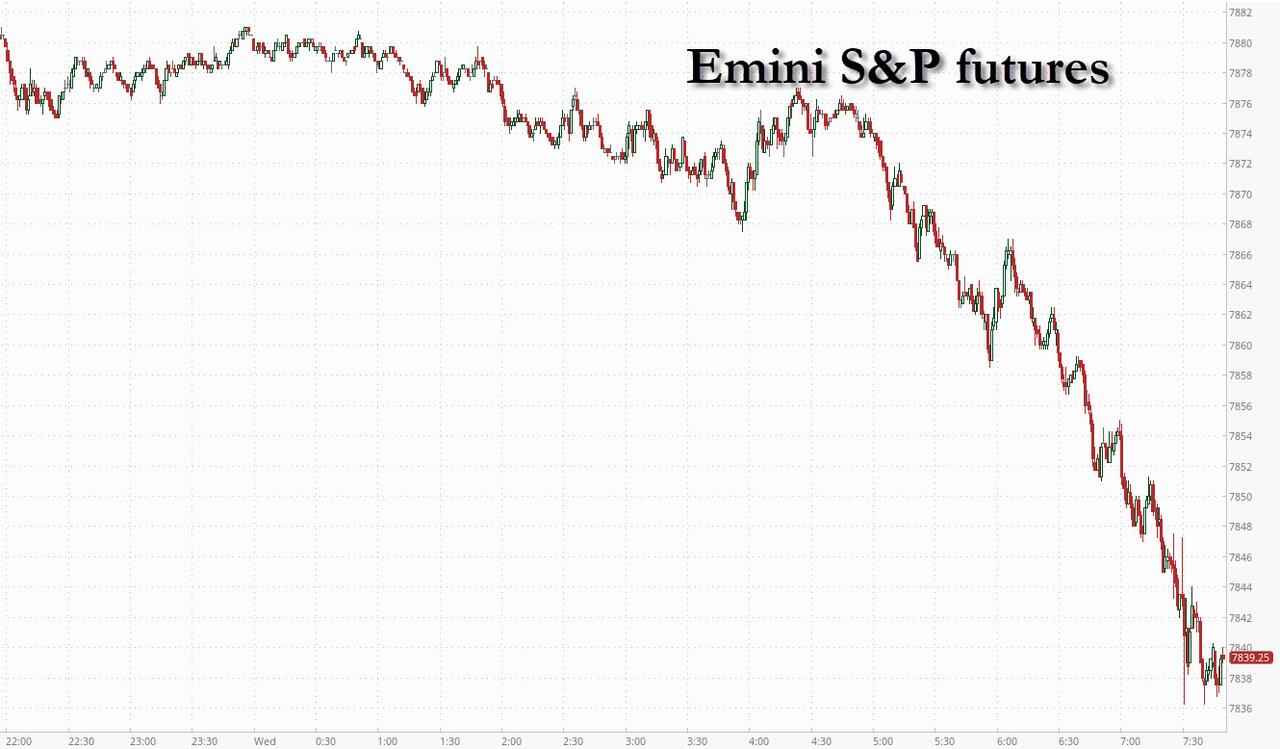
In premarket trading, Magnificent Seven stocks are mixed: Apple (AAPL) +0.6%, Meta Platforms (META) -0.1%, Alphabet (GOOGL) -0.5%, Nvidia (NVDA) -0.6%, Amazon (AMZN) -0.6%, Microsoft (MSFT) -0.7%, Tesla (TSLA) -0.8%
- Constellation Brands (STZ) is down 3.6% after the maker of Modelo Especial and Corona Extra reaffirmed its comparable earnings per share forecast for the full year. The company also announced the acquisition of SpikedAde, a vodka-based drink brand.
- Enphase Energy Inc. (ENPH) and SolarEdge Technologies Inc. (SEDG) shares fall 3% and 3.4%, respectively, after Deutsche Bank issued sell catalyst calls on the solar stocks on expected lower growth.
- Flutter Entertainment shares (FLUT) rise 3% after Citi upgraded it to buy from neutral, saying recent share-price weakness on concerns over Brazil and September US sports results is overdone.
- Neogen shares (NEOG) climb 13% after the life sciences firm reported adjusted earnings per share for the first quarter that exceeded Wall Street’s expectations.
- NetApp Inc. shares (NTAP) are up 2.4% after Evercore ISI upgraded the computer hardware and storage company to outperform from inline, seeing a strong growth outlook.
- Penguin Solutions shares (PENG) are up 4.2% after the semiconductor device company reported fourth-quarter results that beat expectations and gave an outlook that is seen as strong.
- SailPoint Inc. shares (SAIL) are up 0.9% after Oppenheimer & Co. started coverage on the software company with an outperform rating and $30 price target, seeing strong growth potential related to AI.
- Sigma Lithium shares (SGML) gain 5.8% as the company said it has resumed operations after a Brazilian court of appeals upheld its environmental licenses.
- SpaceX (SPCX) shares fall 1.9% as it is in talks with banks and investors to raise $40 billion to buy chips from Nvidia Corp., people familiar with the matter said, in what would be among the biggest-ever debt financings for the AI buildout.
- Taiwan Semiconductor Manufacturing Co. ADRs (TSMC) fall 2.2% as Elon Musk said his business empire will build and operate Terafab independently, quashing speculation about industry TSMC swooping in to run his ambitious chipmaking venture.
- Vylor Inc. (VYLR -0.9%) was initiated with a sector weight rating, while Corteva Inc. (CTVA +0.7%) was upgraded to overweight as KeyBanc Capital Markets looks to earnings growth potential.
- Webull Corp. shares (BULL) fall 30% after CNBC reported that the US House Select Committee on China is set to release a report on Wednesday that Webull is tied structurally to the government in China, raising national security concerns.
- Zscaler shares (ZS) are up 0.5% with analysts positive on the security software company in the wake of an investor day event that increased confidence about its growth potential.
In other corporate news, Apple’s upcoming smart home devices will include a doorbell, thermostat, and other accessories developed through a partnership with LG Electronics. Shell expects to report strong results from oil trading in the third quarter as a squeeze on global fuel supplies drives refining margins to a record. HSBC is planning sweeping job cuts across its UK wealth management business as part of a broader push to use AI to serve affluent clients more efficiently, the FT reported. Frasers Group acquired an 8.8% stake in Under Armour. Affiliates of Energy Capital Partners are selling about $891 million of shares in Constellation Energy in an unregistered block trade, while Oaktree sold its remaining 6.2% stake in Torm. Black Hills will invest $1.8 billion serving a Google data center, CRH is buying aggregates operations in Denmark and Finland, and Porsche plans to raise prices of its top-end sports cars by an average of 20%.
A rally in stocks came to a halt and global bonds fell as mounting attacks on tankers in the Middle East pushed oil prices higher. "Stocks are taking a breather after closing at new record highs," Bloomberg's Neil Campling writes, noting that volumes, volatility and single stock dispersion remain low, with AI and earnings continuing to dominate the narrative. Meanwhile, the debate around an AI bubble is back: Temasek’s CIO said the unwinding of the AI trade is the biggest risk facing global markets along with inflation, Ray Dalio warned once more that AI is a “classic bubble” near bursting point, and the IMF sees the world facing risks from AI, a prolonged energy shock and record debt piles. Not that the market seems to care much: as we noted last night, stocks hit fresh record highs even as the 10Y hovers near its highest since 2002, and earnings concentration is getting absurd, with Micron and Nvidia alone set to deliver a third of Q3 earnings growth.
“Bond markets really worry about the outlook for fiscal policy, but the political reality is that the people on the ground are not ready to accept that,” she said.
“Extraordinary” AI-related earnings growth should keep certain major indexes relatively resilient despite rising yields, says Mark Cudmore of Bloomberg’s MLIV. Earnings growth expectations for the upcoming season have been ticking higher and are currently sitting at 24.5%. Barclays strategists agree that the AI boom remains a key earnings driver, but note that rising debt issuance and capital intensity are putting returns under greater scrutiny.
In other AI news, SpaceX is said to be in talks with banks and investors to raise $40 billion to buy chips from Nvidia (we covered the Apollo-led SPV debt here). Given that SpaceX is currently sitting on $100 billion of cash, the financing isn’t out of necessity, but speaks to the ongoing appetite for AI deals in credit markets. AMD is working with customers to optimize memory footprints as tight supplies persist, and Intel said it will continue to work with Elon Musk on Terafab.
For traders getting more nervous about AI names, BofA strategists recommend tapping equity derivatives both to benefit from the record rally and hedge against the fallout from a potential bubble. Traders are also looking to the upcoming earnings season to see whether profits can support valuations despite macro headwinds and whether the artificial-intelligence boom still has plenty of legs.
“It’s the period before earnings when there’s a bit of a lull, so markets can be pushed around easily,” said Guy Miller at Zurich Insurance. “The focus point is still around bond yields. There was relief yesterday but let’s be clear, nothing fundamental has changed.”
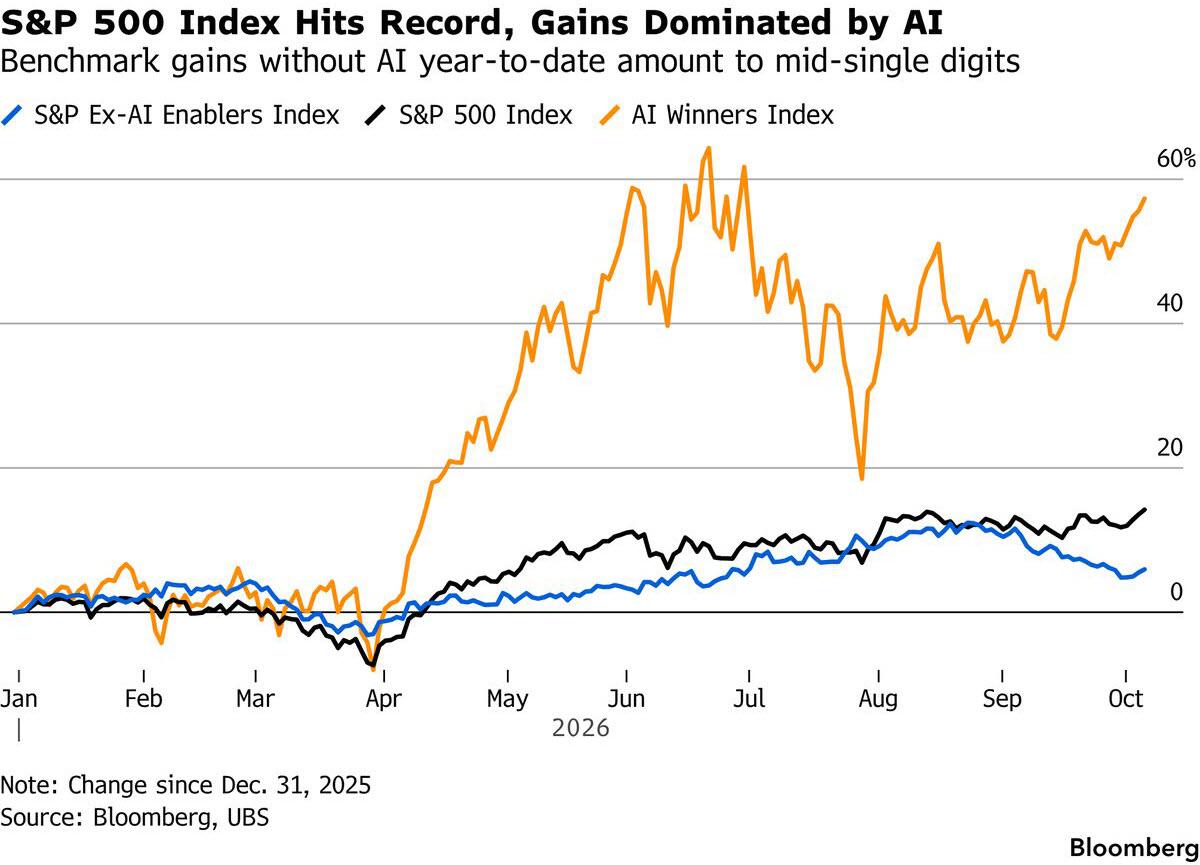
JPM's Market Intel desk under Andrew Tyler remains Tactically Bullish and thinks the market "may not be BULLISH enough into earnings": FactSet reports 26Q3 set a record for the largest number of positive pre-announcements, all 11 sectors are expected to show positive revenue and earnings growth, and consensus sees 12.3% revenue growth and 29.5% earnings growth with 15.0% margins (vs 52.3% EPS growth in Q2). The desk sees a broadening, but given where yields are, prefers a barbell with large-caps over small-caps and AI/Tech as the core. JPM also notes the bond market now prices a ~22% chance of an October hike and ~80% for December, down from 70% and 84% at the start of last week. JPM's Manish Sinha is less sanguine, flagging that the Equity Risk Premium is negative, which "effectively requires a meaningful earnings re-rating higher to justify taking equity risk," and that Momentum looks vulnerable either way.
Goldman's desk is turning more cautious. US derivatives MD Shawn Tuteja writes that "the Tech / AI asymmetry has shifted. The macro is unequivocally more difficult, and the positioning within AI and large-cap tech no longer seem to be tailwinds." Since Aug 27, the SPX is +1.28% while the S&P ex-AI names is down 5.19%, and Mag 7 net exposure on GS Prime is near 22% of total US exposure, the highest since the start of 2022. His left-tail scenario: one where "the Fed must hike an excessive number of times to maintain credibility in the backend of the bond curve." In London, Goldman Delta One head Rich Privorotsky says today's tape "feels less like generic risk off and more like higher oil + higher real rates increasingly biting the duration sensitive parts of the tape," adding that "more leverage in the AI ecosystem is not exactly what the market wants to hear right now." Meanwhile, the GS cash desk notes hedge fund nets are approaching a 5-year low with market breadth at the lowest level since 2000 (no wonder traders keep paying up for protection).
On the macro front, FOMC minutes come later but may offer less insight into current thinking given Warsh’s desire to trust the data and with PCE revisions and jobs data having been released since the Sept. meeting. Speaking of inflation, oil is ticking higher as traders weigh increased flows through the Strait of Hormuz against a pickup in Iranian attacks against vessels. Elsewhere, the EU is preparing safeguard measures to limit imports of Chinese hybrid vehicles into the bloc.
France is back on the tape: the spread between French and German 10-year yields widened as much as 10bps to 138bps, unwinding Tuesday's Le Pen relief rally, as investors continue to price in heightened fiscal pressure around budget negotiations (and as Goldman warned, the "Le Pen bounce" was not to be trusted). ECB's Moulin said the situation on France’s bond market is complicated and serious, but doesn’t warrant intervention from Frankfurt. Not everyone is panicking:
“Unlike previous episodes of severe sovereign stress in the euro area, we do not see evidence of broader financial contagion,” ABN Amro senior rates strategist Larissa de Barros Fritz wrote. “We do not expect OAT-Bund spreads to reach the 200bp+ levels seen during past Italian stress episodes.”
In Europe, the Stoxx 600 is down 0.4% at 633.64, ending a three-day run of gains as oil prices climbed and bond yields resumed their rise, with 351 members down and 233 up; Euro Stoxx 50 is down 1.1% and the DAX 0.9%. Telecoms, autos and retail lead, with carmakers rising as much as 1.75% on the EU's planned cap on Chinese hybrid imports, while banks, tech and utilities lag, with French lenders among the worst performers. Pennon plunged as much as 20% to the lowest since 2004 after a larger-than-expected £550m rights issue. Here are the biggest European movers:
- Remy Cointreau shares advance as much as 7.5%, the most since June, after the French beverages maker held a pre-earnings call that analysts said offered reassurance on the sales outlook and US trends.
- Europe’s carmakers advance as the European Union prepares a limit on imports of Chinese hybrid vehicles into the bloc. The Stoxx 600 Auto & Parts Index gained as much as 1.75%, leading gains among sectors.
- NCC shares gain as much as 7.7%, the most since Feb. 6, after the Swedish construction company agreed to sell its Industry business at an enterprise value of SEK8.2b.
- ALK-Abello shares gain as much as 3.4% as Nordea upgrades the Danish pharmaceutical firm to buy, arguing it has the potential to return to substantial sales growth from 2028 onward, following an expected dip in 2027 due to German medication rebate reform.
- Forvia climbs as much as 11% following a double-upgrade to buy at BofA, which removes the stock’s only negative analyst rating, with room seen for the auto-tech supplier to re-rate after weak performance in the shares year to date.
- Pennon shares fall as much as 20% to the lowest level since October 2004 after a £550m rights issue that was larger than analysts expected. Analysts also flag the rebased dividend and uncertainty over returns as limiting the potential for a re-rating of the South West Water owner.
- BE Semiconductor shares drop as much as 8.4% after UBS downgraded the stock to sell from buy, citing a slower adoption of hybrid bonding among memory chipmakers due to a supply crunch.
Asian stocks fell for the first time in three days, led by tech, as the earnings optimism that drove US stocks to records failed to carry over to the region. The MSCI Asia Pacific Index dropped as much as 0.9% with SK Hynix, TSMC and Alibaba among the biggest losers; SK Hynix slumped ahead of the expiry of a lockup in its ADRs on Oct. 8. South Korea's Kospi led declines, closing down 2.0% at 6,803.90, with Goldman's Korea desk noting foreigners sold $1.94 billion (net sellers for an 8th session) while retail bought $1.91 billion, and Samsung's preliminary results due tomorrow. Japan's Nikkei fell 0.9% to 70,035.71, just about holding the 70,000 level as investors booked profits, with beer makers lower after the Fair Trade Commission started investigating them over suspected price fixing; the Topix fell 0.5%. The Hang Seng slid 0.6%, Taiwan's Taiex fell 0.1% and Australia's ASX 200 was flat. Mainland China remains closed for Golden Week and reopens Thursday. Southeast Asian banks sold off after JPMorgan warned surging long bond yields will hurt third-quarter earnings, while India's RBI hiked rates by 25bps to 5.50%, its first hike in nearly four years.
“There’s a sense that Asian markets are starting to lose some of the relative momentum they enjoyed earlier,” said Tim Waterer, chief market analyst at KCM Trade. “After a period of outperformance, the lack of fresh catalysts combined with still-elevated oil and bond yields is leaving the region looking a little tired.”
In FX, the Bloomberg Dollar Spot Index rose 0.3%, approaching its highest since June, with the dollar stronger against all G10 peers and the DXY trading in a 101.88-102.32 range. EUR/USD fell to 1.1180, closing in on the 1.1161 low hit earlier in the week (the lowest since May 2025), as French fiscal angst pushed the euro to a 16-month low against the pound. USD/JPY edged up to around 158.5 after a report that Japan may be considering another supplementary budget, though PM Takaichi said the government will review policies, revenue and spending if rate moves diverge from expectations. GBP/USD slipped 0.2% to 1.3247 as gilts sold off.
“Markets are unlikely to welcome the prospect of a second supplementary budget, regardless of its size, given earlier guidance that they are no longer planned,” said Wei Liang Chang, macro strategist at DBS Bank. “The yen and JGBs may trade slightly weaker as investors await details.”
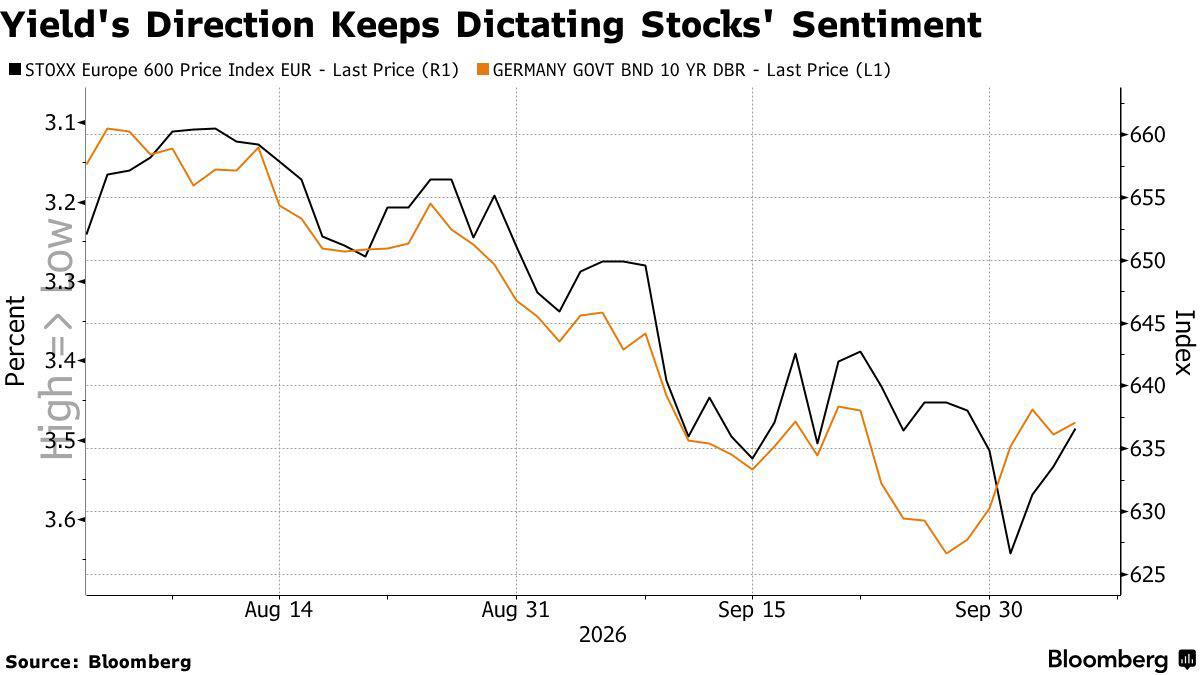
In rates, Treasuries' long end leads the selloff into the early US session, with 30-year yields cheaper by 5bps on the day at 5.70%, the highest since 2002, and peeking through Monday's highs. Yields are 1bp to 5bps higher across the curve, with 2s10s and 5s30s steeper by 4bps and 2bps; the 10-year trades around 5.325%. Gilts lag by an additional 4bps in the 10-year sector, with UK 30-year yields up 10bps to 6% (round number, nobody panic), while bunds slightly outperform and OATs give back all of Tuesday's gains; a new 2033 Bund auction drew a dire 1.42x cover with 52% retained. Duration supply is a factor: the $39 billion 10-year reopening at 1pm follows Tuesday's solid $58 billion 3-year sale, which stopped 0.2bp through, and the 10-year WI around 5.33% is ~50bps cheaper than the September reopening, which stopped 1.5bps through. The IG dollar issuance slate includes a couple of deals after four borrowers priced $4.25 billion on Tuesday. FOMC minutes from the September 16 hike land at 2pm.
“Instead of blaming bond vigilantes, deficits, Japan, fiscal dominance, erosion of central bank independence, the driver of higher rates is central banks delivering rate hikes,” wrote Bank of America rates strategist Ralf Preusser, adding that “term premium explains the entirety of the 10y yield move in US, UK, Japan, Australia and Canada” since the September central bank meetings.
In commodities, WTI for November delivery gained 0.7% to $90.02 and Brent for December rose 1.4% to $101.94 as of 6:52am, in choppy trading (WTI ranged $89.33-90.61, Brent $100.72-102.06) as traders weigh a pickup in Iranian attacks on vessels in Hormuz against resilient Middle East flows; UK maritime authorities logged nine attacks in the strait this month, already half of September's count. Vitol's CEO says the crisis has entered a new phase as buyers struggle to secure tankers (as we discussed here, every crude freight index is at a record), while EU states expect the G7 emergency release of up to 100 million barrels to merely enact prior commitments; the IEA holds an informal meeting on releasing oil and diesel reserves. Shell is evacuating non-essential workers from several US Gulf assets ahead of Tropical Storm Isaias. Dutch TTF rose to €77.37/MWh. Spot gold fell from $4,170 to a $4,117 low and silver from $61.50 to $60.34 as the dollar firmed, while 3M LME copper is stuck in a $14,339.60-14,445.85 range.
US economic data slate includes MBA mortgage applications (7am, -4.2%, 30-year rate 7.49%), September NY Fed 1-year inflation expectations (11am), FOMC minutes (2pm) and August consumer credit (3pm). Fed speaker slate: The Treasury sells $75 billion of 17-week bills (11:30am) and $39 billion of 10-year notes (1pm).
No significant earnings are expected before the open; Costco reports September sales later in the day and Levi Strauss and Applied Digital report after the close.
Market Snapshot
Top Overnight News
- Japan’s Sanae Takaichi said the government may review spending and revenue plans if bond yields move unexpectedly. BBG
- The EU’s preparing measures to limit imports of Chinese hybrid vehicles into the bloc, people familiar said. One option is to impose a levy on imports above a certain volume. BBG
- India’s central bank raised interest rates for the first time in more than three years as the Middle East conflict kept energy prices high, hurting the rupee and fueling inflation fears. The Reserve Bank of India’s monetary policy committee voted unanimously to raise its benchmark repo rate by 25 basis points to 5.50%, ending a pause spanning four consecutive meetings. WSJ
- According to the Saudi aviation authority, Saudi Arabia’s airports in Jazan and Najran were targeted in two attacks, as hostilities between Yemen’s Iran-backed Houthis and the kingdom grow. CNBC
- Leading oil executives warned that the world is running out of stopgaps to manage the impact of the Iran war as the conflict extends into an eighth month. Producers and consumers have pulled virtually every lever available to adjust to the diminished flows, including reductions in demand and large releases from strategic petroleum reserves. BBG
- The global energy crisis triggered by the Middle East conflict has entered a new phase because of a shortage of tankers to move crude around the world, according to the head of the world’s largest independent oil trader. Vitol chief executive Russell Hardy said that while more oil was now flowing out of the Gulf, there was a fresh bottleneck as buyers struggled to secure ships. FT
- The US is gearing up for another quarter of bumper corporate earnings spurred by lavish spending on the AI build-out. The robust growth should help Wall Street shrug off worries about the durability of the AI trade against the backdrop of rising borrowing costs but may do little to allay concerns about how reliant the record-high stock market has become on a small group of technology names. FT
- The French government desperately needs a return to strong growth if it is to contain its rapidly rising debts. But uncertainty about whether the country can fix its finances has itself started to weigh on economic activity. France only narrowly avoided a recession in the second quarter, as activity stagnated after extreme heat hit agricultural output and the energy price shock from the war in Iran continued to squeeze households and businesses. WSJ
- SpaceX is in talks to raise $40 billion to buy Nvidia chips, people familiar said, in one of the biggest-ever debt financings for AI buildout as the borrowing binge accelerates. BBG
- Iran has increased the pace of attacks on tankers in the Strait of Hormuz in recent days, just as oil shipments through the world’s most important energy chokepoint approach prewar levels. BBG
- US 30-year yields rose 5bps to 5.7%, the highest since 2002, while 10-year yields climbed 4bps to 5.3%; traders extended their short bets against US government bonds. BBG
- Germany’s industrial production for Aug came in ahead of expectations at +2% M/M (vs. the Street +0.5%). BBG
- Taiwan’s CPI overshoots the consensus at +2.73% headline (vs. the Street +2.4%) and +2.52% core (vs. the Street +2.45%). BBG
- Iraq devalued its currency by about 13% versus the dollar as Hormuz disruption hits oil exports. BBG
- The Dutch government plans to cut its stake in ABN Amro to 10.5% from 20.7%. BBG
- US VP Vance said that Iran must make a "meaningful" reduction in its nuclear enrichment capacity to satisfy US demands and end the war. RTRS
- US officials have formally requested additional information from Russia and are coordinating with governments around the world: State Department spokesperson
- France's government is willing to bypass parliament to pass billions in cuts. WSJ
- US equities have decoupled from the ex-AI market: since Aug 27, the SPX is +1.28% while SPX ex-AI is -5.19%, with the rolling 30-day gap near its widest since January 2023. GS
- FactSet reports 26Q3 set a record for the largest number of positive pre-announcements, led by Tech, Industrials and Healthcare. JPM
A more detailed look at global markets courtesy of Newsquawk
APAC stocks were mostly negative, with the region failing to take inspiration from the gains on Wall St, where the S&P 500 and Nasdaq printed fresh all-time highs, while the sentiment soured overnight amid a rebound in oil and yields. ASX 200 struggled for direction and was flat for the session in the absence of any major catalysts and tier-1 data. Nikkei 225 retreated with investors booking profits following the recent rally in the index, which just about held on to the 70,000 status, with participants also reflecting on Labour Cash Earnings data, which decelerated but still topped forecasts. Elsewhere, there was pressure seen in brewers including Asahi on reports that Japan's FTC is probing Japan's four major breweries over suspected price fixing. KOSPI underperformed in choppy trade with the index weighed on by weakness in SK Hynix, while Samsung Electronics was indecisive ahead of its preliminary earnings results tomorrow. Hang Seng conformed to the downbeat mood amid tech-related weakness and continued absence of mainland participants, who will be returning from the week-long holiday closure tomorrow.
Top Asian News
- Japanese PM Takaichi said the government will review policies, revenue and spending if interest rate shifts diverge from expectations.
European bourses (STOXX 600 -0.6%) are broadly lower, giving back the gains seen earlier in the week, but have rebounded slightly in recent trade amid the recent downside in energy benchmarks. No clear driver has been seen to explain this reversal. Sectors lack a clear bias. Telecoms top the sector pile, with Autos and Retail rounding out the sector gainers. Banks reside at the bottom of the sector pile, with Tech and Utilities rounding out the sector laggards. European autos are finding some support this morning, after Bloomberg reported that the EU is preparing a temporary import cap on Chinese hybrid cars. The safeguards by the EU will be welcomed by domestic manufacturers, as Chinese hybrid sales make up 25% of total sales in the bloc. Further in the report, the source added that the Commission plans to use hybrids as a test case, and if successful, would replicate it in other sectors. US equity futures are lower, with the ES outperforming as it hovers around the unchanged mark. Constellation Brands, the Corona owner, fell after hours despite upbeat Q2 metrics as they highlight softer underlying beer demand and a reduced operating margin outlook.
Top European News
- UK Chancellor Healey held a scheduled meeting with economists from primary dealer firms in the Gilt market, with the purpose of the meeting being to share views on global and UK economic prospects.
- UK Chancellor Healey is considering a major intervention to cut energy bills for poorer households at this month’s budget, according to The Guardian.
- UK Labour Party is to shelve GBP 800mln of planned military housing repairs until at least 2029, according to The Times.
- France's government is willing to bypass parliament to pass billions in cuts, according to the WSJ.
- ECB's Moulin said the situation in the bond market is "complicated", but stated that France is not in an economic crisis yet. The French economic situation is serious but "we can act", while adding that the ECB is not there to respond to nations' budgetary problems.
- Germany’s foreign trade association raised its 2026 export growth forecast to 1%.
FX
- USD is stronger against most G10 peers this morning, with strength facilitated by higher energy prices and elevated yields. JPY holds towards the top of the pile, whilst the EUR underperforms.
- DXY is firmer this morning and trades within a 101.88 to 102.32 range; strength has been facilitated by higher energy prices and continued pressure in the EUR. US-specific news flow has been lacking, but attention later will be on the FOMC Minutes. It will be eyed to see how members view the future path of tightening. Elsewhere, geopolitical updates remain light. The usual rhetoric from Trump on continued oil flows through the Strait, and ongoing strikes between Saudi Arabia and the Houthis remain the key drivers.
- EUR is once again on the backfoot this morning, after finding some reprieve in the prior session. To remind, French fiscal woes appeared to ease as Le Pen provided markets with a friendly alternative budget, but failed at expressing how she would achieve it. Therefore, it was mentioned in yesterday’s FX “Market Analysis” that the EUR pressure would likely return – and it has come alongside a bout of USD strength. French fiscal concerns have re-emerged; for reference, OATs are underperforming today, and the OAT-Bund spread has widened back towards 138bps (vs yesterday’s close at 130bps).
- JPY outperforms vs peers, but still resides flat/slightly lower. Strength which comes despite widening yield differentials, and after Yomiuri reported that Japan is considering a second supplementary budget. Sticking with the fiscal side of things, PM Takaichi said that she would review policies and spending amidst elevated yields – which could help ease debt concerns within the region. Nonetheless, JGBs remained fairly unchanged overnight, which means that the JPY action may be subject to other factors. That could potentially be the region’s Labour Cash Earnings data, which showed a deceleration but still printed firmer-than-expected. Overall, a report which keeps BoJ hikes on the table by year-end.
Central Banks
- RBI hiked the Repurchase Rate by 25bps to 5.50% via unanimous decision, and adjusted its policy stance to calibrated tightening from neutral with four out of six MPC members in favour of stance change, with the RBI Governor saying it implies a "milder form" of a hiking cycle. The RBI said its FY27 inflation forecast while also lifting its real GDP growth.
- BoJ Board Member Sato said she agrees on the need for a gradual adjustment to interest rates and does not think there should be a pre-set pace of rate hikes, while she added the BoJ must decide monetary policy independently in a way that is consistent with the administration's proactive fiscal policy. Sato also noted risks to the price outlook are skewed to the upside due to rising oil costs from the Middle East conflict, according to Kyodo.
- ECB's Dolenc said that the current ECB rate level ensures flexibility for the central bank's upcoming rate decisions.
Fixed Income
- A bearish start to the day, as renewed energy upside lifted fixed income overnight. Magnitudes are in-fitting with Tuesday’s action, in the sense that OATs outperformed yesterday and currently underperform today.
- Within Europe, for today, the focus is more on Germany into the CDU/CSU-SPD coalition meeting at around 15:30BST today. A meeting that is in focus after Bild reported that the Grand Coalition is looking to get agreement from SPD to outline a deadline for pension reform.
- In general, EGBs are under pressure given the energy move. Bunds lower by about 10 ticks in 120.45-90 parameters, while OATs underperform at a 108.86 low, down by essentially a full point. A move for OATs that has unwound all of yesterday’s upside, and thus the OAT-Bund 10yr yield spread is wider today, at 138bps currently.
- It is worth noting that a new 2033 Bund auction was met with dire demand, with b/c at 1.42x; more pertinently was a massive retention of 52%, indicating a high amount of caution for EGBs.
- Ex-OATs, Gilts are underperforming. Hit by the mentioned energy move and the usual somewhat outsized reaction seen in Gilts to this. Additionally, fresh budget speculation regarding energy relief is factoring; while welcome for consumers, it adds to the funding pressure that Chancellor Healey is already under. Lower by 55 ticks at the time of writing.
- Finally, USTs conform to the energy-driven move, with US yields extending as energy picks up across the morning, to the benefit of the USD and detriment of the general risk tone. At the lower-end of 104-07+ to 104-15+ parameters, with the yield curve bear-steepening. Ahead, FOMC Minutes and a 10yr auction dominate the docket.
- Germany sells EUR 1.912bln vs Exp. 4bln 2033 Bund: b/c 1.42x, average yield 3.36%, retention 52.2%.
- UK sells GBP 1.0bln 0.25% 2031 Gilt via tender; b/c 4.39x (prev. 2.65x), average yield 4.842% (prev. 1.144%).
- Australia sells AUD 1.0bln 4.25% October 2026 bonds: b/c 4.51x, avg. yield 5.3802%.
Commodities
- WTI Nov and Brent Dec futures are mixed after paring overnight gains, with the complex caught between ongoing geopolitical risks and signs of improving supply. Overnight upside was driven by continued Saudi-Houthi attacks, reports of a vessel being attacked off Oman’s Musandam coast and missiles launched towards the Strait of Hormuz. However, gains were capped by yesterday’s Saudi Energy Minister supply comments, while Trump reiterated that millions of barrels have recently moved through Hormuz and expects oil prices to fall once the Iran war ends. US VP Vance also highlighted terms to end the Iran war, stating that Iran must cut its enrichment meaningfully. More recently, modest brief upside was seen after EU states said they expect no new oil-release obligations following the G7 agreement, alongside Zelensky saying Ukraine struck four targets supporting Russia’s war effort, including two oil facilities. WTI resides within a USD 89.33-90.61/bbl range, while Brent trades within a USD 100.72-102.06/bbl range.
- Dutch TTF is firmer, extending from a EUR 75.52/MWh low to EUR 77.37/MWh at the time of writing, as European energy-security concerns remain elevated amid continued Middle East disruption. Attention is also on the IEA’s informal meeting at 12:00 BST, where proposals to release oil and diesel reserves will be discussed.
- Precious metals are softer as the USD firms and yields rebound alongside energy prices. Spot gold has fallen from USD 4,170/oz to a USD 4,117/oz low, while spot silver has declined from USD 61.50/oz to USD 60.34/oz. The FOMC Minutes later today could provide impetus. As a reminder, The Fed unanimously hiked rates by 25bps in September, with the median participant projecting one more hike in 2026 and rates on hold through 2027. Since then, Williams and Jefferson have signalled no rush for further hikes, and Bowman sees none, while softer PCE data and a soft jobs report, with unemployment rising to 4.2%, may leave the minutes stale.
- Base metals are flat/mixed amid the firmer USD, higher yields and a generally lacklustre risk tone, with Chinese buyers still absent ahead of their return from the week-long holiday tomorrow. Copper remains capped, with the return of Chinese participation overall providing little support to the complex. 3M LME copper resides in a USD 14,339.60-14,445.85/t range.
- US Weekly Private Inventory Data (bbls): Crude -2.1mln (prev. +1.0mln), Gasoline -1.4mln (prev. +3.0mln), Distillate +0.5mln (prev. -0.3mln), Cushing +0.9mln.
- Shell (SHEL LN) is evacuating non-essential workers from Stones, Mars, Olympus, Ursa, Vito and Appomattox assets in the US Gulf, while Chevron (CVX) does not expect the approaching storm to affect offshore operations.
- EU diplomats said the IEA will hold an informal meeting at 12:00 BST to discuss proposals to release oil and diesel reserves.
- EU states expect no new oil release obligations following the G7 agreement.
- US Secretary of State Rubio said the current situation in the Strait of Hormuz and the Red Sea makes a strong partnership with Greece essential.
Trade/Tariffs
- Talks between the EU and China will focus in on autos, as the EU looks for a commitment from China on stemming exports of hybrid vehicles, Politico reported citing sources. Bloomberg earlier reported that the EU is preparing a temporary import cap on Chinese hybrid cars.
Geopolitics: Middle East
- US President Trump said they have to finish up regarding Iran and that the question is how, while he added that we will soon find out how they will finish up Iran and stated that Iran's drone-making capacity will soon be gone.
- US VP Vance told Reuters that Iran must make a "meaningful" reduction in its nuclear enrichment capacity to satisfy US demands and end the war. Vance added that the US remained open to an agreement but would require concrete Iranian nuclear concessions. Furthermore, the VP questioned who makes decisions in Tehran, following on from earlier comments by US President Trump saying that his biggest problem is that no one knows who is running Iran.
- US Secretary of State Rubio reiterated Iran cannot be allowed to have a nuclear programme.
- Yemen's Houthi forces said they used drones to attack King Khalid International Airport in Riyadh, while they targeted Abha Airport and Khamis Mushait using missiles and drones.
- Satellite imagery, cited by Sabereen, confirmed that there is still a fire at Saudi's Khurais oilfield.
- An Asharq reporter posted that Syria may join the war in Yemen, with the idea said to be under discussion, citing multiple sources, although no final decision has been made; it follows Syria's President visiting Saudi Arabia.
Geopolitics: Ukraine
- US President Trump said the Russia-Ukraine war is getting closer to ending, while he had a call scheduled with Russian President Putin regarding the plague and said he will probably be able to report on the pneumonic plague incident in Russia on Wednesday.
- Ukrainian President Zelensky said Russia launched one of the largest attacks on Ukraine, directly targeting the country’s energy sector. Zelensky added that Ukrainian forces struck four targets supporting Russia’s war effort, including two oil facilities and a training ground in the Perm, Samara and Astrakhan regions.
Geopolitics: Other
- North Korea warned South Korea not to cross the border by even a millimetre. It was separately reported that North Korea said the US should think twice before opposing China regarding Taiwan, according to KCNA.
Crypto
- Bitcoin slumped early in the Asian session before stabilising around the USD 84k mark.
US Event Calendar
- 7:00am: Oct 2 MBA Mortgage Applications -4.2%, prior -6.0%
- 11:00am: Sept. NY Fed 1-Yr Inflation Expectations, est. 3.64%, prior 3.58%
- 11:30am: US to sell $75bn 17-week bills
- 1:00pm: US to sell $39bn 10-year notes (reopening)
- 2:00pm: FOMC Meeting Minutes (Sept. 16 meeting)
- 3:00pm: Aug. Consumer Credit, est. $15.000b, prior $18.062b
DB's Jim Reid concludes the overnight wrap
Although we said on Monday that the French government bond sell-off looked overdone — likely driven largely by the unwinding of carry trades amid an aggressive repricing of ECB rates — there is also a longer-term fundamental story to tell about France. Last night, Henry and I published a chartbook on the Deutsche Bank Research Institute (link here), with a series of long-term charts on France, in some cases using data going back a couple of hundred years. One standout is an old favourite of ours: France hasn't run a budget surplus since 1974. One of the longest consecutive runs in the world. Italy hasn't had one since 1925, but it has mostly run primary surpluses over the last three decades or so, so there is an important difference. See the pack here for plenty more charts putting the current situation in French debt into a longer-term perspective. Also a reminder that our Q3 survey results can be found here.
For now the stress in France continues to ease with OATs staging a strong recovery yesterday, which came as RN leader Marine Le Pen vowed to continue cutting the French deficit in the years ahead, which offered some reassurance on the country’s fiscal risks. So that helped a big rebound for French OATs and we’ve now seen the biggest 2-day decline in the Franco-German 10yr spread (-13.7bps) since the initial pandemic turmoil in March 2020, so these aren’t everyday moves. The optimism also translated into a global cross-asset rally, as US Treasury yields also pulled back from their multi-year highs while the S&P 500 (+0.58%) reached its first record high since mid-August. Although US equity futures are flat overnight, the mood in Asia is weaker amid a rise in oil and bond yields.
Starting with Le Pen’s speech, markets were reassured by her pledge to cut the French deficit. She said that they’d get the deficit below 3% over the first 18 months if elected next spring, so in 2028. In addition, she also pledged to eliminate the primary deficit before end-2028, and called for spending as a share of GDP to fall beneath 50% by the end of her presidential term. Given Le Pen is currently leading in opinion polls, her fiscal plans are ones that markets are paying attention to. There are plenty of questions over both the feasibility of her radical headline fiscal target, which would far outpace any fiscal tightening France has delivered in recent history, as well as the credibility of some of the details in Le Pen’s proposals. Still, her public focus on delivering fiscal consolidation helped to ease the recent spike in investor concerns.
To be fair, much of the rally in OATs had also already played out before Le Pen’s speech, with a likely unwinding of some of the distortions that had emerged in the recent sell-off. Notably, at the front-end of the curve the 2yr Franco-German spread tightened by -15.4bps to 45bps. In absolute terms, there was also a sharp decline in French yields across the curve, with the 10yr yield (-10.9bps) falling to 4.74%, in contrast to the modest decline for 10yr bund yields (-1.4bps).
That recovery in French bonds also supported a relief rally across much of Europe, as it eased fears about contagion spreading to other countries. So the sovereign bonds of other countries with high debt levels also outperformed, with Italy’s 10yr BTP yields (-9.8bps) seeing a decent pullback to 4.53%. Moreover, several assets that struggled last week also stabilised, with the Euro (+0.32%) picking up from its recent low on Monday, whilst the STOXX Banks Index (+1.34%) was up for a second day running. That extended to credit as well, with European HY spreads (-15bps) seeing their biggest daily tightening since April.
Outside of Europe, the other big headline yesterday was that the S&P 500 (+0.58%) closed at a new record high for the first time since August 13, ahead of the Q3 earnings season. The move was a broad-based one, with the equal-weighted S&P 500 (+0.58%) rising by the same amount. And there were also new highs for the Mag 7 (+0.45%) and the NASDAQ (+0.45%). The moves were also part of a global equity rally, with Europe’s STOXX 600 (+0.48%) and France’s CAC 40 (+0.40%) also rising.
US Treasuries also rallied. The 10yr yield (-2.6bps) fell back from its post-2002 high on Monday to 5.28%, and the 2yr yield (-1.4bps) also fell to 4.80%. The move lower was led by real yields, with the 10yr real yield (-2.6bps) falling back from its post-2008 high to 2.91%.
All that came as yesterday saw a sizeable round trip in oil prices. Brent crude fell towards $97/bbl early in the US session amid optimism on oil flows coming out of the Middle East. However, this gave way to caution later on news of increased Iranian strikes against tankers passing through the Strait of Hormuz and as Iran’s IRNA reported that a blast was heard off Qeshm island near Hormuz. This brought Brent crude back up to $100.58/bbl by the close (+0.26% on the day), and it is another +1.01% higher this morning. Meanwhile, European natural gas prices rose yesterday, with front-month TTF rising +2.96% to €75.70/MWh, its highest level since mid-September.
With bonds selling off and oil rallying, the mood in Asia is softer this morning. 10yr US yields are +2.8bps, reversing yesterday's rally so far. In equities, the KOSPI (-1.18%) is leading declines, weighed down by losses in index heavyweight SK Hynix. The Nikkei (-0.81%) and the Hang Seng (-0.53%) are also trading lower, while the S&P/ASX 200 (-0.05%) is fairly flat. Mainland Chinese markets remain closed for the National Day holiday and will reopen tomorrow. European Stoxx futures are -0.64% lower, underperforming their flat US equivalents.
Elsewhere, the Japanese yen (-0.20%) is weakening for a third straight session, trading around 158.40 against the dollar, after newly appointed BOJ board member Ayano Sato signalled support for a gradual, multi-stage approach to further interest-rate hikes. In terms of data, real wages rose by 1.5% last month matching estimates with nominal up +3.8% and the seventh month above 3%, the longest run since 1992.
To the day ahead now, data releases include the NY Fed’s Survey of Consumer Expectations for September, US August consumer credit, Germany’s August industrial production, France’s August current account balance, and Sweden September CPI. We’ll also get the FOMC minutes and hear from the Fed's Logan, along with the ECB’s Cipollone and Vujcic.