


Futures Slip As Korean Data Center IPO Faceplant Revives Tech Rout, French Spread Blows Out
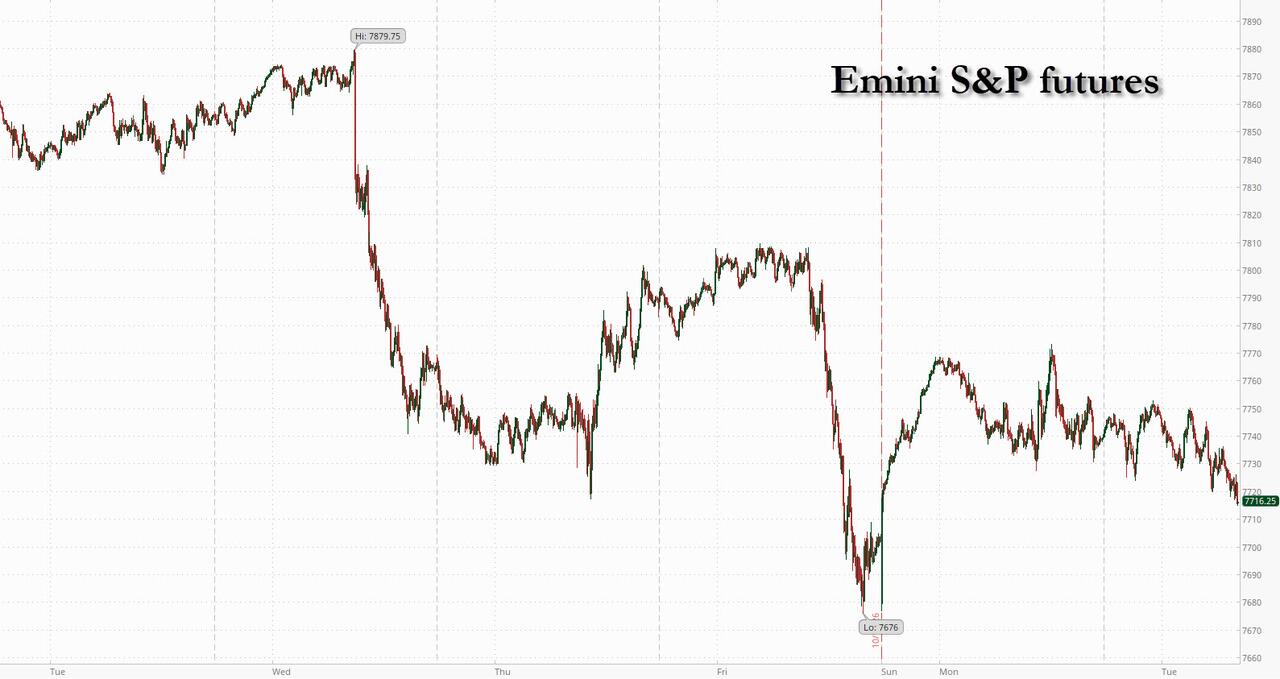
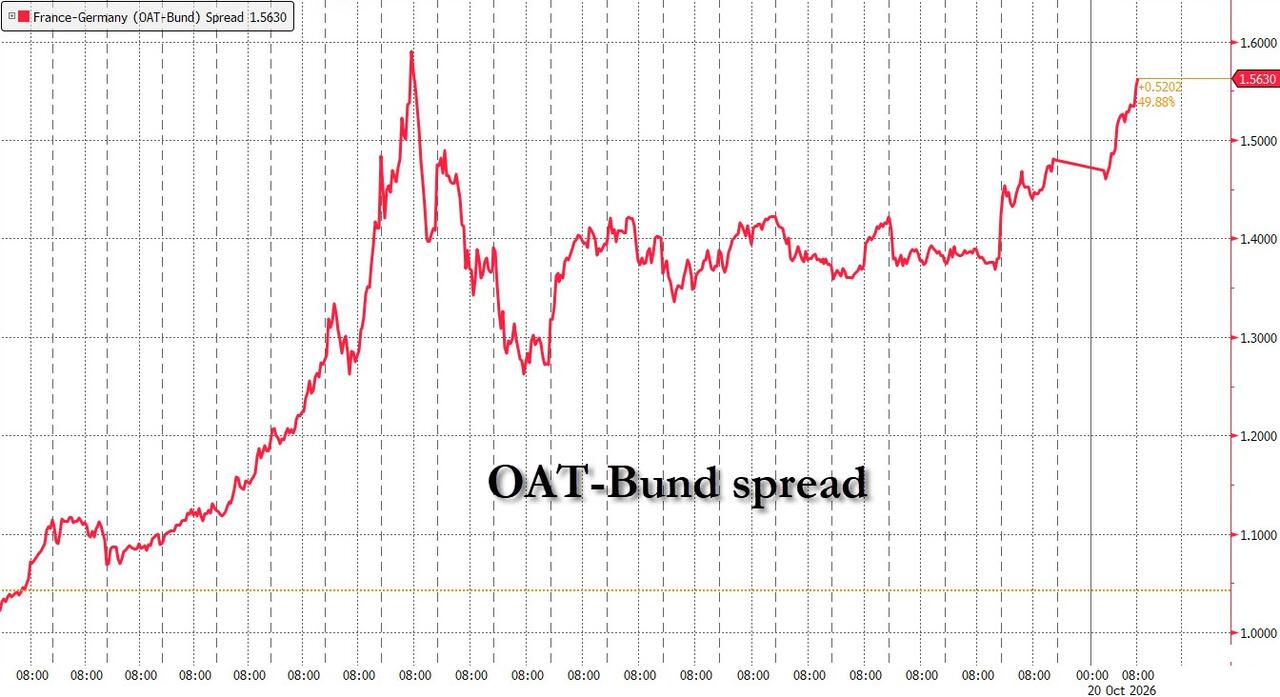
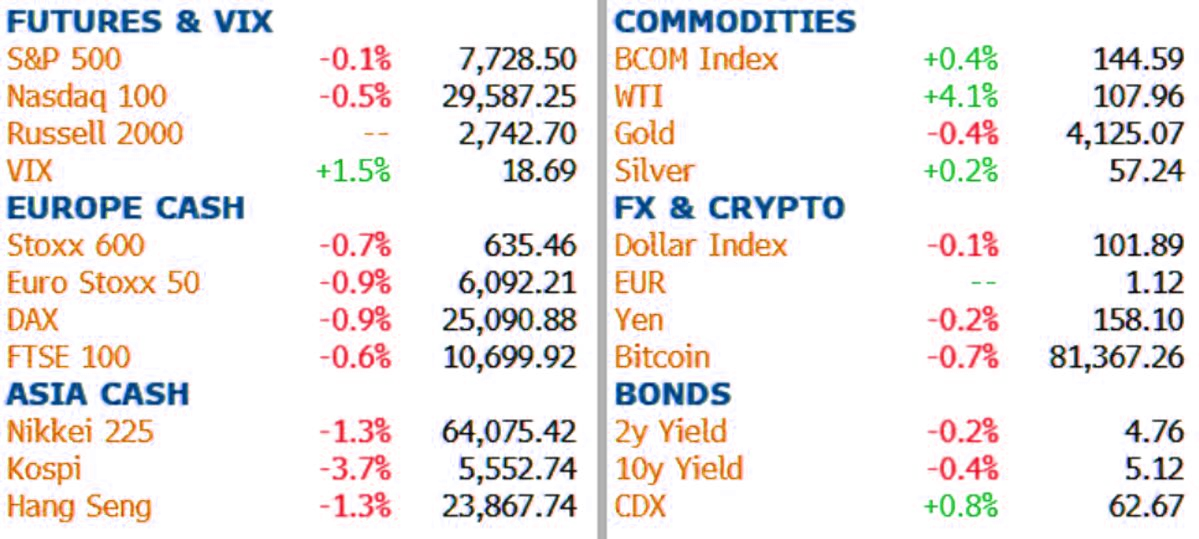
US futures are lower, led by the Nasdaq, as Monday's AI relief bounce fizzled overnight after South Korean data-center firm Elice cratered more than 30% in its trading debut, reviving doubts about who exactly will earn a return on the AI capex binge, while OpenAI is reportedly rushing to raise about $30 billion ahead of Anthropic's IPO and French stress returned with a vengeance; as a result the OAT-Bund spread widened to a 151bps peak, swiftly approaching the 152bps high from just after the draft budget was presented. As of 8:00am ET, S&P futures are 0.2% lower while Nasdaq futures are down 0.7%; Dow futures are flat, in a repeat of yesterday's divergence when the S&P rose 0.41% and the Nasdaq jumped 1.11% while the Dow slipped 0.07% and almost two-thirds of S&P components fell (see our wrap of Monday's session). In premarket trading, Mag 7 names are mostly lower (AAPL -0.9%, META -0.4%, NVDA -0.4%), while levered AI names like CoreWeave and Nebius give back some of Monday's gains. The day's driver is AI (again): The spectacular collapse of Korean neocloud Elice, which as we flagged last night plunged 30% minutes after IPOing, hit chip-heavy Asian markets hardest with the Kospi tumbling 3.65% and Hynix slumping, and with the Fed in blackout ahead of the Oct. 28 FOMC, tech earnings are the only game in town this week. Treasuries are marginally firmer with the 10Y yield down 2bps at 5.12%, tracking a haven bid in Bunds even as French OATs underperform and Gilts lag after a hawkish UK jobs report. The dollar is modestly weaker, with the DXY in a 101.74-101.98 range and cable rising after UK unemployment unexpectedly fell to 4.7%. Brent holds above $110/bbl near a five-month high and European gas is back near €90/MWh, gold slips toward the bottom of its $4,116-4,147 range and copper hovers around $14,400/t. Bitcoin is choppy around $81-82k. US economic data slate includes ADP weekly employment (8:15am), September housing starts and building permits and the Philly Fed non-manufacturing survey (8:30am) and September pending home sales (10am). There are no Fed speakers as the Fed is in its blackout period ahead of next week's FOMC.
In premarket trading, Magnificent Seven stocks are mostly lower: Apple (AAPL) slips 1% after after Loop Capital Markets downgraded the stock to hold, citing iPhone shipment reductions (Amazon (AMZN) -0.2%, Microsoft (MSFT) +0.4%, Tesla (TSLA) -0.4%, Alphabet (GOOGL) -0.3%, Nvidia (NVDA) -0.7%, Meta Platforms (META) -0.8%, Apple (AAPL) -1%)
- 3M (MMM) rises 1.4% higher after topping Wall Street’s profit estimates and raising its full-year outlook for the second straight quarter.
- Alvotech (ALVO) jumps 7.4% after the US Food & Drug Administration approved a new manufacturing process for the drug Simlandi.
- Arhaus (ARHS) rises 4% after Piper Sandler upgraded the furniture company to overweight, writing that “a positive business inflection appears to be underway.”
- AST SpaceMobile (ASTS) falls more than 2% after Viasat petitioned the FCC to reject the company's request for additional overseas spectrum authority
- CoreWeave (CRWV) falls over 3% even after Cathie Wood's ARK bought the dip on Monday; the stock had rallied yesterday after Goldman upgraded it to Buy
- General Motors (GM) falls 7% after narrowing its full-year profit forecast.
- Halliburton (HAL) rises 3.7% after the oilfield services company reported third-quarter adjusted earnings per share that beat the average analyst estimate as drilling and evaluation revenue was higher than expected. The company also forecast mid-single digit revenue growth for 2027.
- Hertz (HTZ) climbs 7.1% after Oro Mobility, which is backed by the car rental company, secured an $80 million strategic equity investment from a consortium of investors, including Cohen Private Ventures.
- MSCI Inc. (MSCI) gains 6.5% after the index provider reported adjusted earnings per share for the third quarter that beat the average analyst estimate.
- Nebius (NBIS) drops more than 2%, tracking weakness across AI-related stocks
- NuScale Power (SMR) falls 7.2% after Barclays cut its recommendation on the nuclear reactor company to underweight as it sees risks from a lack of contracts.
- Rapport Therapeutics’ (RAPP) soars 34% after the drug developer said a mid-stage trial of its experimental therapy for acute bipolar mania met the primary endpoint. Shares have since pared gains to 28%.
- Solstice Advanced Materials (SOLS) gains 2.9% after the Financial Times reports that activist hedge fund Starboard Value has built a stake in the Honeywell spinoff, citing unidentified people familiar with the matter.
- 3M (MMM) in focus after signing a deal with Amazon that includes a warrant for 3.2 million shares, vesting up to $6 billion
- Analyst actions: BlackRock (BLK) raised to Buy at TD Cowen; TKO raised to Buy at Arete; Prologis (PLD) raised to Buy at Freedom Capital; Trex (TREX) raised to Buy at Stifel; Live Nation (LYV) cut to Sell at CFRA; Werner (WERN) cut to Neutral at Baird; nVent (NVT) initiated Overweight at JPMorgan
In other corporate news, OpenAI is reportedly rushing to lock in investor commitments for a roughly $30 billion private round, with SoftBank and MGX in talks, before rival Anthropic's expected mid-November IPO; the raise could value OpenAI above $1.4 trillion and the company is pitching annualized revenue of $50 billion, which it expects to hit $70 billion by year-end (nothing says "no bubble here" like racing to get your round done before the competition lists). ByteDance, Alibaba and Tencent have ordered more than 3 million of Nvidia's export-compliant RTX PRO 5500 GPUs worth over $35 billion. Amazon plans to invest €16 billion in Germany in 2027 after Chancellor Merz said Berlin aims to quadruple AI compute capacity by 2030, and Business Insider reports Amazon is buying billions of dollars of GPUs and parking them in inventory while it waits for data center capacity to come online. Broadcom signed a 10-year cloud infrastructure agreement with Japan's NTT Docomo; Waymo reportedly plans a fleet of 20,000 vehicles by the end of 2027; and Micron's Taiwan union may strike Thursday over a bonus dispute.
Monday's tech bounce was always going to need confirmation, and overnight it got the opposite. Elice, a Korean neocloud whose KRW201bn IPO was, don't laugh, "more than 400x subscribed", fell as much as 33% on its debut, a reminder that the IPO was priced before the AI selloff and that the market's appetite for levered AI infrastructure has not come back (as we discussed in The AI Canary, the buyers in Korea have disappeared). The result: de-rating of AI and crowded growth trades continued to dominate Asian price action, with the Kospi down 3.65% and back below 5,600, while Nasdaq futures handed back a chunk of yesterday's gains.
“What they’re questioning is whether every dollar of AI capex earns more than it costs to finance,” said Ninghui Liu, head of investment strategy and research for APAC at State Street Investment Management.
“The weekend’s protests have further intensified concerns about French public finances,” said Pia Fromlet, an economist at SEB.
Under the surface, Monday was hardly a ringing endorsement either. JPM's Market Intel desk notes that equities rebounded on muted volumes and with little sign of broad participation; equal weight lagged and most of tech's gains came premarket with limited follow-through. JPM TMT trader Brian Heavey was blunter: "We are NOT seeing any real demand in the AI complex, this feels like a technical over sold bounce after last week's wipeout," pointing out that CRWV traded flat after indicating +8% on the Goldman upgrade. His punchline: "Capital markets hold the keys to capex levels going forward." Andrew Tyler's team nonetheless stays Tactically Bullish, preferring cyclicals outside tech and selectively buying Semis and Memory weakness via defined-risk options.
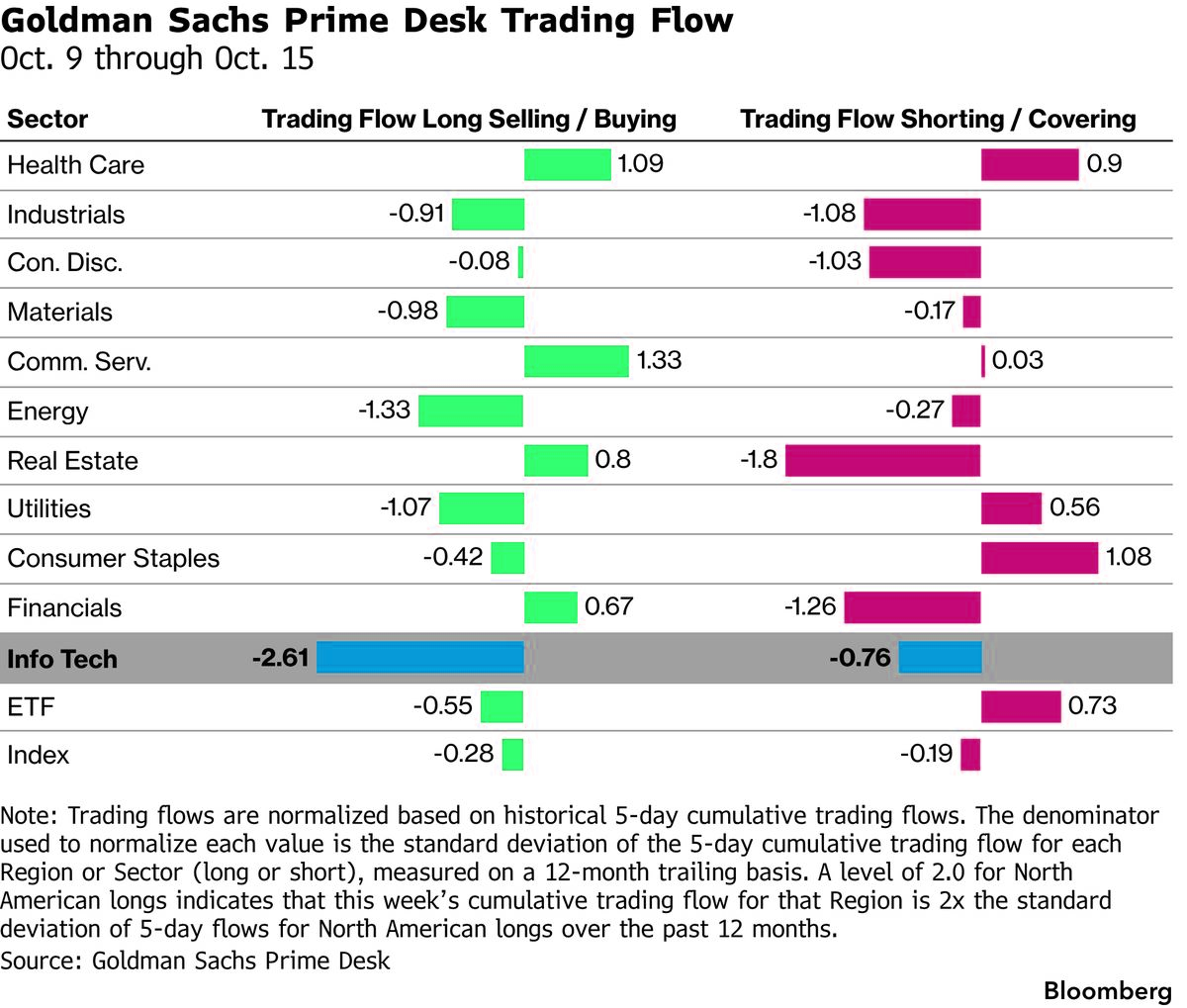
Goldman's desks see the de-risking as largely done but the rotation as unfinished. Per GS Prime data relayed by the Asia sales desk, US L/S net leverage fell 3.2pts last week, the largest weekly drop since Liberation Day, with Info Tech seeing the largest net selling and de-grossing on record, while the HF VIP basket had its worst week since Covid. At the same time retail went the other way, with a record $7 billion pouring into SOXL, as we detailed over the weekend. Goldman's Sam Dunn described Monday as a "calm start to the week with a relief rally ... that felt like a cessation of the high-velocity supply," with floor activity "a 3 on a 1-10 scale," while the bank's chart of the day shows the AI winners vs AI at risk pair is now flat on the year after rising some 100% in the first half. And with an early Q3 read showing only 53% of firms beating EPS by more than one standard deviation (vs a 64% four-quarter average), GS's Dani Wojdyla notes "the next market move is largely dependent on earnings confirmation."
Credit remains the pressure point. The FT reports investors are racing to buy credit default swaps to protect portfolios in case the AI boom unravels, CoreWeave CDS remains above 1,000bps per Newsquawk, and Goldman notes AI-related HY spreads widened 25bps vs just 2bps for non-AI issuers. Recall that Morgan Stanley warned that AI's $1.6 trillion capex plan now lives or dies in the credit market, and Goldman quietly shifted its credit preference toward BBBs as AI debt floods every corner of the market.
In Europe, the French story is back. The 10Y OAT yield jumped 13.4bps to 4.93% on Monday, its highest close since 2002, and the OAT-Bund spread widened again today to a 156bps peak even after protests subsided following tighter security measures and curfews. Goldman's Alexandre Stott expects the budget to be adopted this year, with Finance Minister Lescure saying the government would take "the unprecedented step of using ordinances to bypass Parliament altogether" if needed, but GS's poll-based model still sees Le Pen as the clear favorite for 2027. Moody's is expected to downgrade France on Friday; JPM's EGB desk thinks it is priced in.
In Europe, the Stoxx 600 is down 0.6%, falling for a second day after nearly a 1% drop on Monday, not helped by the risk tone in Asia and several disappointing company updates. Health care tops the sector pile, followed by personal care and food & beverage, while industrials, tech and basic resources lag. Chip names are hit hardest, with ASML and ASMI each down more than 3% and JPM's European Semis basket down 3.3%, alongside its Ceasefire, China Exposure and Software baskets among the worst performers. The DAX and Euro Stoxx 50 underperform after a weak ZEW, where the German expectations index dropped to 28.1 vs 30 expected, while German PPI surged 6.7% y/y.
Asian stocks were mostly lower despite the rebound on Wall Street, as the region failed to sustain the AI-led recovery. South Korea's Kospi slumped 3.65% with roughly 86% of names lower, as foreigners net sold $255 million of tech including $296 million of SK Hynix, amid reports that US big tech is pushing for lower memory prices by citing Chinese suppliers. Japan's Nikkei fell 1.3% and the Topix 1.4%, with SoftBank, Tokyo Electron and Advantest accounting for about 60% of the Nikkei's decline; Goldman notes the Topix broke its CTA short-term threshold again, implying around $1.1 billion of CTA selling this week, while Japanese banks fell 4.3% after a strong 20-year JGB auction. The Hang Seng dropped 1.3% as it returned from holiday, with Lenovo down 10% and CATL down 6.6%, while the CSI 300 fell 0.5% after China held its loan prime rates for a 17th month. Taiwan's Taiex fell 1.1% and Australia's ASX 200 slipped 0.4%. The exception was Indonesia, where the JCI soared 5.3% after a two-day crash of about 15%, the steepest since 1989 (more here).
In FX, the dollar is modestly softer, with the DXY in a 101.74 to 101.98 range and the low of the day coinciding with its 21-DMA. Sterling is the story after a better than expected UK jobs report, with unemployment falling to 4.7% vs 4.9% expected, lifting cable from 1.3328 to 1.3358 and bolstering the case for a BoE hike in November. The kiwi and loonie outperform, the latter on bets the BoC hikes next week (about 80% priced, up from about 40% last week), while the euro is flat and the only G10 currency failing to gain against the dollar as the OAT-Bund spread widens. The yen is little changed after Reuters reported the BoJ will likely hold in October but could signal a December hike.
In rates, Treasuries are slightly firmer, holding within Monday's ranges, with the 10Y yield about 2bps lower at 5.12% after Monday's jump of nearly 7bps; JPM sees 2s flat and 5s, 10s and 30s about 1bp lower, with no overt flattening or steepening bias. Bunds outperform, rallying about 3bps on a modest haven bid from the tepid Asian risk tone, while French OATs lag as the OAT-Bund spread widens to 151bps ahead of Moody's Friday review, and gilts slip after the hawkish jobs data. In Japan, a strong 20-year JGB auction (5.84x bid-to-cover vs 4.01x prior) boosted JGBs. With the Fed in blackout ahead of the Oct. 28 FOMC, the focus is on tech earnings and geopolitics (in a market where the 10Y sits above 5%, apparently that passes for calm).
In commodities, crude is choppy but holds near the top of its range: Brent trades above $111/bbl in a $109.00-111.75 range, near a five-month high, while WTI briefly topped $100 ($98.04-100.93). Iran's IRGC said two oil tankers struck naval mines along the southern route of the Strait of Hormuz and that it downed a US MQ-9 drone, while Pakistan's Army Chief arrived in Tehran for talks and the Iranian Foreign Ministry struck a conciliatory tone. IEA chief Birol said the agency will consider releasing more emergency stocks if needed. Dutch TTF gas is climbing again in a €87.60-89.80/MWh range. Spot gold is at the lower end of its $4,116-4,147/oz range, and LME copper briefly slipped below $14,300/t before rebounding to $14,410/t.
US economic data slate includes ADP weekly employment (8:15am), September housing starts and building permits and Philly Fed non-manufacturing activity (8:30am) and September pending home sales (10am). The Fed is in blackout. On the corporate calendar, GE Aerospace, RTX, GM, 3M, Northrop Grumman and Halliburton report before the open, Netflix, SpaceX, United Airlines, Capital One and Intuitive Surgical report after the close, and Nvidia's GTC Berlin runs through Thursday.
Market Snapshot
Top Overnight News
- Nasdaq futures fell as shares of South Korean data-center infrastructure company Elice plunged over 30% in their trading debut. BBG
- ByteDance, Alibaba and Tencent have ordered more than 3 million of Nvidia's new RTX PRO 5500 graphics cards with a collective sticker price of over $35 billion, two people familiar with the matter said, in a rush for a less powerful but export-compliant chip amid US restrictions on trade with China. RTRS
- Investors are racing to buy credit default swaps to protect their portfolios in the event the AI boom unravels, sending trading volumes surging for an instrument that shot to prominence during the global financial crisis. FT
- AMZN (Amazon) is buying billions in GPUs and putting them in inventory as it waits for the necessary data center capacity to come online and power them up. Business Insider
- OpenAI is seeking to raise about $30 billion, including from SoftBank and MGX, ahead of Anthropic's expected mid-November IPO, in a round that could value it above $1.4 trillion. RTRS
- Netflix plans to cut about 6% of its workforce, or roughly 1,000 roles, its largest round of cuts since 2022, ahead of results after the close. RTRS
- The French-German 10-year yield spread widened to 156 bps even after protests in France subsided following tighter security measures. Treasuries advanced and Brent climbed to a five-month high. BBG
- The UK will fly defensive missions to protect Saudi Arabia from Houthi attacks, officials familiar with the matter said. Iran’s IRGC said two oil tankers struck naval mines along the southern route of the Strait of Hormuz, according to Tasnim. BBG
- Ryanair Holdings Plc Chief Executive Officer Michael O’Leary predicted a record increase in European air fares next year due to the Middle East war driving up oil prices. BBG
- Japan is months from running out of supplies of yttrium, a critical metal, and has asked the US to push China to ease rare earth export controls that threaten severe disruption to the global automotive, defense and chip industries. FT
- President Trump said on Monday the US Department of Agriculture will launch what he called a new "harvest fuel relief program" that will provide farmers with $8 billion in support to offset diesel costs during the harvest season. RTRS
- The BoJ is reportedly likely to keep rates unchanged in October, but could signal that a rate hike could come in December: Reuters
- US President Trump posted that American incomes have reached record highs, employment and exports are at all-time highs, and the US is now the "hottest" country in the world. Newsquawk
- UK Chancellor Healey has reportedly ruled out raising capital gains tax in the October 28th Budget amid concerns over growth and investment: The Times
- The Trump administration has delayed approving transfers of Patriot interceptor missiles to Ukraine from partner countries: Washington Post
- US L/S net leverage fell 3.2pts last week, the largest weekly drop since Liberation Day, with Info Tech seeing the largest net selling and de-grossing on record. GS Prime
- JPM Positioning Intel: hedge funds are -2.1% MTD globally, but AI Core Revenue positioning is still at the 94th percentile; the setup resembles 3Q23 and a 4Q rally is seen as more likely than not. JPM
- Goldman raised its copper forecasts to $14,700/t for end-2026 and $15,400/t for the 2027 average.
A more detailed look at global markets courtesy of Newsquawk
APAC stocks were mostly lower despite the rebound on Wall Street, as the region failed to sustain the AI-led recovery, with chip-heavy markets in South Korea and Japan underperforming but macro newsflow rather light. ASX 200 declined, with gold miners pressured following Monday's pullback in the precious metal, while financials were in focus after S&P downgraded Bank of Queensland's long-term rating to BBB+ from A-, and Westpac flagged an AUD 41mln notable item related to RAMS litigation. Nikkei 225 was subdued as tech names failed to benefit from the AI-led rebound stateside, although the index pared some of its earlier losses of over 1%. SoftBank was in focus following reports that it is in discussions to participate in OpenAI's private funding round ahead of Anthropic's IPO. KOSPI was the regional laggard, extending its October rout, with Samsung Electronics and SK Hynix pressured amid reports that US big tech firms are pushing for lower memory prices by citing Chinese suppliers as alternatives. Hang Seng and Shanghai Comp diverged, with Hong Kong lower as it returned from Monday's Chung Yeung holiday, while the mainland was flat as Chinese LPRs were maintained, as expected.
Top Asian News
- Japanese Finance Minister Katayama said no decisions have been made on funding defence spending increases, but measures to secure stable funding will be considered while maintaining fiscal sustainability.
- China's NDRC said it will introduce additional policy measures as needed to keep economic activity within a reasonable range.
European bourses (STOXX -0.6%) are lower again on Tuesday, not helped by the risk tone in Asian equities, while updates from several companies also disappointed. Focusing on South Korea, Elice had a poor debut, slumping as much as 30%. This can have a read-across for the tech space as Elice is a data-centre firm which provides AI cloud services as well as AI-based education and business software. To note, the IPO price was set before the recent sell-off in AI-related stocks, exacerbating the downside on debut day. Sectors highlight the negative bias. Health Care tops the sector pile, with Optimised Personal Care and Food, Beverages & Tobacco rounding out the top three. To the downside reside Industrials, with Tech and Basic Resources following closely behind. US equity futures are mixed, with the NQ underperforming as it gives back some of Monday’s gains. Plenty of earnings to keep an eye on today, which include RTX, GM, GE Aerospace and SpaceX.
Top European News
- UK Chancellor Healey has reportedly ruled out raising capital gains tax in the October 28th Budget amid concerns over growth and investment, The Times reported. The Chancellor reportedly plans to increase taxes on banks, introduce targeted cost-of-living support and reduce fiscal headroom from GBP 23bln to around GBP 15bln in the October 28th Budget.
- French President Macron and German Chancellor Merz got behind agreeing an EU budget before end-2026, Politico reported citing officials. However, a German source said no landing zones of specific numbers have been agreed.
- German Chancellor Merz said they aim to quadruple AI compute capacity by 2030 with its data centre strategy. Following this, Amazon (AMZN) announced plans to invest EUR 16bln in Germany in 2027, pledging to build more sustainable infrastructure across Germany and to strengthen water-resource management.
- US President Trump urged European countries to close their borders and deport migrants.
FX
- G10s are stronger against the broadly softer USD, and to varying degrees. The Kiwi outperforms, followed closely by the Loonie. The EUR is flat, and is the mild underperformer this morning.
- USD is under very mild pressure this morning, but has found some strength as it trades in a 101.74 to 101.98 range; the low of the day coincides with its 21-DMA. There is no specific driver for the pressure this morning, but perhaps as AI-concerns remain front of mind, particularly as the swap on CoreWeave CDS remains elevated beyond 1,000 points. With the data docket fairly light for the remainder of the week, and the Fed on blackout, markets will have to use geopolitical developments and/or tech earnings as a proxy for sentiment. Bar any debt-related concerns, the index should remain within familiar ranges into the FOMC next week.
- Kiwi is the mild outperformer this morning, benefiting from slightly firmer copper prices. The Loonie has been lifted in the past few days amidst a recent hawkish repricing at the BoC; as it stands, money markets assign a c. 80% chance of a hike next week (vs c. 40% last week). To remind, BoC Governor Macklem recently stated that higher energy prices are lifting the inflation outlook, signalling that the Bank stands ready to raise rates.
- The GBP benefits from a better-than-expected UK Jobs report. In brief, the Unemployment Rate fell to 4.7% vs expectations of it holding steady at 4.9%; Employment Change also jumped from the prior, and above consensus. As for the wage components, they remain benign, with little evidence of second-round effects filtering through so far. Overall, this report will provide confidence to the more hawkish members on the MPC, to deliver a rate hike in November. Following the data, Cable rose from 1.3328 to 1.3358, and currently holds at the upper end of the day’s 1.3302-1.3358 range.
- EUR is flat vs the USD, and the only G10 currency failing to benefit from the softer Dollar. Pressure that stems from the ongoing widening of the OAT-Bund spread, which has now breached its recent peak of 151bps; a move which comes amidst ongoing civil unrest in France, and now several parts of Europe. Adding to the negative sentiment is a poor German/EZ ZEW Sentiment read, which fell from the prior and by more than expected.
Central Banks
- The BoJ is reportedly likely to keep rates unchanged in October, but could signal that a rate hike could come in December, according to Reuters sources. The report added that the Bank may also raise its FY27 inflation forecast slightly.
Fixed Income
- A contained start for fixed generally, USTs in a thin 105-05 to 105-12+ band, into a much busier docket than Monday, but one that is still generally awaiting events over the next few weeks; barring a significant geopolitical development, of course.
- Currently, this leaves USTs entirely within Monday’s confines, by just a tick at the low-end and 12+ at the upper-end. Yields lower across the curve, though only marginally and with no overt flattening/steepening bias currently seen.
- EGBs tracked USTs overnight, with a modest haven bid coming from the tepid APAC risk tone, but offset by energy upside, points that left the space near-enough flat in early trade. Thereafter, a hawkish UK job series pushed Bunds down by about five ticks, before this unwound and a 121.39 peak printed in the early morning.
- Specifics for the bloc thus far a little light, we mainly await updates on the fiscal front, as Politico suggests that German Chancellor Merz and French President Macron are more aligned on the need to get the next framework done by end-2026. Albeit, the immediate focus is on the weekend’s unrest, with French curfews approved more widely, though the litmus test will be the coming weekend’s planned action; and then the demonstrations unions are calling for in early-November.
- Reflecting the ongoing French political, and by extension, fiscal risk, the OAT-Bund 10yr yield spread has widened to a 151bps peak today, swiftly approaching the 152bps high from just after the draft budget was presented. Again, such widening does not bode well into Moody’s on Friday.
- Finally, Gilts opened with some modest downside, but didn’t stray too far from the 84.00 handle. Thereafter, some slight choppiness was seen in 83.85 to 84.13 confines amid a number of factors being digested at once; since, it has slipped into the red and marginally lags.
- Pressure that comes on the energy upside and hawkish jobs data, the latter being another factor in favour of a BoE hike in November, or at the very least by end-2026. Elsewhere, the discussed risk tone would have had a modest offsetting influence. While reports around the budget could be taken either way. Specifically, The Times reported that Chancellor Healey has abandoned plans to increase Capital Gains Tax, due to the likely growth hit. A point that reduces his revenue-raising avenues, and this means a lower headroom is likely to result; however, it factors well for confidence levels in domestic business.
- Germany sells EUR 0.992bln vs Exp. EUR 1bln 2.10% 2029 Green Bobl and 1.80% 2053 Green Bund.
- The UK sells GBP 4.25bln 4.875% 2036 Gilt: 3.61x (prev. 3.34x), Average Yield 5.418% (prev. 5.383%), Tail 0.2bps (prev. 0.5bps).
- Japan sells JPY 700bln 20yr JGB; b/c 5.84x (prev. 4.01x). average yield 3.7230% (prev. 3.8560%), tail 0.07 (prev. 0.15).
Commodities
- Crude benchmarks have been choppy at the start of Tuesday’s European session, but ultimately reside at the top end of their daily range. WTI briefly tops USD 100/bbl (USD 98.04-100.93/bbl) while Brent holds above USD 110/bbl (USD 109.00-USD 111.75/bbl).
- Geopolitical headlines have been light thus far. Overnight, the IRGC said it downed a US MQ-9 drone over Hormuz. Elsewhere, Saudi Arabia and Houthis continue to strike each other, with reports this morning suggesting that Saudi intercepted missiles heading towards Riyadh.
- As for the path to diplomacy, Pakistan’s Army Chief has arrived in Tehran, so focus will be on any updates following these talks. Recent comments from Iranian officials have suggested that he is yet to arrive in Tehran. This morning there were some updates from the Iranian Foreign Ministry spokesman who struck a conciliatory tone, but ultimately did not spur a reaction in the crude complex. He mentioned that Iran held several contacts and consultations, adding that if there is even the slightest chance that it may be able to prevent the escalation of tensions through diplomacy, it must definitely go this route. However, sticking points in negotiations remain on the Strait of Hormuz and nuclear issues.
- Dutch TTF is back on the climb, and currently sits at the upper end of its EUR 87.60-89.80/MWh range, with the peak just above Monday’s peak of EUR 89.70/MWh.
- Precious metals continue to gradually fall, with spot gold at the lower end of its USD 4116-4147/oz range, but remains well-contained within the wider USD 4067-4228/oz band. The yellow metal will continue to be driven by yields. The next level on the US 10yr that could spur upside in the precious metal is back below the 5% level.
- 3M LME Copper briefly slipped below USD 14.3k/t, falling to a trough of USD 14.27k/t before rebounding to a current peak of USD 14.41k/t. Traders highlight the risk of tariffs as a downside risk for the red metal. The metal benefited from the surge of copper being piled in the US, in anticipation of tariffs being placed on copper imports. However, this possibility is fading somewhat, according to a trader at Ningbo.
- IEA Chief Birol said they will consider releasing more emergency stocks if needed.
- US Energy Secretary Wright said no Russian Diesel has been released yet and yet to be seen if Russia will release diesel.
- Saudi and the UAE have committed to provide 95k and 100k tonnes per month, respectively, of diesel to France. Deliveries to begin in the coming weeks.
Trade/Tariffs
- The UK Treasury is expected to be asked to assess the economic benefits of closer ties with the EU, including a potential customs union, single market return or full EU membership, ahead of the November 20th Brussels summit, according to the FT.
Geopolitics: Middle East
- US President Trump criticised Europe for failing to support the US over Iran and suggested Washington could reconsider its support for Europe.
- Iran's IRGC said it intercepted and destroyed a US MQ-9 drone over the Strait of Hormuz using its new advanced air defence system.
- Iranian Foreign Ministry Spokesperson Baghaei said they have held several contacts and consultations and that if there is even the slightest chance that it may be able to prevent the escalation of tensions through diplomacy, they must definitely go this route. On talks with Russia, Baghaei said there was no discussion about nuclear negotiations with the US, and that Iran are not negotiating with the US in this regard.
- Iranian Foreign Ministry said the US' response to the proposal from Iran was incomplete and insufficient.
- Iranian President Pezeshkian said US bases in the region provide no benefits and only fuel insecurity, Press TV reported.
- Iranian Foreign Minister Araghchi said Iran-Russia cooperation is closer than ever, with talks covering regional developments and expanding economic and nuclear cooperation, IRNA reported.
- Qatari Foreign Ministry spokesperson said "We are working with Washington and Tehran in partnership with other mediating countries to end the war in the region."
- Pakistan Army Chief Munir has arrived in Tehran to meet with senior officials of Iran.
- Russian Foreign Minister met Iran's President and Supreme National Security Council Secretary in Tehran, following earlier talks with his Iranian counterpart, Iran Nuances reported.
- An explosion was reportedly heard in Iran's southern city of Bandar Abbas, Sabereen News reported.
- Yemeni forces reportedly targeted Saudi Arabia's Dammam airport with missiles and drones, temporarily suspending operations, Tasnim reported, citing Al-Masirah.
- Israeli PM Netanyahu said there are indications that Iran and its proxies want to challenge Israel before the elections.
- US War Secretary Hegseth met Israeli PM Netanyahu during an unannounced visit to Israel on Monday, Axios reported.
Geopolitics: Ukraine
- US President Trump's envoys Kushner and Witkoff plan to travel to Norway this week for Ukraine talks and Ukraine President Zelensky is expected to join talks.
- Ukrainian President Zelensky said he talked with US Secretary of State Rubio on the topics of ballistic interceptors and Starlinks. He later said that Ukraine supports a mutual energy ceasefire.
- Ukraine's DTEK said a Russian attack struck three of its energy facilities in the Odessa region.
- The Trump administration has delayed approving transfers of Patriot interceptor missiles to Ukraine from partner countries, Washington Post reported.
Crypto
- Bitcoin has been choppy, briefly topping USD 82k before returning to its session low of USD 81.1k.
US Event Calendar
- 8:15am: ADP Weekly Employment Change
- 8:30am: Sep Housing Starts, est. 1304.5k, prior 1275k
- 8:30am: Sep P Building Permits, est. 1385k, prior 1403k
- 8:30am: Oct Philadelphia Fed Non-Manufacturing Activity
- 10:00am: Sep Pending Home Sales MoM, est. -0.5%, prior 0.3%
Central Bank Speakers
- No Fed speakers: the Fed is in its blackout period ahead of the Oct. 28 FOMC
- BoE's Greene and RBA's Hauser speak
DB's Jim Reid concludes the overnight wrap
I wanted to start by highlighting yesterday’s CoTD “Different Ways to Skin Capex”, partly as it took me a long time to do, and partly as the graphs may not have been easy to read on email. Hopefully with the link to the piece on the DBRI site here, they’re slightly easier to read. The key divide from the main chart is that over the last year the gap has increased between those writing the enormous AI capex cheques and those cashing them in. Many of the big spenders have gone sideways, while the physical bottlenecks in memory, storage, chip packaging and networking have been the big winners. There is a second striking split between “atoms” and “bits”, with Asian hardware names surging as software and Indian IT services have lagged, alongside sharp falls among some of the more leveraged AI build-outs. Apple and Alphabet are notable mega-cap exceptions, but for different reasons — Apple because it has largely avoided the data-centre capex arms race, and Alphabet because it is increasingly demonstrating that heavy AI spending can translate into revenue. The broader conclusion is that investors are no longer simply investing in Big Tech or AI in aggregate: they are investing in Big Tech’s budgets, while becoming much more discriminating about who ultimately earns an adequate return from them. See the short note for more. I think it breaks things down nicely.
It’s been another eventful 24 hours for markets, with a bunch of competing narratives for investors to grapple with. On the bright side, the AI selloff began to stabilise, with the Philly semiconductor index (+1.61%) finally breaking a run of 8 consecutive declines. So that helped to lift US equities in aggregate, and the S&P 500 (+0.41%) posted a recovery despite most of its constituents falling on the day. That said, tech stocks in Asia have weakened again so the volatility continues. There's been considerable volatility elsewhere as well, as the stress around French assets returned after the weekend unrest. Indeed, the Franco-German 10yr spread (+10.3bps) hit a post-2012 high on a closing basis, ending the session at 148bps. And matters weren’t helped by another rise in European natural gas prices, which moved up to a post-2022 high of €88.04/MWh. So that fuelled the broader economic concerns around the continent, with equities including the STOXX 600 (-0.80%) posting sharp declines.
We’ll start with the French story, as that created the biggest market moves over the session, with the negativity clear from the open. The impact was most obvious for the country’s sovereign debt, with 10yr French OAT yields up +13.4bps on the day to 4.93%, their highest closing level since 2002. Moreover, because Germany’s 10yr bund yields were “only” up +2.9bps on the day to 3.45%, that pushed the 10yr OAT-bund spread up to 148bps by the close. Admittedly, it wasn’t quite as high as the intraday peak above 150bps earlier this month, so we haven’t returned to peak stress yet. But after two weeks when the spread had broadly stabilised, the concerns were clearly picking back up in yesterday’s session. Indeed, it was a similar story for the 2yr spread as well, which also jumped up +6.6bps on the day to 54bps.
Those market concerns around French debt cascaded across other countries and asset classes too. For instance, the Italian 10yr spread over bunds was also up +4.7bps on the day to 111bps, whilst Spain’s was up +1.2bps to 62bps. Meanwhile in equities, the STOXX Banks index (-2.07%) hit a 4-month low, and there were even bigger declines for the French banks, including Société Générale (-3.41%), Crédit Agricole (-2.64%) and BNP Paribas (-2.48%). And in turn, all that caused fresh pressure for the Euro itself, which weakened -0.23% against the US Dollar to close at $1.1213. The Euro is back up +0.17% this morning as the unrest in France didn't continue overnight after strict curfews and other measures were implemented across the country.
Yesterday's news out of Europe was exacerbated by the latest moves in energy prices, which added to concerns around inflation and further ECB rate hikes. Most strikingly, the front-end natural gas future (+0.56%) rose to €88.04/MWh, which is another post-2022 high, and now leaves it up +21.7% in October alone. So that led investors to price in more inflation, with the 1yr Euro inflation swap (+11.3bps) up to 3.80%, its highest since May.
Oil prices did stabilise but Brent crude (-0.28% top $109.55/bbl) still settled within touching distance of Friday’s 5-month high. Brent had pulled back towards $107/bbl early on Monday, helped by some talk on the wires that US and Iran had reached a breakthrough in mediations that would be announced later in the week. However, the fact that this got very little airtime reflects that markets have heard this story before and will take a lot to believe it. The respite indeed proved short-lived, with oil prices jumping higher around the European close as Iran’s First Vice President Mohammad Reza Aref said that Iran has “no choice but to exercise sovereignty over the Strait of Hormuz”. So that added to the sense that a deal before the US midterms in two weeks’ time is going to be challenging, while investors are also concerned that the US administration may be more likely to escalate against Iran after the midterms as Iran’s increased strikes in Hormuz have now slowed the increase in oil flows through Hormuz that had emerged over the previous couple of months. Perhaps reflecting that, the longer-dated futures continued to climb, with 12-month Brent futures (+0.14%) at another high for the year of $88.00/bbl, implying an extended period of high oil prices deep into 2027.
Whilst the European news was overwhelmingly negative, US equities put in a stronger performance, though the rally did lose some momentum as oil prices rebounded. The improvement was led by tech stocks, as the NASDAQ (+1.11%) had its best day in two weeks, and the Philly semiconductor index (+1.61%) finally ended a relentless run of 8 consecutive declines. So given the concentration of tech in the broader index, that actually helped the S&P 500 (+0.41%) to post a steady gain, even as almost two-thirds of components within the index lost ground on the day.
That AI stabilisation also pushed US Treasury yields higher, as it countered fears about an AI-related slowdown. Indeed, that was clear from the fact that higher real yields drove the bulk of the rise in Treasury yields yesterday, rather than inflation breakevens. So Treasury yields saw a consistent rise across the curve, with the 2yr yield (+6.5bps) up to 4.77%, whilst the 10yr yield (+6.6bps) rose to 5.14%. Moreover, that optimism on the growth side saw investors price in slightly more rate hikes for the months ahead. For instance, 74bps of hikes were priced in by the June 2027 meeting at the close, up +7.7bps relative to Friday.
As mentioned up top, the AI trade has reversed back again this morning with the KOSPI (-4.39%) leading the declines, dragged down by chip heavyweight SK hynix Inc. (-5.17%), which is on track for its lowest close since April. The Nikkei 225 (-1.08%) is also being weighed down by tech. Elsewhere, the Hang Seng (-0.95%) is also falling after reopening following a holiday, while China’s CSI 300 (-0.51%) is also soft. Additionally, the S&P/ASX 200 (-0.40%) is also edging lower with National Australia Bank (NAB) shares sliding around -3.0% after the lender announced restructuring charges and job cuts. Meanwhile, S&P 500 futures are up marginally (+0.06%), with Nasdaq 100 futures slipping (-0.20%) along with the overnight tech retreat. Stoxx (-0.60%) futures are continuing Europe's recent declines and 10yr USTs are -2.1bps lower standing at 5.12% as we go to print.
On the monetary policy front, the PBOC held its one-year and five-year Loan Prime Rates (LPR) steady at 3.00% and 3.50%, respectively. This marks the 17th consecutive month of unchanged benchmark rates, as stronger-than-expected Q3 GDP growth reduced the immediate need for monetary stimulus. While the decision provides no fresh rate relief for borrowers, the PBOC is reportedly considering replacing its seven-day reverse repo rate with the overnight rate as its primary policy benchmark to enhance monetary transmission.
Finally yesterday, there was little data to speak of. However, Canada’s CPI came in slightly softer than expected, with headline CPI only up to +3.1% in September (vs. +3.2% expected). Moreover, both of the core measures followed by the Bank of Canada unexpectedly fell by a tenth. So the median core measure fell to +1.9% (vs. +2.0% expected), and the trim core measure fell to +1.8%. Elsewhere, the US NAHB’s housing market index fell more than expected to 29 in October (vs. 31 expected), its lowest level since 2012.
Looking at the day ahead now, and data releases include UK unemployment for August, US housing starts, building permits and German PPI for September, and the German ZEW survey for October. Otherwise, central bank speakers include the BoE’s Greene. Finally, today’s earnings releases include Netflix, United Airlines and General Motors.