Goldman Reports Blowout Equity Trading Revenues As FICC Disappoints
In a carbon copy of JPMorgan, which kicked off Q3 earnings season this morning, Goldman’s equities traders blew past expectations in the third quarter, while its fixed-income and rates-trading counterparts fell far below Wall Street’s estimates.That said, Goldman's earnings were far cleaner than JPM's, which saw various misses across investment banking, while Goldman was an across the board beat, with the exception of FICC.
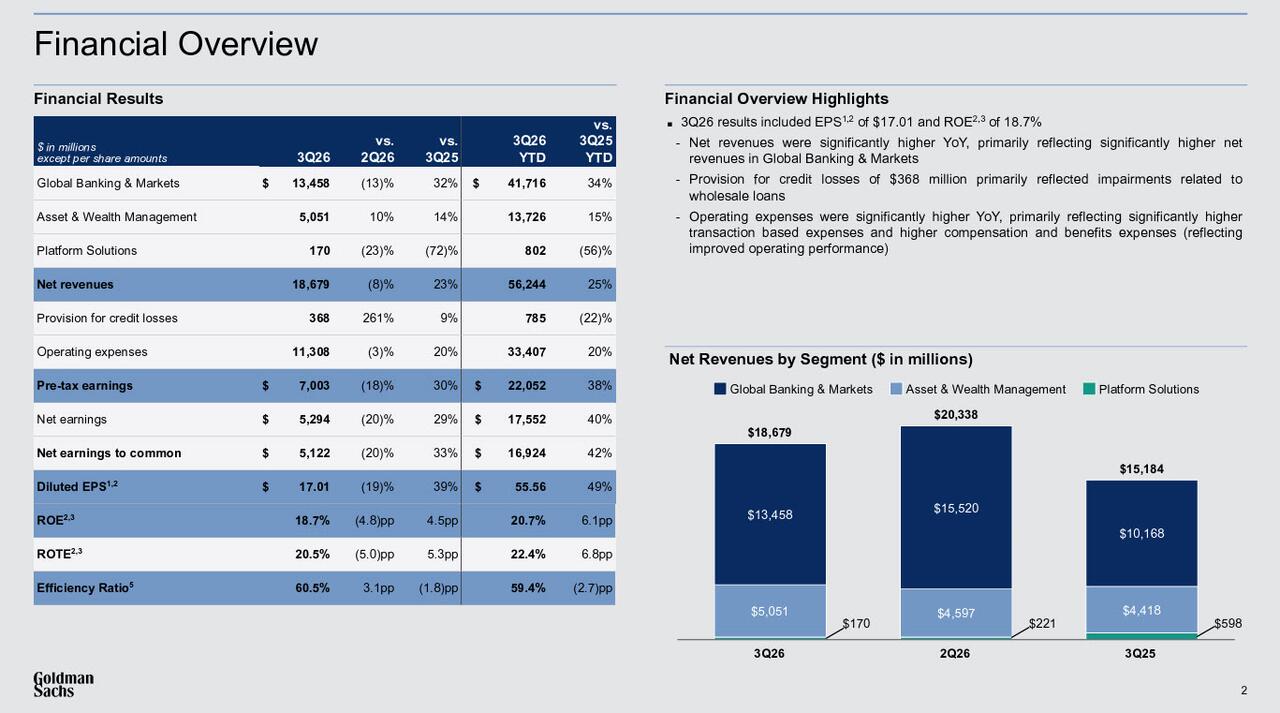
First, let's take a quick look at what the company reported for Q3:
- EPS $17.01, beating est. $13.07
- Revenue $18.68BN, beating est. $16.84BN
- FICC sales & trading revenue $3.47 billion, missing estimate $3.72 billion
- Equities sales & trading revenue $6.44 billion, beatingestimate $5.09 billion
- Global Banking & Markets net revenues $13.46 billion, beating estimate $11.8 billion
- Investment banking revenue $3.23 billion, beating estimate $2.86 billion
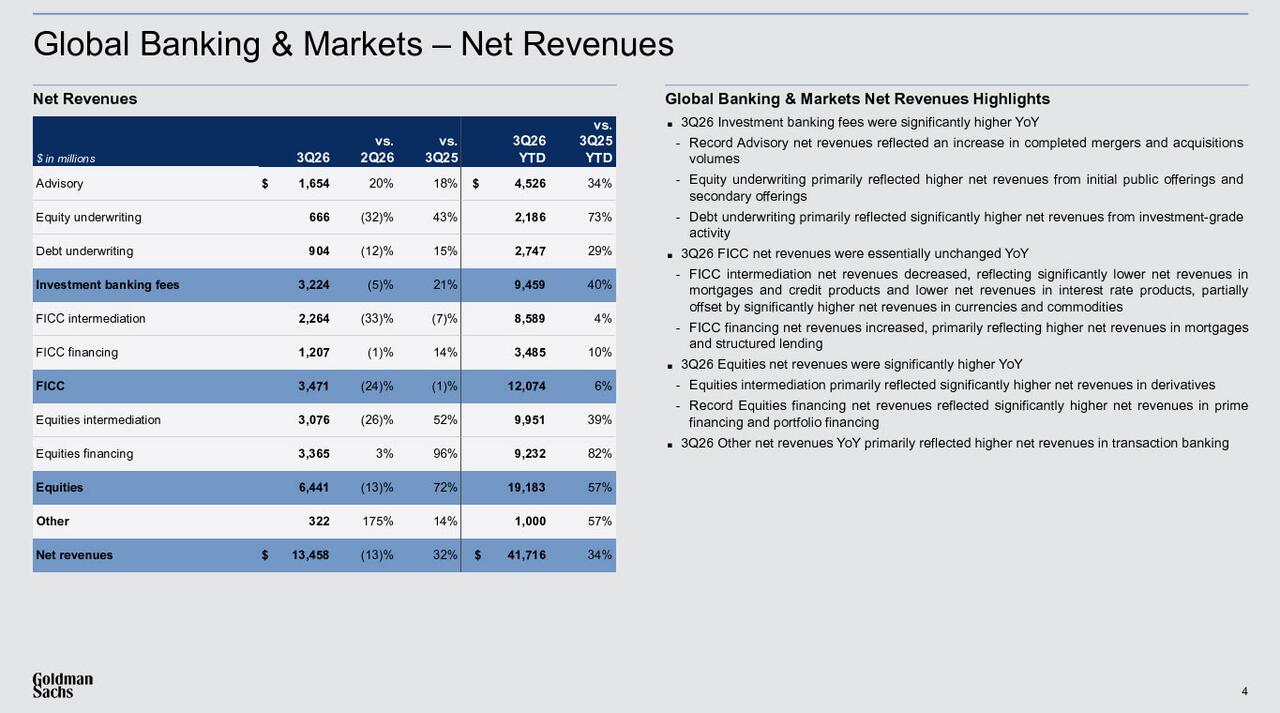
- Advisory revenue $1.65 billion, beating estimate $1.4 billion
- Equity underwriting rev. $666 million, beating estimate $645.5 million
- Debt underwriting rev. $904 million, beating estimate $824.4 million
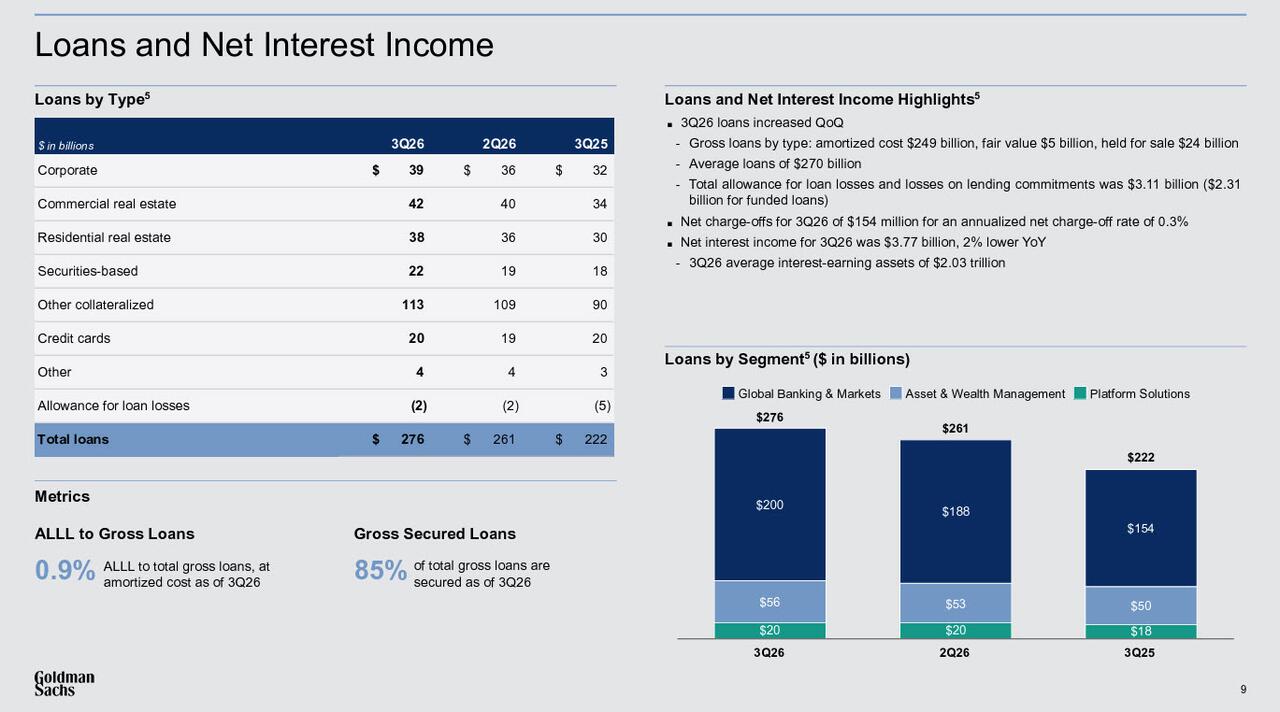
- Net interest income $3.77 billion, beating estimate $3.61 billion
Some more details focusing on expenses and balance sheet details:
- Total deposits $568 billion
- Provision for credit losses $368 million
- Total operating expenses $11.31 billion, estimate $10.95 billion
- Compensation expenses $5.12 billion, estimate $5.06 billion
- Annualized ROE +18.7%, estimate +14%
- Return on tangible equity +20.5%
- Standardized CET1 ratio 12.4%, estimate 12.6%
- Book value per share $372.64
- Efficiency ratio 59.4%, estimate 65.5%
- Net charge-offs $154 million, estimate $282.8 million
- Assets under management $4.10 trillion, estimate $4.14 trillion
- Total AUS net inflows $83 billion
- Loans $276 billion, estimate $264.55 billion
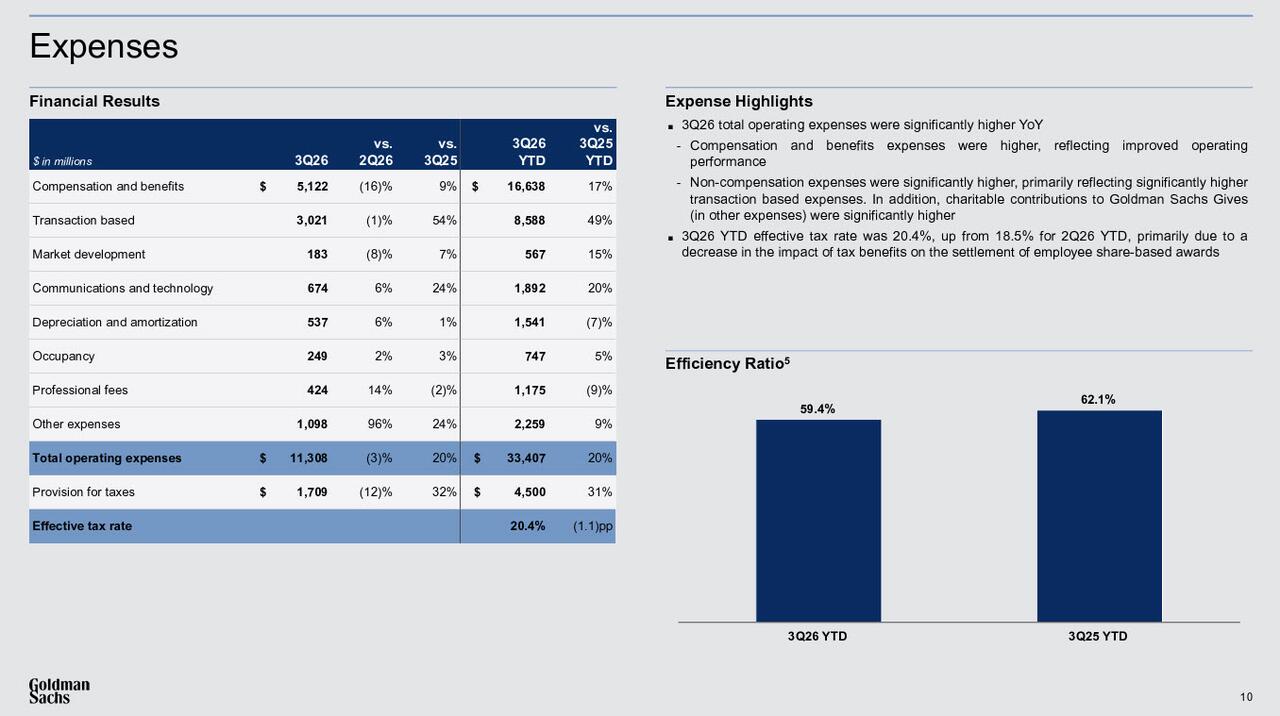
Goldman pay rose along with the bank’s boost in revenue, pushing compensation and benefits expenses to $5.12 billion, a 9% increase from a year earlier. Year-to-date, those expenses are up 17% compared with the same period in 2025.
Commenting on the jump in expenses, Goldman said that “operating expenses were significantly higher YoY, primarily reflecting significantly higher transaction based expenses and higher compensation and benefits expenses (reflecting improved operating performance).”
CEO David Solomon pointed to “a complicated operating environment” but said that “notwithstanding the current complexity and uncertainty in the world, we remain very well positioned to continue to deliver for our clients."
Turning to the all important sales and trading group, the company’s equities traders, who in July posted a record of any bank for a third straight quarter, reported revenue of $6.44 billion for the third quarter. That’s lower than the all-time high, from the second quarter, of $7.42 billion, but still beat the expectations of $5.09 billion. "Equities reflected significantly higher net revenues in financing and intermediation" the bank said.
Meanwhile, fixed-income and commodities traders brought in $3.47 billion, significantly lower than the $3.72 billion expected and an almost 1% drop from a year earlier, after Chief Executive Officer David Solomon warned in September of a slower quarter. The result "reflected lower net revenues in intermediation, offset by higher net revenues in financing".
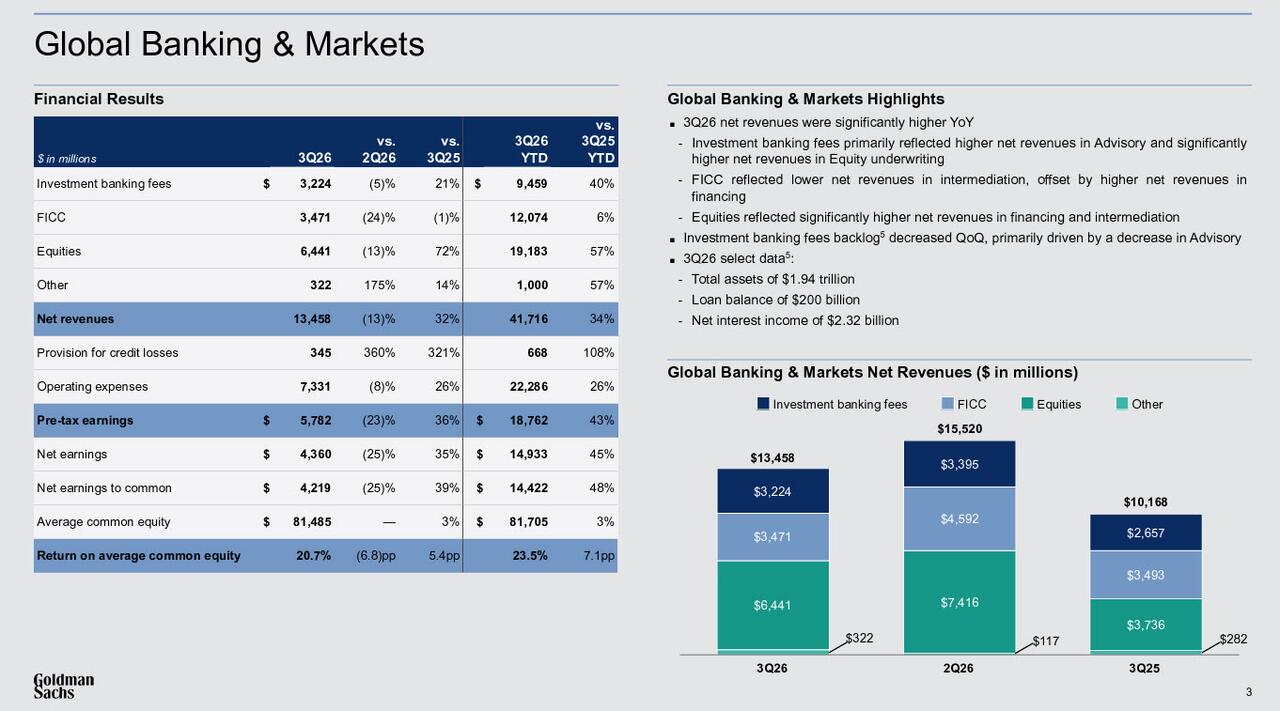
Goldman’s dealmaking machine helped drive growth in the third quarter, with its investment bankers bringing in a higher-than-expected fee haul of $3.22 billion. The bank’s asset-management unit also drew record management fees. Higher net revenues in Advisory reflected an increase in completed mergers and acquisition volume, while higher net revenues in equity underwriting "reflect higher net revenues from IPOs and secondary offerings."
Goldman has led the rebound in Wall Street dealmaking while also pulling in billions of dollars from trading around volatile equity and fixed-income markets. Like peers, it’s seen its share price retreat in the face of rising bond yields weighing on capital-markets activity.
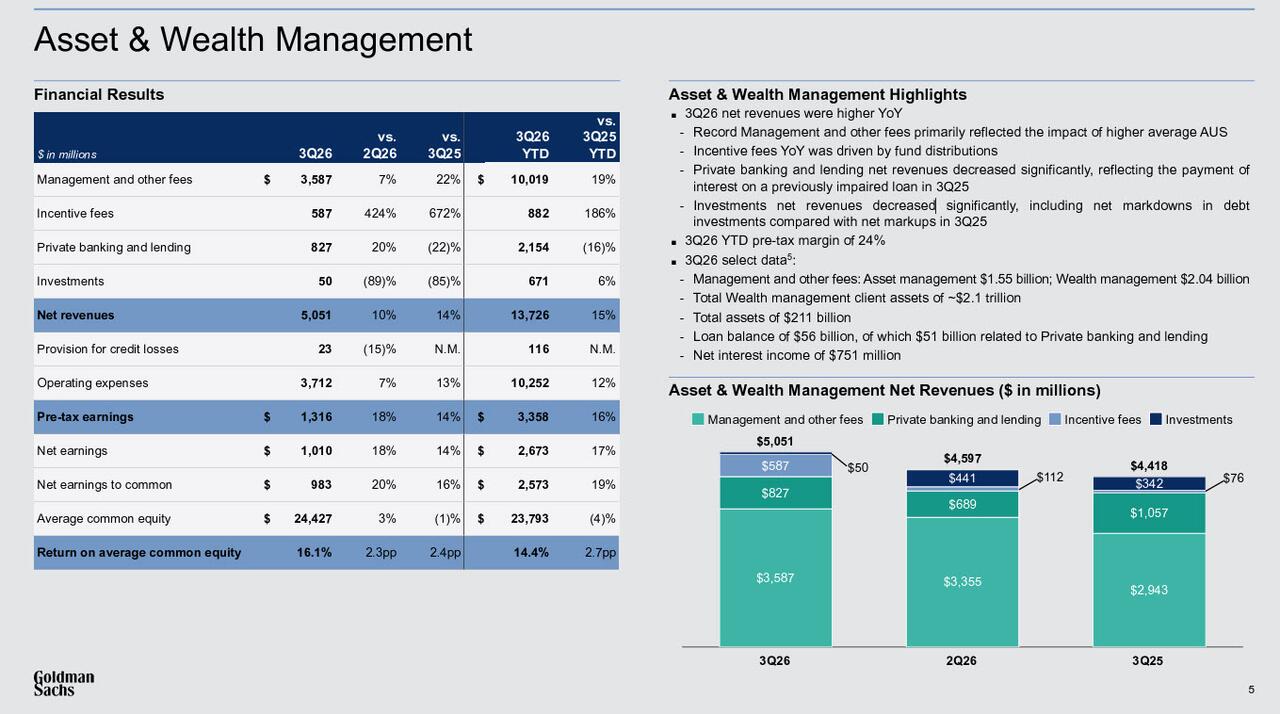
In the bank's Asset and Wealth management divison, incentive fees surged almost eightfold from a year earlier to $587 million. That was tied to arranging bets for its wealth clients on SpaceX during its early funding rounds, Bloomberg News reported this month. Goldman’s revenue from those fees far surpassed the price it was paid for advising on the record IPO.
Goldman also made two key acquisitions in the quarter to expand its more than $4 trillion asset-management division. It bought exchange-traded fund provider NEOS Investments for $2.25 billion and LCN Capital Partners, a commercial real estate investor, for as much as $410 million.
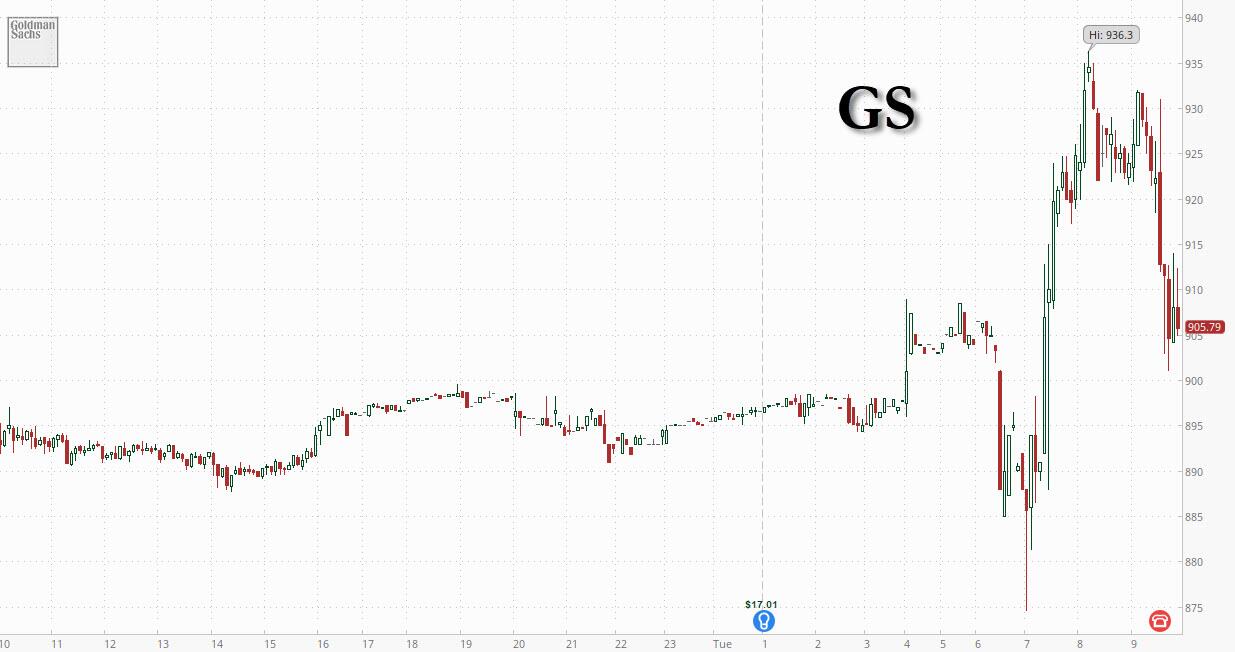
Goldman stock, which has been battered this year after a deep slump in September rose 1.8%, trimming earlier gains of nearly 4%.