





"I'll Be Short Whole Year": Paul Tudor Jones Dismisses Goldman's Optimism, Warns Of Looming Dot-Com Style Equity Supply Tsunami
Paul Tudor Jones appeared on CNBC's "Squawk Box" earlier this morning and warned that corporate buybacks and mergers and acquisitions, which have fueled the four-year bull market, are nearing an inflection point and could reverse next year.
"2027 is going to be really, really challenging for the stock market," Jones, the founder and CIO of Tudor Investment, told Andrew Ross Sorkin.

Jones continued, "You've probably got the most negative flow picture for the U.S. stock market that we've had, say, since 2002."
"I'll be short the whole year. There just... there's little value," Jones emphasized.
He added, "You had all this issuance, all these IPOs in '98 and '99, and really 2000, 2001, 2002. Those were the easiest years to be short because you kept having these unlocks that just kept adding supply to the market."
Unlike Jones, Goldman's chief US equity strategist Ben Snider does not expect the tsunami of new supply to "derail the bull market" in the near term.
The Equity Flood
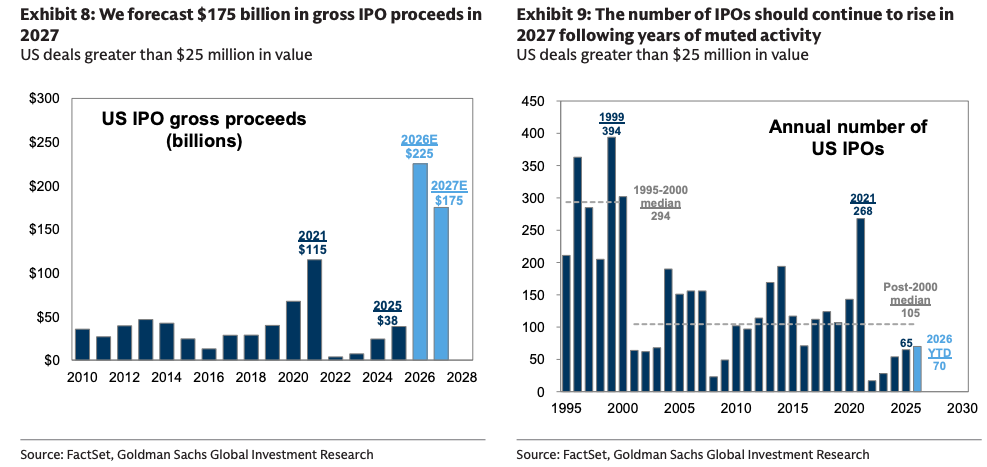
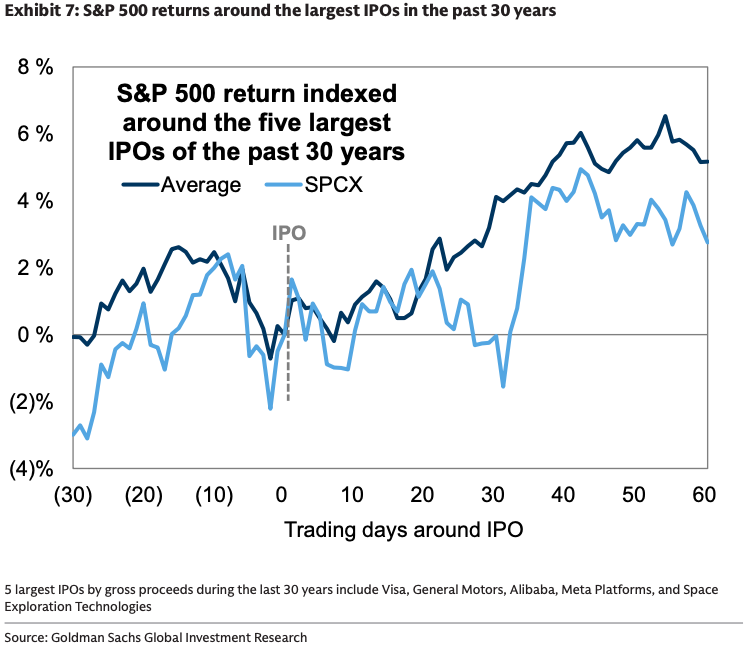
SpaceX's blockbuster $75 billion IPO, SK hynix's $26.5 billion US cross-listing, and others have sparked a wave of new equity issuance and upcoming lockup expirations, setting the stage for the largest increase in net US public equity supply since the bubbly dot-com era.
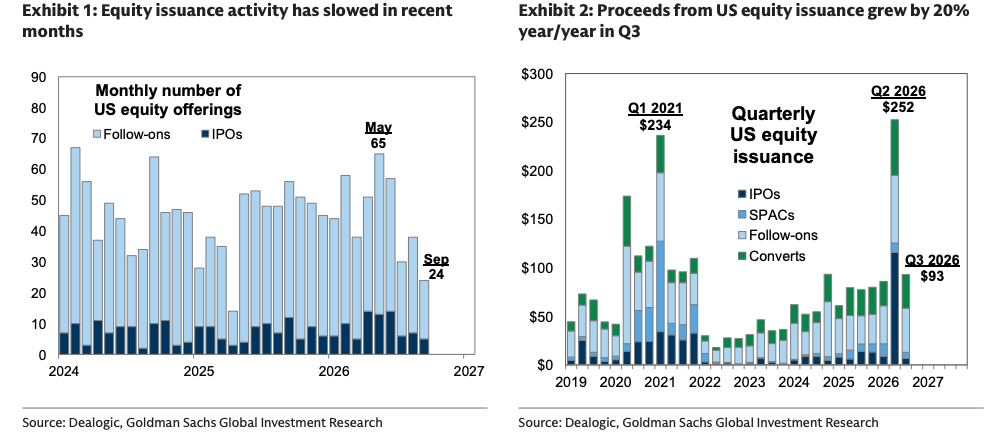
"2026 is on track to be a record year for US equity issuance. US corporates have raised $431 billion YTD via IPOs, follow-ons, converts, and SPACs, representing growth of 98% year/year. The total dollar volume of US equity issuance in 2026 will likely surpass the previous high of $540 billion in 2021. However, the number of deals and the value of issuance scaled to market cap are close to historical averages," Snider wrote in the note.
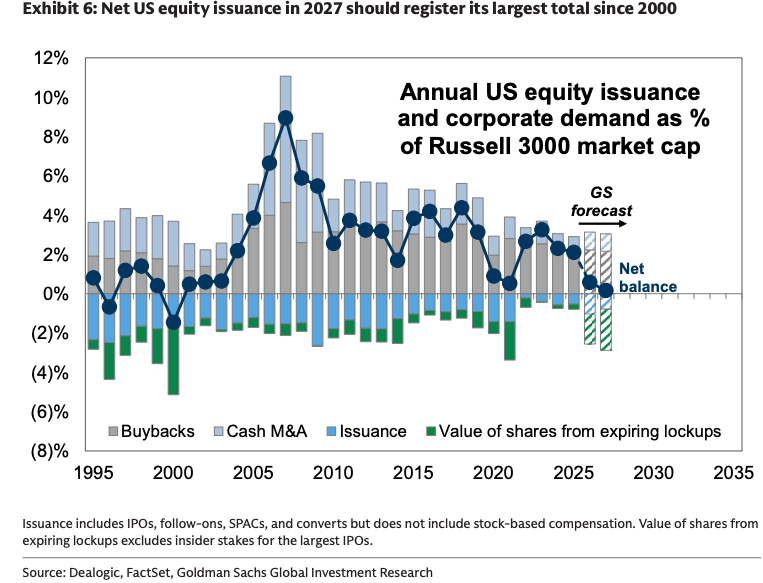
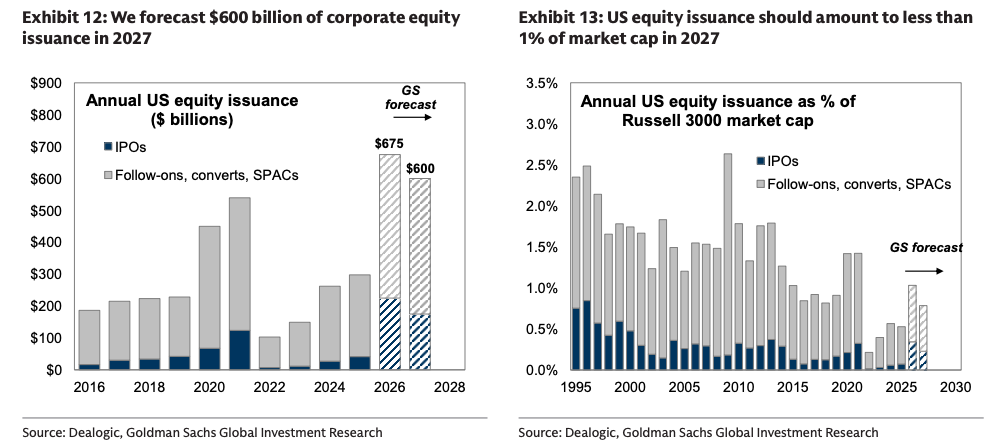
Snider's outlook for next year is as follows: $1.7 trillion in shares will become eligible for sale in 2027 as IPO lockups expire, alongside $600 billion in new corporate equity issuance. Including those unlocks, he expects the largest increase in net US public equity supply since 2000.
Goldman Doesn't See Surging Equity Supply "Derailing Bull Market"
"Including expiring lockups, the net supply of US public equity will likely increase next year by the largest amount since 2000. The shifting balance of corporate supply and demand adds pressure on equity valuations, but we do not expect increasing equity supply to derail the bull market. Strong demand from households and foreign investors totaled more than $1 trillion in H1 2026, and our outlook for continued economic and earnings growth alongside declining interest rates should support continued investor demand for equities in 2027," Snider said.
"Corporate equity issuance in 2027 should equate to slightly less than 1% of US equity market cap, in line with the 10-year average," Snider added.
As of Friday, when the note was penned, the S&P 500 was within 1% of its record high, with the median stock trading 16% below its own high. Snider said his breadth indicator, which compares the index's and the median stock's distances from their respective 52-week highs, has weakened to its lowest level since the Dot Com era.
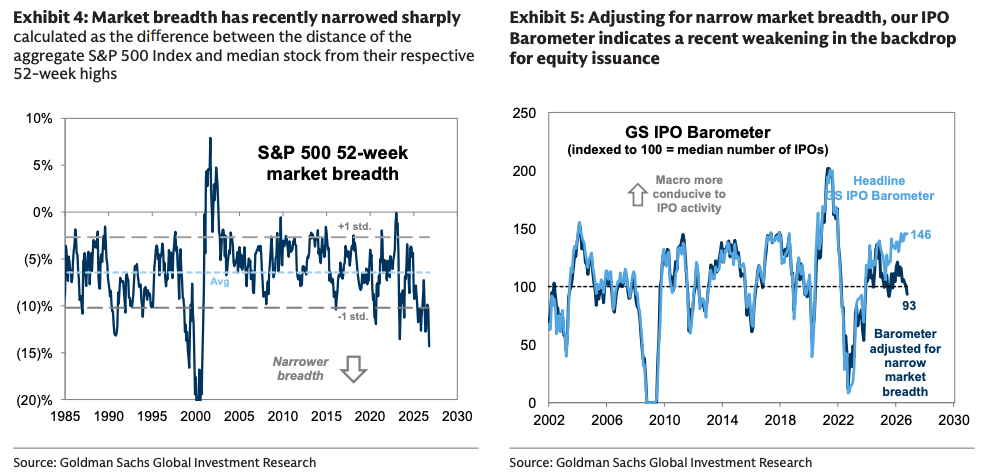
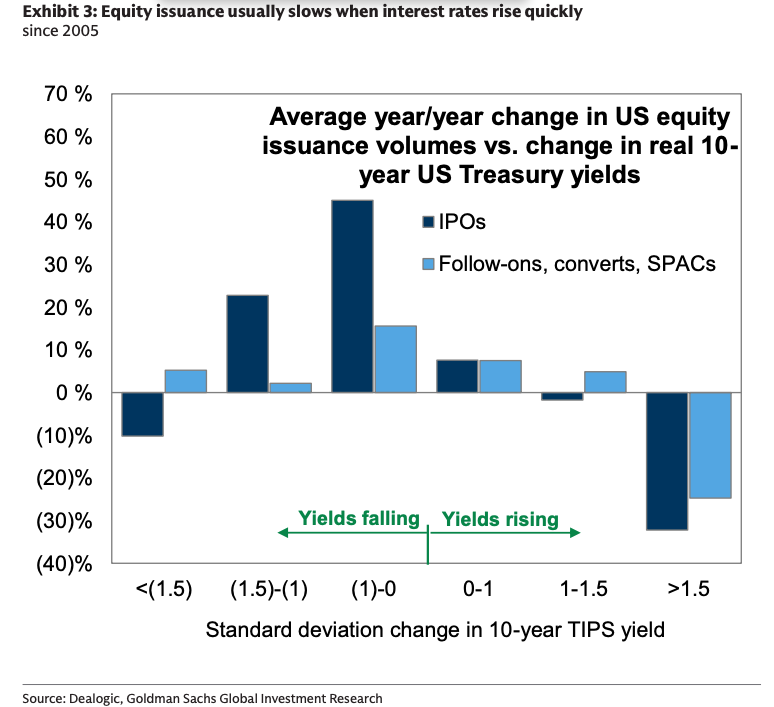
The counterweight to the flood of new equity issuance is expected to be $1.7 trillion in corporate share buybacks next year, up from $1.5 trillion in 2026, with cash acquisitions helping push total corporate equity demand above $2 trillion. But one vulnerability remains: further interest rate increases could slow buyback growth as debt financing becomes more expensive relative to equity.
Here's more color on why Snider doesn't think the new equity supply will weigh on the major equity indices:
We do not expect additional equity supply to derail the bull market in the near future. The shifting balance between corporate equity supply and demand adds to the various macro and micro factors pressuring equity valuations. However, Federal Reserve data show US household equity purchases exceeding $800 billion in H1 2026, with non-US investors adding more than $350 billion in additional demand. Our outlook for continued earnings growth alongside declining yields should support continued investor demand for equities.
Weak market breadth, heavy index concentration in AI-related stocks, and the prospect of the largest increase in net US public equity supply since 2000 create a troubling backdrop if bond yields continue rising. Higher financing costs could pressure valuations and curb buyback growth.
Easing tensions between Russia and Ukraine or in the Gulf could lower crude and refined-product prices (diesel), temper inflation expectations, and ease bond yields.
That would support valuations and help equities absorb the supply.
Now it should make sense ...
Scott Bessent on @TrumpAccounts: "We think that this is the beginning of the ownership society." 🇺🇸 https://t.co/MdxxUQzaoO
— Trump War Room (@TrumpWarRoom) October 7, 2026
... why Treasury Secretary Scott Bessent and others in the Trump administration are pushing non-stock owners to buy now. Someone besides pension funds needs to soak up the new supply: retail.
Let's not forget that both Anthropic and OpenAI confidentially filed draft S-1 registrations for potential IPOs.
So who do you trust? The trader who was there risking his own money the last time this flood of supply occurred? Or the bank that is picking up nickels in front of the underwriting steamroller?
