





It's Past Time To Privatize The Post Office
Submitted by QTR's Fringe Finance
A new piece from the Cato Institute lays out how bad things have gotten at the post office, arguing that the United States Postal Service is facing a severe and worsening financial crisis. According to the article, USPS has been losing billions of dollars annually for well over a decade and is now at a point where it cannot realistically fix its problems without major structural changes. I could have told you this after the horror show I lived through at the post office back in September of 2025.
The USPS now is the predictable outcome of trying to run a massive logistics operation through a government bureaucracy that moves slowly, resists change, and answers more to politics than to performance. The piece makes clear that USPS was built for a world that no longer exists, yet it continues operating as if nothing has changed because, as usual, government institutions are the last to notice reality.
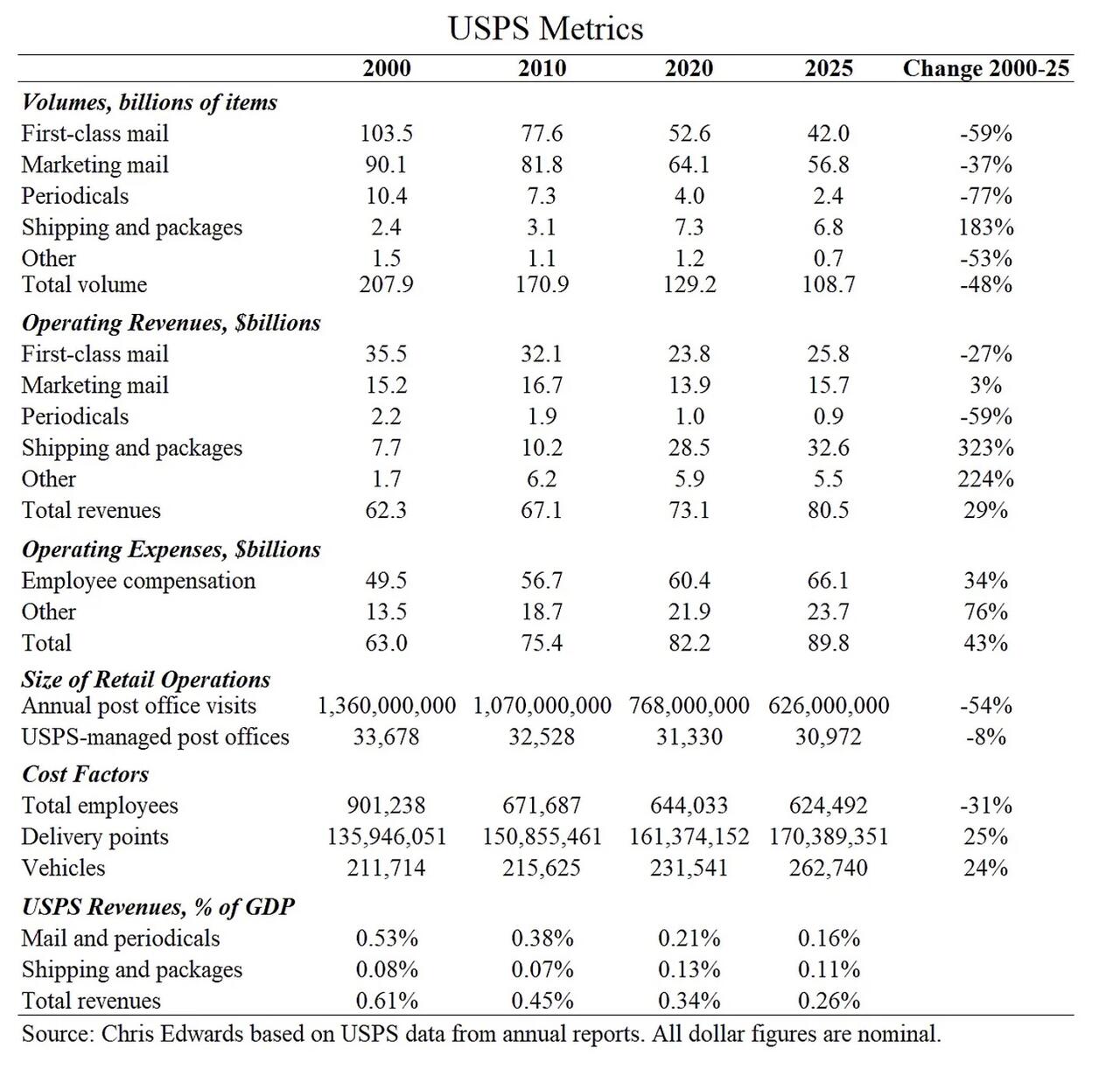
The problems outlined are extensive and, frankly, not surprising. Mail volumes have collapsed as Americans switched to faster, cheaper digital alternatives, yet USPS continues to behave like it’s still 1995. What mail remains is increasingly dominated by low-value marketing material, while the agency struggles to compete in package delivery against companies that actually specialize in logistics.
Even Amazon, a company that started as an online bookstore (what could be less efficient to ship than godd*mn books — bricks?), has figured out how to build a better delivery network.
Meanwhile, visits to post offices have fallen off a cliff, but the system has barely shrunk its footprint. Labor costs remain enormous, productivity lags, and the workforce is structured in ways that prioritize stability over efficiency.
The result is exactly what you would expect when there is no real pressure to perform: bitchy apathetic staff, declining output, rising inefficiency, and billions in annual losses that just keep piling up. In the private sector, that kind of performance would trigger a full-scale overhaul or bankruptcy.
In government, it triggers a Congressional hearing and maybe a strongly worded memo, in addition to switching the Postmaster General and paying the new guy even more than the last guy got paid.
This is why privatization is not some radical idea but a logical response to a system that clearly is not working. A privatized USPS would finally be allowed to operate like a business instead of a political artifact. It could close unprofitable locations without needing a congressional debate, adjust delivery schedules based on actual demand, and invest in technology that improves service instead of maintaining outdated systems because “that’s how it’s always been done.”

Most importantly, it would have to make money (or at least stop losing it) which is a constraint that tends to focus the mind in ways government management never quite experiences. When survival depends on efficiency, organizations tend to discover it very quickly.
The contrast with private carriers like FedEx and UPS could not be clearer. These companies operate in a world where excuses don’t pay the bills. They optimize routes, invest in automation, analyze data, and constantly refine their operations because if they don’t, their competitors will. They have built systems that deliver packages faster, track them more precisely, and adapt to changing demand almost in real time. None of this happened because a committee approved it after years of debate. It happened because the profit motive demands results.
Meanwhile, USPS is stuck navigating layers of regulation and political oversight, where even obvious changes can take years to implement, if they happen at all.
🔥 50% OFF FOR LIFE: Using this coupon entitles you to 50% off an annual subscription to Fringe Finance for life: Get 50% off forever
There is also the small matter of accountability. Private companies cannot run losses indefinitely and expect someone else to quietly cover the gap. They either fix the problem or they go under. USPS, on the other hand, operates with the understanding that there will always be some form of backstop, explicit or not. That safety net removes urgency and allows inefficiencies to persist far longer than they would anywhere else. It is the classic government model: spend more, deliver less, and call it a “challenge” instead of a failure. Privatization would replace that dynamic with one where performance actually matters, where bad decisions have consequences, and where efficiency is not optional.
Of course, defenders of the status quo often argue that privatization would undermine public service, but that assumes the current system is delivering high-quality service to begin with. Other countries have already shown that it is possible to maintain universal delivery while still operating under private or semi-private models. Targeted subsidies can ensure rural access without requiring the entire system to function inefficiently. The difference is that those systems are designed around outcomes, not inertia.
At some point, it becomes difficult to ignore the obvious. Government agencies are notoriously bad at adapting, innovating, or even cutting costs, because they are not structured to do any of those things well. The USPS is not an exception; it is a textbook example. Continuing down the current path means more losses, more inefficiency, and more attempts to patch over structural problems with temporary fixes. Privatization, by contrast, offers a way to align incentives with reality, bringing the postal system into the same competitive, performance-driven environment that has already transformed the rest of the logistics industry. And if that means admitting that the government is not particularly good at running a nationwide delivery business, that is less a controversial statement than an overdue acknowledgment of what the evidence has been showing for years.
QTR’s Disclaimer: Please read my full legal disclaimer on my About page here. This post represents my opinions only. In addition, please understand I am an idiot and often get things wrong and lose money. I may own or transact in any names mentioned in this piece at any time without warning. Contributor posts and aggregated posts have been hand selected by me, have not been fact checked and are the opinions of their authors. They are either submitted to QTR by their author, reprinted under a Creative Commons license with my best effort to uphold what the license asks, or with the permission of the author.
This is not a recommendation to buy or sell any stocks or securities, just my opinions. I often lose money on positions I trade/invest in. I may add any name mentioned in this article and sell any name mentioned in this piece at any time, without further warning. None of this is a solicitation to buy or sell securities. I may or may not own names I write about and are watching. Sometimes I’m bullish without owning things, sometimes I’m bearish and do own things. Just assume my positions could be exactly the opposite of what you think they are just in case. If I’m long I could quickly be short and vice versa. I won’t update my positions. All positions can change immediately as soon as I publish this, with or without notice and at any point I can be long, short or neutral on any position. You are on your own. Do not make decisions based on my blog. I exist on the fringe. If you see numbers and calculations of any sort, assume they are wrong and double check them. I failed Algebra in 8th grade and topped off my high school math accolades by getting a D- in remedial Calculus my senior year, before becoming an English major in college so I could bullshit my way through things easier.
The publisher does not guarantee the accuracy or completeness of the information provided in this page. These are not the opinions of any of my employers, partners, or associates. I did my best to be honest about my disclosures but can’t guarantee I am right; I write these posts after a couple beers sometimes. I edit after my posts are published because I’m impatient and lazy, so if you see a typo, check back in a half hour. Also, I just straight up get shit wrong a lot. I mention it twice because it’s that important.