


Ken Griffin Says AI Is "Almost Certainly" A Bubble As Corporate America Opens Its Anthropic And OpenAI Bills
The man who runs one of the world's most profitable hedge funds and America's biggest market maker has a word for the AI trade, and it starts with a "b".
Speaking at the Future of Global Markets Conference in New York on Tuesday, Citadel founder Ken Griffin told Bloomberg that investors are "almost certainly" in the midst of an artificial intelligence bubble, as many companies are still figuring out how much they will spend on the technology and what, exactly, they are getting for it.
"Corporate America has been very uneven in its ability to extract value from its AI models. I think all of Corporate America is looking at their bills from Anthropic and OpenAI and going, 'Okay, we need to think about how to make sure we're getting productivity out of this.'"
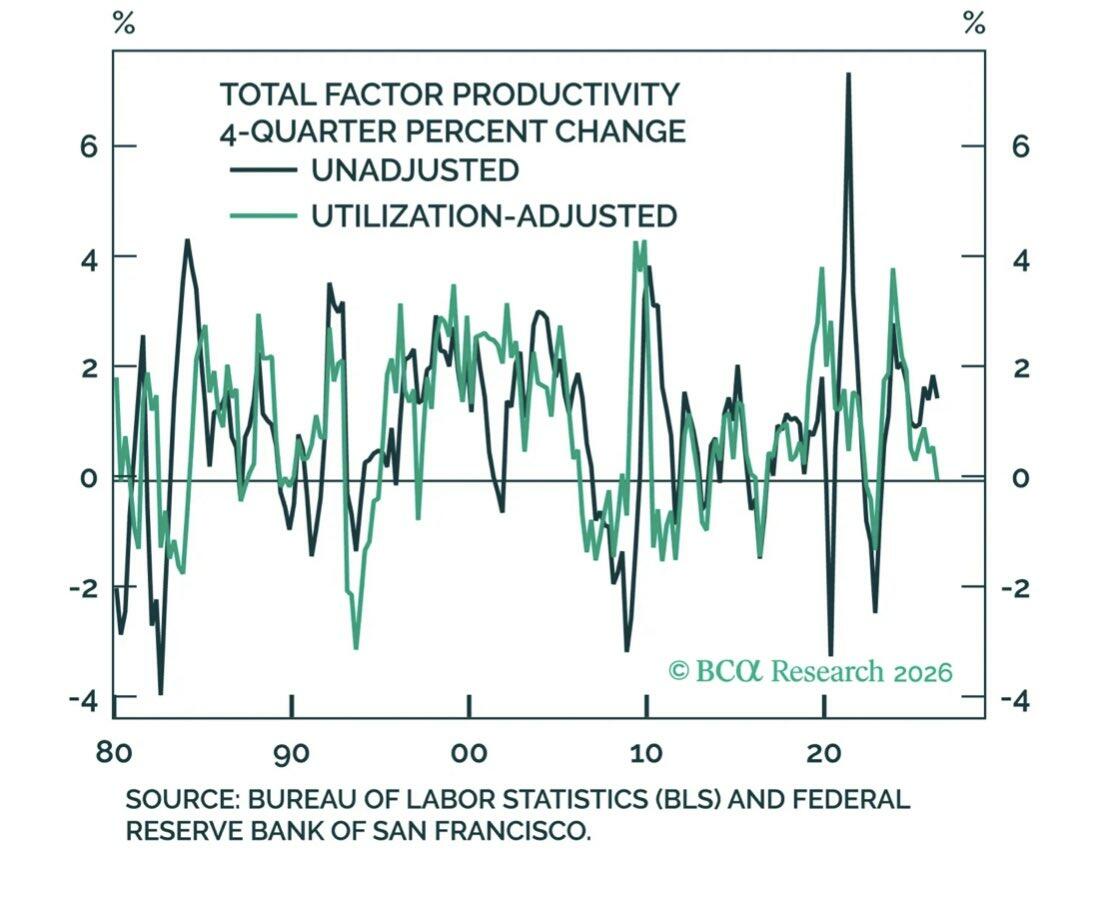
That could be a problem because as BCA Research showed this week, so far AI has not produced an economy-wide acceleration in productivity growth. In fact, adjusted for shifts in utilization rates, total factor productivity growth was zero in Q2. Said otherwise, there has been zero productivity boost from AI!
And just in case anyone thought that was a throwaway line:
"Any radical transformation of our economy is generally intertwined with a bubble. These bubbles, if we want to use that word, often coincide with these giant technological transformations."
In other words, the best-paid man in the room thinks the room is in a bubble, and he is fine saying so out loud. Which, for regular readers, will sound familiar: we have been warning since last October that the AI boom runs on debt, and lately the market has started doing the warning for us.
To be sure, nobody will care this is a bubble... until the market crashes, at which point everyone will scream how nobody warned them in advance. And just like that the new TBTF is born.
"Looking At Their Bills"
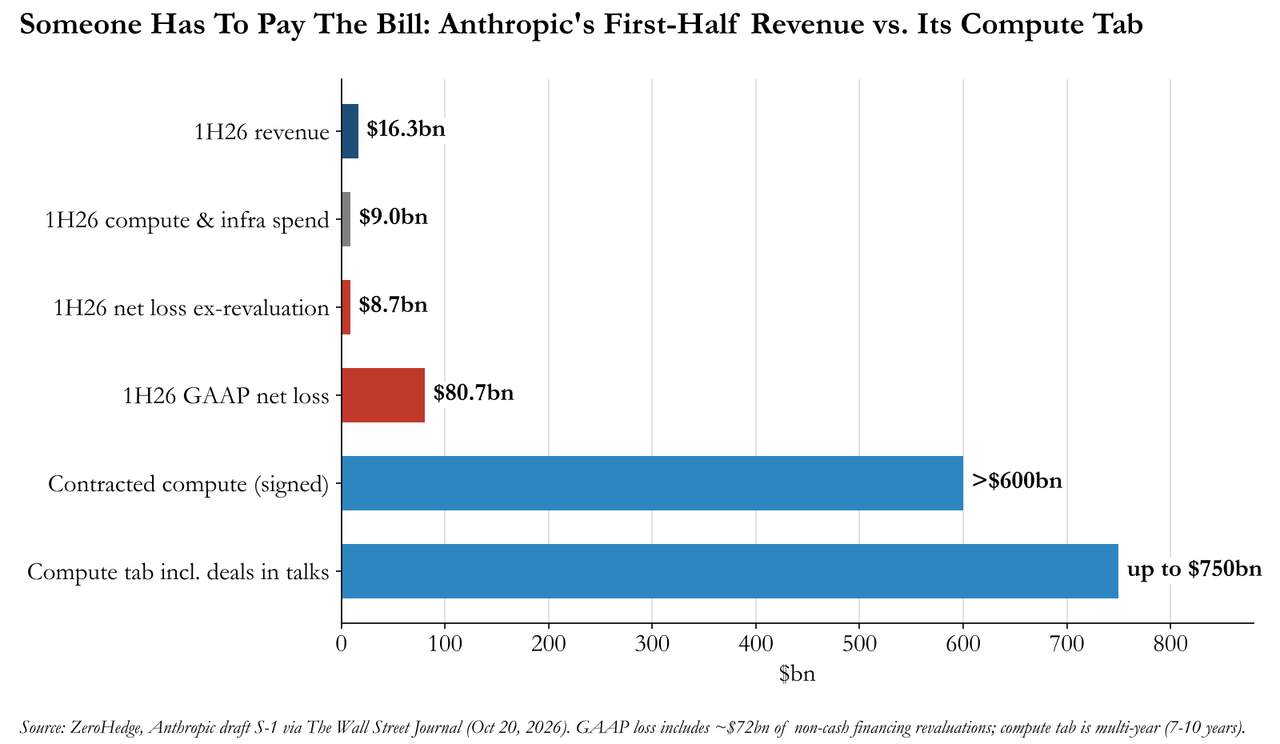
Griffin's timing was impeccable, maybe a little too impeccable. Hours earlier, the WSJ reviewed a fresh draft of Anthropic's S-1, which we broke down in "Anthropic's Updated S-1: An $80.7BN Half-Year Loss, A $750BN Compute-Tab, And A 'Catastrophic Incident' Warning." The short version: Anthropic booked $16.3 billion in revenue in the first half of 2026, posted an $80.7 billion GAAP net loss (about $72 billion of which is a non-cash revaluation of financing instruments, leaving a still-hefty ~$8.7 billion underlying loss), and has signed more than $600 billion of mostly noncancelable compute contracts, with talks under way for another $150 billion. That would take the tab to as much as $750 billion.
Our reaction to the revenue headline was, well, brief:
*ANTHROPIC HAD $16.3B IN REVENUE IN FIRST HALF OF 2026: WSJ that's it?
— zerohedge (@zerohedge) October 20, 2026
Here is what that looks like on one chart: eventually someone has to pay for the blue bars, and Griffin just told us the customers are starting to check the invoices.
Griffin, for his part, said Anthropic's success will ultimately depend on proving to investors that its models are a must-have across every industry. That is a tall order when the price of the product keeps falling (and that ignores the fact that as "every industry" finds models are indispensably, it fires "almost every" worker currently employed, leading to a labor depression) . As we showed last week, Anthropic's token prices have tumbled to an all-time low:
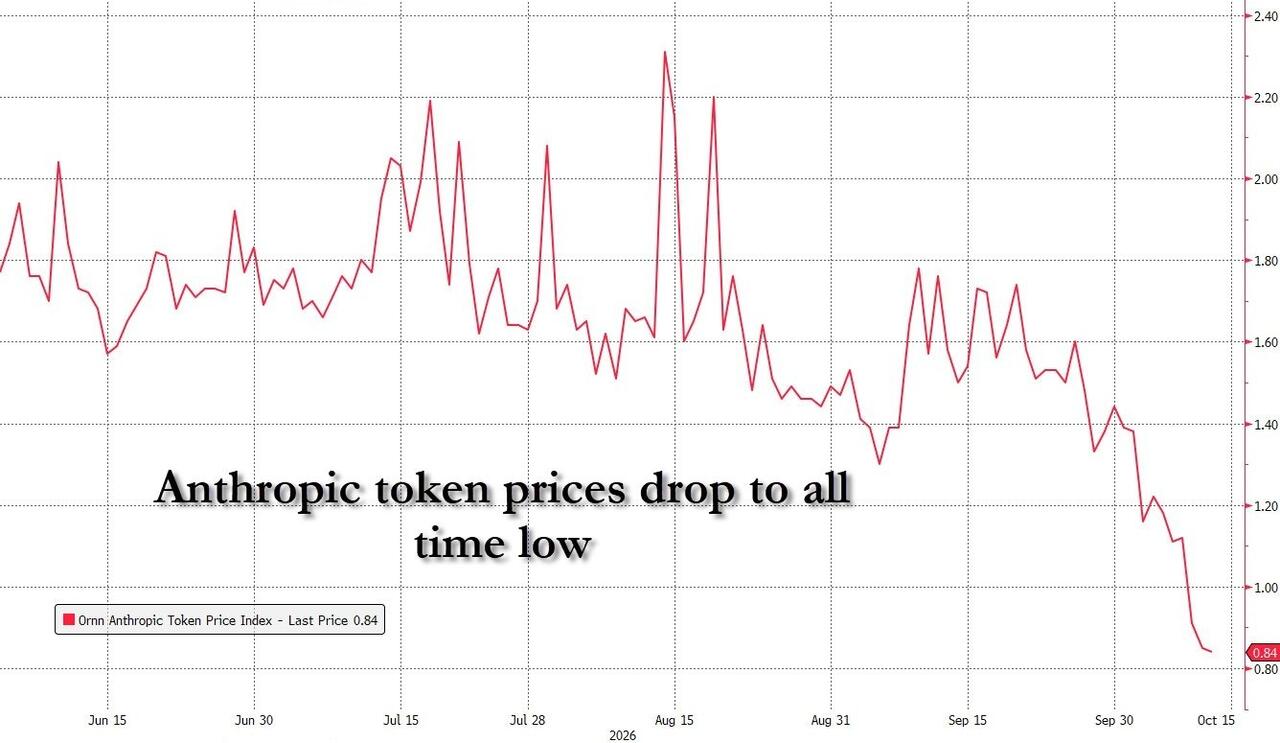
Falling prices and decelerating growth are a tricky combination for a company with fixed, ten-year take-or-pay obligations. It is also why IPO investors marked the valuation down to $1.5 trillion last week after Anthropic's Q3 numbers showed the sequential growth rate hitting the brakes. Put differently, the bill keeps rising and the price per unit keeps falling, and the gap is what the IPO is supposed to fund.
From "Garbage" To "Depressed" To "Golden Era"
To be fair to Griffin, his AI views have had quite a year. Speaking in Davos in January, he called AI garbage, per Bloomberg. By May he told an audience at Stanford Business School that he was depressed by everything AI could achieve. On Tuesday he struck a sunnier tone, arguing the technology will unleash a wave of new business formation in the US:
"You're seeing the threat to white collar jobs playing out; as a business owner, you're seeing your competitive moats be filled in by bulldozers. At the same time, you're thinking that this will be a golden era for entrepreneurs."
Garbage, then depressing, then a golden era that happens to be a bubble. Three views in ten months is roughly how the market has traded AI too, so maybe he is just being consistent.
Griffin also pointed back to the days before the dot-com crash and some of the "fanciful" business models of that era:
"The companies that are on the other side of that bubble are the market leaders for decades to come. I just wish I'd kept my Amazon stock in that moment."
A fair point, with one footnote: anyone who kept their Amazon stock through that moment first had to sit through a drawdown of more than 90%. The winners on the other side of a bubble tend to get there the hard way.
Goldman: Breadth Is At Its Narrowest Since The Dot-Com Bubble
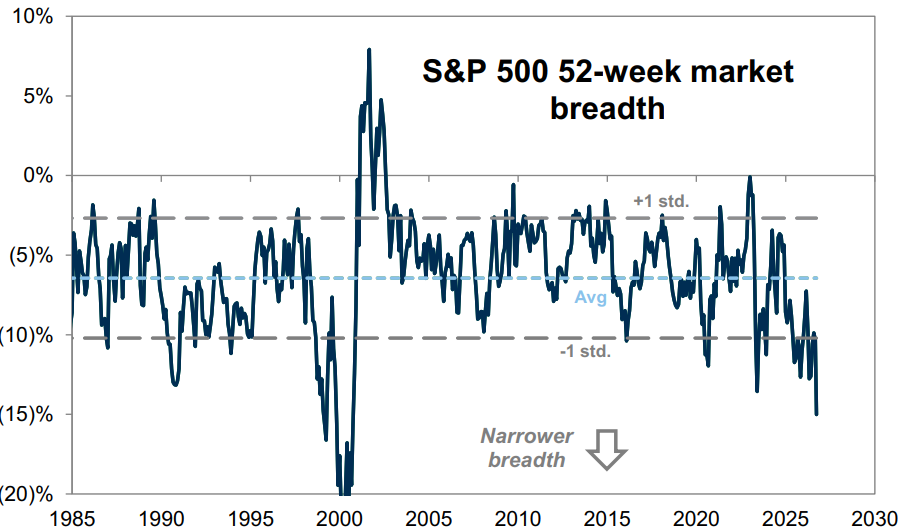
Griffin isn't the only one reaching for the 2000 analogy. Goldman's chief US equity strategist Ben Snider, in his latest US Weekly Kickstart (available to pro subs), notes that with the S&P 500 just 2% from its record high but the median S&P 500 stock 15% from its high, Goldman's preferred measure of breadth "remains near its narrowest level since the Dot-Com Bubble."
Snider also tackles the "productivity" question Griffin raised, from the earnings side. He expects S&P 500 EPS growth to slow from 29% in 2026 to 18% in 2027 (adjusting for accounting distortions), and warns that "slowing AI investment growth will be a fading tailwind." How big a tailwind? Goldman's Asia sales desk (Dani Wojdyla) puts it bluntly in this week's "Positioning Reset" note: "AI capex is currently contributing about half of S&P 500 EPS growth," an impulse Goldman expects "to diminish as capex growth slows and depreciation builds."
Translation: half of the earnings growth the market is paying for comes from companies spending money on AI, which shows up as someone else's revenue... and eventually as everyone's depreciation. The early Q3 read already shows the slope turning: 53% of S&P firms have beaten consensus EPS so far, above the 25-year average of 50% but well below the 64% rate of the past four quarters.
Last week Goldman's Tony Pasquariello argued breadth "isn't so bad"... then brought up the dot-com bubble twice, including a 2027 supply wildcard that could lift net US equity supply by the most since 2000. Anthropic's IPO, of course, is a big chunk of that wildcard.
Over at BofA, Michael Hartnett's team has done the bubble math on concentration. Peak concentration in the major bubbles of the past two centuries clustered around 40% (railroads were the outlier at 63%). The "AI Big 10" (Mag 7 plus Broadcom, AMD and Micron) recently hit 42%, above the 41% TMT peak in 2000:
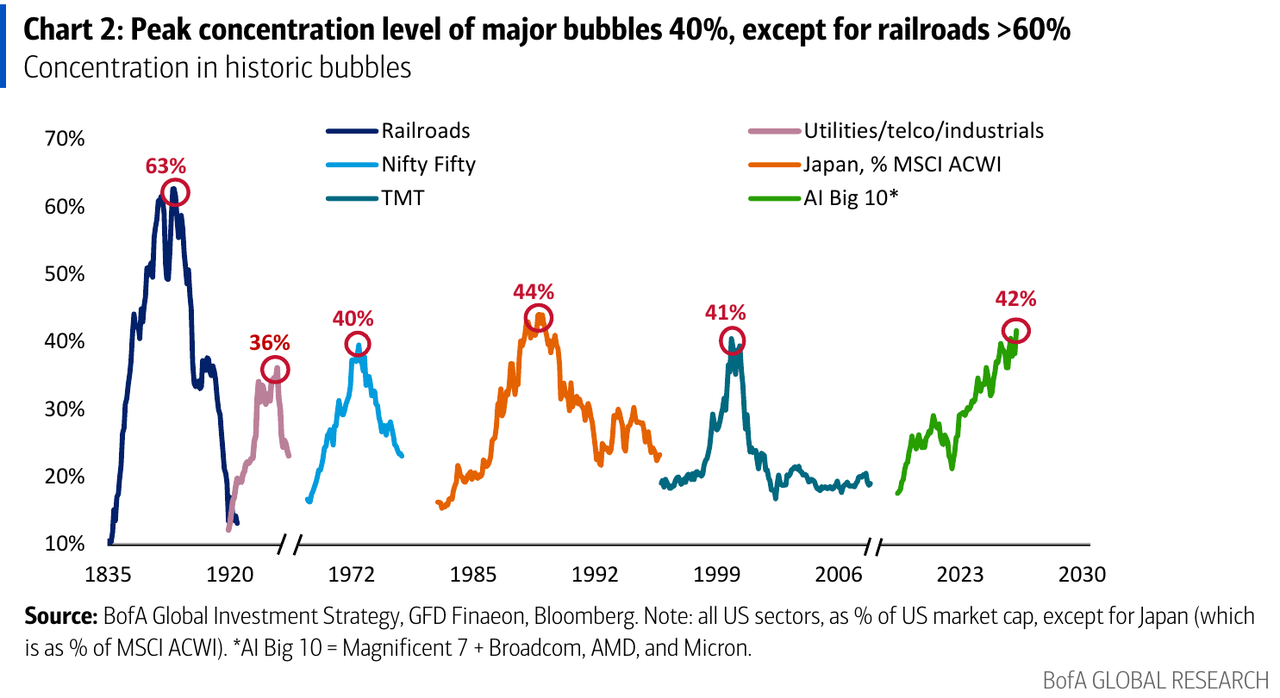
Nothing says "healthy market" like a chart where the current reading sits between the Nifty Fifty and Japan in 1989.
Credit Got There First
If equity investors are only now discovering the word "bubble", the credit market has been pricing it for weeks. Per Goldman credit strategist Amanda Lynam's Global Credit Trader, "AI, Credit, and a Higher Cost of Capital" (also available to pro subs), USD HY AI-related spreads widened 25bp to 360bp over Treasuries, compared with just 2bp for non-AI issuers, with data center issuers leading the way:
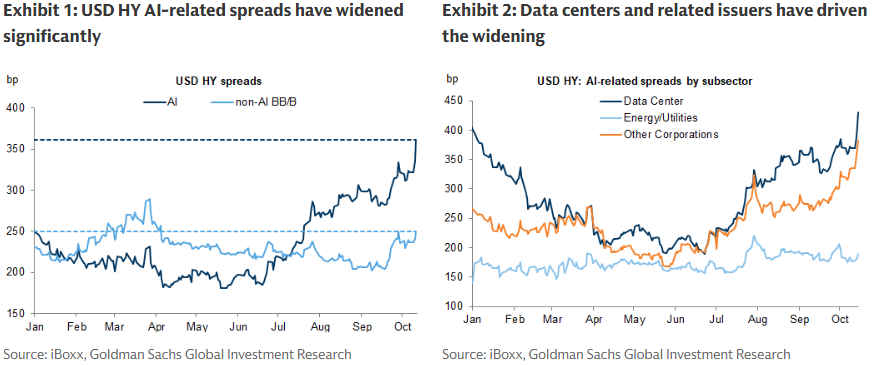
Even Goldman's strategists, who just moved tactically overweight equities in their latest GOAL Kickstart, concede the point in the same note:
"Concerns on AI capex returns and funding are increasingly showing up in credit: CCC-BB spreads, hyperscaler CDS and neocloud OAS have all widened, with the latest move particularly sharp for neocloud issuers."
So Goldman is long the stocks and short the credit, while the credit is the one sending the warning. Their own Risk Appetite Indicator just "turned negative for the first time since March 2026," with all five sub-components down over the past month. Bullish, maybe... but not exactly confident.
The equity-credit gap is stark. As Goldman's basket desk showed in a chart we highlighted in "Trick Or Treat", hyperscaler equities were about 15% lower the last time hyperscaler credit spreads were this wide:
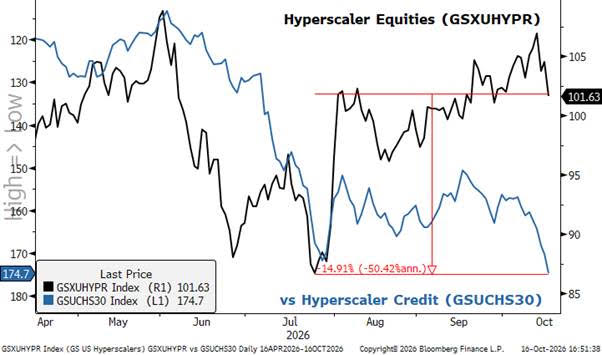
And the debt pile is only getting bigger. Goldman's credit team expects project finance plus direct hyperscaler issuance to hit $720 billion in 2027, up from $37 billion of project finance in all of 2025, with risks "firmly skewed to the upside":
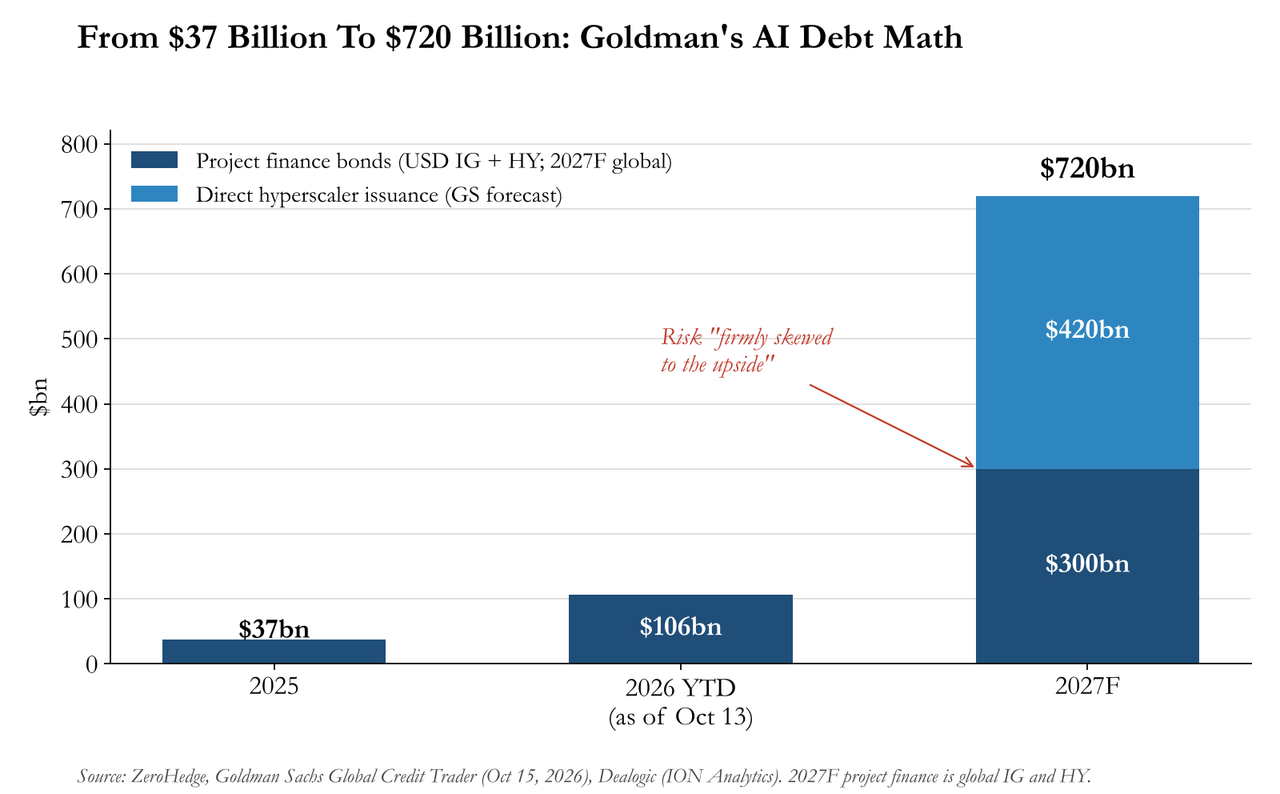
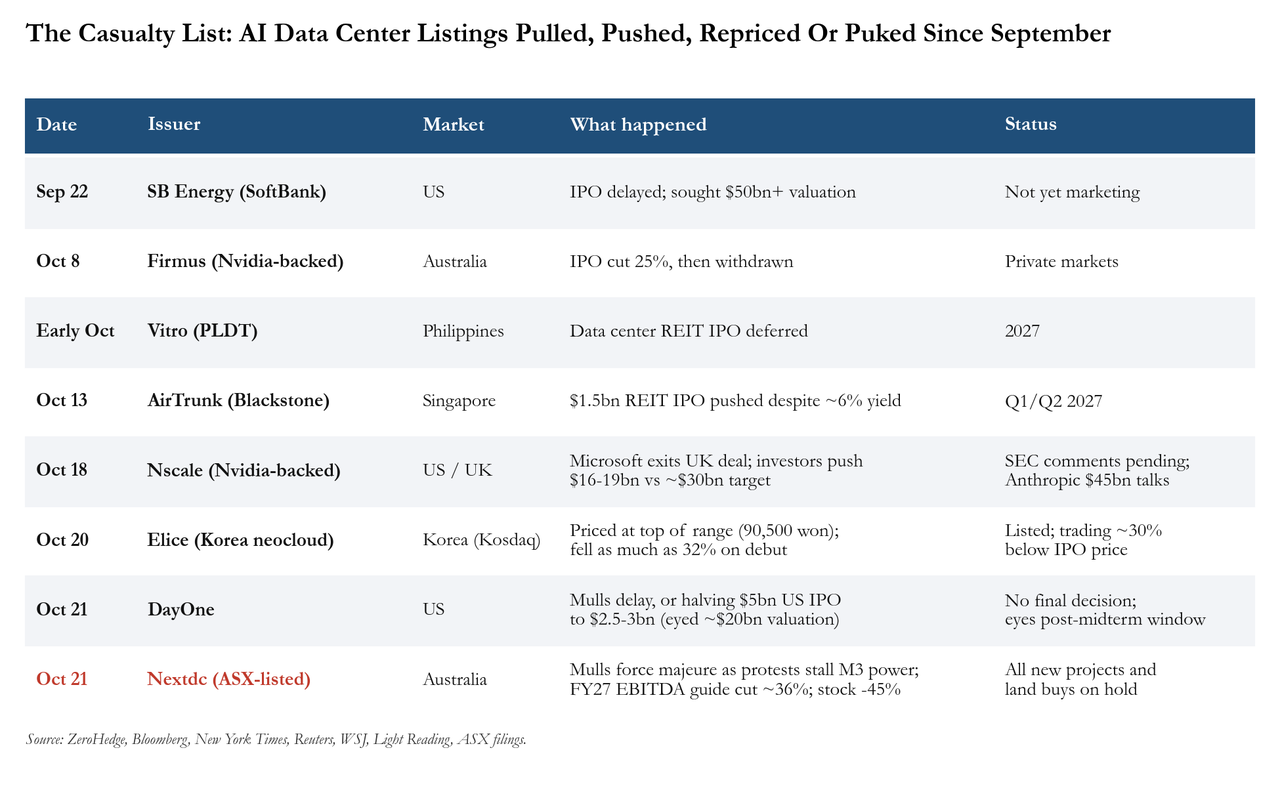
The cracks are already showing where capital meets reality. Korea's Elice cratered 32% on its debut despite a retail tranche 400 times oversubscribed, and Australia's Nextdc imploded 45% and is mulling force majeure as protesters stall power to its Melbourne campus. Here is the updated casualty list:
Fink: The Bubble Can't Stop Inflating
Not everyone in the C-suite agrees with Griffin, or rather they agree, they just don't see any way out. Less than a day after the Citadel CEO's comments, BlackRock's Larry Fink took the opposite side, warning on Bloomberg TV from the Berlin Global Dialogue that the real danger is building too slowly. Per Bloomberg:
"If we don't build out these data centers, it is actually more inflationary because the cost of compute is so high right now. And the faster we can build out more data centers, the more compute we have, the faster we can bring down the cost."
Incidentally, this is precisely the point we made a month ago:
The more data centers are lit, the faster this bubble pops
— zerohedge (@zerohedge) September 25, 2026
And, just to raise the stakes, Fink added that "If we slow down the build out of this technology, I think it really does jeopardize the economy." (Deutsche Bank's Christian Sewing, for what it's worth, also played down Griffin's bubble fears on Wednesday.)
Translation: the bubble is too important to stop inflating. Coming from the head of a firm whose infrastructure arm is among the biggest data center buyers on the planet, maybe that is not a huge surprise.
Fink does have a point on the physical bottleneck, and it is one we have been hammering for months: the constraint is power, permits and angry neighbors, which is why we keep arguing that "behind the meter" generation should be mandatory for new campuses. Nextdc's Melbourne fiasco is exactly that constraint in action, and so are the billions in Nvidia chips collecting dust in Amazon warehouses because there is nowhere to plug them in.
But the rest of his argument runs into the numbers above. If compute is so scarce and expensive, it is odd that Anthropic's token prices just hit an all-time low and its revenue growth is slowing (thank Chinese open-source models, which Dario is desperate to ban at the sovereign level). More importantly, building faster means borrowing faster, and Fink himself flagged the problem in the same interview:
"We're at a time now where we're finally unlocking private capital, and so the competition for capital is as large as I've ever seen in my professional career."
He also said bond yields are "flashing," adding: "Wake up, federal government. Our deficits are starting to have real large issues." Put the two together and you get the trade-off we have been describing for months: every extra dollar of AI debt is competing with Uncle Sam's ~$2 trillion deficit for the same duration buyers, with the 10Y already above 5%. As we noted on Sept 1, AI issuance has been crowding out Treasuries. In other words, Fink's cure for compute inflation (build more, faster, with borrowed money) is a fine recipe for bond-market inflation.
Who Holds The Bag On The Other Side?
Griffin's bubble call comes with a familiar bullish escape hatch: bubbles fund revolutions, and the survivors become the Amazons of the next two decades. That is probably right about the technology. It says very little about the price anyone pays to get there, or about who ends up holding the paper when the bills come due.
Griffin says it's a bubble; Fink says stopping it would be inflationary. Both can be right, which is precisely the problem. And right now the bills are piling up on both sides. On one side, Anthropic needs public investors to backstop as much as $750 billion of compute it has already promised to pay for. On the other, its biggest customers (per Griffin) are starting to ask what they are getting for their money. Meanwhile half of S&P earnings growth depends on the capex continuing, the credit market is already charging more to fund it, and the bond market (per Fink himself) is "flashing."
So we'll side with Griffin's first word over his last one. The AI buildout will probably produce a few generational winners, but the path from here to there looks a lot more like 2000-2002 than like a "golden era", and as usual, credit is telling equities which way the bubble deflates. If the man with the best seat in the house wishes he had kept his Amazon shares, maybe the more useful lesson is that he didn't buy more of them in March 2000.
Much more in the full Goldman US Weekly Kickstart "What to own when slowing growth meets narrow breadth, the "AI, Credit, and a Higher Cost of Capital" Global Credit Trader and the GOAL Kickstart "AI concerns weigh further on risk appetite", all available to pro subs.