


Life After AI: Where The Money Is Now Moving
Submitted by QTR's Fringe Finance
As I write this Thursday morning, Dow futures are green while Nasdaq futures are down roughly 0.5%. It’s a small but interesting divergence, and one that supports something I’ve been predicting for a while now: a rotation away from speculative technology and AI-related investments and toward established businesses with more predictable earnings and cash flows.
I continue to believe tech, particularly the more speculative corners of the AI trade, is headed lower over the short to medium term. Yesterday’s rally didn’t change that view. As I discussed yesterday, citing Gordon Johnson, I think much of the move could be attributable to VIX compression and the unwinding of election-related hedges. Once the election uncertainty disappeared, investors no longer needed as much protection, implied volatility fell, and the resulting repositioning helped push stocks higher.
That doesn’t mean there wasn’t genuine buying, or that the market can’t rally further. But I would be careful about mistaking a mechanical relief rally for a fundamental improvement in the outlook. Valuations remain stretched, financing costs remain a problem, and the economics of the AI infrastructure boom are increasingly difficult to justify. The election, in my opinion, added another layer of risk rather than removing one.
What interests me more than yesterday’s index performance is where money appears to be moving to.
For a few months, I’ve been arguing that 2027 could be characterized by a rotation away from speculative AI and technology investments and toward larger, established companies with real earnings and durable businesses.
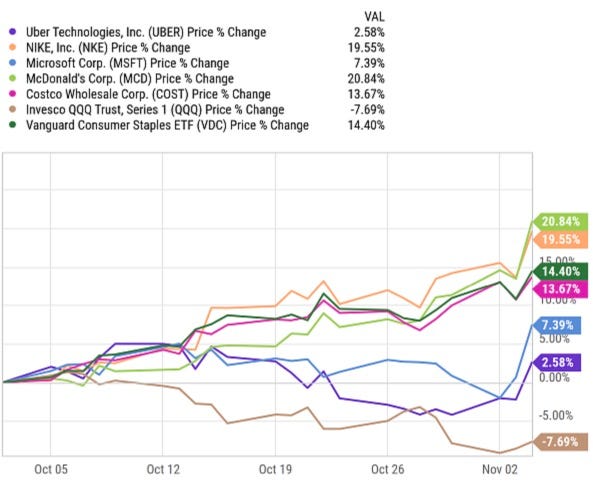
The relative action in some names I’ve pointed out, including Nike (NKE), Costco (COST) Microsoft (MSFT), Uber (UBER), Consumer Staples (VDC) and McDonald’s (MCD), along with several other companies I’ve been watching, suggests that process may already be underway. Names like these are outperforming the NASDAQ and that outperformance appeared to accelerate during yesterday’s rally.
These businesses have very different exposures, but they share an important characteristic: investors can evaluate them based on existing operations and identifiable earnings power, rather than exclusively on extraordinary assumptions about future growth.
Microsoft, for example, may face legitimate questions about its AI spending, but it has the financial resources to fund those ambitions without continually returning to capital markets.
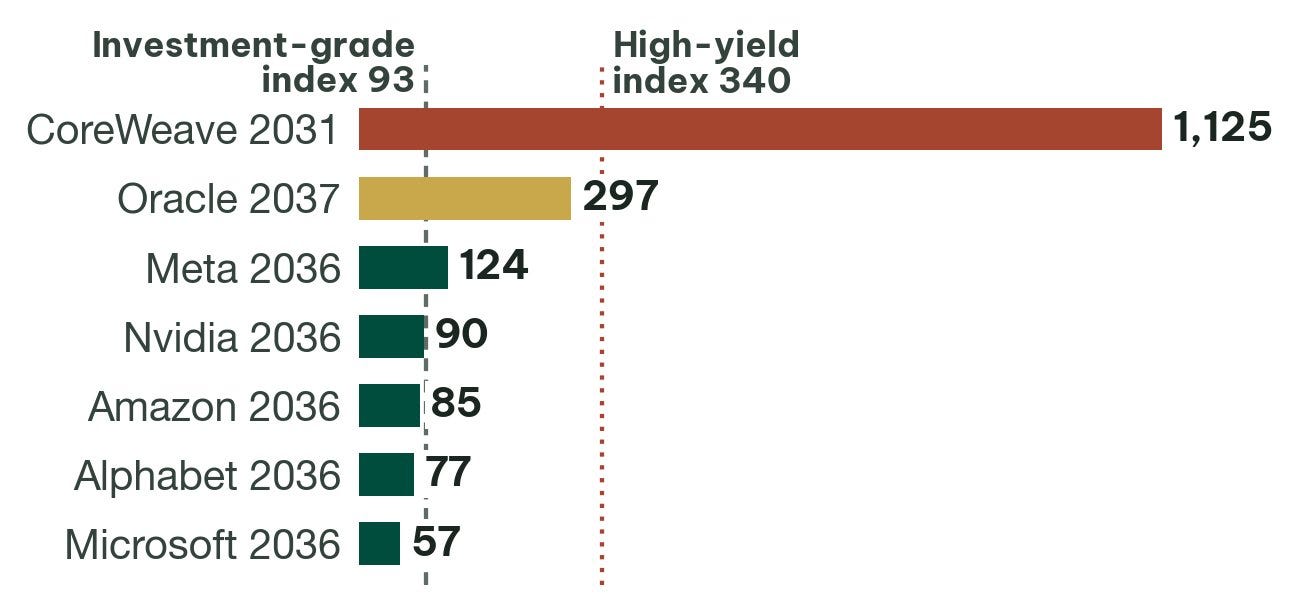
Interestingly, JPMorgan’s trading desk described a similar pattern yesterday. According to an X post by Zero Hedge, JPM’s Brian Heavey noted a clear preference for large-cap quality, particularly companies with access to financing and ownership of computing infrastructure. The desk observed demand for hyperscalers like Amazon, Microsoft, and Alphabet, while second-tier AI infrastructure names like CoreWeave (CRWV) and Nebius (NBIS), which are more dependent on continued capital raising, showed weakness.
As I noted on a brief X Spaces call yesterday, names with leverage (like CoreWeave) and inconsistent cash flows will be the first to be abandoned in the AI space. Quality like Google (GOOG), Amazon (AMZN) and the likes will be the beneficiaries, though I personally don’t love Apple (AAPL) here at 40x earnings.
JPMorgan also noted that AI data-center names were generally underperforming, while more cyclical analog semiconductor companies like Texas Instruments (TXN) and NXP Semiconductors (NXPI) were showing relative strength.
Matt Reiner, also from JPMorgan, described relatively subdued trading activity, with volumes running approximately 16% below normal early in the session today.
Long-only investors were buying, particularly cyclicals, while hedge funds were shorting technology into weakness. He also observed that investors were adding mega-cap technology exposure in relatively small size, while becoming more receptive to shorting the broader AI complex.
To me, the message is fairly straightforward: investors aren’t necessarily abandoning technology, but they appear to be becoming more selective about which parts of it they want to own. The distinction between companies that generate capital and companies that constantly need to raise it is becoming increasingly important.
I was also interested to hear about Citrini Research’s latest State of the Themes report, covered this morning by Dow Jones’ MarketWatch. The firm is now making an argument remarkably similar to one I’ve been discussing for roughly two months, when the Nasdaq was approximately 10% higher. But that’s great. Citrini does good work, there’s plenty of room in this lifeboat and I’m happy to see some validation on my thoughts from August, when I wrote: The Real AI Crash Will Start This Year
85% OFF FOREVER IF YOU SUBSCRIBE TODAY: I am again offering an 85% discount to anyone that wants to become a Fringe Finance annual subscriber today. It’s a discount you can keep and stays applied for as long as you wish to remain a subscriber: Get 85% off forever
Citrini’s central prediction is that we’re approaching peak growth in AI capital expenditures. The firm estimates that annualized hyperscaler investment is approaching $1 trillion, while annual recurring revenue across the AI ecosystem is roughly one-fifth of that amount. Those aren’t directly comparable financial measures, but the disparity highlights the fundamental question I’ve been asking: where are the returns on all this spending?
The firm argues what I have written about the last month or two…that capital markets cannot indefinitely accommodate the extraordinary financing demands of the hyperscalers and that spending growth will eventually have to decelerate. It also points to growing pricing competition between OpenAI and Anthropic, the potential commoditization of AI models, and the increasing risk that AI disrupts established software businesses without necessarily producing attractive returns for the companies building it. It’s Official: The AI Emperor Has No Clothes
This among other things, was also covered in an article I published in August reviewing 8 different bear cases facing the market by 8 well known respected investors: 8 Sharp Bear Cases You Must Read Today
Add the election’s potential implications for data-center permitting, energy infrastructure, and regulatory oversight, and the investment case becomes even more complicated.
Perhaps most interestingly, Citrini is also shifting attention toward relative value and overlooked parts of the real economy, including consumer businesses, traditional software, financials, entertainment, and energy. Its report highlights companies like Victoria’s Secret, e.l.f. Beauty, IMAX, Cinemark, and MGM Resorts, alongside relative-value trades within technology. I like their take a lot. Hopefully, we’re both right.

Their take fits with my broader expectation that the next phase of the market may favor established businesses over speculative promises. It doesn’t mean AI disappears or that every technology stock declines. It means the days of indiscriminately rewarding anything associated with AI may be ending.
Overnight trading in Asia also reflected that possibility. South Korea’s Kospi fell roughly 5%, with semiconductor names like Samsung and SK Hynix under significant pressure, while Hong Kong’s Hang Seng gained 3.6% as Tencent and Alibaba rallied more than 6%.
One session doesn’t establish a trend, but taken alongside JPMorgan’s observations and this morning’s Dow/Nasdaq divergence, the evidence of a potential rotation is becoming more interesting.
There’s another possible explanation for some of yesterday’s relative strength in large technology companies and data-center names like Microsoft. As I discussed yesterday, Elon Musk and his businesses could become particularly prominent targets for scrutiny under the new political environment.
If congressional attention initially concentrates on Tesla, SpaceX, Starlink, and Musk’s relationships with the federal government, other technology companies could enjoy some relative relief simply because investors perceive them as less immediately exposed. That’s speculative, but plausible, and it doesn’t mean the broader AI industry is out of the woods.

In fact, I expect news flow surrounding Tesla (TSLA) and SpaceX to be directionally negative for a while. Questions involving autonomous driving, government contracts, environmental permitting, subsidies, and political relationships could all attract greater attention. That doesn’t imply wrongdoing or guarantee enforcement action, but it introduces uncertainty into businesses whose valuations already reflect enormous expectations.
I also want to emphasize another risk I didn’t spend enough time discussing yesterday: prediction markets.
I think these platforms could come under serious congressional and regulatory scrutiny, particularly around the distinction between financial instruments and gambling, potential market manipulation, insider information, and contracts tied to political events.
Robinhood (HOOD) is the most obvious publicly traded name I associate with this exposure, although other public companies have interests in the broader ecosystem. Prediction markets generated $433 million in revenue in the first nine months of 2026, compared with just $40 million in the comparable 2025 period. That makes them one of Robinhood's most important growth engines
Prediction markets aren’t necessarily going away, but I suspect investors may be underestimating the political and regulatory risks associated with their rapid expansion.
I also wanted to, again, reiterate the sector postives and negatives I see from the election that I laid out yesterday. Here’s what sectors I think will face headwinds, and others I think will benefit from yesterday’s election outcome.
My outlook remains essentially unchanged…both since yesterday’s reaction, since last week’s speculation the election could crash markets, and since August when I first floated the idea of the AI crash.
I still expect technology, particularly speculative AI infrastructure, to move lower over the short to medium term. Yesterday’s rally looked to me like a significant amount of election-related hedging being unwound, not evidence that the fundamental problems facing the sector have disappeared.
At the same time, I think we’re beginning to see evidence of the rotation I’ve been anticipating for 2027. JPMorgan’s trading desk is observing demand for large-cap quality and more selective technology exposure. Citrini is now advocating a shift toward relative value and overlooked real-economy businesses. And this morning, Dow futures are outperforming Nasdaq futures, widening the spread between the two from the last month…
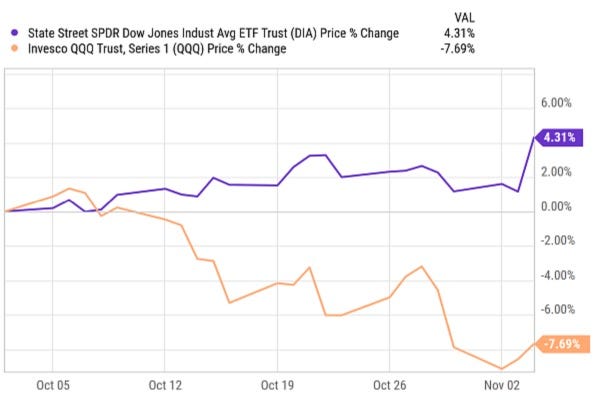
None of that guarantees the rotation will persist. A meaningful decline in interest rates, stronger-than-expected earnings, or convincing evidence of attractive returns on AI spending could change the outlook. And established large-cap businesses aren’t automatically cheap or immune to a broader market decline.
But the combination of stretched valuations, enormous capital requirements, sticky inflation, potentially higher-for-longer interest rates, and a more complicated political environment continues to make me cautious.
I don’t think the next phase of this market will necessarily be about abandoning equities altogether. I think it will be about abandoning the assumption that every speculative growth story deserves an extraordinary valuation.
I’ve been making that argument for two months, since the Nasdaq was roughly 10% higher. It’s encouraging to see more institutional commentary moving in the same direction, but I suspect the adjustment still has further to run.
The rally hasn’t changed my mind. If anything, the emerging rotation is making the underlying thesis more compelling. God bless and have a great Thursday.
--
QTR’s Disclaimer: Please read my full legal disclaimer on my About page here.