


Sell The Bailout: Skydance Tumbles As Musk's $1 Billion Check Reminds Everyone Paramount Needs One
It took about ten minutes.
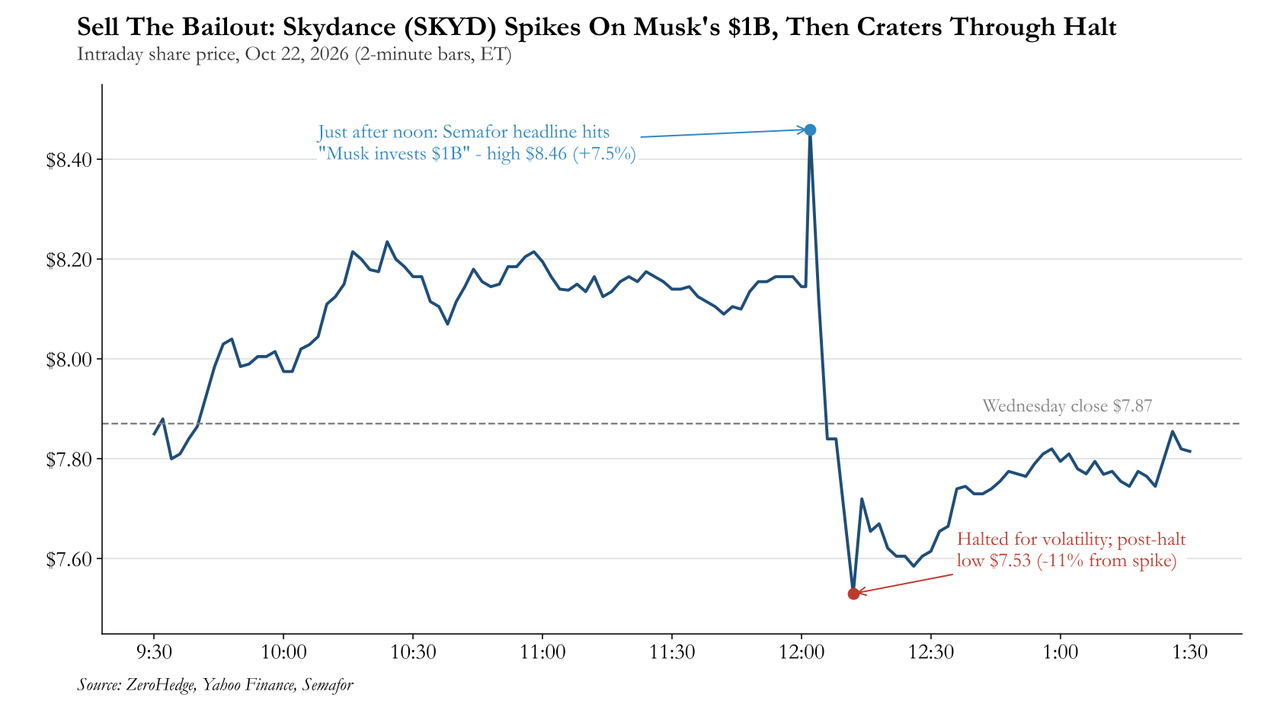
Just after noon on Thursday, Semafor reported that Elon Musk has invested roughly $1 billion in Skydance (SKYD), the newly renamed Paramount-Warner Bros. Discovery combo run by David Ellison. The stock did what stocks are supposed to do on a billionaire endorsement and spiked to $8.46, up 7.5% on the day. Then traders actually thought about it, and by 12:10pm the shares had been halted for volatility after tumbling, before printing a low of $7.53 once trading resumed, 11% below the post-headline spike.
*SKYDANCE HALTED FOR VOLATILITY AFTER SHARES TURN NEGATIVE (narrator: "not up")
— zerohedge (@zerohedge) October 22, 2026
Our own read of the headline was about as succinct as it gets:
Market: "wait, Paramount needs a bailout?"
— zerohedge (@zerohedge) October 22, 2026
Which, well, is probably the right question. Because while equity investors had been hoping for a white knight, credit investors have spent the past three weeks pricing Skydance like a company that would very soon need one.
The CDS Market Already Knew
Regular readers know we have been all over the Skydance capital structure since the deal financing hit the tape. On October 1, we documented how Paramount's record $52 billion bond offering sank before the ink was dry, with the 8-year second-lien notes trading around 95 within a day of pricing at par, and 5Y CDS jumping to 432bp, the highest since April 2009. Five days later, as the Warner deal closed, Fitch sent the old Paramount unsecured paper to the back of the line behind ~$57 billion of new secured debt, and the legacy 6.875% 2036s plunged to a record low of 77 cents.
It was all downhill from there: Paramount CDS soared to Global Financial Crisis levels on October 7, took out the Lehman highs on October 14 and, on Tuesday night, we put out this chart showing 5Y CDS at a new all-time record of 601bp, comfortably above anything on record.
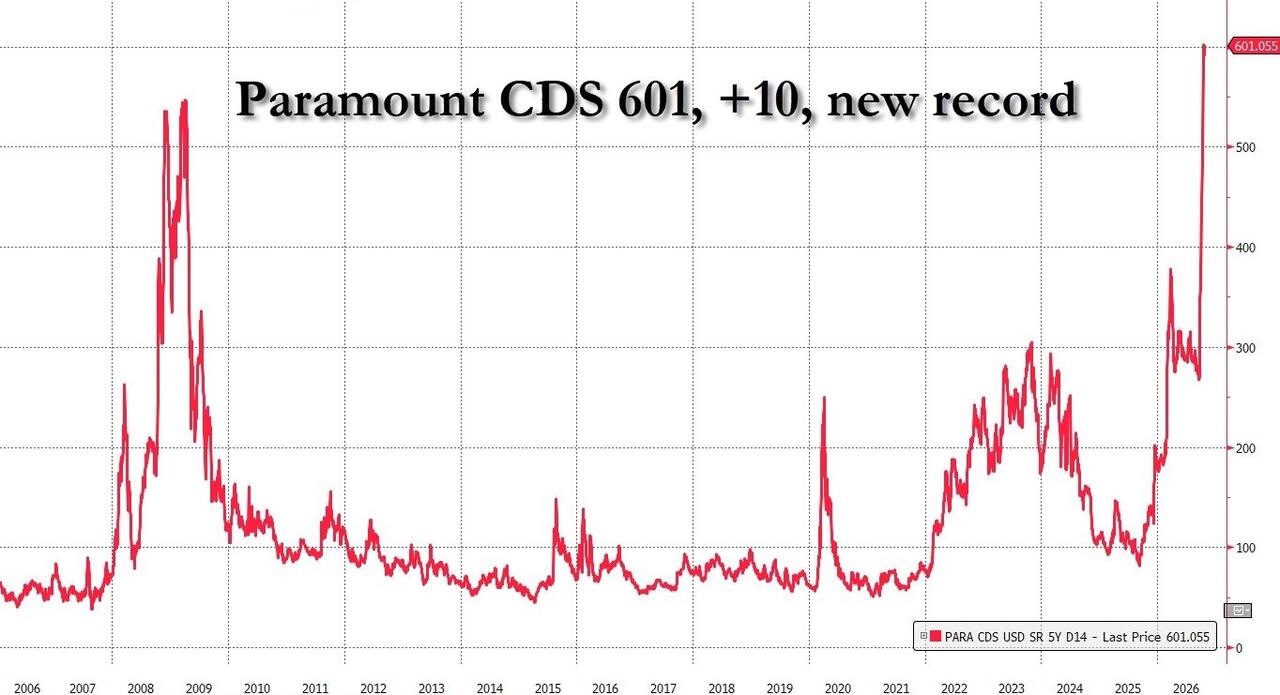
Put differently, the credit market has been screaming for weeks that Skydance has too much debt and not enough equity. So when the solution to that problem turned out to be a $1 billion check, it maybe shouldn't come as a surprise that equity holders reached the same conclusion as the CDS desks: if the company is raising emergency-sized equity from friends of the family, there must be an emergency.
Malone Promised $10 Billion. Musk Sent One
The other problem is that the market had been primed for a much bigger number. Just one day earlier, billionaire media mogul John Malone told the Paley International Council Summit that a Musk investment was coming, and that it would be big:
"Who helped Elon finance Twitter when he bought it? Larry Ellison. How did Larry Ellison come up with some of the money to put into the creation of Skydance? Tesla stock. And I would not doubt for a minute that before very long you're gonna see an announcement."
Malone was right about the announcement, but he pegged the check at $8 billion to $10 billion. Musk delivered about one-tenth of that. Against Skydance's roughly $87 billion of total debt, the Musk money comes to a little over 1%, or about the same weight as a rounding error in the company's synergy targets.
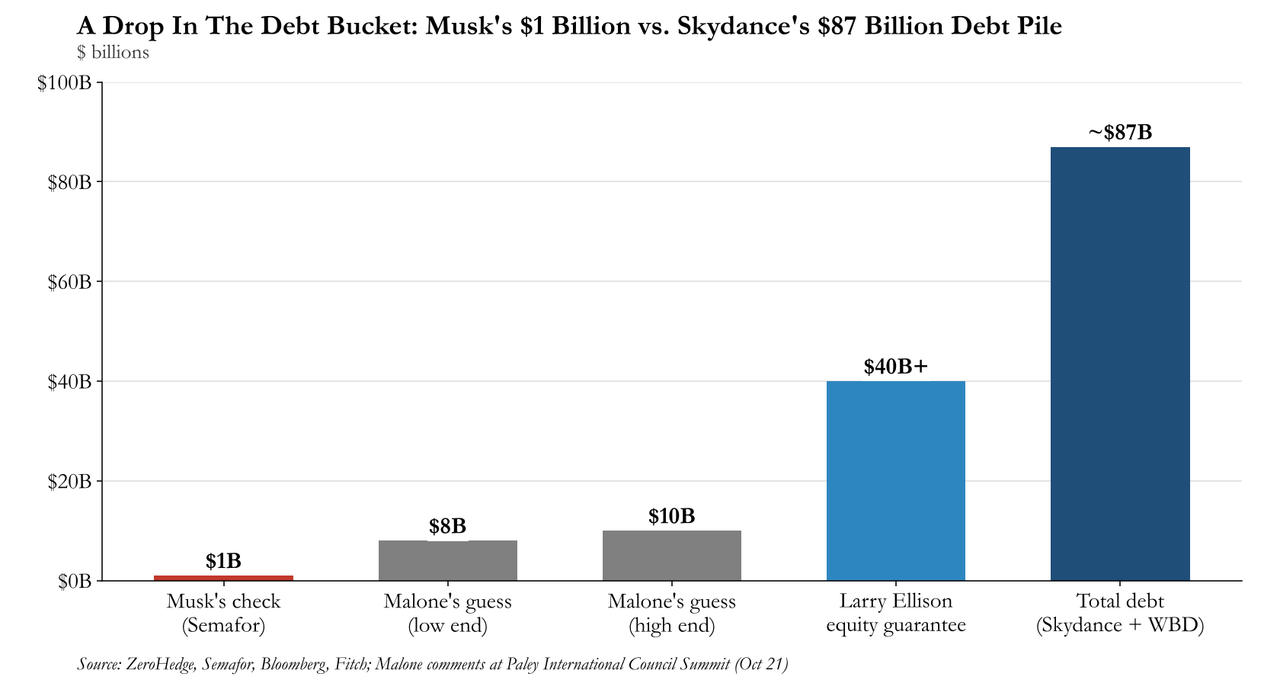
Some napkin math: the fixed-rate notes sold in the deal financing alone carry about $3.3 billion a year in coupons, and the ~$9.5 billion of term loans at SOFR+275 add maybe another $650 million. Call it $4 billion a year in interest on the acquisition debt, which means Musk's $1 billion covers roughly one quarter's worth of interest. Generous, sure. Transformational, not quite.
Per Semafor, the Musk money came in around the same time as fresh equity from Skydance's other investors, including board member Laurene Powell Jobs, though neither the size of those checks nor the price paid has been disclosed (and if the price had been flattering, we suspect someone would have mentioned it). Skydance declined to comment and Musk's camp didn't respond.
Who Needs The Money, Anyway?
None of this should be news to anyone who has followed the saga. When Semafor first reported back in September that Paramount was weighing tapping Musk for an equity check (Sep 24), the stated rationale was to "reduce Larry Ellison's financial burden" after the Oracle founder personally guaranteed more than $40 billion of the equity financing. Fitch, for its part, made it clear in its rating action timed to the close that hitting the company's 3x net leverage target by the end of 2029 would likely require issuing equity or selling assets on top of the promised $6 billion in cost cuts.
So here is the equity. A very small amount of it.
Meanwhile, the stock has been a one-way trip since the merger closed. Skydance ended October 6 at $9.53 and is now trading around $7.80, a drop of about 18% (some of that is the October 14 warrant distribution, which knocked 16% off the price as shares started trading ex-warrant, so the damage is less dramatic than it looks, but only a bit). That said, the real story is in credit, where the equity drawdown is a sideshow next to bonds at record lows and CDS above Lehman.
And there is one more wrinkle that we flagged when CDS first took out the 2008 highs: how much of this is effectively cross-collateralized with Larry Ellison and, by extension, Oracle (ORCL), whose own CDS was hitting record highs at the same time? With the Ellison family on the hook for a big chunk of Skydance's equity and Oracle's balance sheet already stretched by the AI capex binge, a little outside help is probably welcome. A little is what it got.
Friends With Benefits
Of course, there is more to the Musk check than finance. The world's richest man, who already owns X, now has a stake in the parent of CNN and CBS, and the Ellisons, via Oracle, are part owners of TikTok's US operations. Semafor's original September scoop was enough to cause panic at CNN; today's confirmation will probably do the same, even though David Ellison has insisted the newsrooms will stay editorially independent. Given how many times CNN has warned its viewers about Elon Musk, there is a certain poetry in Musk now being one of its shareholders.
Markets, however, trade the debt stack, and the debt stack says Skydance needs a lot more than $1 billion. If anything, today's tape suggests that each new "vote of confidence" will be read as a sign of how much more is needed, which is why we suspect this check is the first of several, and that the next one will have to be far closer to Malone's number than Musk's.
Until then, the CDS market will keep its own counsel. It hasn't been wrong yet.