


SK Hynix Scraps Solidigm IPO, Single-Handedly Drags Kospi Out Of A 4% Hole And Easing AI Rout
Last night we were fairly confident how the Korean session would go.
Three hours until Korea is halted seconds after the open
— zerohedge (@zerohedge) October 22, 2026
Well, we were half right. The Kospi did crater at the open, sliding as much as 4.1% and more than halfway to triggering a market halt as Asia digested the overnight carnage in US tech (SOX -6.7%, META -7.0%). And then, over the course of the session, it climbed all the way back and closed green, up 0.30% at 5,550.
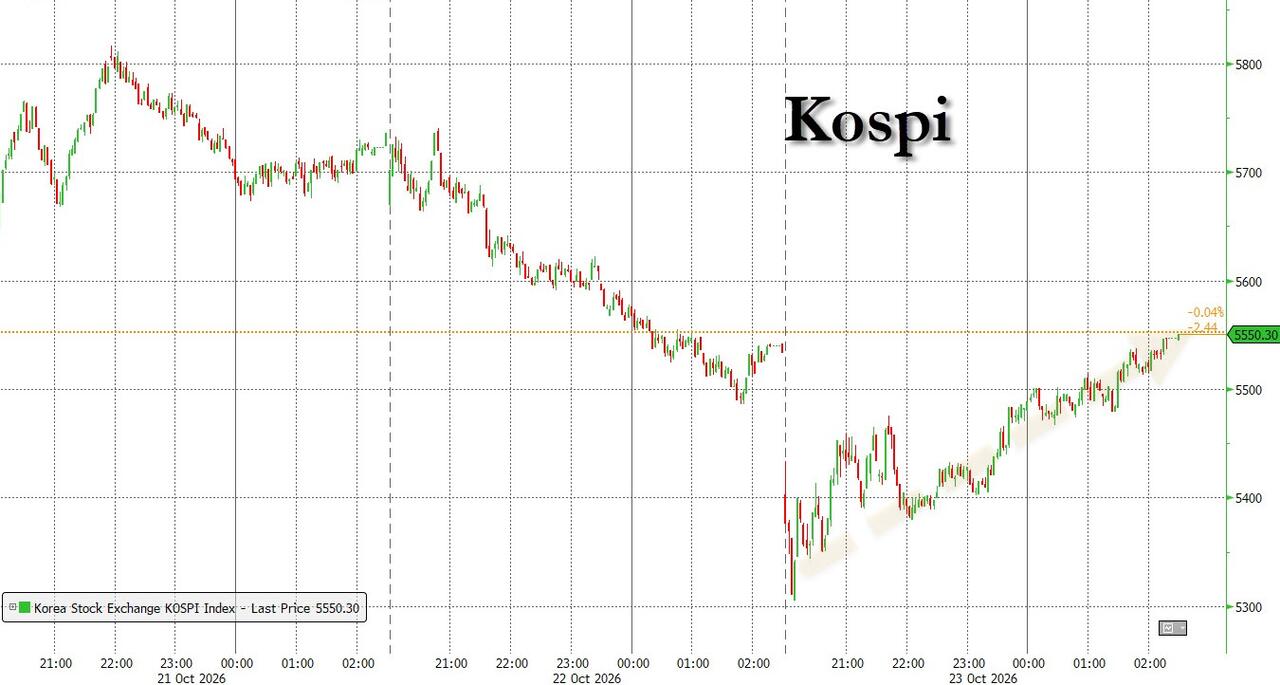
What changed? Well, according to Bloomberg, the biggest AI news out of Asia overnight was that SK Hynix scrapped plans for a potential $10 billion US listing of its Solidigm unit after facing strong opposition from regulators and shareholders. SK Hynix shares, which had dropped as much as 4.3% early, immediately reversed and rallied as much as 4.5% on the news, defying a broad market slide triggered by the rout in US tech.
SK Hynix Pulls Solidigm’s $10 Billion IPO on Regulatory Pushback: BBG
— zerohedge (@zerohedge) October 23, 2026
Seoul Says No To The "Duplicate Listing"
The retreat followed domestic regulatory scrutiny over concerns that Solidigm's IPO could dilute share value for SK Hynix's minority investors and complicate SK Group's ownership structure. In a Friday regulatory filing, the company also halted talks on a pre-IPO investment, citing - what else - "recent capital market conditions."
The deal was meant to be a monster. Solidigm, one of the world's largest makers of the flash memory used for storage in AI data centers (it was carved out of Intel's NAND and SSD business, which SK Hynix bought in 2021), had already picked banks including Goldman and Morgan Stanley and was looking to raise about $10 billion as soon as next year, at a valuation of as much as $100 billion. When the spin first hit the tape last month, Goldman's TMT specialist desk was passing along talk of a valuation of "up to $150bn", which tells you how hot things were running just four weeks ago.
Investors in the parent never liked it. When the IPO reports first hit on Sept 28, Hynix fell 5.0%, and Goldman's Korea desk noted that "local reports attributed today's weakness in Hynix to headlines that said its US subsidiary Solidigm is considering a US IPO as soon as next year," with foreigners dumping $1.27 billion of the stock that day. The math is simple enough: why own the parent at a big discount when the crown jewel is about to list separately in New York, with the family controlling both?
The regulators, it turned out, agreed. In its Oct 19 open, Goldman's Seoul desk flagged that the FSC governor said "both the FSC and FSS judge that Solidigm falls under the restriction on duplicate listing," the same morning President Lee said the government "should press ahead with efforts to improve corporate governance." Once Seoul had openly made Solidigm a test case for the "Korea discount" crusade, the IPO was probably dead on arrival.
Governance activists were thrilled. Namuh Rhee, chair of the Korean Corporate Governance Forum, called it "great news" and "a sign that the company is aware of conflict of interest between Chairman Chey and minority shareholders." Terton Capital's Ryan Albert called it "a major positive for Korean corporate governance."
Not a sentence you often read about a chaebol.
One Stock, One Green Close
So did the Solidigm reversal save the Kospi? The Goldman Korea desk's closing wrap (available to pro subs) makes it pretty clear who did the heavy lifting:
KOSPI grinded higher after falling as much as -4.1% in the early morning, eventually closing +30bps. The recovery was mainly led by SK HYNX(000660) +4.4%, while most other sectors still finished lower (weak breadth with 719 declining vs. 173 advancing in KOSPI) as risk off sentiment persisted amid geopolitical tensions and fragile sentiment toward Tech.
Translation: more than four stocks fell for every one that rose, and the index still closed green (a mirror image of what happened in the US the day before). Goldman's regional wrap said the same thing, noting Korea "recovered from a 4.1% intraday decline to close 0.30% higher, driven by SK Hynix, although breadth remained weak." Samsung helped a little, closing +0.5% after being down as much as 5.1%.
There is a wrinkle, though. The Solidigm filing came out before the open, and Goldman's morning call still had Kospi futures -2.6% with Korea "poised to extend its losses." Hynix then dropped 4.3% anyway before turning higher, and the desk says the chipmakers recovered "despite no fresh intraday catalyst (appeared partially driven by local insto bids)." In other words, the IPO news gave Hynix a reason to rally, while the actual buying came from Korean institutions:
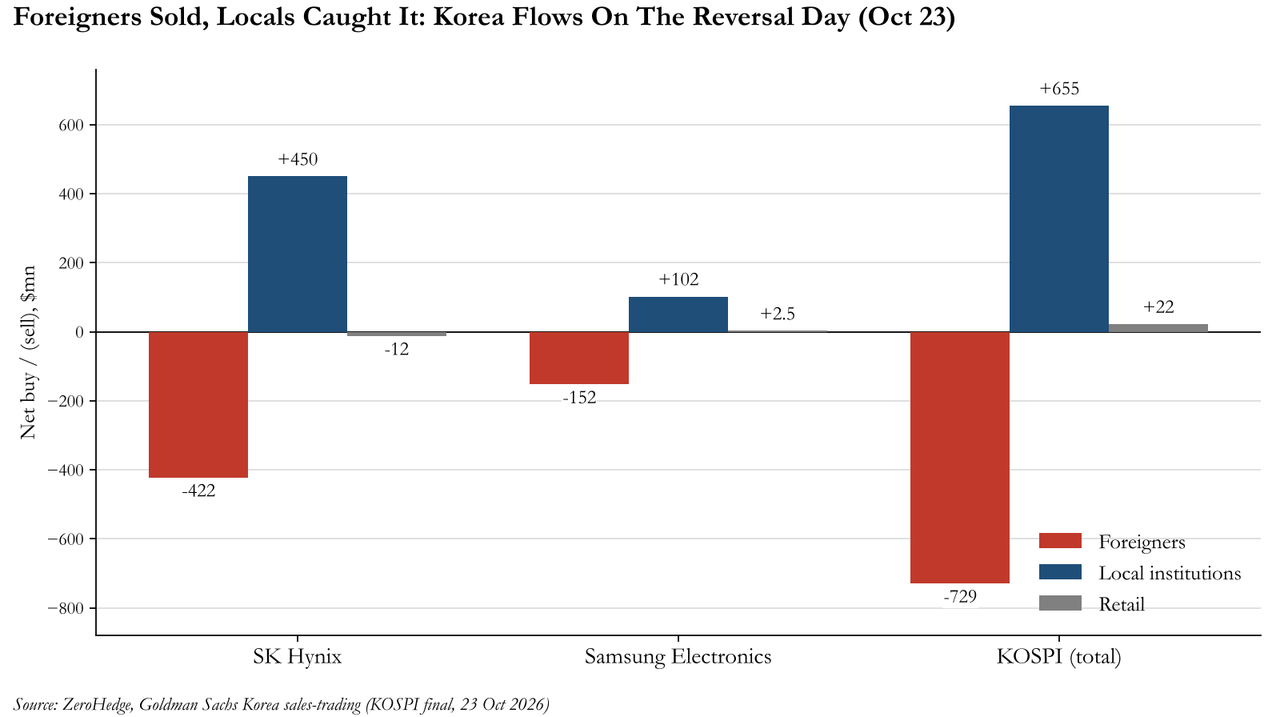
Flow-wise, foreigners were net sellers in both Hynix (-$422mn) and Sammy (-$152mn), while local instos were net buyers (+$450mn in Hynix and +$102mn in Sammy). Retail investors were more on the sidelines today in the chipmakers, ending as marginal net sellers in Hynix (-$12mn) and net buyers in Sammy (+$2.5mn).
Across the whole market, foreigners were the only net sellers at -$729 million (of which -$672 million in tech), local institutions bought +$655 million, and retail - once the most feared dip-buying army on the planet - added a rounding error of +$22 million. Turnover ran 16.2% below the 20-day average. That is a very specific kind of rally: foreigners selling into domestic institutional bids on light volume.
Maybe that was just Korean pension and insurance money seeing value in Hynix. Maybe it was something a bit more... encouraged. The same morning, Goldman's regional wrap credited China's surge (CSI 300 +1.7%, ChiNext +4.0%) to "state-backed 'national team' ETF buying" with RMB84 billion of turnover across nine favored ETFs, and Indonesia's fourth straight gain to Danantara sovereign fund support. Asia, it seems, has decided it will not go down quietly with the Nasdaq. Whatever the source, the regulator's success in killing the Solidigm deal gave local buyers a convenient headline to lean on.
Supply Destruction, IPO Edition
There's a broader reason the market cheered the death of a $10 billion deal, and Goldman's EMEA head of one-delta trading Richard Privorotsky spelled it out in his flow and positioning observations this morning (available to pro subs):
Perhaps we're overthinking the concerns around AI demand and the issue is simply a repricing of the cost of capital. The assumption of effectively unlimited cheap capital to fund this buildout is being challenged. You either cut capex, delay deployment or increasingly fund through equity. None are particularly supportive of equity prices.
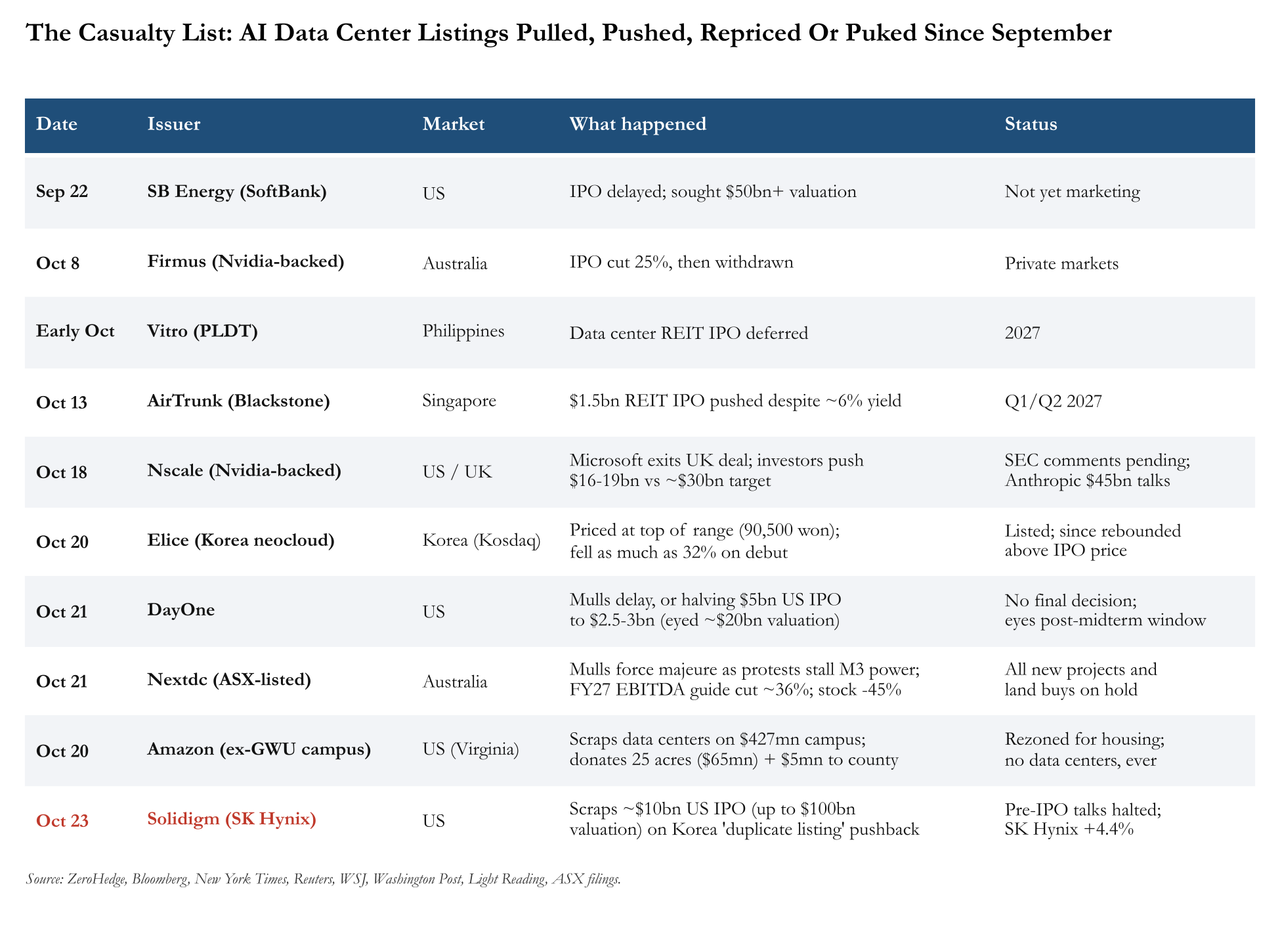
A $10 billion AI storage IPO sits squarely in the "fund through equity" bucket, and the market just watched one disappear. Solidigm also joins data center developers Firmus Grid and AirTrunk on the list of high-profile deals suspended or cancelled as AI bubble fears roil markets, while OpenAI is reportedly now targeting a $1.25 trillion valuation in its latest $30 billion round, down from $1.4 trillion. Back in Seoul, data center infrastructure name Elice dropped 32% in its trading debut this week, the worst opening day ever for a sizeable Korean listing. In this tape, the best IPO is the one that doesn't happen.
The AI casualty list is getting longer by the week:
As for Korea, Privorotsky admitted he was braced for worse:
Korea is actually holding up better than I would have expected given the acute liquidation across Europe and the US (Kospi flickering green having been down a lot on open)... Putting my trading hat on, I expected Korea to be down another mid-single digits this morning. The fact that we're not seeing another complete air pocket is encouraging.
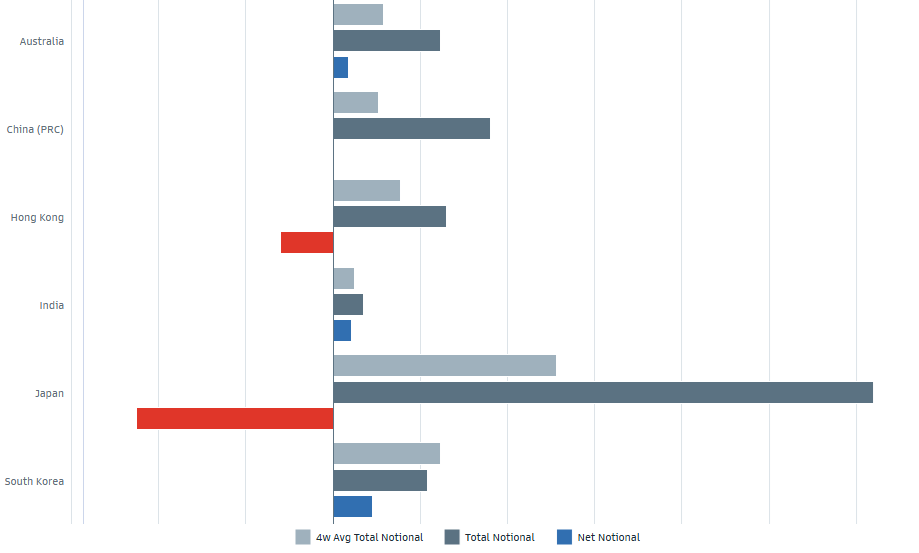
He was not alone (see our tweet above). Goldman's Asia sales trader Peter Sheren also argued in "Stress Without Capitulation" that October's drawdown looks like "a concentrated positioning/technical reset rather than systemic capitulation," with GS desk flows "active but largely balanced and rotational." Korea, notably, was a net buy on the desk on Friday:
Sheren also points out the concentration problem every EM manager is wrestling with: TSMC, Samsung and SK Hynix together account for more than 30% of MSCI EM. When one of the three gets a governance-friendly headline on a day like this, an index can flip on its own.
The Buyback Is Done, The DRAM Price Isn't
Context matters here, because Hynix needed the win. The stock had plunged about 60% from its June peak before today, a slide that accelerated right after the company completed its $26.5 billion ADR listing in July, the biggest US listing by a foreign company ever. Regular readers will recall we asked at the time whether SK Hynix's US debut was the AI bubble top (Jul 11); two days later the stock suffered its steepest decline on record, sending the Kospi down as much as 9%.
Then came South Korea's biggest-ever "buyback bazooka" in August, which for a while was the only thing holding the market together. As we said in September, once retail fled, only record buybacks were preventing a Kospi crash. Earlier this month, the bid vanished:
The only thing that was propping up the Kospi in the past months is ending: the frenzied, record buyback spree by Samsung and SK Hynix is now over, earlier than expected, as it was running far faster than expected: 55 trillion won in stock bought back. Kospi closed at the lows.
— zerohedge (@zerohedge) October 7, 2026
Goldman's Asia macro sales desk confirms in its Asia FX Weekly (available to pro subs) that SK Hynix is "finishing its 40 trillion won buyback early and preparing further returns on Oct 28." So the next shareholder-friendly catalyst is barely a week away, and cancelling a dilutive spin right before it doesn't hurt the pitch.
Meanwhile, the fundamentals that made Hynix a $679 billion company keep heading the other way from the stock. As Russell Clark notes in his latest Capital Flows and Asset Markets note, "SK Hynix has typically been pretty responsive to spot DRAM prices. Not for the last three months." His chart shows the DDR5 spot price still grinding to new highs while Hynix shares have collapsed (perhaps this simply means that real DDR5 prices are far lower than represented by yet another gamed index):
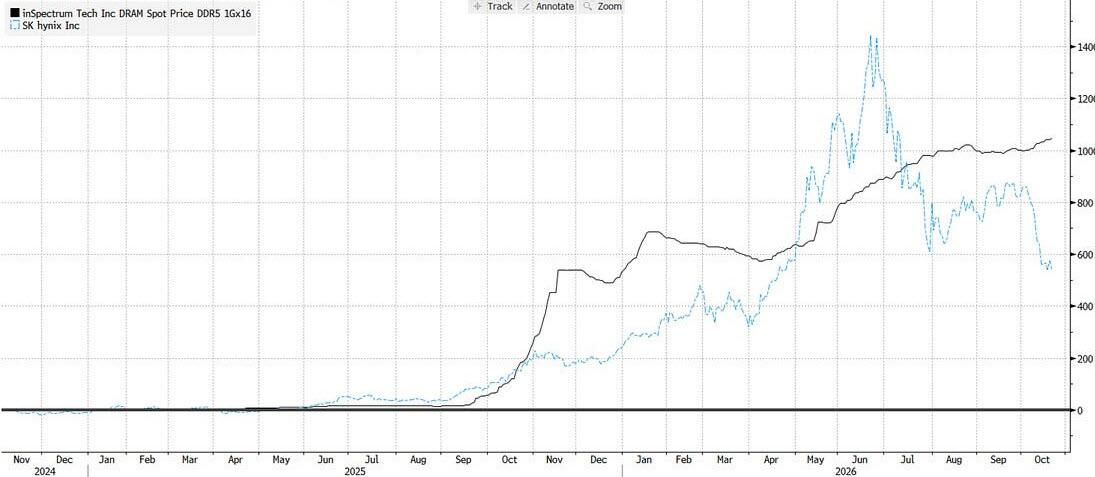
Since November 2024, DRAM spot is up more than 1,000% versus 530% for Hynix shares, and as recently as June the stock was running well ahead of memory prices. Bank of Korea Governor Shin, per Goldman's FX desk, is "brushing off KOSPI softness given robust DRAM prices." Clark himself admits that "starting from a point of 'equities are wrong' is a recipe for disaster," which is about as honest a disclaimer as you'll find this month.
A Governance Win In A Market Still Looking For A Floor
The cancellation is good news for Hynix shareholders: no duplicate listing, no dilution of the parent's economic interest, no parent-subsidiary discount. Fibonacci Asset Management's Jung In Yun said as much, and Seoul gets a clean win for its "Korea discount" campaign.
But let's not confuse one stock's governance win with a bottom. Breadth was dreadful, foreigners sold for yet another day, Kospi turnover was light, and the index closed at 5,550 - down from 6,890 on Sept 28, when it was falling on the very Solidigm headline it rallied on today. In other words, the Kospi has lost about a fifth of its value in less than a month, and Friday's "rescue" came from local institutions bidding up the one name with a fresh catalyst. Next week brings the hyperscaler earnings that Privorotsky calls "critical," plus Hynix's Oct 28 shareholder return update. Until then, we'd lean toward this being a governance pop inside an ongoing AI deleveraging rather than the start of something bigger.
Then again, after we called for a halt at the open and got a green close instead, we'll leave the Korea predictions to the national teams for now.
Much more in the full GS Korea Final, and Privorotsky's "GS flow and positioning observations" notes, all available to pro subs.