





Skyfall: Fitch Downgrade Sends Legacy Paramount Bonds To Record Low As Merger Closes
Last week, when we documented how Paramount's record bond offering cratered before the ink was dry, we flagged one line from the Bear Traps chat as deserving extra attention: "Paramount's existing unsecured bonds? Primed." Today, with the $110 billion Warner Bros. Discovery takeover officially closed and the combined company (now simply "Skydance", although "Skyfall" is certainly more appropriate) open for business, Fitch made it official.
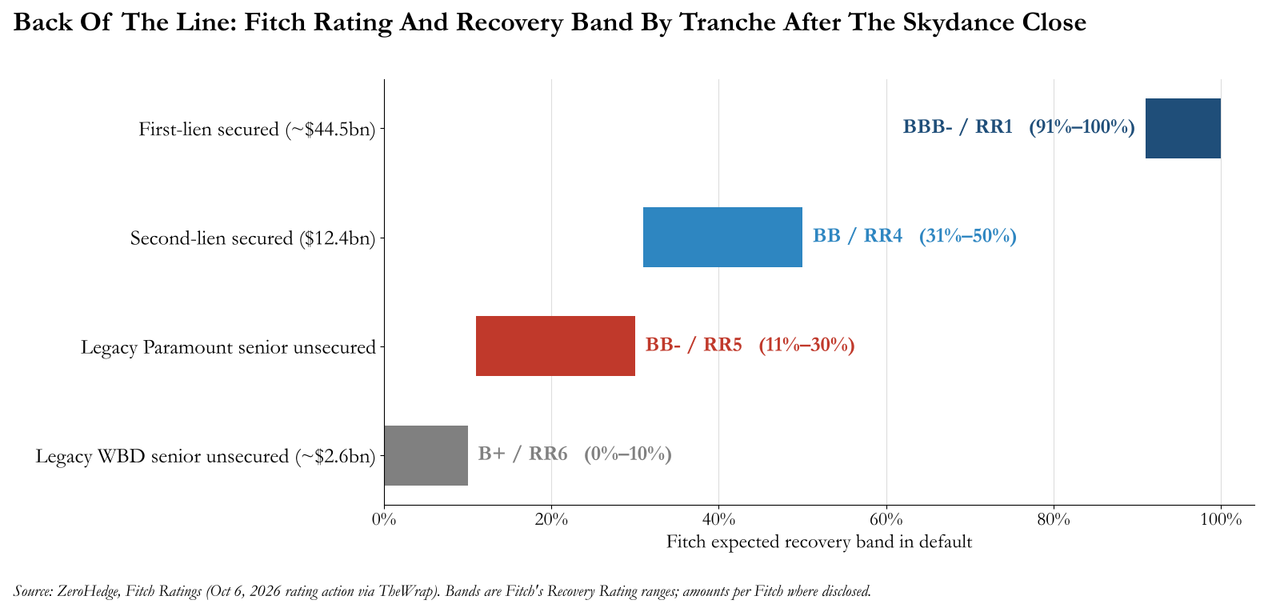
In a rating action timed to the close, Fitch cut Paramount Skydance and WBD's issuer ratings deeper into junk territory, to BB from BB+, citing "materially higher leverage" and "significant execution and integration risks." But the real damage was further down the stack: Paramount's legacy senior unsecured notes were downgraded to BB- with a Recovery Rating of RR5, which in Fitch-speak means expected recovery of just 11% to 30% in a default. WBD's leftover unsecured notes fared worse still, cut to B+/RR6 (0% to 10%).
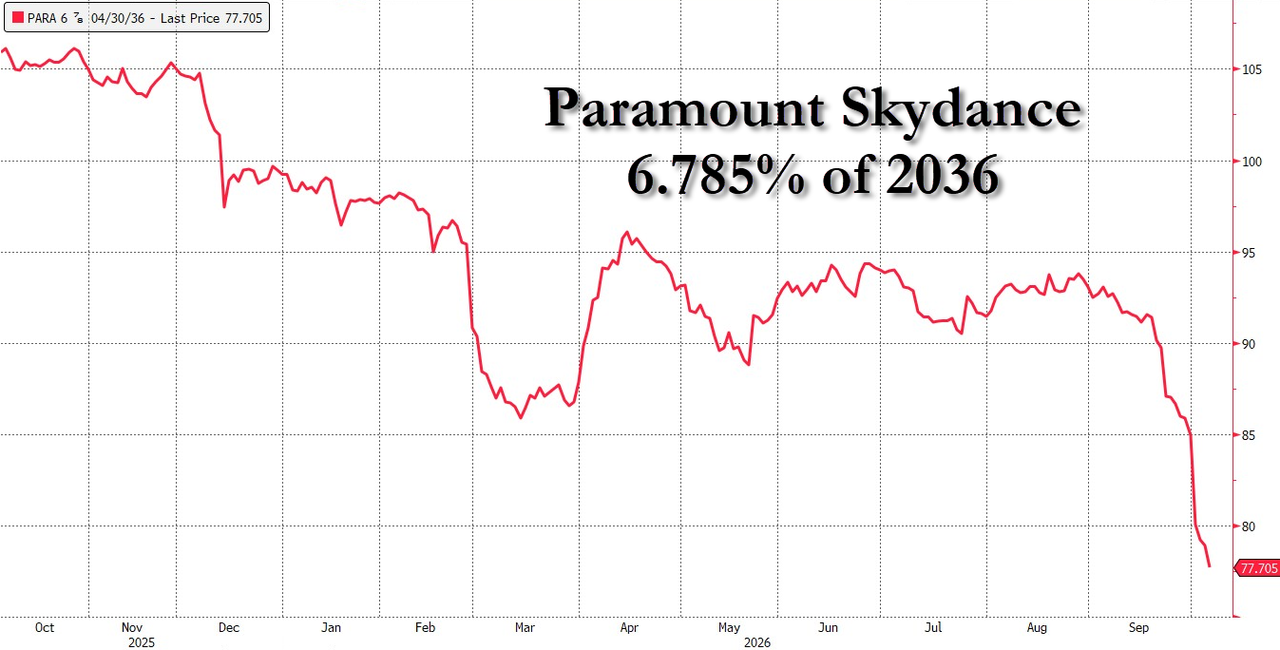
The market got the message. The old Paramount 6.875% notes due 2036 (originally Viacom paper) plunged to a record low of 77.7, down from 105 a year ago and roughly 92 as recently as mid-September. That's ~14 points in three weeks, and a yield of roughly 10.6% by our math, on a bond that was trading above par last fall.
Get In Line
The logic is simple enough. Before the deal, legacy Paramount unsecured holders sat near the top of a ~$14 billion capital structure. After it, per Fitch, the combined company carries about $87.5 billion of total debt, including $44.5 billion of first-lien secured debt (rated BBB-/RR1) - still viewed as investment grade but not for long - and $12.4 billion of new second-lien secured paper (BB/RR4), all of which now ranks ahead of the old unsecured notes. Put differently, roughly $57 billion of secured creditors just cut in line.
And here is the delicious irony: at ~10.6%, the legacy unsecured 2036s now yield more than the brand new second-lien junk bonds did at the very worst of last week's puke, when the 8-year 2Ls traded a touch above 95 for a ~9.7% yield. The old bonds now trade like they're junior to the junk, because they are.
Fitch Doesn't Believe The Deleveraging Story Either
Fitch pegs leverage at 7.8x for fiscal 2026 after ~$57 billion of acquisition debt is added, falling to 6.2x in 2027 and 4.5x in 2028 if merger cost savings materialize. The company's target is net leverage of 3x by the end of 2029, which leans heavily on $6 billion of synergies (read: mass layoffs, most likely from CNN) in three years. Fitch was blunt that this won't be enough on its own:
"Execution risk stems from combining operations, realizing synergies and managing a higher debt burden. The transaction also requires integration of content, streaming technology, corporate systems and operating models... Delays or weaker execution could reduce planned cost savings and slow deleveraging."
Translation: to hit the 2028 and 2029 targets, Fitch believes issuing equity or selling assets would be required on top of synergies and free cash flow. That's the same equity we noted last week Paramount is "still looking for." The agency also flagged that linear TV generated about 86% of the combined company's pro forma 2025 EBITDA on just 52% of revenue, which is a polite way of saying the cash engine funding this deleveraging is the one business everyone agrees is in secular decline.
Throw in the commitments from the settlement with 12 state AGs (which Fitch says are "largely achievable" but could "constrain cost actions and operating flexibility") and you have a cost-cutting plan that the regulators have partly pre-empted. Good news for Hollywood's unions. Bondholders might see it differently.
Goldman's Credit Desks: "One Of The Worst First-Day Performances"
The legacy bonds' collapse comes on top of what Goldman's credit desks are now openly calling a historic flop. In his weekend Lev Fin reading (available to pro subs), Goldman's KC O'Connor wrote that the $12.4 billion second-lien deal...
"...had one of the worst first-day performances for a new deal in recent leveraged finance history. The new 5-year, 8-year, and 10-year 2L tranches underperformed what felt like a well-placed 1L deal, finishing the week 2.125 to 4.5pts below their original issue prices after just two full trading sessions, shaking market confidence."
Goldman's IG desk (Brad Shelofsky's IG Credit Week in Review) wasn't more charitable and noted the PSKY 9.125% 2036 2Ls fell as much as 6 points on Thursday before closing the week roughly 4 points below issue, while the first-lien PARA 7.9% 2036 closed around +280, 17bps wider than pricing: "Tough tone setter for the second largest IG deal of the year." Goldman's weekly credit digest summed it up best: SoftBank was absorbed cleanly, "PSKY was not," which "demonstrated that strong order books do not necessarily translate into secondary sponsorship at current valuations."
Which is exactly what we said the night the bonds broke:
That's odd: the "$109 billion in demand' for PSKY bonds was nowhere to be found after the break today when all tranches (especially HY) dumped and all those who didn't get an allocation could have bought at a big discount. strange how that works.
— zerohedge (@zerohedge) October 1, 2026
Goldman's high-yield desk, for its part, expects "inbound will remain elevated for the newly combined entity" given the price action since new issue. We'll go out on a limb and agree.
Bottom Line
When Paramount won the bidding war for Warner Bros. back in February after Netflix walked because the deal was "no longer financially attractive," the question was always who would end up footing the bill. Last week it was the new-issue buyers who got a full allocation. This week it's the legacy unsecured holders, who never signed up for a 7.8x-levered media conglomerate and now find themselves behind $57 billion of secured debt with an 11%-30% recovery estimate.
The company's CFO called last week's selloff "one-day choppiness." The legacy 2036s are now on their third week of "chop", at a record low, with a fresh downgrade. And with equity issuance or asset sales now effectively a prerequisite for Fitch's deleveraging path, the more likely next leg is more of the same, not a bounce. At least they did get a new name out of it.
Much more in the full Goldman Lev Fin Weekend Reading and "IG Credit Week in Review" notes, both available to pro subs.