





Stock Futures Drift As Attention Turns To European Debt Crisis
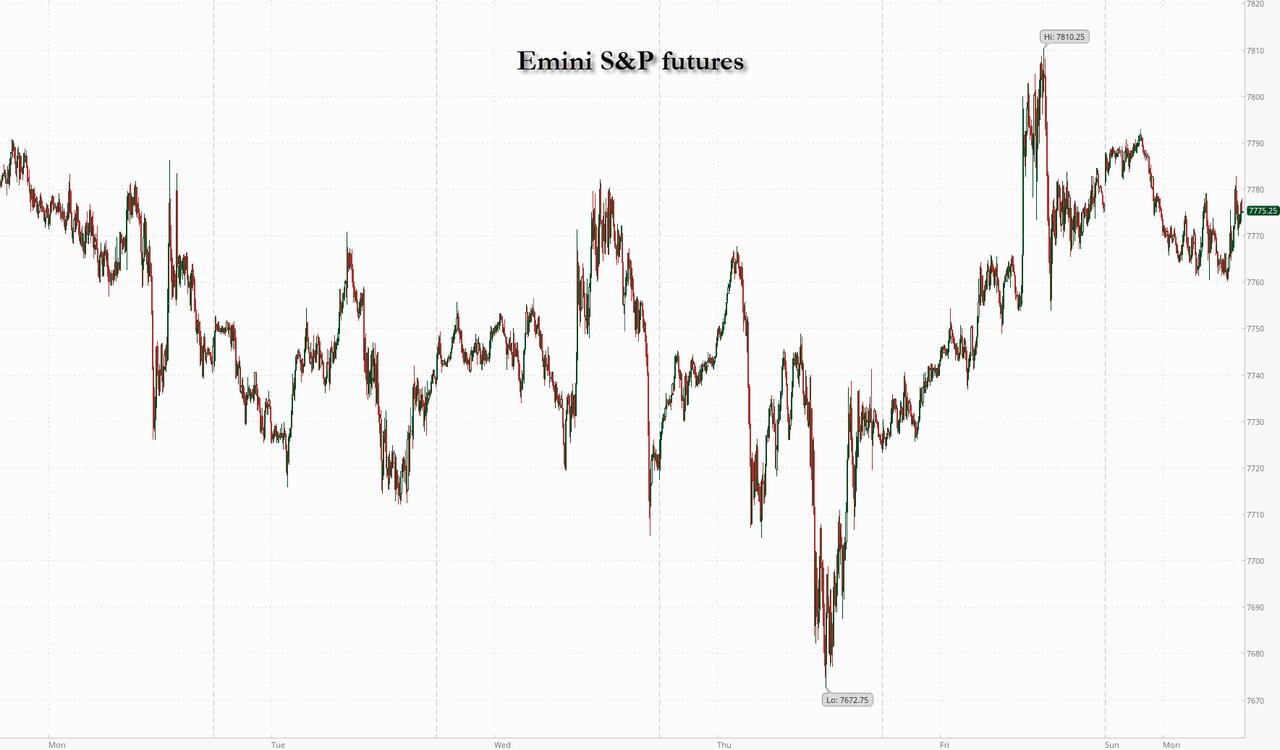
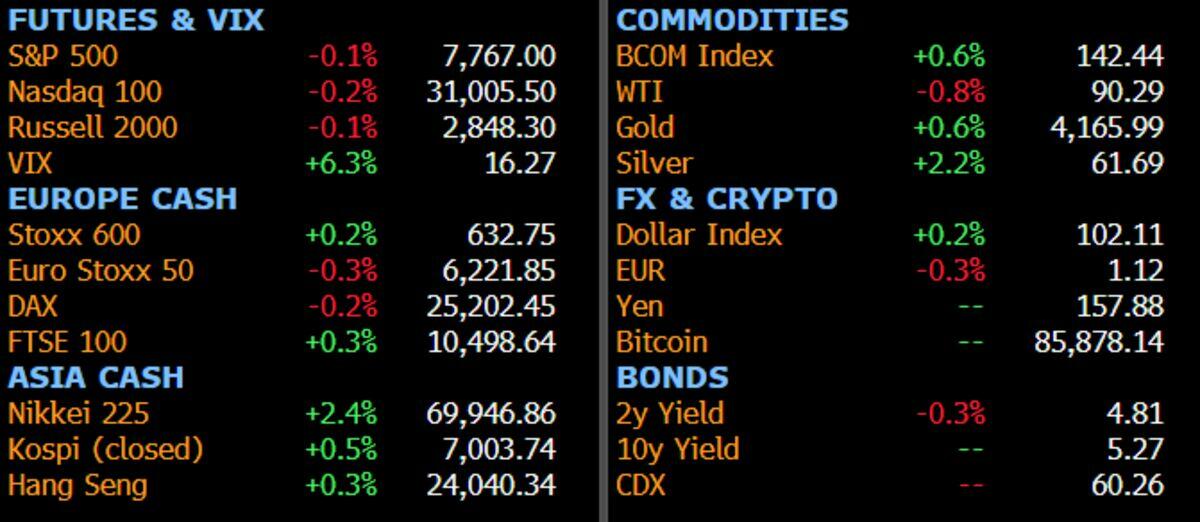
Futures are lower to start the week and global markets struggle for direction, as political upheaval and mounting concern over Europe’s public finances dampened risk sentiment and sent the euro to a 17-month low against the dollar while the US yield curve twists steeper and USD appreciates. As of 8:00am ET S&P futures are down 0.1% and Nasdaq futures slip 0.2% from their record close on Friday, as most Mag 7 stocks are lower although Nvidia climbs another 0.6% after partner Hon Hai Precision Industry reported better-than-expected quarterly revenue, pointing to sustained and elevated spending on AI infrastructure. In premarket trading, tech is lower with Semis / Memory lagging, Mag7 and Software flat. Intel tumbles 4% after a report on discussions of a potential collaboration between Taiwanese chip giant TSMC and Elon Musk’s Terafab, which Intel joined in April. Cyclicals ex-Energy are flat to Defensives with the market looking to broadening if yields stabilize. Brazil-related names are higher following preliminary election results which show Bolsonaro defeating Lula, and EWZ +11.9% pre-market. The CAC 40 in Paris was the main weak spot in Europe. Asian stocks played catch-up with Friday’s US rally. US bond yields fluctuated, with the short end leading as the selloff in Treasuries showing few signs of abating, and traders on alert for signs of bond market contagion in Europe. German bunds affirmed their haven appeal as they outperformed in Europe. French bonds were mixed, while Spanish debt lagged. Currency markets showed the biggest reaction as the euro dropped 0.5% against the dollar. Commodities are higher led by Ags and Metals with Precious leading Base; crude is lower despite unconfirmed, opposing headlines that the Saudi East/West pipeline has been shut. US economic data slate includes September services PMI (9:45am) and ISM services index (10am). Fed speaker slate empty for the session.
In premarket trading, Mag 7 stocks are mixed: Nvidia climbs 0.6% after partner Hon Hai Precision Industry reported better-than-expected quarterly revenue, pointing to sustained and elevated spending on AI infrastructure (Alphabet unchanged, Amazon -0.1%, Apple -0.2%, Meta -0.2%, Microsoft +0.4%, Tesla -0.3%)
- Align Technology Inc. shares (ALGN) are down 2.8% after Evercore ISI downgraded the medical-device company to inline from outperform, writing that “the dental macro picture has meaningfully weakened.”
- Alvotech shares (ALVO) jump 8% after the US FDA approved additional US manufacturing capacity for Simlandi, the biotech’s biosimilar to Humira.
- CH Robinson Worldwide shares fall 7.8% after the freight broker announced an agreement to acquire peer RXO (RXO +20%) for stock and cash for an implied value of $30.25 per share.
- Cboe Global Markets Inc. (CBOE) rises 1.8% as it is being upgraded to buy from hold at TD Cowen, which sees an improving outlook for the exchange operator, especially in the wake of it signing an extension of its licensing agreement with S&P Dow Jones Indices.
- Cenovus Energy Inc. shares (CVE) fall 3.1% after the Canadian energy company agreed to buy Athabasca Oil Corp. for C$12 per share at an enterprise value of C$5.7 billion ($4 billion), with the deal expected to close in December.
- Cerebras Systems shares (CBRS) rally 4.5% after OpenAI CEO Sam Altman said the company is “a close partner” of OpenAI and the two firms have “a deep engagement pushing on the frontiers of speed.”
- DraftKings shares (DKNG) are up 4.6% as BofA raises the recommendation on the online sports betting company to buy from neutral, with the analyst citing her more positive view of the predictions markets (PM) impact.
- Estée Lauder Cos. shares (EL) rise 2.8% as Barclays raised its recommendation on the beauty company to overweight from equal-weight, citing its attractive sales growth and earnings profiles.
- Harley-Davidson Inc. shares (HOG) are up 5.7% after Citi upgraded the motorcycle company to buy from neutral, writing that an acceleration in retail growth is “tough to ignore.”
- HubSpot Inc. shares (HUBS) are down 1.4% after Raymond James downgraded the software company to market perform from outperform, citing near-term uncertainty.
- Mosaic Co. shares (MOS) fall 1.1% after RBC Capital Markets cut its recommendation on the fertilizer firm to sector perform from outperform on delayed phosphate recovery.
- PTC (PTC) surges 36% after Schneider Electric agreed to acquire the company.
- Samsara Inc. shares (IOT) are up 0.9% after Jefferies started coverage on the stock with a buy rating and $50 price target, seeing strong AI-related growth prospects for the hardware-software platform.
- TSMC shares (TSM) gain 1.6% in Taipei on Monday with sentiment boosted by discussions between the Taiwanese chip giant and Elon Musk’s Terafab on potential collaboration, while shares in Intel (INTC), which joined the Terafab initiative back in April, fell 3.9%.
- Texas Roadhouse Inc. shares (TXRH) are up 2.2% after Evercore ISI upgraded the restaurant chain operator to outperform from inline, seeing a buying opportunity in the wake of recent weakness.
- US-listed stock of Brazilian companies and firms exposed to the country (NU +13%, BBD +12%) rallied as Flávio Bolsonaro surged to a surprise lead over Luiz Inácio Lula da Silva in the first round of the presidential election.
- Vaxcyte shares (PCVX) soar 56% after the pharmaceutical firm said that VAX-31, its experimental vaccine to prevent invasive pneumococcal disease (IPD) and pneumococcal pneumonia, met all primary endpoints in the OPUS-1 pivotal Phase 3 adult trial, compared to PCV20 and PCV21.
- Virtu Financial Inc. shares (VIRT) are up 3.3% after JPMorgan upgraded the market-making firm to overweight from neutral, citing a strong outlook ahead.
- Wells Fargo & Co. shares (WFC) are up 2.2% after Morgan Stanley upgraded the bank to overweight from equal-weight, seeing “a clearer path to improving profitability in 2027.”
In other corporate news OKX filed with the SEC to launch a tokenized-stock trading platform, making it one of the first major crypto exchanges to take advantage of new US rules. Digger, the last film to be released from Warner Bros. Discovery before its acquisition, was a major disappointment at the box office, taking in $8 million on its opening weekend. CME Group shelved plans to launch a round-the-clock oil contract following industry pushback. In deals, Schneider Electric agreed to acquire industrial software firm PTC for about $22.6 billion, stepping up its effort to tap into the AI boom. North Sea oil and gas producer Ithaca Energy struck its first international deal, agreeing to buy assets in Canada from Suncor Energy.
US equity futures are slightly lower on the day. Oil slipped after Saudi Arabia cut prices of its benchmark grade to Asia as flows recover, offsetting a lift from intensified fighting in Yemen. Markets are starting the week with strains in Europe firmly in focus after policy gridlock in France sparked a selloff in the region’s more vulnerable debt. French government bonds are underperforming regional peers, widening the 10-year yield spread with Germany by ~5 bps as budget concerns persist. The unease threatened to spread to Spain on Monday as Prime Minister Pedro Sánchez called an early election amid mounting social protests over housing, sending Spanish bonds slightly lower. Treasuries and bunds are higher as haven-demand provides support, while the euro tumbles to a 17 month lows against the USD.
“Europe is out of favor with investors and bond market vigilantes are watching developments in the euro zone closely,” said Kathleen Brooks at XTB. “The question now is, will Spain be next?”
As Goldman wrote over the weekend, stocks continue to be disconnected from everything. Equity resilience has a simple explanation, according to Barclays’ Ajay Rajadhyaksha. “The equity market is repricing the earnings power of a technology cycle that comes along once in a generation,” he wrote. In normal times, the forces driving bonds would be expected to eventually spill over into stocks. “But these are not normal times.”
Meanwhile, Brazilian assets were set to jump after Senator Flávio Bolsonaro finished ahead of President Luiz Inácio Lula da Silva in the first round of the election, making him the overwhelming favorite to win, with Brazil likely to see a big shift to the right. Bolsonaro, seen as a more market-friendly name than Lula, had 47% of the vote, compared with the incumbent’s 45%. Fabrício Taschetto at Ace Capital saw the real strengthening some 3%. Retailers, homebuilders, shopping-mall operators and consumer and apparel companies were set to lead the rally, according to Felipe Arslan at Morada Capital.
Strategists at Citi and JPMorgan reckon that strong earnings can keep equities going despite bond market noise. JPMorgan’s Mislav Matejka sees big differences to the 2022 inflation surge, highlighting the tech outlook and backdrop for wages and labor, while Citi strategists forecast about 6% gains for global equities to year-end, driven by earnings growth.
While markets remain fragile, many stocks have already priced in the risk from higher oil and tighter financial conditions, said Alberto Tocchio, a portfolio manager at Kairos Partners.
“If oil stops rising and bond volatility calms, the next move could be less about another Nasdaq-high and more about a much healthier broadening of market participation,” Tocchio said. “France is clearly the main European risk. For now, however, I would still view this primarily as a French rather than a systemic euro-area crisis.”
Macro data and events to watch this week include services ISM this morning, FOMC meeting minutes on Wednesday and University of Michigan sentiment on Friday. The ISM Services PMI should show the economy continuing to expand in September, but at a slower pace, according to Bloomberg Economics, who note regional Fed surveys point to softer activity and demand after August’s strong readings.
Minutes from the Federal Reserve’s September meeting count among the highlights of a week with a relatively sparse economic calendar. Since policymakers raised rates at that meeting, investors have dialed back bets on a second straight increase following softer US jobs data and weaker-than-expected inflation.
In Europe, the Stoxx 600 is up 0.3% while the CAC 40 is falling 1% although that’s largely down to weakness in Schneider Electric shares. Here are the biggest European movers:
- European stocks exposed to Brazil rise after Flávio Bolsonaro surged to a surprise lead over Luiz Inácio Lula da Silva in the first round of Brazil’s presidential election. Brazilian assets are set to jump.
- Santander rose as much as 2.7% before paring gains; Telefonica advanced as much as 2.2%, Carrefour rose as much as 1.7%; all three generate more than 20% of their revenue in Brazil, according to data compiled by Bloomberg
- Italian financial stocks are on the move after Intesa Sanpaolo said its improved offer for Banca Monte dei Paschi di Siena has won the backing of the target’s biggest shareholder. While shares in Monte dei Paschi, Intesa and Unipol gain, Mediobanca slips.
- BT shares gain as much as 1.9% after the British telco agreed to buy struggling broadband provider TalkTalk in a deal that will inflict a £400 million hit on the company’s cash position, but should help protect the payments it receives from TalkTalk.
- Genmab climbs as much as 5%, to the highest since October 2023, after the Danish biotech firm releases Phase 2 data for Rina-S in ovarian cancer. Jefferies says this further de-risks the bull case for the upcoming Phase 3 readout.
- Air Liquide shares rise as much as 4.1% to the highest since July 27. Analysts reacted positively to the industrial gas supplier’s new strategic targets through 2030, including plans for a €4 billion share buyback program over 2027-2028. This comes ahead of the group’s virtual capital markets day later Monday.
- Schneider Electric falls as much as 9.2% in Paris, the most since April 2025, as an agreement to acquire PTC draws a cautious initial response from analysts. Concerns center on the size and financing of the transaction, as well as uncertainty over AI disruption and whether the deal can strengthen Schneider’s competitive position.
- IG Group falls as much as 4%, extending Friday’s 23% selloff, after Panmure and RBC analysts trim estimates and price targets for the stock following the trading platform’s profit warning on Friday.
Asian stocks played catch-up with Friday’s US rally, rising as softer US jobs data alleviated pressure on the Federal Reserve to keep raising interest rates and investors scooped up tech shares. The MSCI Asia Pacific Index climbed as much as 1.3%, the most in about a month, with Taiwan Semiconductor Manufacturing Co., MediaTek and Tokyo Electron as the biggest contributors. Mainland China and South Korea were closed for a holiday. Other markets traded higher following Friday’s report that showed US employers added fewer workers than forecast in September. Investors are also assessing Middle East developments, after Yemen launched a military campaign to recapture all Houthi-held territory. Shares of TSMC jumped 3% in Taiwan following a report that the chip giant is in discussions with Elon Musk’s Terafab on potential collaboration.
In FX, the Bloomberg dollar spot index rose 0.2%, closing in on its highest level of the year as EUR/USD dropped as much as 0.8% to 1.1611, its weakest since mid-May
In rates, German bunds affirmed their haven appeal as they outperformed in Europe. French bonds were mixed, while Spanish debt lagged. Treasuries fluctuated, with the short end leading. US yields cheaper by 1bp across long-end of the curve while front-end outperformance steepens 2s10s and 5s30s spreads by 2bp and 1.5bp on the day. US 10-year yields trade near unchanged at 5.27% with gilts lagging by 2bp and bunds, along with French debt, slightly outperforming. Treasuries curve twist steepens with front-end outperforming, where 2-year yields are lower by around 1bp on the day. Price action supported by bigger steepening move seen across German bonds where front-end yields are lower by 5bp on the day, along with WTI futures which trade down 1%. German bunds affirmed their haven appeal as they outperformed in Europe. French bonds were mixed, while Spanish debt lagged. Treasuries fluctuated, with the short end leading. IG dollar issuance slate empty so far. Dealers are expecting around $100 billion in new debt sales for October, compared with $195 billion seen in September. Multiple issuers stood down last week as unfavorable credit conditions kept funding costs elevated. Treasury auctions this week kick off Tuesday with $58 billion 3-year notes, followed by $39 billion 10-year and $22 billion 30-year reopenings Wednesday and Thursday
In commodities, Brent crude swung between gains and losses as traders remained wary of disruptions to Middle East flows. While Saudi Arabia cut prices of its benchmark grade to Asia, the kingdom’s state producer warned about the risk of low stockpiles and fighting in Yemen intensified. WTI futures lower by around 0.70%. Precious metals are advancing, with spot silver up over 2%.
US economic data slate includes September services PMI (9:45am) and ISM services index (10am). Fed speaker slate empty for the session
Market Snapshot
Top Overnight News
- Oil fluctuated in jittery trading, as Saudi Arabia cut prices of its benchmark grade to Asia, the kingdom’s state producer warned about the risk of low stockpiles and as fighting in Yemen intensified: BBG
- Yemen’s internationally recognized government launched a full-scale military campaign to recapture Houthi-held territory after weeks of escalating conflict between the Iran-backed group and Saudi Arabia: BBG
- Flávio Bolsonaro surged to a surprise lead over Luiz Inácio Lula da Silva in the first round of Brazil’s presidential election, making him the overwhelming favorite to win the runoff and take Latin America’s biggest economy sharply to the right: BBG
- The euro fell to its weakest level since May 2025, as France’s deepening fiscal crisis and the prospect of fresh political upheaval in the region rattled European markets: BBG
- Spanish PM Sanchez gambles on snap election to end parliament deadlock: BBG
- Democrats Inch Into Red Territory, but Have Problems on Home Turf: WSJ
- Intel stock slides as TSMC explores Terafab tie-up, analyst flags share losses: RTRS
- Savills’ Prime London index is down about 27% since its peak in 2014, as a cocktail of taxes, political and economic shocks have created more than a decade of misery for the owners of the city’s finest homes. When combined with the consumer price index, the real-terms drop is more than 49%: BBG
- US goes into midterm elections with a less dynamic form of full employment: RTRS
- US Senators Warren (D) and Hawley (R) are reportedly beginning a probe into how home and auto insurers process claims: WSJ.
- US Army tests counter-drone tech at Mexican border as cartel drone use rises: RTRS
- All B-1 Bombers Returning to U.S. From U.K. Base: WSJ
- Bank Stocks Are Haunted by the Ghosts of 2023: WSJ
A more detailed look at global markets courtesy of Newsquawk
APAC stocks began the week mostly higher in holiday-thinned conditions and following the gains last Friday on Wall St, where stocks were underpinned as Fed rate hike bets were unwound in a knee-jerk dovish reaction to the weak jobs data. ASX 200 eked marginal gains with upside in miners, materials and healthcare helping keep the index afloat, although gains were limited by weakness in utilities and consumer stocks. Nikkei 225 rallied and briefly reclaimed the 70,000 level amid strength in tech stocks, which seemed to also benefit from the holiday closure in South Korea. Hang Seng lagged amid the continued absence of mainland participants and stock connect flows, while automakers were also pressured following reports that the UK is considering imposing tariffs on Chinese electric vehicle imports amid concerns that Beijing is flooding the market with state-subsidised cars.
Top Asian News
- Brazilian President Lula won around 45.2% of votes, and Flavio Bolsonaro won around 47% of votes in the first round of Brazil's Presidential Election and will head into a runoff on October 25th. Brazil's President Lula said it was an unexpected result and he was convinced that he would win in the first round, while Bolsonaro said he is very happy with the results and that Brazil wants change.
- Japanese PM Takaichi said that realising strong, lasting growth is her starting point and will achieve virtuous cycle through GDP growth. Takaichi said that they will seek to draw in domestic investment with massive long term fiscal expenditure, deployed in a well-planned and predictable manner. On debt, she said the government will control the annual debt issuance amount appropriately while scrutinizing the economy, prices, tax revenues, interest rates, debt servicing costs and market developments.
European bourses start the week mixed, with Spain's IBEX 35 outperforming after Brazil’s Bolsonaro took a surprise lead over current President Lula in the Presidential Election. A factor which has helped buoy those companies with exposure to Brazil. Elsewhere, France's CAC 40 lags following recent M&A and broker updates in the luxury sector. Sectors highlight a positive bias. Chemicals lead, with Optimised Personal Care and Food, Beverages & Tobacco following, while Industrials is the only sector in the red.
Top European News
- Spanish PM Sanchez called for an early election, to be held on November 29th, after the government failed to pass a housing bill through the Spanish Congress.
- UK government is to announce plans for a social media ban for under-16s in the coming weeks amid concerns that children are being exposed to harmful content, according to The Times's Swinford.
FX
- Snapshot: G10s are mixed against the USD, with the Aussie leading whilst the EUR lags on regional political woes.
- DXY is a touch firmer this morning and trades within a 101.85 to 102.53 range. Upside is broadly facilitated by a weak EUR, which has been pressured by ongoing French fiscal woes. The narrative is that the latest Budget proposal from PM Lecornu is not sufficient to solve the fiscal situation in France; moreover, the French budget watchdog suggested that current growth assumptions for the plan are optimistic. In the near term, focus will be on whether the draft budget can be passed; as it stands, National Rally Leader Le Pen has voiced her support to amend the current draft, rather than outright block it. Her aim would be to show fiscal responsibility ahead of the 2027 Presidential election. Should the draft budget fail, the likely option for Lecornu is to invoke Article 49.3.
- France aside, there has also been some focus on Spanish politics; PM Sanchez announced an early election for November 29. This comes after he failed to pass emergency housing bills through Congress, which has led to some unrest within the region. The EUR was ultimately little moved on the announcement itself. As it stands, the ruling coalition is losing in polls, with the People’s Party leading with 34%. Sanchez is likely banking on using the blocking of the housing bill by the far-right in his party’s favour; however, other key talking points such as immigration and the economy remain at the forefront of minds.
- JPY held firmer for much of the overnight action, but has held around the unchanged mark throughout the European morning. Initial strength was perhaps associated with positive commentary from PM Takaichi, where she told markets to “rest assured” over the country's spending plans; she essentially pledged fiscal discipline.
Central Banks
- ECB's Lane said underlying inflation indicators indicate that an upward shift in medium-term inflation has not taken hold but that the recent surge in energy prices can be interpreted as a second wave of the energy supply shock, following the initial jump at the start of the Middle East conflict and the temporary fall-back during the summer. This second wave of the energy supply shock poses direct upside risks to the inflation outlook but also downside risks to the growth outlook. In any event, the overall size and duration of the energy supply shock remain highly dependent on geopolitical developments. Lane reiterated the meeting-by-meeting and data-dependent basis.
- ECB's Nagel said the inflation outlook faces upside risks and that uncertainty requires a flexible response rather than inaction while there is currently no clear signs that inflation has fed through into price or wage setting.
- BoJ Deputy Governor Uchida said adoption of AI might have positive and negative implications for productivity and labour markets, while he added that AI has become a key topic of discussion among central banks, including at the BoJ's monetary policy meetings. Furthermore, he said AI has implications for several key monetary policy variables, including the output gap, financial conditions and neutral-rate measures, as well as noted that AI represents a strong positive demand shock, adding upward pressure to both the economy and prices, while it could also influence the supply side, potentially in a positive way by lifting productivity and supporting capital accumulation.
Fixed Income
- A mixed start to the week for fixed income. USTs are near-enough flat despite the numerous key energy/geopolitical updates this morning, looking ahead to the ISM print for more timely insight after Friday’s weak Payrolls. Currently, USTs are in a narrow 104-10 to 104-13+ parameter, well within the 104-07 to 105-08 band from Friday.
- Focus this morning, energy/geopolitics aside, has been firmly in Europe. Firstly, OATs find themselves under further pressure as the fiscal situation remains fraught and is likely to continue to be so well into next year, a point that has spurred much commentary around ECB-level intervention in the market. Perhaps more likely, the weakness in European fixed income, particularly if the OAT situation reverberates through the periphery, could dissuade some from supporting a back-to-back hike in October.
- OATs hit a 108.32 low, down by c. 60 ticks, but have since lifted modestly off that to around 108.55. This morning, the OAT-Bund 10yr yield spread hit a 147bps high today, just shy of the 151bps peak from last week.
- Competing with France for the limelight is Spain. After a period of speculation, PM Sanchez has started the process to hold early elections on the 29th of November. Once again, opposition PP is ahead in the polls, but incumbent Sanchez will be banking on the housing bill dispute and the relatively limited chance of PP and moderate parties coming to a coalition agreement.
- Bonos not too reactive thus far, as the early election was on the cards. However, it adds to the fractured European backdrop at the moment and provides further political risk to the region. Bono-Bund hit a 66bps peak today, just shy of the c. 70bps high from last week, which printed alongside the French action.
- Finally, for the UK, domestic updates are comparably light as we count down to the budget. Action is instead driven almost entirely by the energy moves, with Gilts currently lower by around 30 ticks but around 10 off worst levels.
Commodities
- WTI Nov and Brent Dec futures have pared some of the earlier downside following fresh supply and geopolitical developments. The complex initially remained pressured by Friday’s G7 agreement to release 100mln bbls of diesel and crude from emergency reserves, Trump ruling out a US diesel export ban and Kpler data showing Middle East oil exports exceeded pre-war levels last week. OPEC+ also kept November production quotas unchanged, while Saudi Aramco surprisingly cut its OSP to Asia to a USD 5/bbl discount (exp. USD 5/bbl increase).
- The complex caught a bid this morning after AFP sources reported that Saudi Arabia’s East-West oil pipeline halted pumping following a new attack, with “big damage” reported, while Iranian Armed Forces Chief of Staff Major General Abdollahi warned that if a new war is launched against Iran, its consequences will engulf everyone. Focus also remains in the Bab al-Mandeb Strait, after Yemeni government forces now say they have successfully taken control of Bab al-Mandab after earlier claiming to have seized Dhubab, although the Houthis deny this.
- WTI rebounded from a USD 89.31/bbl low towards USD 92/bbl, within a USD 89.31-91.88/bbl range, while Brent recovered from a USD 100.65/bbl low to above USD 103/bbl, within a USD 100.65-103.40/bbl range. Dutch TTF is modestly firmer in relatively contained trade and resides within a EUR 74.20-76.52/MWh range.
- Precious metals are firmer but to varying degrees, with spot gold relatively contained within Friday’s range following post-NFP volatility, as the softer jobs report prompted markets to pare near-term Fed hike expectations, while the subsequent Dollar rebound limits upside. Spot gold trades within a USD 4,124-4,170/oz range, while spot silver outperforms within a USD 60.37-61.79/oz range.
- Base metals are modestly firmer as the reduction in near-term Fed hike expectations provides some support, although upside remains capped with mainland China absent for the National Day holiday and therefore little participation from the complex’s largest consumer. 3M LME copper trades within a narrow USD 14,281.83-14,388.38/t range.
- Saudi Arabia's East-West pipeline is flowing as normal, Bloomberg reported citing sources. It was earlier reported by AFP that Saudi Arabia's East-West oil pipeline pumping reportedly halted after a new attack by the Houthis over the weekend.
- Saudi Aramco CEO said oil market pressure will worsen until the Strait of Hormuz reopens, refilling global oil stockpiles could take two years after the reopening of the Strait and that global oil releases provide only temporary relief for markets. The CEO added that global oil demand needs to rise by at least 2mln BPD over the next 18 months to draw down current inventories. Oil demand is recovering and inventories need replenishment. On Brent, the CEO forecasted that it could have reached USD 200/bbl without the East-West oil pipeline.
- Saudi Arabia set November Arab light crude oil OSP to Asia at a discount of USD 5/bbl vs Oman/Dubai average, while it set the OSP to Northwest Europe at a premium of USD 0.85/bbl vs ICE Brent, and set the OSP to the US at a premium of USD 4.60/bbl vs ASCI.
- Major OPEC+ producers agreed to maintain oil production quotas at current levels for November, according to delegates.
- ConocoPhillips (COP) sees US oil production exceeding 14mln BPD in 2027 if prices remain at current levels.
- Asian gold producers reportedly began hoarding supplies following recent increases in prices and are stepping up efforts to capture more of the value from gold boom through increased refining or discouraging exports through taxes or central bank purchases
- The EU would “significantly limit” Ukraine’s access to the EU’s agricultural markets and lucrative farming subsidies if Kyiv became a member of the bloc, according to proposals for EU enlargement cited by FT.
Trade/Tariffs
- US President Trump said on Friday that they didn't jump the gun on the Alaska pipeline and warned if Korea doesn't do the pipeline, they will charge South Korea more.
- The UK is reportedly preparing plans to impose import tariffs on Chinese EVs to meet a key demand from the EU to ensure it remains part of the Made in Europe local-content rules, The Times reported.
Geopolitics: Iran
- A US official told Semafor that there is a real possibility that Iran may want to inflict some pain on US President Trump before the midterms, and that Iran may do something in the next couple of weeks.
- The US removed all its B-1 bombers from the UK's Fairford air base amid security concerns, while Axios reported that a US official said the base was under threat of attack by Iran.
- Iran said the Strait of Hormuz will not reopen until its conditions are met.
- Iranian Foreign Minister Aragchi stated that Iran is serious and firm in both defending itself and advancing diplomacy, while he emphasised that if the enemies once again take the path of military confrontation, they will face a stronger response than in the past, but noted Iran remains ready to achieve a just and honourable solution through diplomacy.
- Iranian Foreign Ministry senior official said Iran is reviewing Washington’s response to the 7-day proposal sent through intermediaries, as other officials offered differing assessments of whether further negotiations with the US were needed, according to Iran International.
- IRGC's Commander-in-Chief Advisory Group head Fadavi warned that if the US launched a ground attack, Iran will target vessels, bases and any place belonging to the US, while he also stated that Iran has not even wasted a day to strengthen its military capability.
- Pakistan's Deputy PM and Foreign Minister, Federal Minister of Defense and Chief of Army Staff will pay an official visit to Riyadh, Saudi Arabia on Monday to attend a meeting of the SPDC established under the Makkah Joint Defence Agreement.
- Yemeni Government Forces said they have successfully taken control of Bab al-Mandab, while the Houthis denied that government forces made any progress.
Geopolitics: Ukraine
- Ukrainian President Zelensky said Ukraine will strike Russian refineries in response to Moscow's "new doctrine" of airstrikes. In response, Russia's Kremlin said Ukraine will “pay the price” if it strikes Russian oil refineries.
- Russia said it would intensify attacks on Ukrainian infrastructure, while the Russian Foreign Ministry separately warned that diplomats and foreign officials in Kyiv were in mortal danger.
- Russia said it struck a cargo vessel off Odessa and downed 559 drones. It was also reported that Russia struck an infrastructure facility in Zaporizhzhia, although there were no preliminary reports of casualties in the Zaporizhzhia attack, according to Novyny Live.
- German Foreign Intelligence Chief said Germany is at risk of getting into a violent conflict with Russia and that Russian President Putin has passed the point where he could simply stop the war with Ukraine without risking his own power.
US Event Calendar
- 9:45 am: Sep F S&P Global US Services PMI, est. 58.7, prior 58.7
- 9:45 am: Sep F S&P Global US Composite PMI, est. 58.3, prior 58.4
- 10:00 am: Sep ISM Services Index, est. 55, prior 55.4
DB's Jim Reid concludes the overnight wrap
The French situation will dominate markets in the early part of this week. Last week the Franco-German 10yr spread widened by +32bps to 141bps, which is the biggest weekly widening in available Bloomberg data back to 1990, the year of German reunification. At one point on Friday, the spread hit +160bps so we were on the edge of a mini panic. Ironically, the weak US payroll print seemed to turn things around as some global rate hikes got priced out. The big question is whether this is the start of a new euro sovereign crisis or whether markets have already overshot. After listening to Friday’s excellent DB webinar on France that had 600 listening in, my bias is towards the latter — although I suspect markets may continue to force political responses in the near and medium-term. France’s fiscal problem is real and has been building for years, but that is why the timing of the latest move is so interesting: there has been little genuinely new in the fundamentals. Instead, an aggressive ECB hiking cycle had been priced into a market where leveraged investors had become comfortable owning French front-end carry. Once OATs started to see large VAR swings, that positioning was flushed out and the move became disorderly. DB’s rates team now sees OATs as around 40-50bps cheap even relative to France’s already weak fundamentals. So the house view is not that France suddenly looks healthy; rather, a very large political-risk premium is now embedded in prices and the eventual political outcome may be less damaging than the market fears.
What happens next could therefore be quite different from the early stages of the euro crisis. The pressure itself may become the circuit breaker. Higher French yields are already tightening financial conditions and should make it progressively harder for the ECB to deliver the hikes markets had been pricing; DB economists see the terminal rate nearer 2.75%, perhaps 3%, rather than the 3.5% priced in 8 business days ago and 3.20% now. Interestingly, around the weakest point on Friday when the France-German 10yr spread hit +160bp, the ECB terminal rate slumped to 3.01%. So France and the ECB cycle are inextricably linked at the moment.
Meanwhile the French budget is more likely to pass than in the last two years, RN is increasingly trying to establish fiscal credibility, and French banks enter this episode with much less of the sovereign-bank feedback problem seen in earlier peripheral crises. None of that means the lows in French assets are necessarily in — our strategists are not yet comfortable simply buying OATs outright — but the faster contagion develops, the greater the pressure on French politicians to produce credible spending reform and on European institutions eventually to provide a backstop if markets materially overshoot fundamentals. In other words, there is a plausible path where things get worse before they get better, but where the sell-off itself accelerates the solution.
So far this morning the Euro has seen a relatively large slide for this time of day, trading -0.72% lower. However European equity futures are fairly flat alongside US futures. There has been talk overnight about the Spanish government calling for an early election after being defeated in two housing bills on Friday. We may know as soon as today. So another topic to watch in Europe.
Elsewhere, Brazil’s election delivered a sizeable surprise overnight, with right-wing Senator Flávio Bolsonaro finishing ahead of President Lula in the first round and the contest now heading to a run-off on October 25. With virtually all votes counted, Bolsonaro had around 47.0% of valid votes against roughly 45.1% for Lula, having gone into the weekend with private polls generally showing Lula ahead. The result was accompanied by a strong showing for the right in congressional races, with our LatAm team noting that right-leaning parties increased their share of Senate seats from 47% to 63%. Brazilian assets are likely to open strongly today with equity ETFs trading as much as 10% higher in Asia, while our LatAm rates strategists expect a broad rally in DI rates of around 100bp as election premium unwinds and favour front-end receivers.
In Asia, the Nikkei (+2.53%) is leading gains, with technology stocks again benefiting. Elsewhere, the S&P/ASX 200 (+0.14%) and the Hang Seng (+0.02%) are quiet. South Korea’s equity markets remain closed for the National Foundation Day holiday, while mainland Chinese markets will be shut until Thursday.
Early morning data showed that growth in Japan’s services sector slowed in September and came in below expectations, as weaker business activity and softer new orders offset stronger employment growth. The Services PMI declined to 51.3 in September from 52.5 in August.
Given the high stress and high alert in bond markets, the main focus in the week ahead will be on central banks, with the minutes from the September FOMC meeting on Wednesday and the ECB’s account of its latest meeting on Thursday. There is also a busy run of central-bank speakers, while the data calendar includes US ISM services today and the University of Michigan survey on Friday, a run of German activity data through the week, and Japanese wages on Wednesday.
In the US, the week begins in the shadow of Friday’s important September employment report. Headline payrolls rose just +29k, compared with +133k expected, while private payrolls increased +46k versus +127k expected. There were also 60k of downward revisions to headline payrolls over the previous two months, and average hourly earnings rose only +0.1% against +0.3% expected. Nevertheless, our US economists think the details still point to a broadly stable labour market. The unemployment rate edged up only slightly to 4.175% from 4.141%, the broader U-6 rate fell a tenth to 7.6%, and participation rose two-tenths to 61.8%, its highest since May last year. Prime-age participation and the employment-to-population ratio also recovered further after their unusually large June declines. So although the headline payroll number was disappointing, the wider labour-market picture remains relatively resilient, particularly alongside recent ADP and jobless-claims readings, and our economists continue to expect two further 25bp Fed hikes over the next couple of quarters. The market is pricing in another 86bps over the next 12 months, down from 100bps early last week but up from 70bps just after the payroll release. So lots of vol on Friday in rates and fixed income as we'll see in the review of the week at the end.
The highly unsettled bond market makes the incoming US data and Fed communication particularly relevant. The first key release is the September ISM services index today, where our economists expect the headline gauge to rise to 55.9 from 55.4 in August. Tomorrow brings the August trade balance, while Wednesday’s September FOMC minutes should provide more colour on the near-term policy outlook. Since the meeting, Fed communication has broadly reinforced the quarterly pace of rate hikes implied by the September SEP. Vice Chair Jefferson and New York Fed President Williams have both indicated a preference to take some time to assess incoming data before deciding on the next move, but several officials have continued to argue for additional tightening. So the minutes will be worth watching for how the broader Committee is framing the current tightening cycle and for its discussion of the neutral rate, where estimates shifted higher in the September SEP.
The rest of the US calendar is lighter. Thursday brings initial jobless claims and August wholesale trade sales, before attention turns to the preliminary October University of Michigan survey on Friday. Our economists expect consumer sentiment to be broadly unchanged at 48.0, versus 48.1 in September. The survey may attract some extra attention with the November 3 midterm elections approaching. More broadly, our US economists currently estimate Q3 real GDP growth at 3.3% annualised, and this week’s activity data will help refine that estimate.
Moving to Europe, the ECB publishes the account of its September meeting on Thursday, alongside a packed speaker calendar. It'll be interesting to see whether the French situation gets prominent mentions. Germany has a particularly busy run of activity data, with August factory orders tomorrow, industrial production on Wednesday and the trade balance on Thursday. France releases August industrial production tomorrow, while Italy follows on Friday. Sweden publishes September CPI on Wednesday and Norway on Friday. In the UK, the BoE releases its Bank Liabilities and Credit Conditions surveys on Thursday, when Governor Bailey is also due to speak.
In Asia, Japan is the main focus. August labour cash earnings are released on Wednesday, with our Chief Japan Economist expecting same-sample total cash earnings growth to accelerate to 3.6% year-on-year from 2.9% in July. The September Economy Watchers survey follows on Thursday and August household spending on Friday. China’s September foreign-exchange reserves are also due on Wednesday.
Recapping last week now and of course the big story was the European contagion, with genuinely historic moves in spreads last week. As we noted at the top, the Franco-German 10yr spread widened by +32bps last week to 141bps, which is the biggest weekly widening in available Bloomberg data back to 1990. Similarly in Italy, the 10yr spread over bunds widened +23bps to 114bps, the biggest weekly jump since April 2020 during the initial wave of the Covid-19 pandemic. There were also big moves in absolute yield levels too, with Germany’s 10yr bund down -14.0bps to 3.46%, its biggest weekly decline since the week of the Liberation Day tariff announcements in April 2025. And in turn, that had knock-on effects elsewhere, with the STOXX 600 down -1.14% despite a +0.75% rebound on Friday, whilst France’s CAC 40 fell -2.24% (+0.79% Friday). Meanwhile, the Euro itself weakened -1.19% against the US dollar.
Given the financial contagion, there was growing doubt about whether central banks would hike again in October. And that was cemented after the US jobs report for September was softer than expected. So that led investors to dial back rate hike pricing, with the chance of a Fed hike in October falling from 64% to 23% over the week, whilst an ECB hike in October went from 42% to 14%. Nevertheless, the wider bond selloff still pushed the 10yr Treasury yield up +11.0bps over the week to 5.27%, its 5th consecutive weekly rise. The volatility on Friday was significant with 10yr US yields trading as low as 5.155% just after payrolls.
Whilst geopolitics wasn’t the biggest market story last week, oil prices continued to move slightly higher. Looking at Brent crude, prices were up +4.94% last week to $102.25/bbl, using the December contract for consistency given the roll. But there was some relief for refined products, with European diesel prices falling -7.31% (-6.62% Friday) as the G7 on Friday announced a plan to release as much as 100 million barrels of oil and diesel reserves.
Meanwhile, US equities were relatively steady, with the S&P 500 only down -0.27% on the week. However, there were big swings over the week, with the index falling at the start, before a +0.73% jump on Friday after the jobs report led to a dovish repricing. Finally, credit spreads widened on both sides of the Atlantic, with US IG (+2bps) and HY (+12bps) widening, while Euro IG (+14bps) and HY (+47bps) saw their biggest weekly jump since the post-Liberation Day sell off last April.