





Treasury Yields Surge After Bessent Disappoints Market With Small Buyback Size
Ahead of today's highly anticipated Treasury buyback announcement - which put a number to the shocking Aug 19 news from the Treasury that the maximum size of $2 billion per longer-dated buyback operation would be "at least $4 billion" - we warned that no matter what was unveiled at 11am ET, the market would be disappointed...
Bessent will reveal the expanded Treasury buyback size at 11am ET. It will disappoint.
— zerohedge (@zerohedge) September 9, 2026
... for the simple reason that when it comes to $2+ trillion in gross issuance every year and hundreds of billions in annual duration (DV01) supply, $4 billion - or even $10 billion as some expected - would be a drop in the bucket as this chart from Goldman shows (where if you use a microscope, you can even see the size of the TSY buyback in context).

So at precisely 11am, the Treasury did release the long-awaited number.... and it was a huge disappointment.
The treasury announced that going forward, the maximum par amount of 20-30 Year TSYs to be repurchased would be $6 billion... which while more than the $4 billion guaranteed minimum per the original press release, was less than the $10 billion whisper.
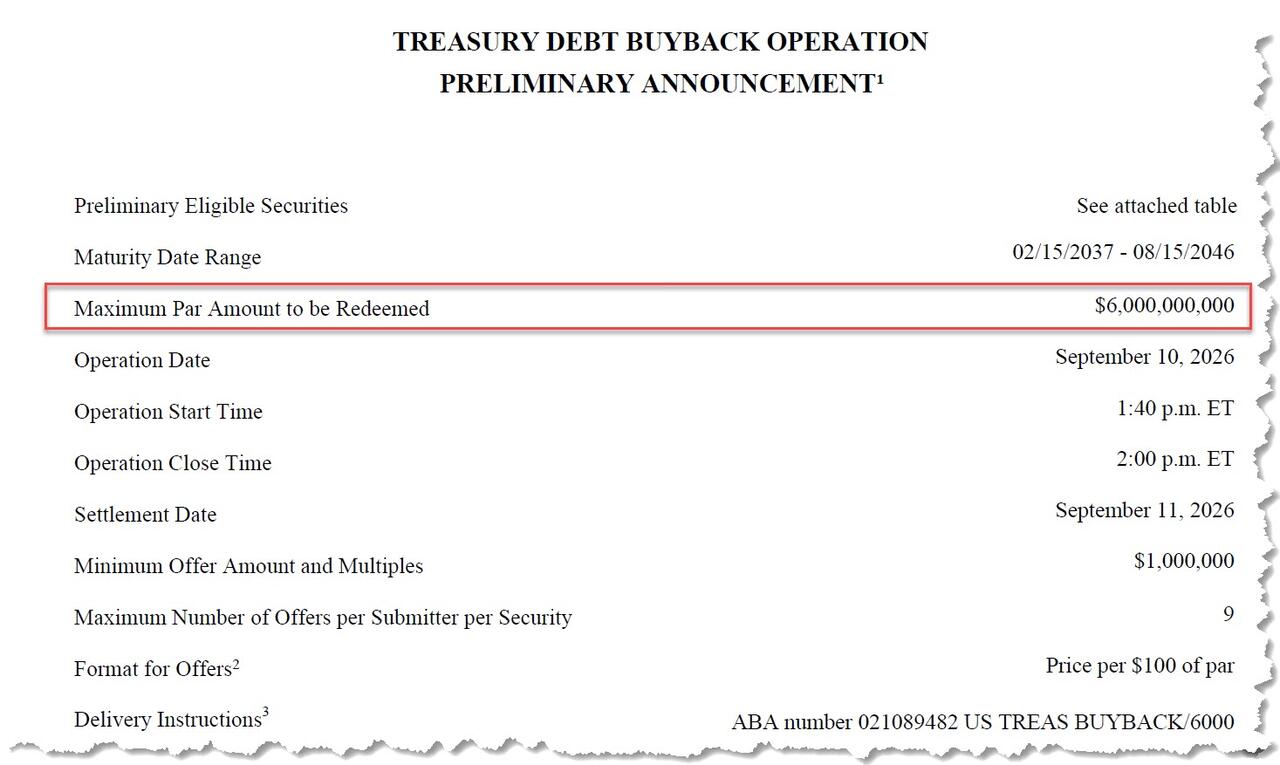
Many dealers had ramped up their predictions for Thursday’s buyback operation after Bessent publicly touted the potential for purchases of over $4 billion; many expected $6 billion, a few even said that a number north of $10 billion isn't out of the question. The Treasury chief on Tuesday reiterated that while he cannot alter the “equilibrium” price of Treasuries, his objective was to slow moves down and prevent any damaging narrative taking hold in the world’s biggest bond market
BNP Paribas head of US rates strategy, Guneet Dhingra, said before the announcement it would take a maximum size of $7 billion to surprise the market, with anything less triggering selling pressure. He was right: the $6 billion number proved to be a dud as confirmed by the bond market reaction which has sent 10Y yields spiking 4 bps higher on the disappointing news, rising as high as 4.85%.

How successful the enlarged program will prove remains to be seen. Yields dropped after the initial announcement of the plan last month, but retraced the move. Benchmark 10-year yields last week hit their highest since 2023.
Markets in August, when 30-year yields hit their highest since 2007, were driven by concerns “the US is not going to be able to pay its debt. It was absurd, but it just became kind of the dominant narrative,” Bessent claimed in a Texas event. He has separately characterized buybacks as aimed at boosting liquidity. They will enable banks and other institutions to offload harder-to-trade securities so that they can then boost their participation in auctions of new debt, he said last week.
“Scott has absolutely adopted a very activist model as Treasury secretary,” Krishna Guha, head of economics at Evercore ISI, said before Wednesday’s announcement. “He’s tactically very skilled in terms of when and how to surprise and move markets and has had some near-term success.”
Guha, who previously worked at the Federal Reserve Bank of New York, said “the challenge is always whether the impact of these kind of interventions can be sustained without bigger changes in fundamentals.”
Of course, since the buyback size is a "maximum", that means the Treasury will not necessarily purchase that amount of securities. However, when it comes to buybacks targeting longer-dated nominal debt, the department does tend to buy the full size, having only twice not done so in the 52 such operations since the program was reintroduced in 2024.
Bessent’s expansion of the long-dated buybacks program last month took investors by surprise because it was announced outside the Treasury’s quarterly announcement schedule. That’s fanned talk of a new, more activist style of US debt management, in contrast to the department’s long-held mantra of being “regular and predictable.”