





What T. Boone Pickens Would Ask About AI CapEx
Authored by Patrick Feeley via Substack,
I keep waiting for someone in the AI discussion to talk like an owner. What we get instead is a week of model releases, token counts, and model-lab valuations that look like oil majors, while the harder questions about turbines, interconnect queues, and who answers for the spend sit offstage. That imbalance would have driven T. Boone Pickens up a wall.
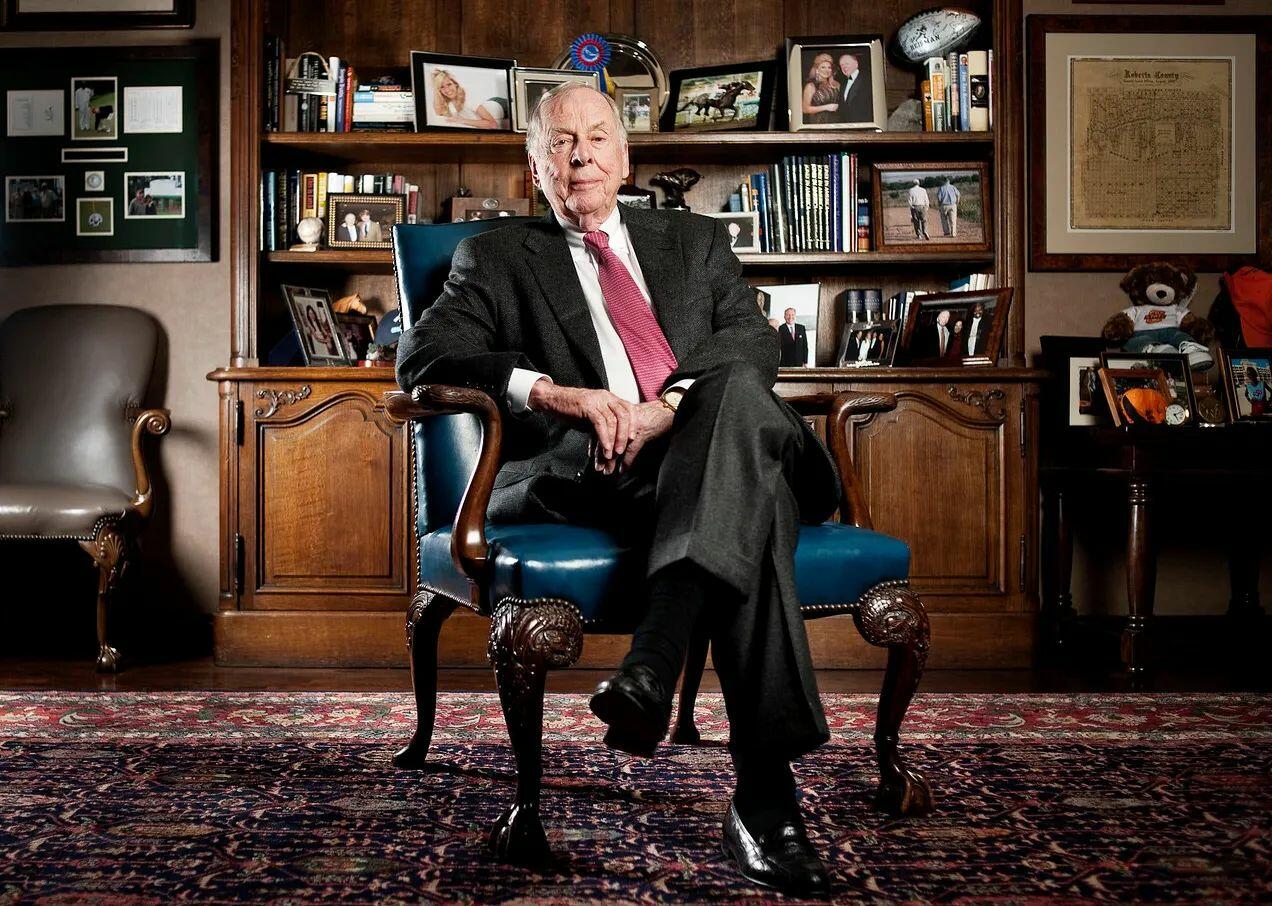
Boone passed away in Dallas on September 11, 2019. He was 91. He grew up in Holdenville, Oklahoma, worked as a geologist at Phillips Petroleum, quit, and built Mesa Petroleum from a shoestring into a company that could force Gulf Oil into Chevron's arms. Later he ran an energy hedge fund out of Dallas and spent a decade trying to shove the country onto wind and natural gas before the transmission system could carry either. Two things always set him off. Soft managements that treated shareholders as a nuisance. And a national energy policy that treated imported oil as something America just had to live with.
If he were still in the room this week, he would not be picking sides in a chatbot fight. He would start with the physical bill of materials that decides who can actually build AI.
Power first. Every incremental megawatt of AI load is an order for firm generation. New combined-cycle gas capacity for the post-2027 cohort is now running near $2,000 a kilowatt, roughly double the cost of earlier plants, with turbines on multi-year backorder. Existing, grid-connected gas plants have been changing hands near $1 million a megawatt, about half the cost of building new. In Boone's language, it is getting cheaper to find megawatts on the floor of the exchange than in a turbine queue.
Then metal. Copper goes into the transformers, busbars, and switchgear that move that power to the rack. Tin goes into the solder on every board and optical module. Fastmarkets' AI-chain work puts solder-related tin exposure on track for roughly a tenth of global solder-tin demand by 2030. Gallium and germanium go into power electronics and high-speed optics. The United States is 100 percent import-reliant for gallium, more than 50 percent for germanium, about 77 percent for refined tin, and about 57 percent for refined copper. China accounts for the overwhelming share of primary gallium refining. None of that stack turns on a two-year Capex slide.
Only then would he get to the denominator. What does each new dollar of Capex earn, and what did that dollar cost to fund? Underneath the math sits the question he put to every oil company he ever owned. Who works for whom?
The Mesa Years
Most readers remember the shareholder campaigns. Fewer remember how improbable the man behind them was. Boone was born in 1928 and went to Texas A&M on a basketball scholarship. After an injury he transferred to Oklahoma A&M, where he took a degree in petroleum geology in 1951. He had not yet found his footing, and his father delivered a line Boone would repeat for the rest of his life. A fool with a plan can beat a genius with no plan. His parents, his father added, were worried their son was a fool with no plan. Get a plan. Boone took the point. Every campaign he ran afterward began with a written plan and a number, and he had little patience for executives who could offer neither.
He spent a few years as a Phillips geologist, went out on his own, and in 1956 formed Petroleum Exploration, Inc. with two backers in Amarillo. It went public in 1964 as Mesa Petroleum, named for the flat-topped land of the Texas Panhandle. Four years later Mesa made a hostile tender for Hugoton Production, a Kansas gas company larger than itself, and won. That deal set the pattern. By 1981 Mesa was one of the largest independent oil companies in the world, with more than $2 billion of assets, and still small next to the companies Boone would go after next. Cities Service. Gulf. Phillips. Unocal.
The method was consistent. He looked for oil companies whose reserves were worth more than the equity market would credit under the people running them. He bought stock, pressed for a restructuring, a sale, or cash returned to owners, and moved on. Critics called it greenmail. Boone called it accountability.
Gulf was the campaign that defined him. In 1983 Mesa and its partners accumulated a large position in Gulf Oil, one of the Seven Sisters and many times Mesa's size. With the stock around $44, Boone argued publicly that Gulf's reserves supported something closer to $114 a share, and that management had depleted more than half the company's reserves in a decade. His remedy was not to shut anything down. It was to place a quarter of Gulf's cash flow, roughly $750 million a year, into a royalty trust paid directly to shareholders. The board refused, and in 1984 Chevron acquired Gulf for $13.2 billion, then the largest merger in American corporate history. Measured against the size of the U.S. economy, that is the equivalent of a transaction of more than $100 billion today, or roughly half of what Alphabet expects to spend on capital this year. The Pickens group realized a pretax gain of approximately $760 million.
The size of the gain was not the lasting significance. The lasting significance was that a small independent from the Texas Panhandle had shown the market something it preferred not to see. As Boone put it, it had become cheaper to look for oil on the floor of the New York Stock Exchange than in the ground, and the boards sitting on that discount could be made to answer for it.
Unocal showed the limits of the approach, and its most durable result. In 1985 Fred Hartley answered Mesa with a self-tender that excluded Mesa by design, and the Delaware Supreme Court allowed it. Boone lost money on the campaign. But within about a year the SEC adopted its all-holders rule, and a tender offer that treated one class of owner differently from another was no longer available to a board. Every American board still operates under that rule. The following year Boone founded the United Shareholders Association and reduced his philosophy to two sentences. Stockholders are owners. Management are employees. That is still the cleanest description of what is missing from most AI board presentations, which are full of pilots and roadmaps and almost never say who will answer for the roadmap if it is still a slide in 2028.
The Second Act
Most people with Boone's first career would have stopped. Mesa moved from Amarillo to Dallas in 1989, and by 1996 Boone had left the company that made his name. He was nearly seventy. The following year he founded BP Capital and went back to work on the same idea that had powered the raids, which is that physical reality eventually overrules the consensus story. In the years before the 2008 oil peak, when many analysts treated high prices as an aberration, he argued publicly and with his own capital that supply could not keep pace with demand. He was early more than once and said so cheerfully. He was right on direction often enough that those who dismissed him looked careless in hindsight.
His favorite story was about a geologist who falls from a tall building and, passing the fifth floor, thinks so far, so good. He meant the optimism. He also meant that you still had to land. The Pickens Plan of 2008 was that temperament applied to the whole country. Build wind across the Great Plains, build the transmission to carry it, move natural gas out of power generation and into heavy trucks, and cut the import bill. He committed real capital, including an order for 667 GE turbines for a Texas Panhandle project that foundered when transmission could not reach the load, credit markets seized, and cheap shale gas undercut the wind economics. He spent years finding homes for those turbines. It was, in effect, a dry hole with a purchase order.
The critics were right that the plan was harder than the advertisements. But the lesson has aged well. The binding constraint then was wires. Today it is wires, interconnection, turbines, and metal. Artificial intelligence did not create the problem of moving power from where it is cheap to where it is needed. It made the load arrive all at once.
The Same Signal, Forty Years Later
The idea underneath Boone's campaigns is the one worth borrowing this year. It was about what happens when an industry is flooded with cash and keeps pouring it back into the ground.
Crude prices rose roughly tenfold during the 1970s, and the majors emerged with more cash than they had sensible uses for. Michael Jensen later put the 1984 cash flow of the ten largest oil companies at $48.5 billion. Very little went back to owners. The industry kept spending heavily on exploration and development even where average returns sat below the cost of capital. The market noticed before the boards did. John McConnell and Chris Muscarella found that while higher capital-spending announcements generally helped industrial stocks, higher exploration budgets pushed oil stocks down. Owners were saying, in the only language available to them, that the next dollar sunk into the ground was worth less than a dollar left in their hands.
Set this year's numbers beside that history. Alphabet, Amazon, Meta, and Microsoft are on track for combined 2026 capital spending on the order of $700 billion to $745 billion, most of it tied to AI infrastructure. On July 22, 2026, Alphabet beat on revenue, raised full-year Capex guidance to $195 billion to $205 billion, reported free cash flow of about negative $5.9 billion for the quarter, and sold off hard after hours. The market was sending the same signal McConnell and Muscarella recorded four decades ago.
The fair caveat matters, and Boone would have offered it himself. The oil majors of the early 1980s were often reinvesting into flatter demand. The hyperscalers are reinvesting into demand that is still compounding, and cloud backlogs are real. But the question Boone asked never depended on whether demand was growing. It depended on whether the marginal dollar earns more than it costs, and whether anyone outside management is allowed to check.
The second half of his insight applies well below the hyperscalers. Proven reserves already in the ground, owned by someone else, were cheaper than new ones, and the same arithmetic now runs through the power market. Existing gas plants have been trading near half the cost of new combined-cycle capacity. The largest buyers have drawn the obvious conclusion. Rather than wait years for a grid connection, they are pulling generation toward the load. Entergy is building gas plants to serve Meta's Hyperion data-center campus in Louisiana. In Texas, ERCOT has fielded large-load interconnection requests on a scale that would have seemed implausible five years ago, and the Legislature has moved to set terms for how those loads connect.
In Boone's language, it has become cheaper to find megawatts on the floor of the exchange than in a turbine queue. An energized site with an interconnection agreement is the proven reserve of this cycle, and the companies that hold one are not always valued for it.
Ready, Aim, Aim, Aim
Boone had a phrase for corporate delay. Ready, aim, aim, aim. He used it on oil executives who preferred another study to a decision, and it describes the enterprise AI economy with uncomfortable precision. MIT's Project NANDA work on generative AI in business, widely covered in 2025, reported that the vast majority of organizations studied were showing no measurable P&L return despite tens of billions in enterprise spend. Treat that finding as directional, not scripture. Even well-run companies are not immune to slow kill decisions. McDonald's tested AI voice ordering with IBM at more than 100 drive-thrus beginning in 2021 and ended the test in 2024 without a rollout. Ending a pilot that does not work is the right decision. The question an owner asks is why it took three years to reach it.
The tools are no longer the main problem. For a great many ordinary operating uses they are good enough. Ownership is the problem. If no executive's compensation depends on turning the spending into cash, the spending becomes theater.
Consider what Boone would do if he were thirty-five today with capital behind him. He would not start with the hyperscalers. He would start where he started with Hugoton, with a company larger than his own whose assets were worth more than its management was delivering. Today that is often a small or mid cap industrial, distributor, or services business that has announced an AI program, committed a meaningful share of its free cash flow to it, and still reports no metric tied to the result. He would read two years of filings and earnings calls and total the committed spend, including the parts buried in IT budgets and consulting contracts. He would buy enough stock to be taken seriously. Then he would pick up the telephone, because he always preferred a voice to an email, ask for the plan in writing, and give management a date. If the plan never arrived, he would take the same questions to the other shareholders and, if necessary, to the public. That was Hugoton, and Gulf, and every campaign in between. It was never about hostility. It was about a calendar.
Five Questions T. Boone Pickens Would Ask AI Companies Today
None of these are exotic. They are the questions a well-run family office puts to the operating businesses it owns, and most public boards have not yet put them to their own AI programs.
- What is the total committed AI spend, including the pieces buried in IT, consulting, and cloud contracts?
- Which line on the income statement is supposed to improve, by how much, and by when?
- Whose compensation depends on that result?
- What happens to the program if the target is missed by half?
- How does the return compare with the simplest alternative, which is returning the capital to the owners?
The last question is the Gulf royalty trust in modern form. Managements with good answers generally welcome an engaged shareholder. Managements without them are running a science project on someone else's balance sheet. The difference is rarely the model. It is almost always the plan.
Boone would have been a handful in any boardroom this year, and he would have enjoyed every minute of it. Yet the lesson of his career is an optimistic one. The oil industry he pressed in the 1980s emerged leaner, better capitalized, and more attentive to its owners, and the shareholders who stayed the course were well rewarded. The AI buildout can follow the same path. The demand is real, the technology works, and the physical constraints of power and metal are problems that capital and discipline know how to solve. What the moment requires is owners willing to ask for the plan and managements confident enough to produce one. Boone spent sixty years insisting that a fool with a plan beats a genius without one. The companies that take that advice in this cycle will set the standard for the rest, and their owners will be glad they asked.
Sources
- Alphabet Q2 2026 earnings release - Capex guidance $195-205B; Q2 P&E purchases $44.9B; Q2 free cash flow about -$5.9B link
- Alphabet after-hours selloff on the Capex raise, July 22, 2026 link
- Hyperscaler 2026 Capex context (Alphabet, Amazon, Meta, Microsoft combined on the order of ~$700B-$745B depending on definition) link
- Enverus - existing gas-plant M&A near ~$1.0M/MW vs new CCGT replacement cost near ~$2.0M/MW for the post-2027 cohort (July 15, 2026) link
- Fastmarkets - AI-chain solder tin exposure rising toward ~10.6% of global solder-tin demand by 2030 link
- USGS Mineral Commodity Summaries 2026 - U.S. net import reliance: gallium 100%; germanium >50%; refined tin ~77%; refined copper ~57% link
- Chevron acquires Gulf Oil, 1984 (~$13.2B); Pickens group pretax gain (~$760M) link 1 link 2
- SEC all-holders / best-price tender offer amendments after Unocal (1986) link
- Pickens launches United Shareholders Association, 1986 link
- Mesa Power orders 667 GE wind turbines for the Texas Panhandle project, 2008 link
- Michael C. Jensen, "The Agency Costs of Free Cash Flow, Corporate Finance, and Takeovers" link
- John J. McConnell and Chris J. Muscarella, "Corporate Capital Expenditure Decisions and the Market Value of the Firm," Journal of Financial Economics (1985) link
- Entergy gas generation approved to serve Meta's Hyperion load in Louisiana link
- MIT NANDA / State of AI in Business 2025 - directional on weak P&L conversion of enterprise genAI spend; not peer-reviewed link
- McDonald's ends IBM AI drive-thru test, 2024 link
This note is for research and discussion only. It is not an offer to sell, or a solicitation to buy, any security. Sargasso Capital Management may hold positions discussed or related instruments and may change those positions without notice.