


Why Nvidia's Nightmare May Be Just Beginning
Submitted by QTR's Fringe Finance
Just to put a bow on the Jensen Huang saga, before this story broke in a big way, I wrote that investors should be preparing for more bad news across the AI trade. I still believe that’s the case, and arguably more so now than I did a few days ago.
Just hours after I raised the question of whether Nvidia CEO Jensen Huang could be forced to resign…a possibility that virtually nobody seemed to be discussing at the time…Huang publicly admitted to an extramarital affair with Alice Huang, a Chinese businesswoman now at the center of allegations involving Chinese intelligence and Nvidia’s chip sales.

Over the last several days, prediction markets have started taking the possibility of Huang’s departure more seriously, with the implied odds of his resignation by March of 2027 move to about 15%. And as I wrote on Sunday:
And lest we forget…I’m getting ahead of myself here, but that’s what I do….there’s also the uncomfortable reality that major executive departures can sometimes bring previously concealed problems into the open.
New leadership, new scrutiny, and changing incentives have a way of revealing things that were previously swept under the rug.
Well, we haven’t even gotten to the executive departure yet, and the questions are already getting considerably more uncomfortable.
Because this morning The Information reported that Huang’s affair with Alice Huang allegedly helped facilitate at least $7.5 billion in Nvidia chip shipments to Chinese firms.

According to the report, Alice Huang, along with her husband and sister, built a network of companies across China and Singapore to acquire Nvidia chips.
At the center of that network was Shanghai Century Litong, a Chinese company founded in June 2023 that reportedly secured preferred cloud partner status with Nvidia just four months later, giving it priority access to chips.
When U.S. export restrictions complicated orders, Alice Huang allegedly used her connections to Nvidia and its distributors to secure supplies, helping move approximately 240,000 H100, H200 and A100 chips into China.
That’s not a rounding error. And it’s certainly not just a story about a CEO’s personal life anymore, if you ask me…
To be clear, these are allegations reported by The Information. They have not been established by a court or regulatory finding, and they do not by themselves prove that Nvidia or Huang knowingly violated export controls. But if even a meaningful portion of these allegations is substantiated, investors might have a much bigger problem on their hands than they did 48 hours ago.
Because the obvious questions now concern Nvidia’s China business, its export-control compliance, the integrity of its customer relationships, and potentially the reliability of management’s prior representations to shareholders.
For years, Nvidia has maintained that U.S. export restrictions effectively eliminated its China compute business. Yet we’re now looking at allegations that billions of dollars of Nvidia hardware continued reaching Chinese customers through intermediary networks, allegedly aided by someone with a personal relationship with the company’s CEO.
How much of Nvidia’s reported revenue was ultimately dependent on Chinese demand? How much was flowing through third-party intermediaries? How thoroughly did the company scrutinize those customers? And what, exactly, did management know?
Those are questions investors should want answered before assuming this controversy is contained.
And remember, as I noted yesterday, short seller Culper Research was raising related concerns back in May, alleging that more than 20% of Nvidia’s fiscal 2026 compute revenue remained driven by Chinese demand through Southeast Asian intermediaries and illegal GPU diversion. Culper also questioned Nvidia’s customer due diligence, alleged hidden Chinese financing behind major chip purchasers, and warned that China’s push toward domestic semiconductors could leave a substantial hole in Nvidia’s forward revenue expectations.
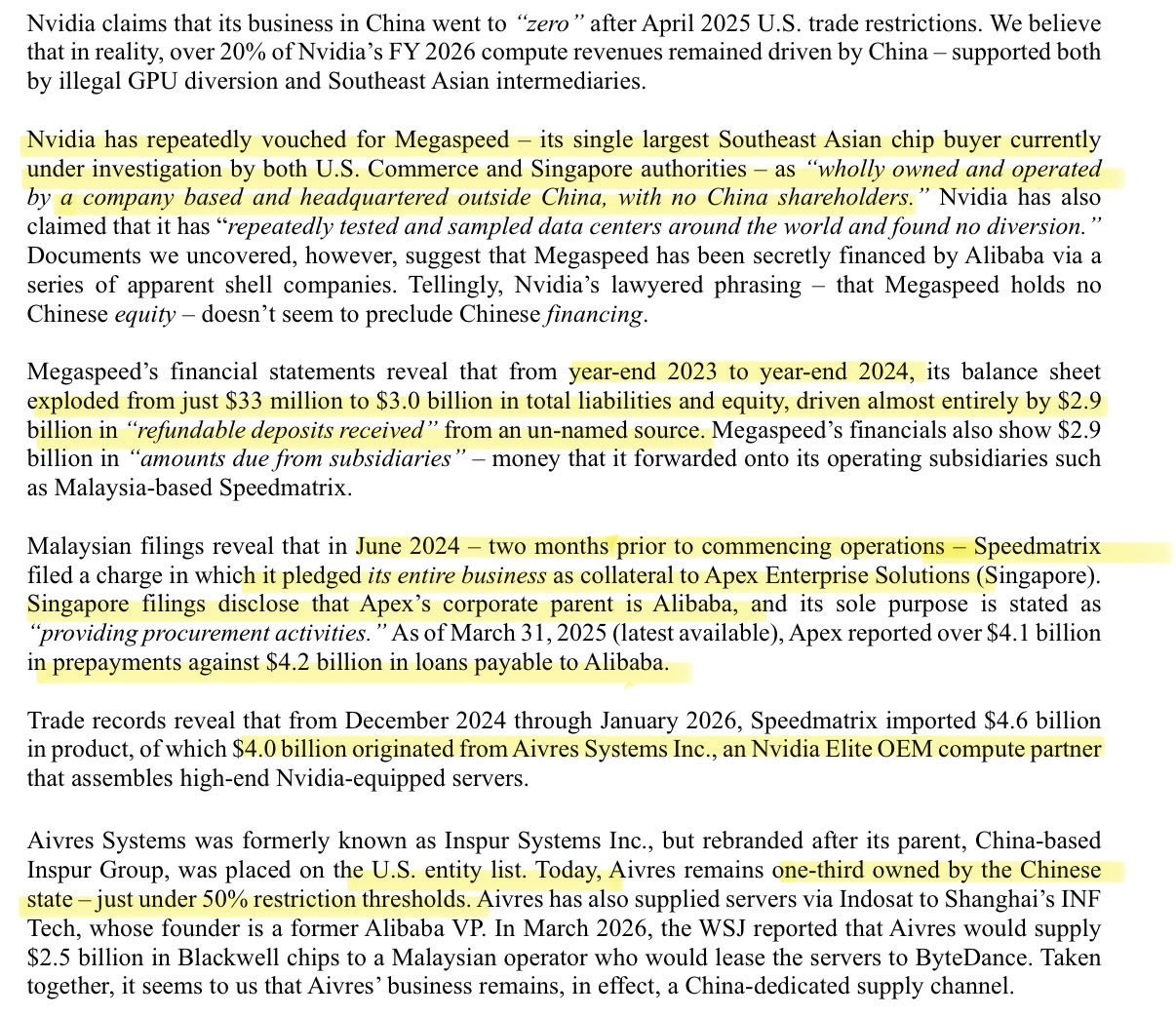
Source: Culper Research report, May 13, 2026
None of that has been conclusively established, but today’s reporting makes those allegations considerably more relevant.
And here’s where I stand now: I think the likely outcome at this point is that Jensen Huang resigns, at a minimum.
That’s my assessment, not a confirmed development. Nvidia’s board has expressed confidence in Huang, and an independent investigation is underway.
But I have a hard time seeing how this story simply disappears, particularly if additional reporting begins to connect the personal relationship to commercial decisions involving restricted chips.
More importantly, I’m increasingly concerned about what broader scrutiny could reveal about Nvidia’s books.
That doesn’t mean I’m alleging accounting fraud or that Nvidia’s financial statements are false. It means I think investors need to start asking whether the company’s reported geographic exposure, underlying end-customer demand and revenue sustainability are as straightforward as management has suggested.
As ZeroHedge asked at one point yesterday, if Huang was concealing the affair, what else might he have been concealing?
Today’s report is a fair reason to scrutinize management’s credibility more closely, especially when the questions involve billions of dollars in potentially restricted hardware.
And there’s other key questions that are starting to make their rounds:
- Why Megaspeed? Nvidia already had a massive backlog of orders. Why did Jensen Huang insist on selling chips to a controversial Singaporean customer when he could have sold them just as profitably elsewhere?
- Nvidia’s intervention: The New York Times reports that Nvidia intervened with the Commerce Department before its investigation into Megaspeed was transferred to the Justice Department, raising questions about what the company was trying to accomplish.
- Huang’s evasiveness on China: Critics are resurfacing Huang’s April 2026 interview with Dwarkesh Patel (starts around 57:30), arguing that he repeatedly dodged questions about the national security risks of selling advanced AI chips to China.
- No Taiwan contingency plan? Stephen Witt’s The Thinking Machine reports that Huang discouraged planning for a Chinese blockade or invasion of Taiwan, despite Nvidia’s extraordinary dependence on TSMC.
This list of questions will continue to grow as more reporting comes out. And every journalist in the world is looking at this story now, working whatever leads they can.
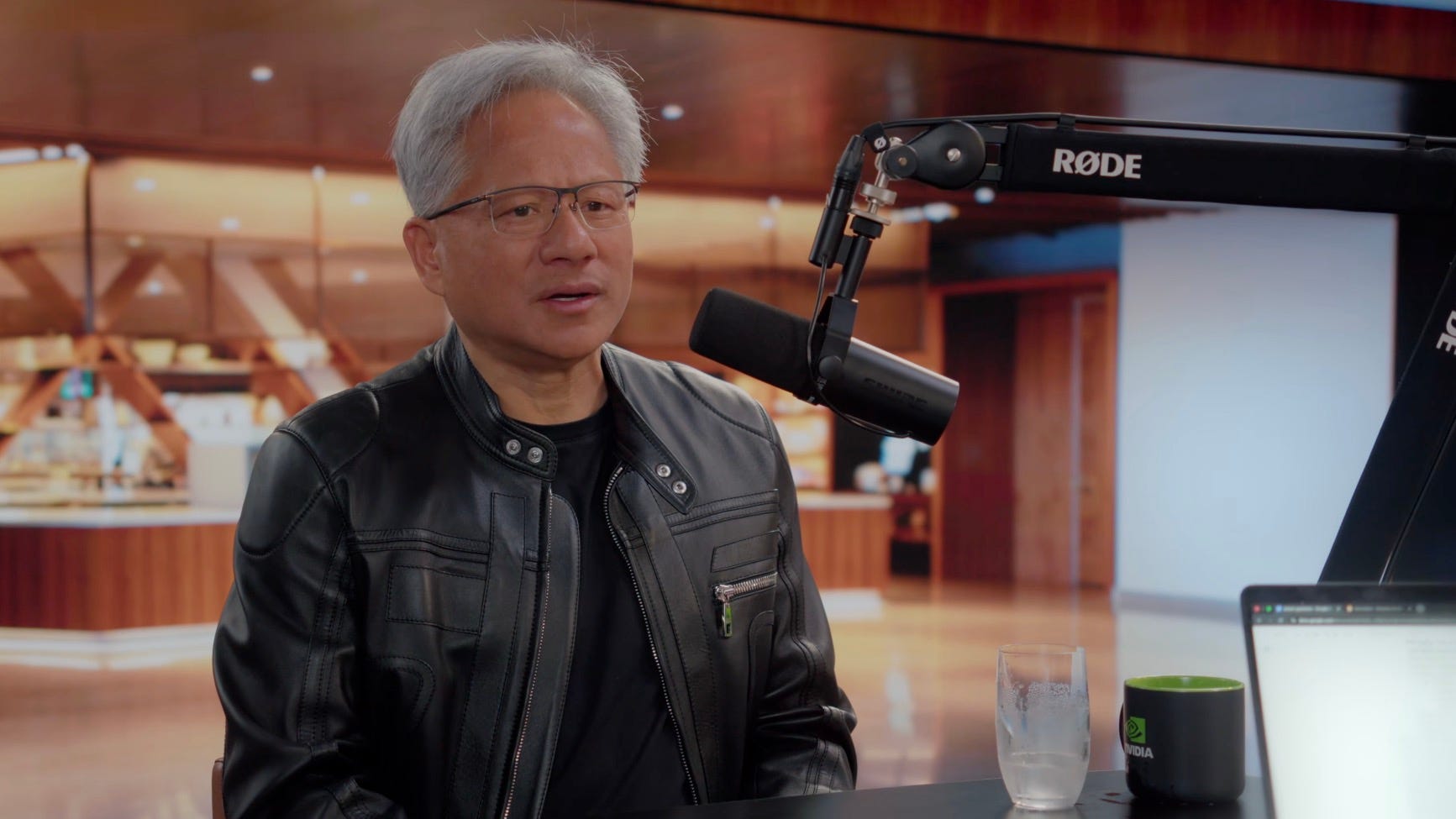
Huang during April 2026 interview with Dwarkesh Patel
There’s a larger market context here that I don’t think should be ignored. Six months ago, perhaps this controversy would have landed differently. Nvidia was still riding extraordinary enthusiasm surrounding AI infrastructure spending, and investors seemed willing to look past almost any risk as long as the growth numbers kept coming.
Today, the backdrop feels very different. The market appears increasingly skeptical of the AI trade, questioning the sustainability of enormous capital expenditures, the returns on AI investment and the valuations attached to companies at the center of the boom. Democrats have wrested control of congress away from the GOP and are actively looking for consequential situations just like this one to investigate.
Now the company sitting at the very nerve center of the AI trade is facing a potentially serious leadership crisis, allegations concerning billions in China-linked chip shipments, and growing questions about the transparency of its business.
This isn’t financial advice, but personally, I would not be buying Nvidia here until a considerable amount of this smoke clears.
85% OFF FOREVER IF YOU SUBSCRIBE TODAY: I am again offering an 85% discount to anyone that wants to become a Fringe Finance annual subscriber today. It’s a discount you can keep and stays applied for as long as you wish to remain a subscriber: Get 85% off forever
Maybe the investigation ultimately finds that the company’s controls held up, that management’s financial disclosures were appropriate and that Huang’s personal misconduct had no bearing on Nvidia’s commercial activities.
But I don’t see a compelling reason to assume that outcome today, particularly when new allegations seem to be emerging before investors have had time to digest the last ones.
My concern is that there’s still way more beneath the surface. And with sentiment toward AI already looking increasingly fragile, I think the downside risk from additional revelations could be considerably greater than investors appreciate.
I hope it’s not the case because of how consequential Nvidia is to the global economy at this point, but I’d be lying if I said that in my 15+ years in markets….with more than a decade digging to try an uncover dirt on public companies working for short sellers…I did tend to notice that situations like these seem to wind up getting worse before they get better.
In other words, the Nvidia story may have started with Jensen Huang’s affair. I’m not convinced that’s where it ends.
--
QTR’s Disclaimer: Please read my full legal disclaimer on my About page here.