







KISS ME!
It’s been a mere 135 days since the grand Jubilee year kicked off and just 115 days since the ‘Disruptor In Chief’ waltzed back into the Oval Office for round two — and wow, what a yawn fest, right? Regardless of your political flavour or where you call home on this spinning rock, one thing’s clear: this Jubilee year has been so far anything but uneventful. And sure, Lenin once said, "There are decades where nothing happens and weeks where decades happen," but honestly, *who knew he was talking about this year?

In an environment like this, investors might want to channel their inner John Maynard Keynes — you know, the guy who, when called out for changing his stance, coolly replied, "When the facts change, I change my mind. What do you do, Sir?" A refreshing reminder that clinging to old narratives in a world flipping upside down every other week might not be the sharpest strategy.
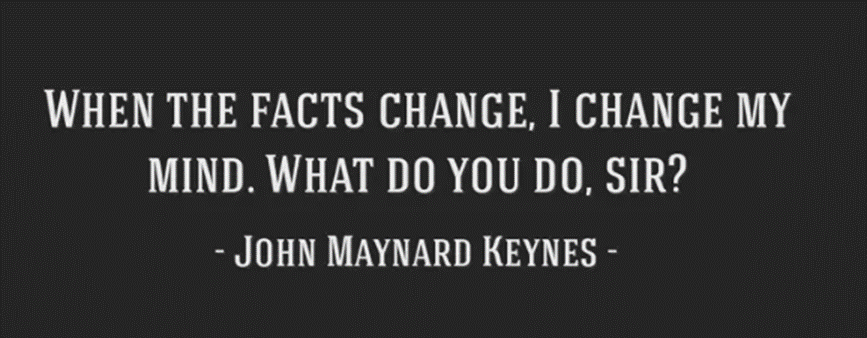
In theory, Keynes’ advice sounds like pure gold — “When the facts change, I change my mind. What do you do, Sir?” Elegant, logical, wise. But in practice? Well, good luck figuring out which “facts” actually matter, and which are just social media chum tossed into the market aquarium by the ‘Manipulator In Chief’ — whose tweets do more for confusion than a magician with a fog machine at a Wall Street conference.
And let’s be honest — today's “new facts” often point in opposite directions. One says buy, the other says sell, and a third says panic quietly into your oat milk latte. So, what’s an investor to do? First, remember the golden rule: KISS ME — Keep It Simple, Stupid; Minimize Entrapment. Yes, in a world spinning faster than a leveraged ETF on FED Day, simplicity is a radical act of rebellion.
Instead of obsessively refreshing Twitter—or whatever we’re calling it this week—or chasing every clickbait headline from financial pundits who haven’t managed a dollar in their lives, focus on the mega-trends reshaping the world like tectonic plates at a disco.
1. Fortress America 2.0: The U.S. has clearly decided it’s time for a glow-up... in bunker form. “Territorial expansion” is back in fashion: booting Denmark out of Greenland, China out of Panama, and whispering sweet nothings about the glory of two oceans and a dream. From the ‘Vice MAGA in Chief’ charming crowds in Munich to Oval Office showdowns with Ukraine’s increasingly unwanted guest star, the signs are clear — America’s done playing world cop and is now binge-building its own gated community.
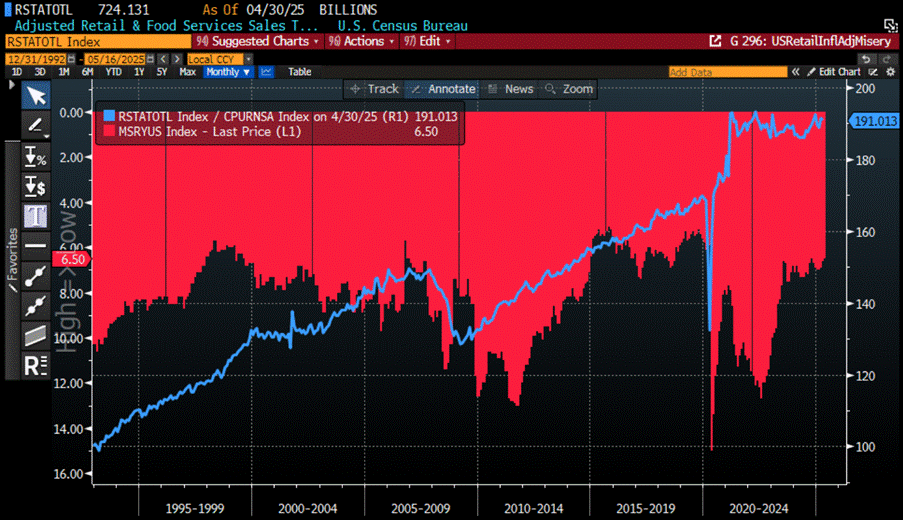
2. The US Consumer? Not Your Atlas Anymore: The US consumer has been the mighty consumer of last resort since WW2, but he is likely to look increasingly just a tired shopper dodging tariffs like potholes in the next few years. The so-called ‘Liberation Day’ tariffs? More like Liberation-from-your-wallet Day. And our ‘Manipulator In Chief’ seems to believe trade wars are a masterstroke of negotiation — when in reality, it’s more like trying to fix a watch with a hammer and has not year that trade wars are wars of attrition and that the time is in China’s favour not the American who will soon have to focus on their next mid-term election.
US Retail Sales Adjusted to US CPI Index (blue line); US Misery Index (red histogram; axis inverted).
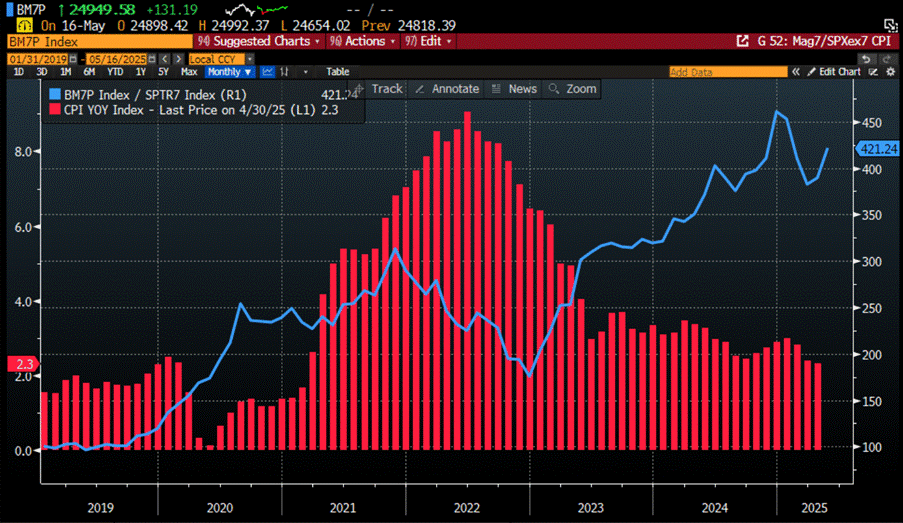
3. AI: The Not-So-Golden Goose: Remember when Artificial Intelligence was supposed to unlock unlimited profits and possibly eternal youth? Well, China just cannonballed into the AI pool with DeepSeek, and let’s be real — when China shows up, profits quietly grab their coats and leave the party. Monopoly-style gains like the post-dot-com boom? Probably not happening when the ‘Maleficent 7’ are up against an industrial juggernaut with no interest in playing by Silicon Valley rules.
Relative Performance of Magnificent 7 to S&P 493 (blue line); US CPI YoY Change (red histogram).
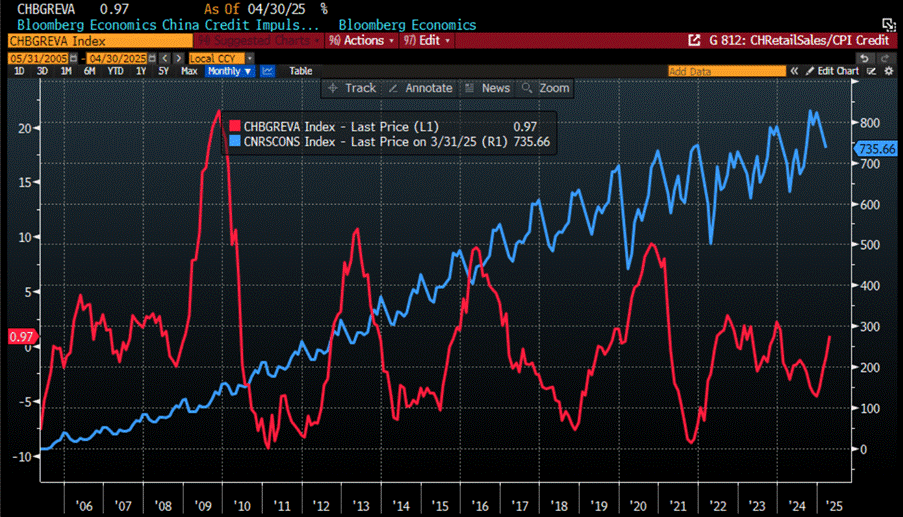
4. Beijing Stimulus Bonanza: While the West debates soft landings and FED next action, China’s out there actually doing stuff — like cranking up fiscal and monetary stimulus to turbocharge domestic consumption. Welcome to the Valeriepieris Circle: where Russia supplies cheap commodities, China builds everything with terrifying efficiency, and India shows up with a booming population ready to spend. It’s basically the Avengers of global economic power — only this time, Captain America will not get an invite.
China Retail Sales Index (blue line); Bloomberg China Credit Impulse 12-Month Change (red line).
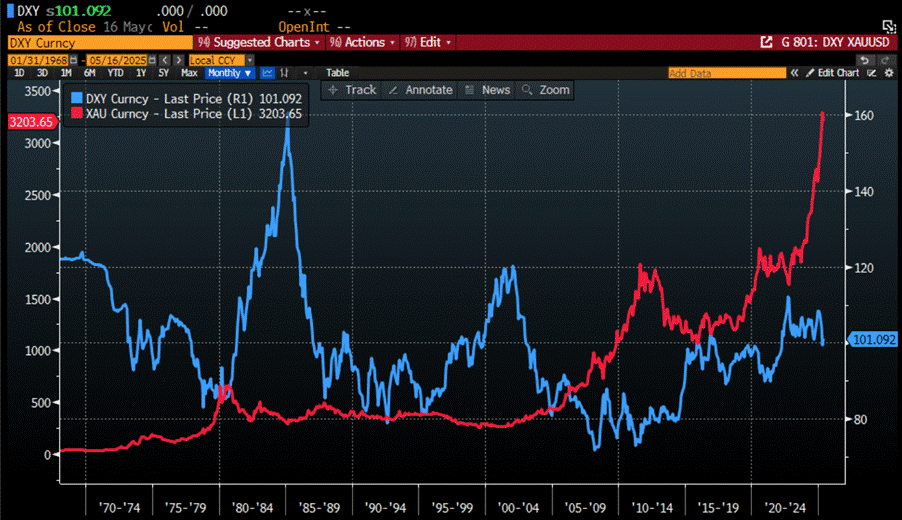
5. De-Dollarization and the Great Asset Exodus: For decades, global excess cash parked itself safely in U.S. Treasuries and more recently in the beloved Magnificent 7 stocks which were mistakenly promoted as ‘antifragile’. But now? The great escape is underway. De-dollarization is no longer a conspiracy theory whispered in gold bug forums — it’s happening in the Global South. And as history reminds us, trade wars don’t end in handshakes; they graduate to capital wars, and eventually to the kind with tanks and awkward UN meetings.
USD Index (DXY Index) (blue line); Gold Price in USD Terms (red line).
In short: Forget the noise. Zoom out. Simplify. And maybe mute the ‘Manipulator In Chief’ while you're at it.
These five trends combine into a heady cocktail — the kind that’s bound to leave financial markets with a long-term hangover (or maybe a total personality shift). Let’s start with the once-mighty USD assets — and specifically, the crown jewel: U.S. Treasuries.
Now, you’d think that after the ‘Liberation Day’ fireworks and the ensuing ‘Tariff Tantrum’, investors would be stampeding into Treasuries for safety like it’s 2008 all over again. But nope — the rally never showed up. It's the bond market equivalent of calling 911 and getting voicemail. In fact, U.S. Treasuries have been dragging their feet ever since Russia kicked off its "Special Operation" — an event that didn’t just redraw geopolitical lines but also highlighted just how weaponized dollar-based assets have become. Add to that the reality of sticky inflation that just won’t quit and whispers of the return of everyone's favourite '70s throwback — Trump Stagflation — and you’ve got a recipe for bond market disinterest at best, desertion at worst.
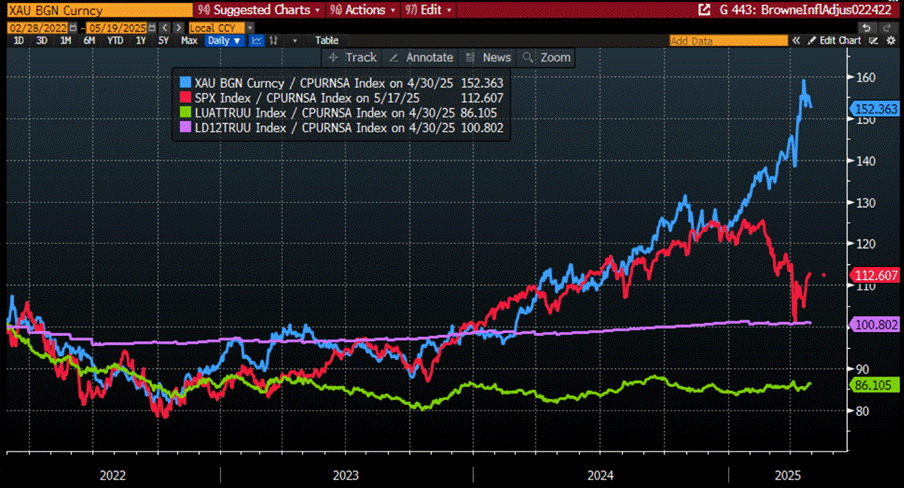
The bottom line? Global investors (and yes, even Americans) seem increasingly uninterested in clinging to the fairytale of Treasuries as “risk-free.” Instead, they’re pivoting to the one asset that doesn’t care who’s tweeting, sanctioning, or printing: physical gold. No counterparty risk, no algorithmic volatility, no empty promises — just 5,000 years of antifragile credibility.
Inflation adjusted performance of Gold (blue line); S&P 500 index (red line); Bloomberg US Treasury Total Return Index (green line); Bloomberg US T-Bills 1-3 months Total Return Index (purple line) since February 24th, 2022.
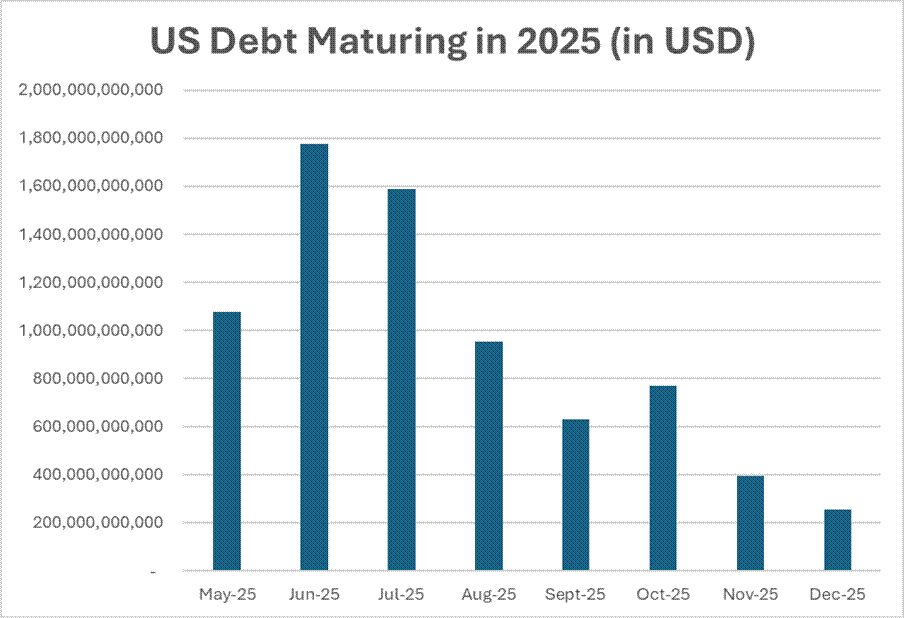
Or, more simply — and far less glamorously — it might just be that Uncle Sam’s tab has gotten so absurdly large that the market can’t stomach it anymore. The issuance and rollover of U.S. debt are no longer routine exercises in fiscal housekeeping; they’re more like trying to sell a truckload of hot dogs outside a vegan festival. There's just too much supply, not enough appetite — and investors are starting to realize that endless debt auctions aren’t exactly the hallmark of a safe haven.
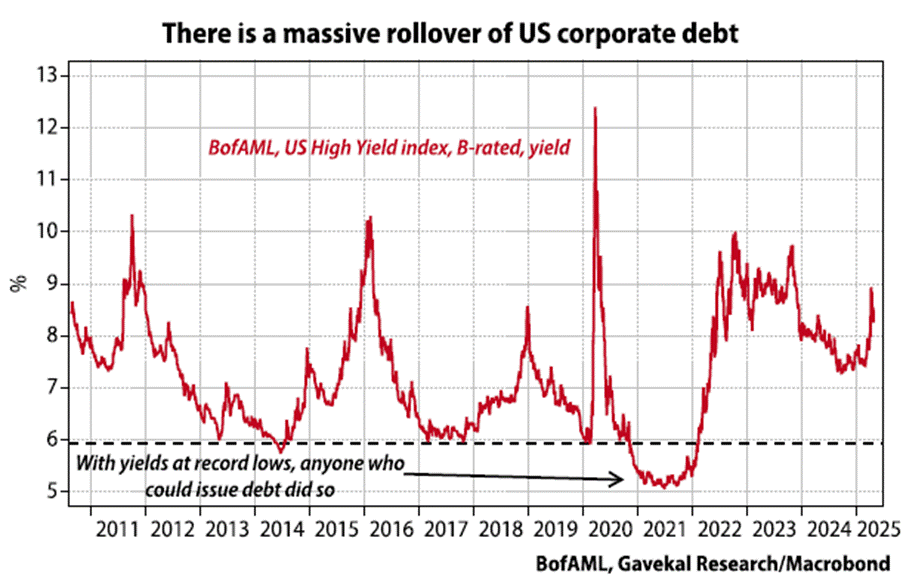
It’s not just the U.S. government staring down a mountain of maturing debt — the corporate world is right there too, nervously eyeing the same Everest. One of the major stories for the second half of this not-so-boring Jubilee year will be the record rollovers in U.S. corporate debt. And no, this isn’t some unexpected twist — it’s the boomerang effect of the 2020 debt binge, when companies gorged on cheap money… and then promptly spent it on share buybacks instead of, you know, building stuff or investing in actual growth. Now, with spreads widening and yields rising like bad headlines on a Monday morning, the U.S. economy finds itself tiptoeing around its very own Achilles’ heel. If refinancing becomes painful — and it will — expect balance sheets to buckle, margins to compress, and markets to start asking some very uncomfortable questions.
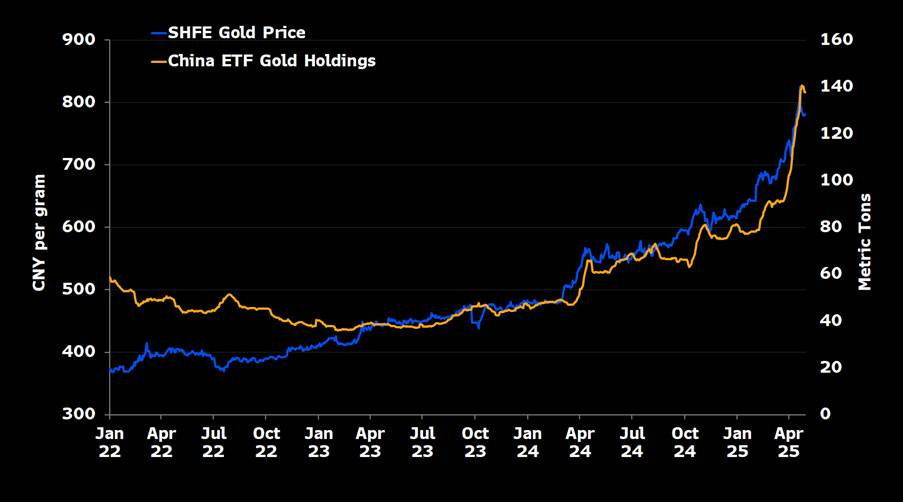
Like it or not — and let’s be honest, Wall Street really doesn’t like it — almost all the trends barrelling down the track are flashing green for gold. The retreat of the U.S. security umbrella, combined with the increasingly creative use of the dollar as a geopolitical battering ram, is nudging (or rather shoving) foreign central banks toward reallocating reserves. Instead of plowing excess savings into U.S. Treasuries or bidding up the already over-hyped Magnificent 7, they’re turning to the one asset that doesn’t come with sanctions, counterparty risks, or political strings: GOLD. And let’s not forget China — which, in its own stimulus-fuelled way, is quietly becoming gold’s best friend. As Beijing dusts off the fiscal and monetary playbook, both institutional giants and retail investors are loading up on gold like it’s 2023 all over again. And if recent history is any guide, they’re not just stacking — they’re setting the price.
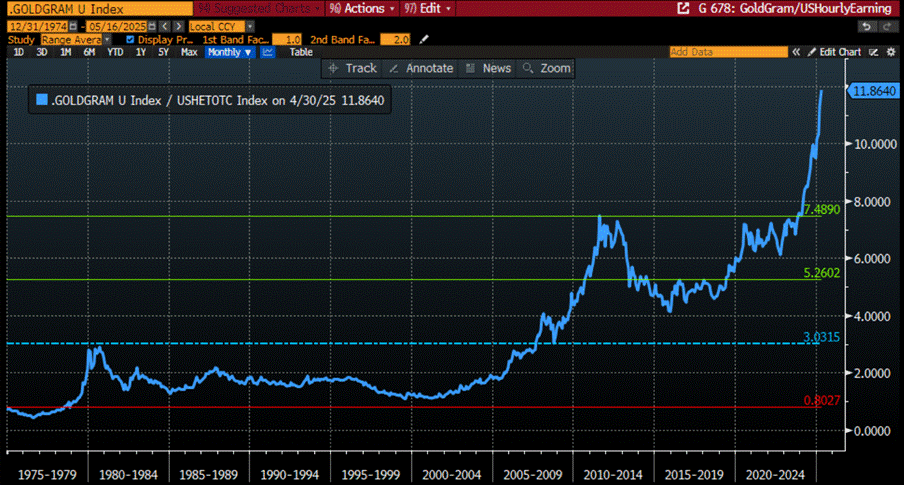
The only catch for gold? Joe Six-Pack is getting priced out. As the U.S. economy sleepwalks into a classic case of Trump Stagflation — think high prices, low growth, and plenty of political theatre — gold may be shining, but it's also slipping further out of reach for the average American trying to build a personal safety net that doesn’t evaporate with every Fed pivot.
Back in the good old days (i.e., the start of this decade), the average U.S. worker only had to put in a little over 5 hours of labour to afford a gram of gold. Today? Try more than 11 hours. So while gold might be the obvious choice for central banks, billionaires, and macro-conscious capital allocators, the working class — the ones most in need of antifragile assets — are being left behind by the very risks they’re trying to hedge against.
Price of a Gram of Gold divided by US average hourly earnings.
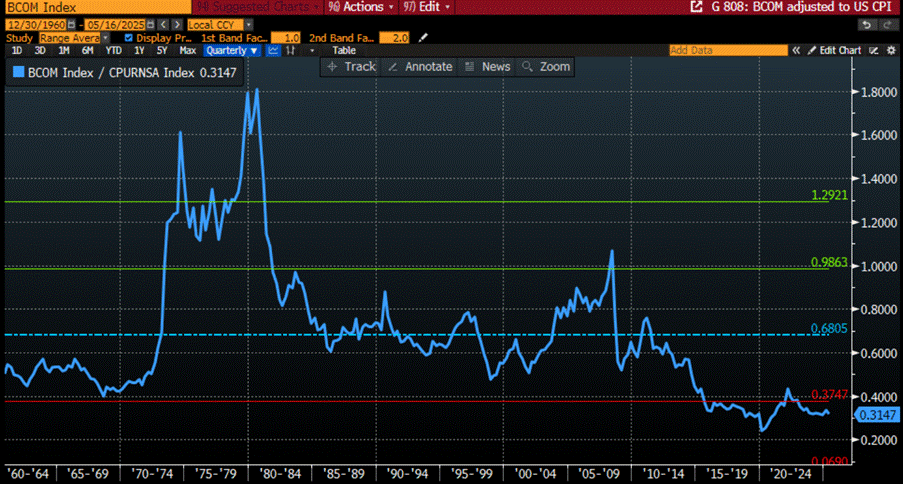
Most of the trends we've touched on — from rising geopolitical instability to China's return to stimulus mode — aren’t just gold-positive; they’re flat-out bullish for commodities across the board. But the real game-changer? The slow-motion collapse of the U.S. security umbrella.
In a world where Pax Americana is more of a historical reference than a functioning reality, countries and corporations alike will be forced to stockpile strategic commodities the way doomsday preppers hoard canned beans — not because it’s trendy, but because uncertainty is the new normal. Supply chains will get bulkier, just-in-time will give way to just-in-case, and the age of abundance will quietly exit stage left. And as the commodity leviathan stirs from its long slumber, inflation won’t just be “sticky” — it’ll be Velcro. That’s a problem for politicians who live on two- to four-year timeframes and central bankers who still pretend CPI is a science. Unfortunately for them, commodity cycles don’t care about re-election calendars.
Bloomberg Commodity Index adjusted to US CPI (rebased at 100 as of December 30th, 1960).
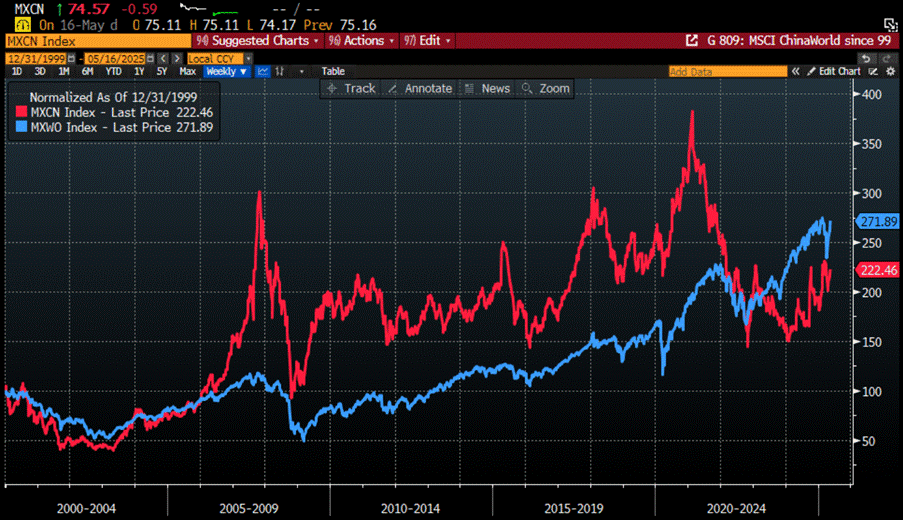
When it comes to China, the Western media chorus and Wall Street talking heads — many of whom wouldn’t know Guangzhou from a dim sum menu — have been preaching the doom of the Middle Kingdom for a decade now. Yet, on the ground, Chinese companies remain as globally competitive as ever. The real issue isn’t collapse — it’s confidence. Both consumers and businesses are still stuck in a post-Covid funk, and despite massive trade surpluses, that money isn’t being recycled into domestic assets. But if — or rather, when — sentiment turns, the recent outperformance of Chinese equities won’t just continue… it’ll go into turbo mode.
Performance of MSCI World (blue line) and MSCI China (red line) in USD since December 31st, 1999.
China’s corporate debt market may look like a graveyard — most issuers are priced to fail, and many probably will. But some won’t. And with Beijing now stomping on the fiscal and monetary gas pedal, the space offers sharp asymmetric upside for those willing to dig through the rubble. At the very least, the renewed stimulus should act as a powerful tailwind for equities. After all, when China’s credit impulse turns up, history says equity bulls aren’t far behind.
MSCI China Index (blue line); China Credit Impulse 12-Month Change (red line) & Correlation.
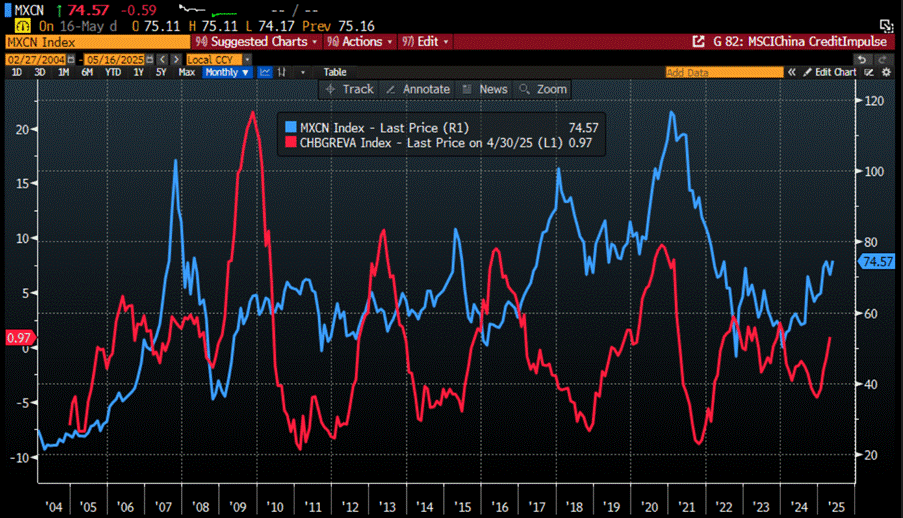
At the very least, investors should start thinking about how to position for the inevitable “brrrr” of China’s money printer — because when Beijing decides to flood the system, it doesn’t trickle, it pours.
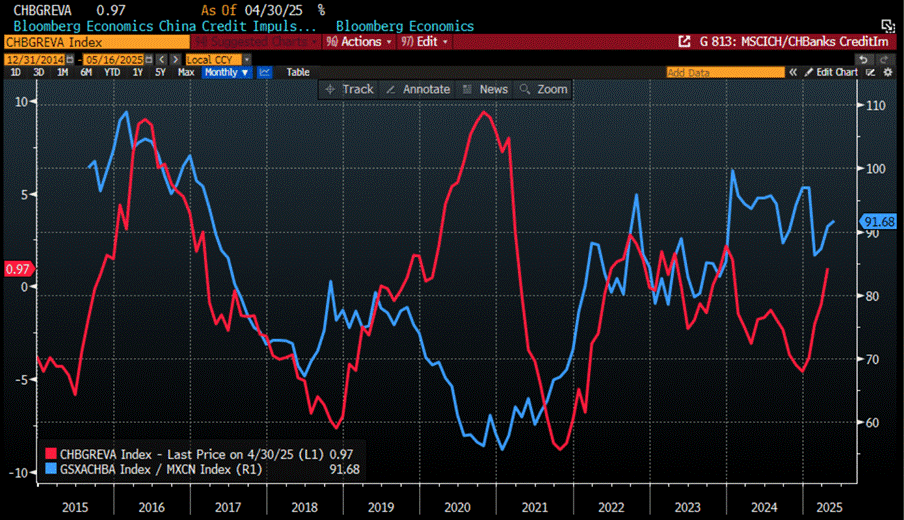
Needless to say, when China’s credit impulse is fully unleashed, shareholders of Chinese banks stand to benefit handsomely. These lenders, backed by the state and stuffed with juicy dividends, are being paid to wait as Beijing prepares to steer the next economic revolution. And with China set to extend its manufacturing dominance across the ValeriePieris circle during the coming deflationary boom, the big state-owned banks look like front-row seats to the show.
Relative performance of GS China Bank Index to MSCI China Index (blue line); China Credit Impulse 12-Month Change (red line).
Anyone with a shred of common sense—and who glanced at The Economist's 2025 outlook—could see it coming: the Jubilee Year was always going to be a turning point. Political chaos, geopolitical realignments, and economic regime shifts are already in full swing, and we’re barely past day 135. This kind of upheaval opens up compelling risk-reward setups across the four core asset classes of the Browne Portfolio. In this environment, smart investors won’t just be judged on their forecasts—but on how fast they can adapt when the ground shifts beneath them.

KISS ME — Keep It Simple, Stupid; Minimize Entrapment — shouldn’t be confused with the ‘Manipulator In Chief’s’ latest attempt to shove his Art of the Deal down the world's throat in true Trumperialistic fashion.
Read more and discover how to trade it here: https://themacrobutler.substack.com/p/kiss-me
If this research has inspired you to invest in gold and silver, consider GoldSilver.com to buy your physical gold:
https://goldsilver.com/?aff=TMB

Disclaimer
The content provided in this newsletter is for general information purposes only. No information, materials, services, and other content provided in this post constitute solicitation, recommendation, endorsement or any financial, investment, or other advice.
Seek independent professional consultation in the form of legal, financial, and fiscal advice before making any investment decisions.
Always perform your own due diligence.