A Plausible U.S.-China Grand Bargain

That Escalated Fast
This week escalated fast: Beijing moved to tighten rare-earth export controls, and late Friday the U.S. answered with an additional 100% tariff headline. Markets read “decouple”—but the sequence matters.
Why now? A Credible Read On China’s Calculus
As analyst Paul Triolo notes, China’s move looks less like spontaneous escalation and more like a direct response to the new U.S. “50% Rule” export-control change rolled out last week—seen in Beijing as breaching the Madrid understanding not to spring fresh measures unilaterally.
Wrong Brad. The Chinese are responding directly to US escalation on export controls with the 50 percent Rule rolled out last week. It was clear they would respond to this, which was a clear violation of the agreement in Madrid not to take new measures. This was a deliberate move…
— Paul Triolo (@pstAsiatech) October 10, 2025
If that’s right, the causation runs U.S. control tweak → Chinese countermeasure, not the other way around, which raises the odds of a bargain: this looks like leverage for negotiations, not a point-of-no-return.
The tape screams “decouple,” but incentives on both sides still point to deal, not divorce. Below is a realistic outline of what a grand bargain could look like—one that begins to rebalance a relationship that’s tilted too far, while letting both countries prosper.
(Context: my “ Trump’s grand strategy” note is here: https://blog.portfolioarmor.com/p/trumps-grand-strategy. And for why a win-win modus vivendi beats doom-scrolling, see “China Has Surpassed the U.S.”—the point isn’t to deny that reality, but to deal with it: https://blog.portfolioarmor.com/p/china-has-surpassed-us.)
The Scaled-Tariff Core
Managed tariff bands that step down when verifiable targets are met (U.S. export purchases, market-access KPIs, compliance) and snap back automatically if they’re missed.
Public quarterly scorecards + 90-day notice before changes → predictable for supply chains, usable for policy.
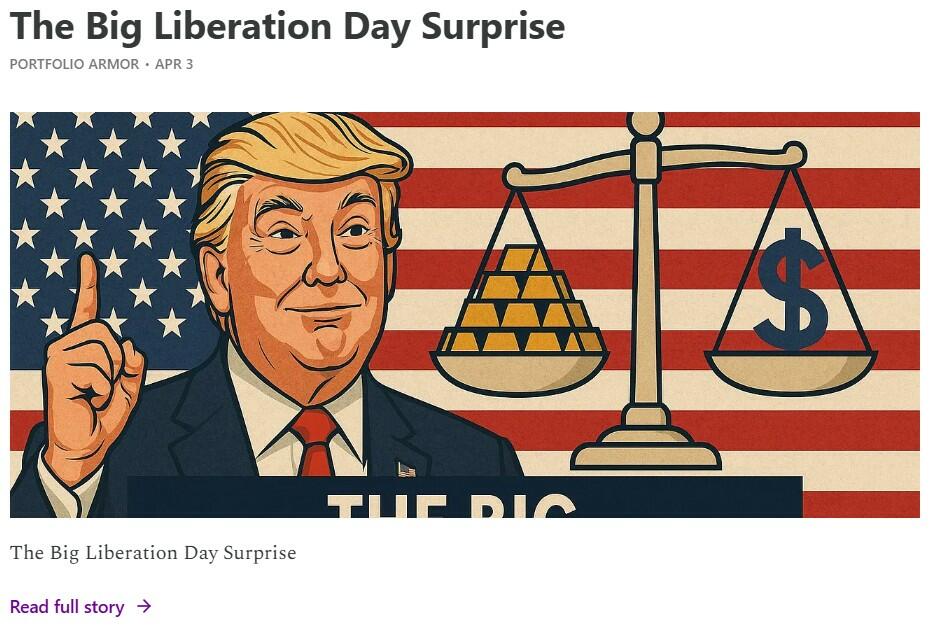
This operationalizes the “scaled tariff” concept we wrote about here:
Investment-for-Access Swap
Multi-year Chinese capital into U.S. hard assets (ports, grid, brownfield factories) via CFIUS-controlled joint ventures/leases with U.S. governance.
Cash flows help address deficits without tax hikes (see our debt-relief framing).
In return, calibrated tariff step-downs and procurement access—all with snapbacks.
Tech Détente—Guardrails First
Capped licenses for last-gen compute and on-prem inference stacks; no cutting-edge training at U.S. clouds.
Independent verification centers; diversion = automatic compute embargo for a set period.
Taiwan: Status-Quo-Plus
Mutual “no unilateral independence, no force.”
Hotlines and drill notification norms; continued defensive arms pacing (not abandonment).
Economic confidence-building measures s in non-sensitive sectors.
Critical-Minerals Truce
China eases rare-earth throttles.
U.S. green-lights minority-capital processing joint ventures on U.S. soil (U.S.-operated, full environmental/NORM compliance) + DoD stockpile program.*
Allies (AU/EU) keep building parallel capacity—diversification, not dependency.
Iran: A Limited, Transactional Stabilizer
Quiet tolerance for stable, capped Iranian exports in exchange for China’s help curbing evasion; maritime de-escalation protocols; a freeze-for-freeze on enrichment/missile transfers tied to sanctions enforcement cadence.
Prestige optics for Beijing without Washington outsourcing security—good enough to lower oil vol.
Enforcement Architecture
Automaticity (scorecards → tariff/compute adjustments), snapbacks, and a fast mediation lane. No ad-hoc waivers.
Why Both Sides Take It
Beijing: growth capital, calmer export lanes, FX stability—without conceding tech sovereignty.
Washington: visible jobs/investment, a path to balanced trade, and hard guardrails that preserve U.S. AI leadership while cooling inflation impulses.
How We’re Positioned (and What We Did Friday)
We favor businesses that win either way—through lingering tariffs or a scaled deal:
AI + grid materials (given multi-year demand from datacenters/transmission).
Factory automation & QA (retooling to reduce rare-earth reliance needs smarter lines).
Reindustrialization has been one of our core themes this year,

And we put on two new trades on Friday that express those themes.
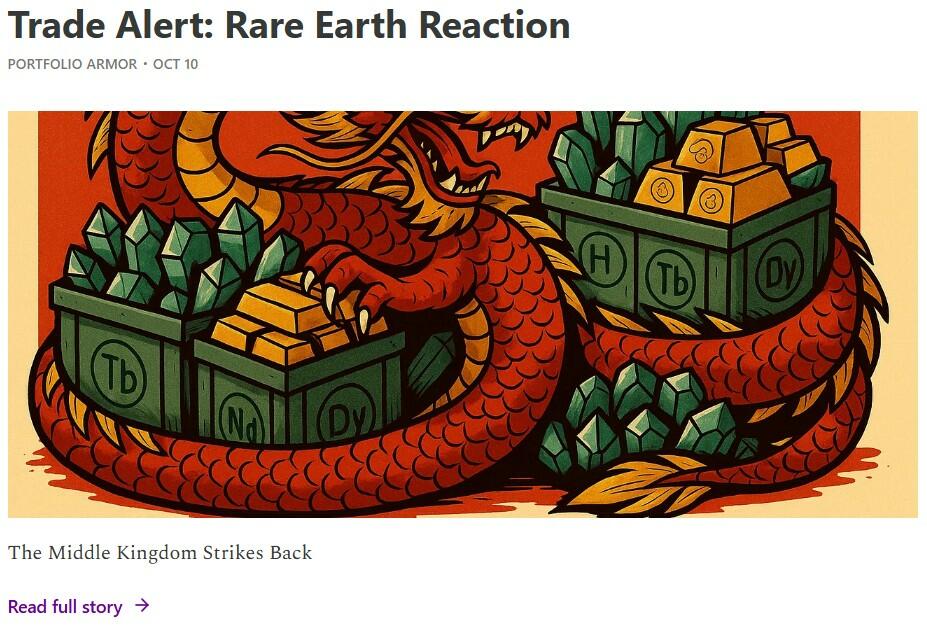
And yes, had we waited until after Trump’s tariff tape bomb, our entries would likely have been better. Process over perfection.
If Headlines Stall
We expect progress before the previously scheduled Trump–Xi meeting (at APEC later this month)—maybe even a positive Trump headline before Monday. If nothing materializes and markets drift lower, we’ll look to add selectively considering what’s on sale, including high-quality China ADRs, using our standard IV-harvesting, defined-risk structures.
Bottom line: the end game isn’t “TACO” (“Trump Always Chickens Out”). It’s a rules-based modus vivendi that begins to rebalance trade and access while letting both countries compound. We’ll keep expressing it with trades that harvest near-term IV and preserve long-dated convexity—so we can get paid by decay now and still participate if a grand bargain takes shape.
So Far So Good
As you can see below, other than our QQQ hedge, which expired worthless, we had a nice series of trade exits, despite the headline headwinds.
Stocks or Exchange Traded Product.
None
Options
Put on Invesco QQQ Trust ( QQQ 0.97%↑). Bought for $1.91 as a hedge on 9/5/2025; expired worthless on 10/10/2025. Loss: 100%.
Diagonal spread on Super Micro Computer (SMCI -2.29%↓). Entered at a net debit of $3.20 on 7/22/2025; short leg expired worthless on 8/22/2025; exited long leg at $4 on 10/7/2025. Profit: 20%.
Calls on UiPath (PATH 12.96%↑). Bought for $2.53, as part of a 4-leg combo on 10/6/2025; sold (half) for $5 on 10/9/2025. Profit: 98%.
Calls on Bit Digital (BTBT -7.88%↓). Bought for $0.90, as part of a 3-leg combo on 9/22/2025; sold (half) for $1.90 on 10/10/2025. Profit: 111%.
Call spread on AST SpaceMobile (ASTS -3.79%↓). Entered at a net debit of $4.40, as part of a 4-leg combo, on 8/27/2025; exited at $12 on 10/8/2025. Profit: 173%.
Call spread on Teradyne (TER 1.73%↑). Entered at net debit of $5.95 on 7/11/2025; exited at a net credit of $20 on 10/6/2025. Profit: 236%.
Four-leg combo on Robinhood Markets (HOOD 2.10%↑). Entered at a net debit of $1.70 on 9/5/2025; exited the put spread at a net debit of $0.25 on 10/2/2025; exited the call spread at a net credit of $12 on 10/6/2025. Profit: 591%.1
Four-leg combo on Centrus Energy (LEU -0.72%↓). Entered at a net debit of $0.05 on 8/13/2025; exited the call spread at a net credit of $8 on 10/2/2025; exited the put spread at a net debit of $0.20 on 10/10/2025. Profit: 15,500%.2
Early Sunday Update
Looks like a bit of de-escalation on the part of China. The key sentence here, from the Spokesperson of China's Ministry of Commerce:
I would like to emphasize that China’s export controls do not amount to an export ban. As long as exports are for civilian use and meet compliance requirements, such applications will be approved, and relevant enterprises have no cause for concern.
I sense Beijing’s restraint from this press conference Q&A.
— Shanghai Macro Strategist (@ShanghaiMacro) October 12, 2025
Spokesperson of the Ministry of Commerce Answers Questions on China’s Recent Economic and Trade Policy Measures
Question: We’ve noticed that the Ministry of Commerce recently issued an announcement to strengthen… pic.twitter.com/QtpAVx7UJp
Later Sunday Update
Trump post. Calls Xi "highly respected" but doesn't rescind his additional 100% tariff rate (yet).
Weekend Markets, Crypto Soar After Trump Addresses "Highly Respected President Xi" https://t.co/ZDokehBdyW
— zerohedge (@zerohedge) October 12, 2025
On premium paid; profit on max risk = 150%.
On premium paid; profit on max risk = 154%
*NORM = Naturally-Occurring Radioactive Material
If you want a heads up when we place our next trade, you can subscribe to The Portfolio Armor Substack below.
And if you want to trade our top names on your own, you can subscribe to our website here, or download our iPhone app here.