







Even "All Time Highs" Feel Sh*tty
Submitted by QTR's Fringe Finance
The headlines say the economy is thriving. The stock market is hitting fresh all-time highs, investors are giddy over rate-cut rumors, and Wall Street is patting itself on the back for another quarter of “resilience.” Great news, right?
Well — it depends on which part of the economy you live in. Because while the S&P hits “all-time highs”, across Main Street, Americans are setting their own kind of “all-time highs” — in delinquencies, defaults, and debt.
Auto loan delinquencies have climbed to their worst levels in decades. Credit card balances are ballooning past $1.2 trillion, with more borrowers falling behind each month. Even commercial real estate, long seen as the bedrock of institutional finance, is cracking under pressure. And household debt? It’s at a record $18.6 trillion.
In general, a growing number of Americans are juggling bills, falling behind on payments, and racking up record interest charges just to stay afloat.
So yes, stocks are soaring. But the real economy — the one made up of actual payments, credit card minimums, rent checks, and student loans — is maxed out, overdue, and running on borrowed time.
Auto loan delinquencies have hit record highs, Bloomberg wrote just today.
The share of subprime borrowers at least 60 days behind on their car payments climbed to 6.65% in October — “the highest in data going back to 1994,” according to Fitch Ratings. Inflation, high borrowing costs, and the return of student loan payments are straining household budgets, pushing more drivers into default.
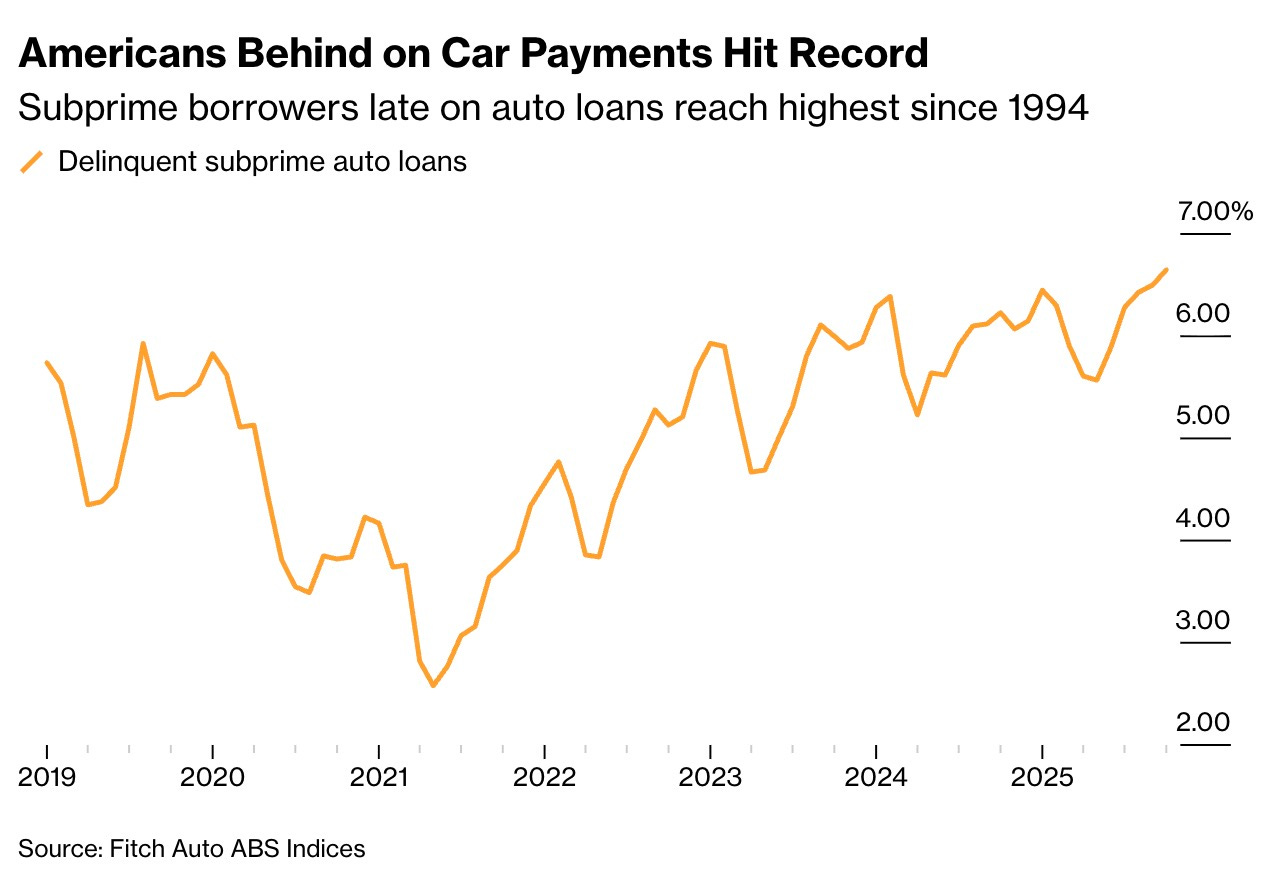
The fallout is already visible, as I’ve written about: subprime lender Tricolor Holdings filed for bankruptcy in September, underscoring the risks facing both borrowers and lenders.
Meanwhile, car prices remain near record levels — with new vehicles averaging over $50,000 — and many trade-ins carry negative equity. For lower-credit borrowers, interest rates often exceed 20%, making it “hard to catch up” once payments are missed.
Then, there are several other areas of the economy that look just as precarious and ugly...(READ THIS FULL COLUMN HERE).