





Silver-War Signals Widening China Conflict
Taiwan’s vulnerability is managed through a cohesive continuity framework that encompasses diplomacy, logistics, resources, and financial mechanisms.
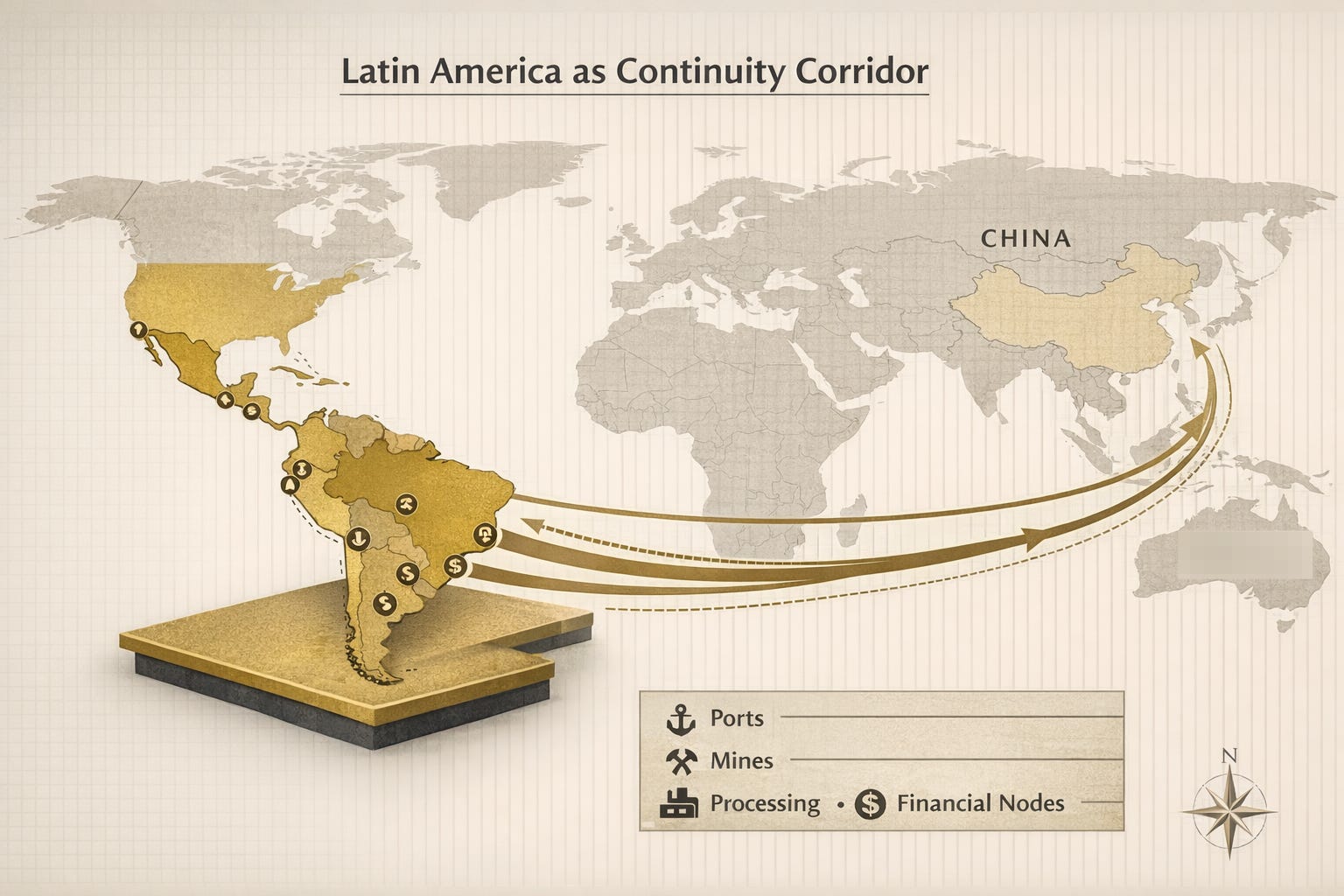
Latin America provides essential support via access to trade corridors, processing capabilities, routing options, diversified settlements, and institutional alternatives.
China’s December policy officially integrates Taiwan into its Latin America strategy, while solidifying structures for corridors, supply chains, and settlements.
Current trends in metals and corridors highlight both underlying pressures and intentional strategic planning, indicating that Taiwan’s risks are shaped by this continuity framework rather than fleeting political news.
The Taiwan–Latin America Continuity Architecture
Authored by GoldFix
As the top title implies, the “silver price war” is peripheral to a far larger and more consequential struggle. Silver pricing, Latin American influence, and Taiwan’s future are not separate issues. They are structurally connected inside China’s strategic planning.
China now treats Taiwan as an existential question. Latin America has become a critical surface in that contest. Failure to secure Latin American trade corridors and institutional alignment compresses the timeline toward confrontation over Taiwan’s status, with systemic global consequences.
Taiwan’s strategic risk follows an integrated continuity architecture across diplomacy, logistics, resources, and settlement. Latin America anchors corridor persistence and institutional optionality. China’s December policy formally embeds Taiwan into this Latin America framework while codifying supply-chain and settlement design. Metals and corridors now reflect declared strategy.
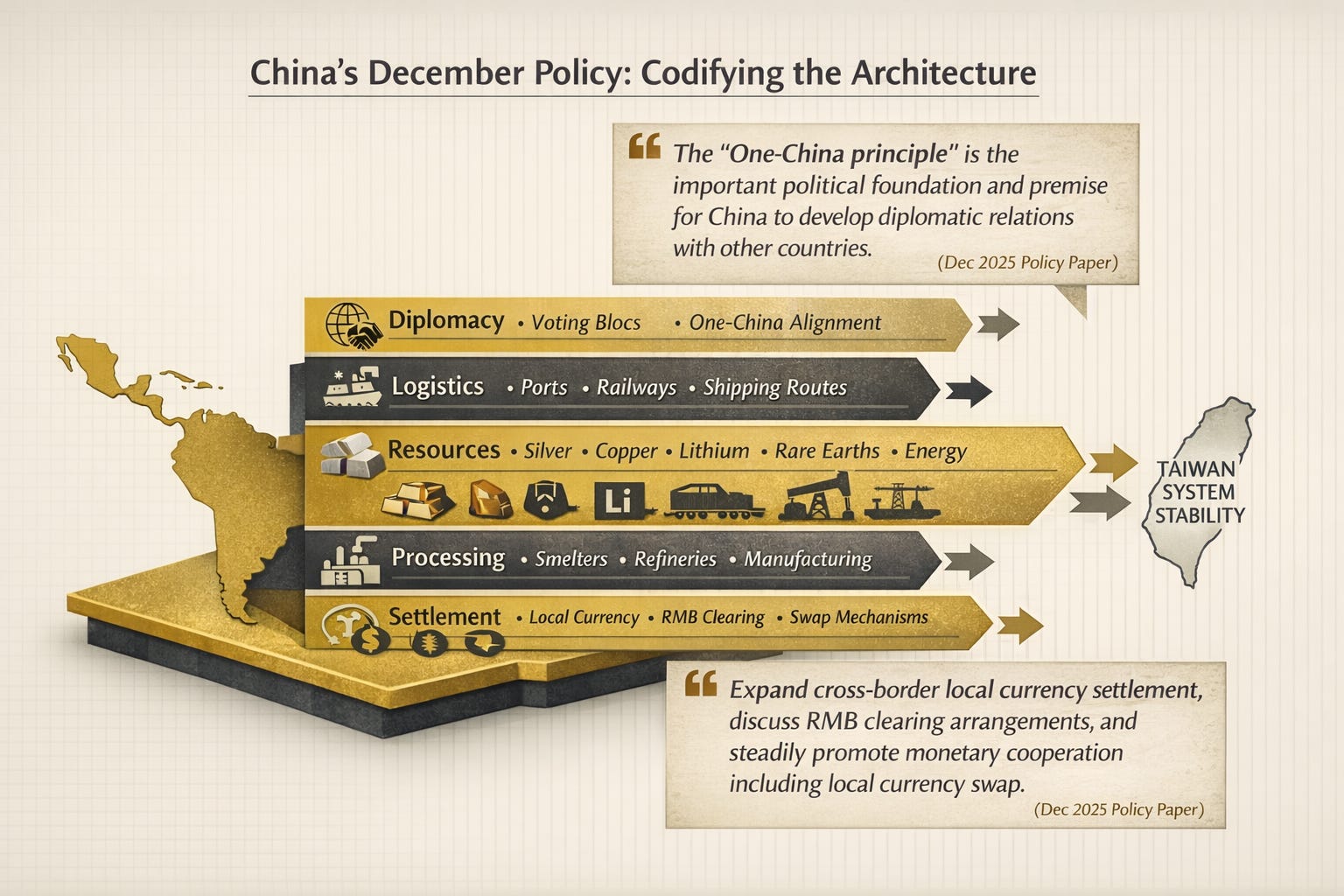
Taiwan’s strategic outcomes follow an integrated continuity architecture composed of diplomatic insulation, enforcement feasibility, supply-chain resilience, industrial continuity, and financial settlement reliability. These variables operate as a unified system. Each is conditioned by institutional voting behavior, corridor access, processing capacity, transport routing, and settlement infrastructure. Latin America materially influences all of these layers and therefore functions as a distributed support structure within Taiwan’s strategic equation.
Exclusive: Silver-War Signals Widening China Conflict

Intro: As the title suggests, this discussion is tangential to a larger and more consequential issue, which will be addressed in Part Two over the weekend. The price of silver and the contest for influence in Latin America are both directly and indirectly tied to China’s strategic objective of reclaiming Taiwan through international diplomacy. Failure to secure Latin American supply chains increases the probability of confrontation over Taiwan’s status and raises the risk of broader conflict. From Beijing’s perspective, this has become an existential struggle.Read full story
This influence operates through logistics corridors, resource continuity, financial settlement structures, and procedural institutional behavior. Together, these layers determine how geopolitical pressure propagates through operational systems rather than how it appears in political signaling.
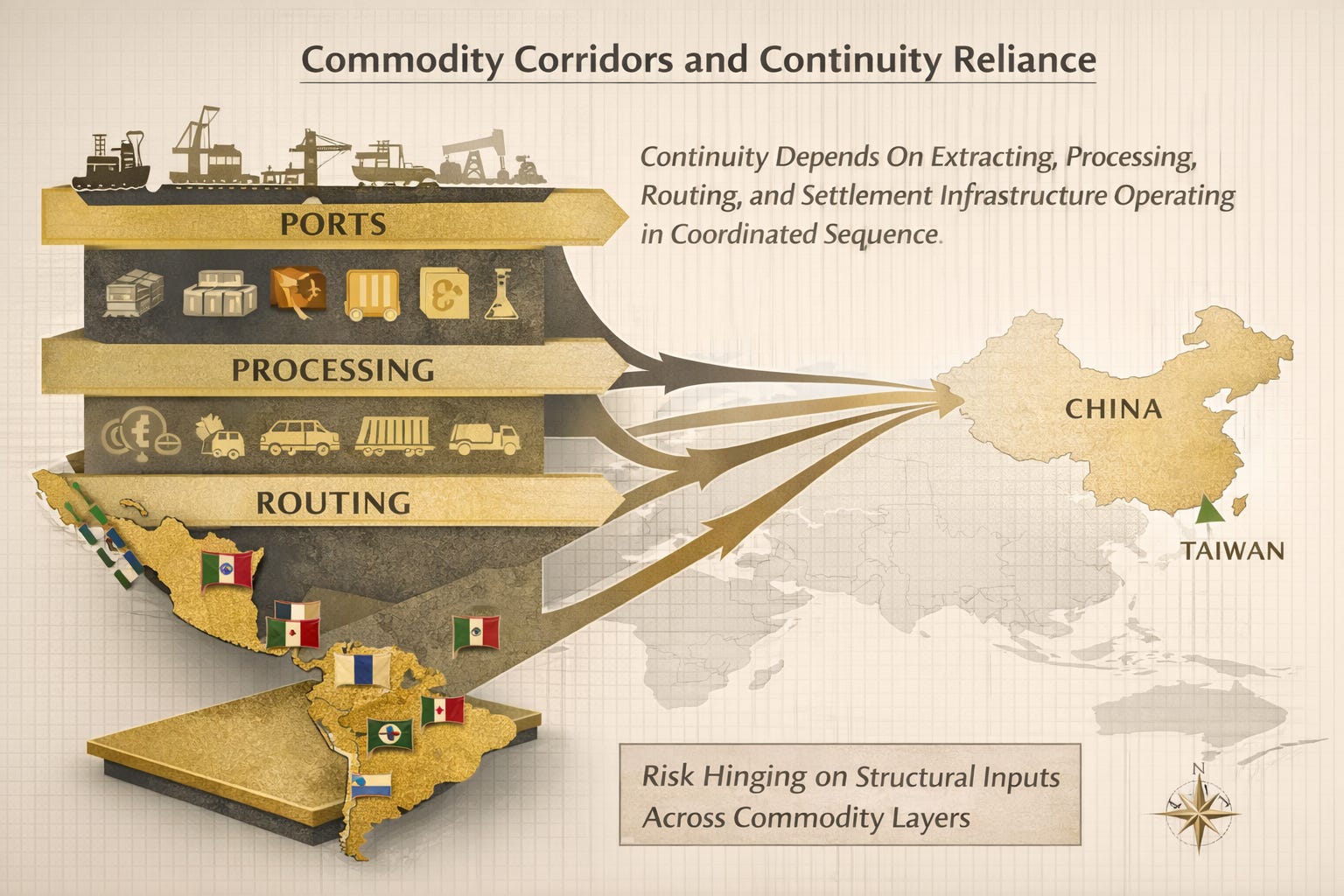
Recent U.S. national security doctrine prioritizes Western Hemisphere consolidation through supply-chain security, resource access, and logistical proximity. This policy architecture stabilizes industrial continuity inside politically reliable corridors. Latin America occupies a central position in this framework because extraction, processing, routing, and settlement operate there in coordinated sequence. Taiwan’s strategic environment inherits these continuity conditions through systemic linkage across industrial inputs, financial pathways, and logistical networks.
China’s posture now mirrors this logic and has hardened its tone. Beijing’s December policy paper on Latin America and the Caribbean formally elevates the region from a commercial theater into a geopolitical continuity zone. The Taiwan linkage is explicit, framed as the political predicate for state relations.
“The one-China principle is the important political foundation and premise for China to develop diplomatic relations with other countries.”
The policy paper makes Latin America a named surface area for Taiwan’s diplomatic condition. Taiwan is not treated as a parallel dispute. It is embedded into the diplomatic basis of engagement with Latin American states, formalizing the linkage at the policy level.
“The Chinese government appreciates that the vast majority of LAC countries abide by the one-China principle… Taiwan is an inalienable part of China’s territory… [and] oppose ‘Taiwan independence’ in any form.”
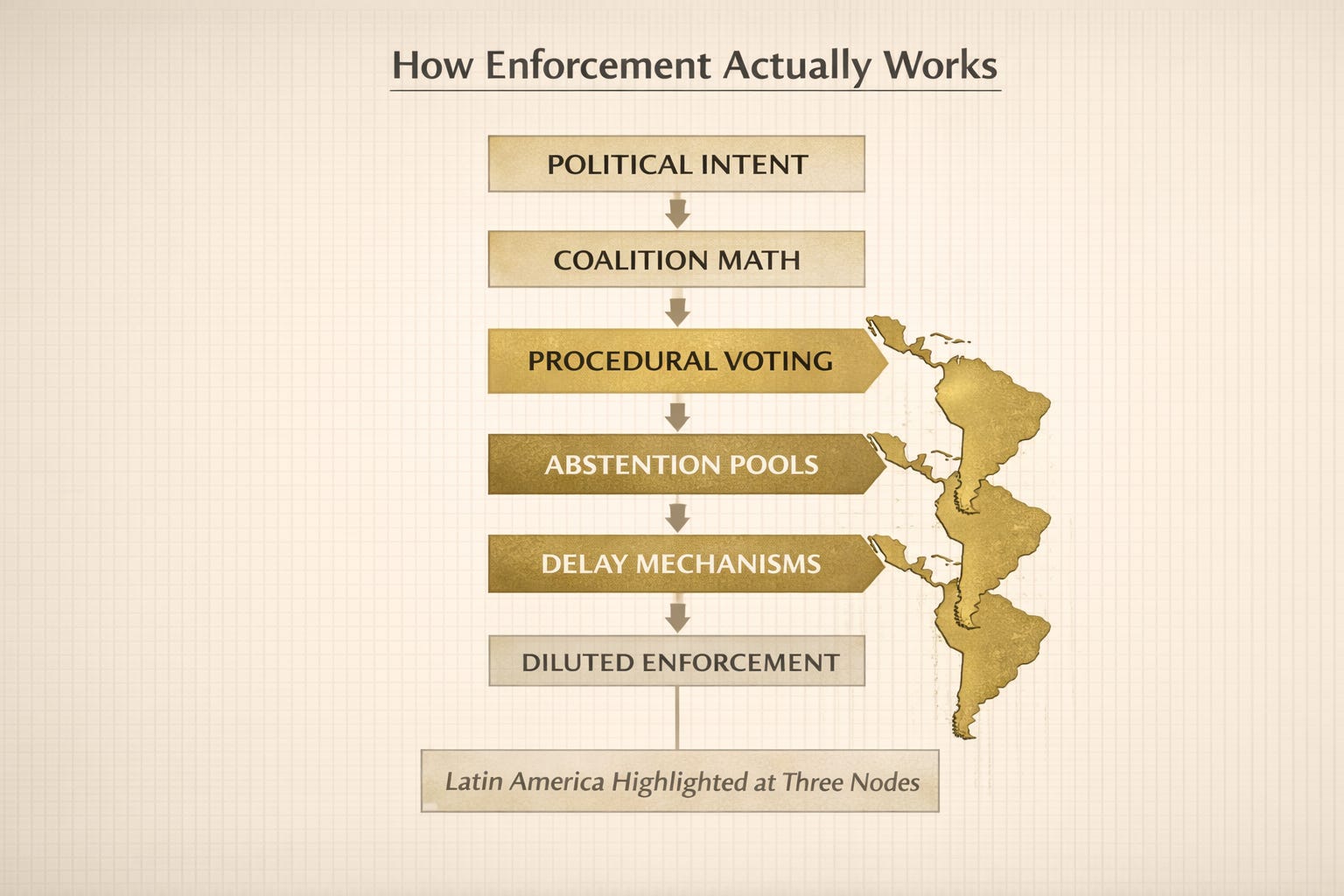
Coalition enforcement runs on coalitions, institutions, and procedures. Taiwan enforcement depends on coalition coordination. Coalition coordination depends on institutional voting behavior. Institutional behavior depends on procedural arithmetic. Latin America supplies voting blocs, abstention pools, and procedural delay capacity. Infrastructure finance and commodity agreements convert into diplomatic optionality. Optionality expands procedural degrees of freedom through pacing, sequencing, and agenda control. These mechanisms increase enforcement friction through institutional mechanics. Procedural extension functions as a system variable.
China’s policy paper reinforces this institutional layer by embedding Latin America within a broader governance posture. It emphasizes multilateral coordination, procedural legitimacy, and explicit rejection of coercive economic tactics.
“Oppose unilateral bullying practices.”
At the operational layer, the same policy instrument ties Latin America to corridor persistence through infrastructure, resources, and settlement. Taiwan’s exposure follows whether the corridors feeding industrial continuity remain intact, diversified, and reliably settled under constraint. Beijing’s language is direct.
The paper commits to safeguarding global industrial and supply-chain stability. That is continuity architecture stated without abstraction.
“Safeguard the stability of global industrial and supply chains.”
China’s Latin America engagement now spans port concessions, rail and logistics corridors, power infrastructure, mining and processing facilities, and financial system integration. Across multiple Latin American economies, China functions as a principal trading partner or financier across logistics, energy, and materials systems. This distributed configuration preserves corridor persistence through structural dispersion of access pathways. Corridor persistence supports industrial continuity. Industrial continuity supports strategic insulation.
The settlement layer is treated as a primary system control point.
“Expand cross-border local currency settlement, discuss RMB clearing arrangements, and steadily promote monetary cooperation including local currency swap.”
The paper further binds resources to settlement mechanics.
“Mechanisms of long-term supply and local currency pricing and settlement of energy and resource products, so as to reduce the impact of external economic and financial risks.”
Latin America constitutes a major corridor for silver, copper, lithium, rare earth processing, and energy logistics. Continuity depends on extraction, processing, transport routing, and settlement infrastructure operating in coordinated sequence. Industrial continuity requires simultaneous operation of all four layers. As commodity systems regionalize under political constraint, continuity stability governs planning behavior across industrial and logistical systems.
Continues here