





Continues here


Gold Becomes America’s Top Export
“It would appear the USA has replaced the LBMA as a physical hub for precious metals destined for the far east”
U.S. May Be Settling China Trade Deals in Gold

Contents
- Gold Warping the Trade Data
- A Reuters Signal: New U.S.–China Trade Channels
- Gold Becomes America’s Top Export
- The Missing Context: The 2025 Gold Import Surge
- From Vault Build to Bullion Outflows
- Trade Deficits and the Hidden Settlement Layer
- Bullion Banks Bridge Dollar Imbalances
- China Wants The Gold
- Why Gold Shows Up in Trade Data
- A De Facto Adjustment Mechanism
- Gold Returns to Trade Settlement
Gold Warping the Trade Data
Authored by GoldFix
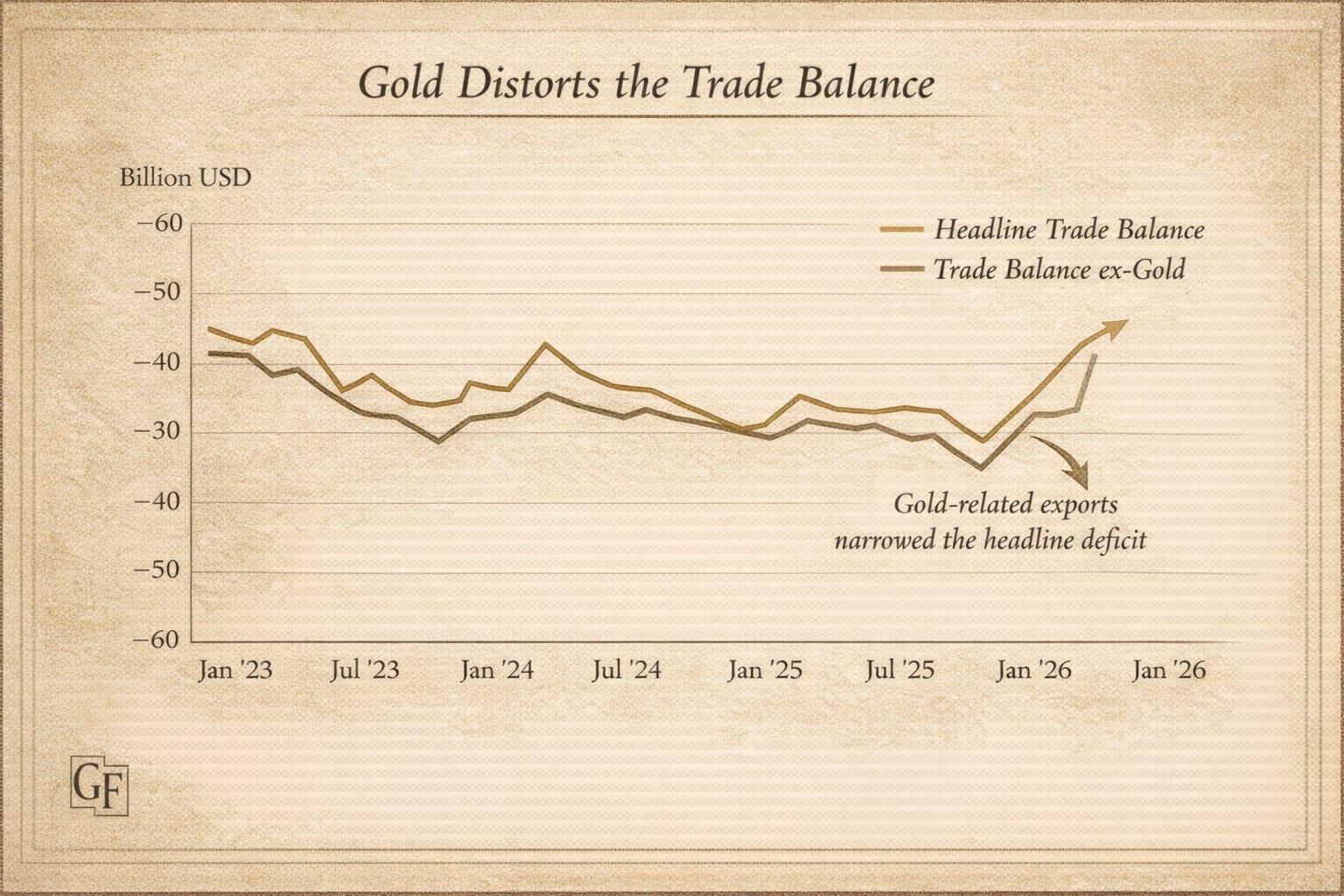
This week, in a report by Wells Fargo (Report1) it was noted pointedly that recent U.S. trade data has been “whipsawed” by the movement of non-monetary gold. The economists emphasized that bullion flows are distorting the headline numbers.
In January, gold wasn't the sole thing driving exports $14.6 billion higher. Other precious metals rose a similar amount as gold, up just over $4 billion last month. Together these two components account for nearly 60% of the export gain.
In January, the reported narrowing of the trade deficit overstated the underlying improvement once gold-related categories were removed from the calculation. In other words, part of the apparent adjustment in the trade balance reflects the movement of investment metals rather than changes in the real production economy.
At first glance, the observation appears technical. Yet when placed alongside several other developments in the data, it begins to look more significant.
A Reuters Signal: New U.S.–China Trade Channels
At roughly the same time that gold has begun to distort U.S. trade statistics, U.S. and Chinese officials have reportedly been discussing the establishment of new mechanisms to manage bilateral trade flows. According to Reuters, the two governments have explored frameworks designed to stabilize economic relations and reduce volatility in trade and investment channels.
CHINA, US DISCUSSED ESTABLISHING NEW MECHANISMS ON TRADE: RTRS
— VBL’s Ghost (@Sorenthek) March 15, 2026
-gold
Those conversations are occurring against a structural backdrop that has remained unchanged for decades. The United States runs a persistent trade deficit, while China runs a persistent surplus. Historically, the imbalance has been settled through the dollar system. The United States imports goods and exports financial claims. Surplus economies recycle their earnings into dollar assets.

Yet the trade data now reveals something unusual.
Gold Becomes America’s Top Export
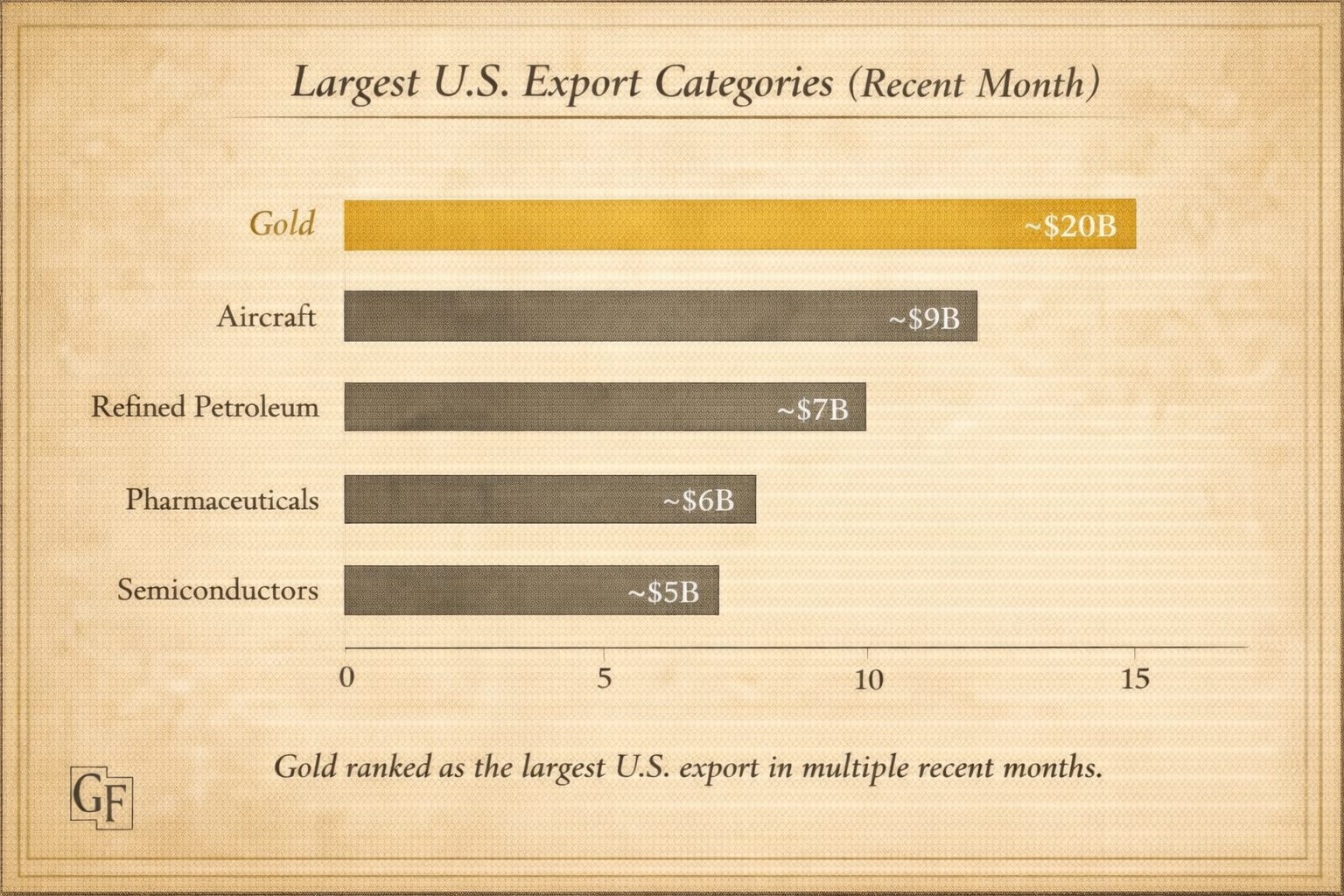
In three of the past four months, gold has ranked as the largest U.S. export category. Luke Gromen recently highlighted that statistic, noting that a similar pattern has not appeared in at least two decades of data.
As Wells Fargo reminds us:
Outside metal flows, the trade story remains remarkably steady where nearly-all the growth sits in high-tech related goods. Computers (+$2.6B), and computer accessories ($1.6B), as well as semiconductors ($353M) posted impressive monthly gains.
That fact alone does not prove anything about policy. Bullion flows can arise from a range of market activities including vault transfers, ETF rebalancing, refinery shipments, or arbitrage between global trading hubs. All of those mechanisms appear in the trade accounts under the category of non-monetary gold.
Nevertheless, the scale and timing of the flows invite a broader interpretation.
The Missing Context: The 2025 Gold Import Surge
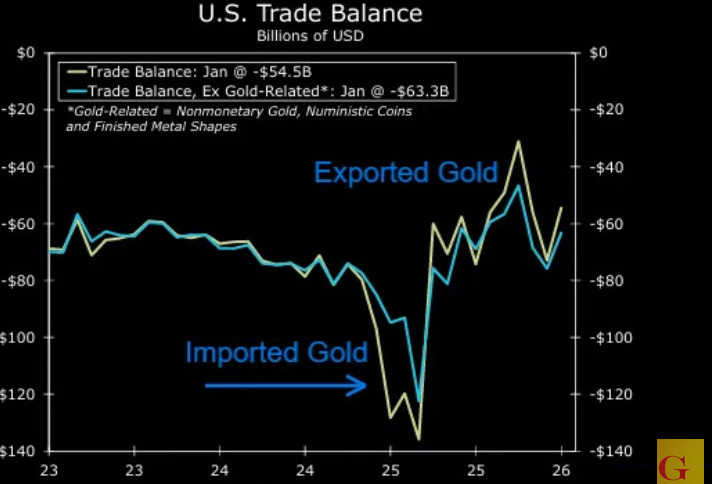
What makes the pattern more interesting to our eyes is that these exports are occurring only months after an equally unusual development on the other side of the ledger. During 2025, the United States imported a very large quantity of gold, with monthly inflows reaching levels rarely seen in modern trade data. The purpose of those imports was never fully explained in the public record.
Now, only months later, significant quantities of that same metal appear to be leaving again.
From Vault Build to Bullion Outflows
When viewed together, the sequence raises a reasonable question about how value is being transferred through the global trade system.
The United States continues to run a substantial trade deficit with China, its largest bilateral trading partner. At the same time, large quantities of physical gold have been moving through U.S. vault systems and appearing in international trade statistics.
To be clear, this does not imply that the U.S. Treasury is shipping gold bars directly to Beijing as payment for imported goods… at least not yet. Official sovereign settlement would occur through central bank reserve channels and would likely not appear in standard merchandise trade statistics.
What the data suggests instead is a more indirect mechanism but one we are quite familiar with.
Free Posts To Your Mailbox
Contributor posts published on Zero Hedge do not necessarily represent the views and opinions of Zero Hedge, and are not selected, edited or screened by Zero Hedge editors.
Loading...