End Phase of the War
Welcome to MktContext! I am a professional money manager, trader, and investor who has been timing and beating the market for over a decade. We specialize in predicting market direction by studying the economy and market signals. Join 12,000 subscribers at MktContext.com for our weekly deep dives and analysis!
Author's note: This piece was written before Monday's announcement of de-escalation. The new development was expected. We have been staunch believers that an offramp is coming soon, and this piece outlines how that will play out.
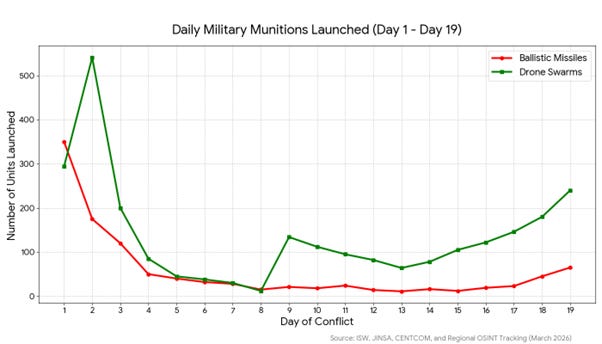
At this stage of the war, Western and Israeli assessments say that Iran’s peak offensive is degraded. That means their longer-range missiles have been hit, so it cannot sustain the massive, synchronized launches it used earlier in the war. Missile production facilities have also been slowed due to factories being hit.
Iranian officials insist they can still fight, but this is limited to shorter-range missiles and smaller salvos (drones, proxy forces, cyber, or economic pressure like disrupting oil flows). A few scattered shots across Hormuz is enough to keep most tankers at bay.
This is consistent with a tracking of Iran’s munitions used (chart below). As the war wears on, their missile attacks (red line) have lessened in favor of drone attacks (green line) which are inherently less damaging. Yes, they can still fight, but not to the extent of severely damaging its Gulf neighbors or besieging Hormuz.
Consistent with Trump’s timeline, now that offensive threats have been neutralized, US/Israeli forces can proceed to clear out threats from Hormuz. Indeed, the Wall St Journal reported this operation is now under way. Granted, it will still take a few weeks to fully clear Iran’s web of assets that have harassed Strait traffic. But this operation (which employs low-flying planes and Apache helicopters) could not be started before clearing the bigger offensive threats.
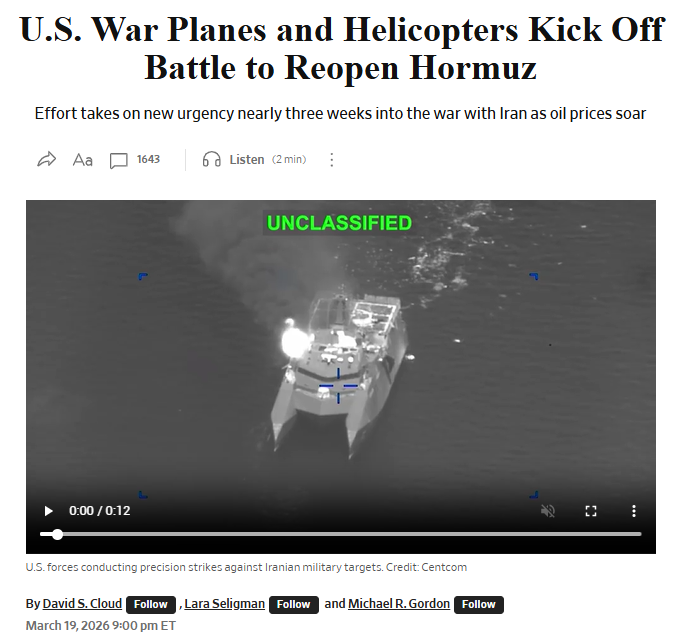
After the armed boats, mines, and cruise missiles have been cleared, US warships can eventually escort tankers through Hormuz as promised.
“The A-10 Warthog is now engaged across the southern flank, targeting fast-attack watercraft in the Strait of Hormuz. Apaches have joined the fight on the southern flank. Some allies are using Apaches to handle one-way attack drones.”
-Air Force General Dan Caine
Note: Fast-attack boats have been responsible for harassing commercial shipping in the Strait. One-way attack drones, a.k.a. kamikaze drones, have been responsible for hitting neighboring Arab states and energy infrastructure across the Gulf.
Farzin Nadimi, expert on Iranian defenses at Washington Institute for Near East Policy: “Despite the strikes, Iran is still believed to have a vast stockpile of mines, cruise missiles on trucks and hundreds of undamaged boats in hidden facilities with deeply dug tunnels along the coast and on islands. It will take weeks to reach a point where there can be safe operations in the strait. Even then, a lot of the Iranian assets will survive.”
Michael Connell, Iran analyst at Washington think tank Center for Naval Analyses: “Lowering the threat to the point where ships can resume transiting the strait is doable but it takes time and you are probably never going to get to 100%. We could reach a stage where we’re getting ships through and they could still get a lucky shot.”
Again, emphasis on weeks not days, and never going to get to 100%.
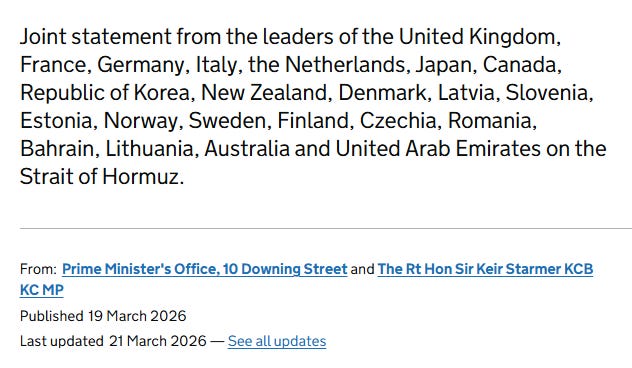
Thereafter, the US may leave a small squad behind to patrol, but it will be up to NATO, Gulf countries, and China to police the Strait. After all, they are the ones who benefit from its trade. Allied countries have now agreed to contribute military efforts to “ensure safe passage through the Strait”:
Join 12,000+ macro investors who get these insights before the mainstream media catches on!