





Continues here


Globalism Was Never Built to Last
Mercantilism Revisited: From Efficiency to Control in a Fragmenting World
Authored by GoldFix
Globalization delivered efficiency by removing buffers, concentrating production, and relying on stable conditions. Those conditions are breaking. What was optimized for cost is now exposed to risk. The system is shifting toward control, resilience, and security, forcing nations and businesses to rebuild around stability rather than speed.
Introduction: A Structural Transition, Not Business as Usual
The current shift in the global economic system is frequently described as cyclical; however, the available evidence suggests a structural transition. The defining characteristic of this transition is a change in the system’s optimization function. For approximately three decades, the global economy operated under a model that prioritized efficiency, cost minimization, and capital mobility. That model is now being reoriented toward control, resilience, and strategic autonomy.
This is not a theoretical abstraction. It is observable across trade policy, supply chain architecture, capital allocation, and geopolitical alignment. The re-emergence of mercantilist behavior reflects a recalibration of priorities rather than a rejection of markets. The system is not abandoning globalization entirely; it is restructuring it around constraints that were previously assumed away.
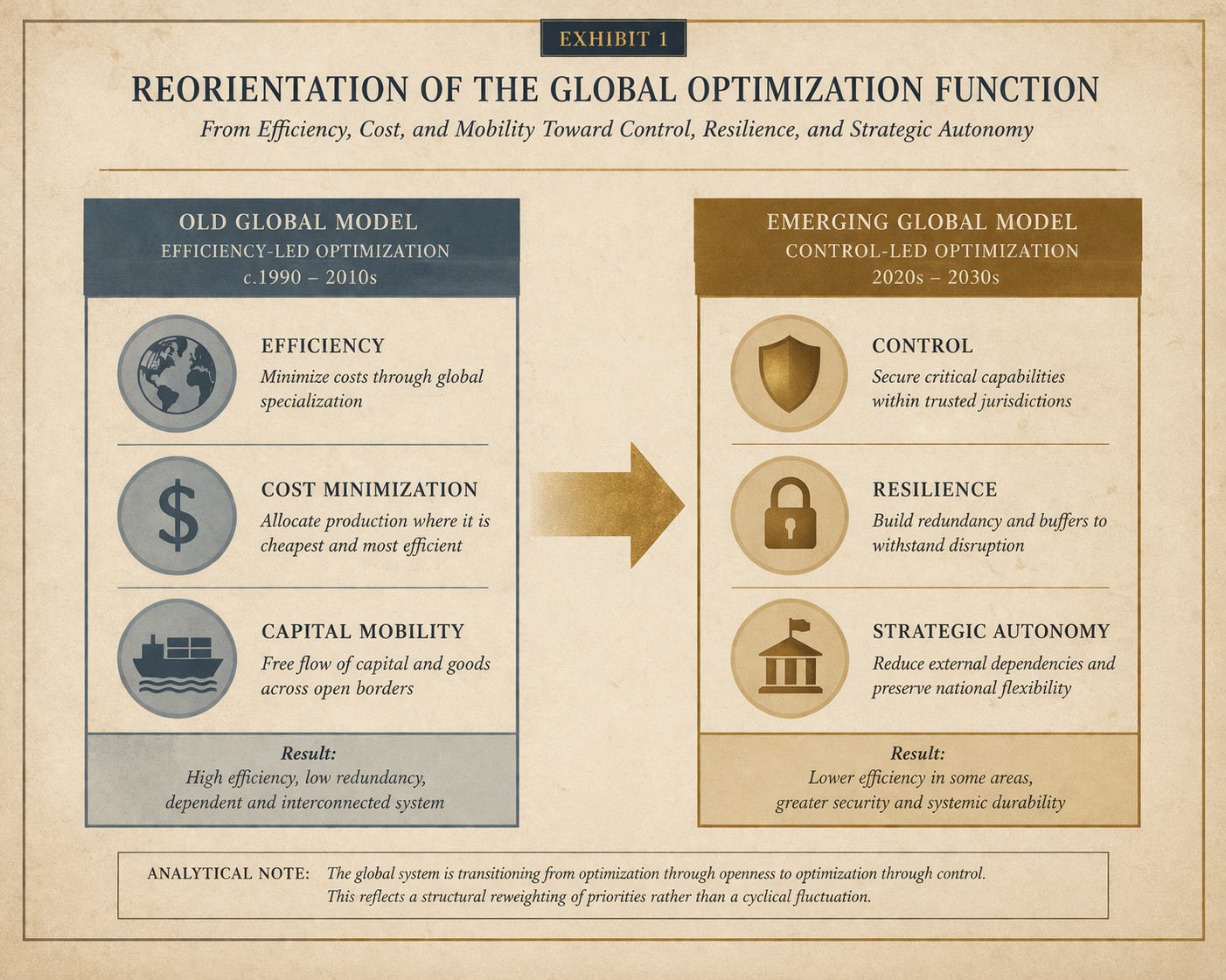
Understanding this transition requires a clear delineation between the world that was, the world that is, and the world that is forming.
The World That Was: Globalization as an Efficiency Engine
From the early 1990s through the late 2010s, the global economy expanded under a framework defined by liberalized trade, integrated capital markets, and extended supply chains. The underlying logic was rooted in comparative advantage: production would occur where it was most efficient, and goods would flow freely across borders.
This system was supported by several reinforcing conditions. First, the United States provided a security umbrella that stabilized maritime trade routes and reduced the risk premium associated with cross-border commerce. Second, the U.S. dollar functioned as a global reserve currency, facilitating transactions and anchoring financial stability. Third, technological advancements in logistics, communications, and manufacturing reduced coordination costs, enabling firms to operate complex, geographically dispersed supply chains.
Within this framework, firms optimized for cost. Production migrated to lower-cost jurisdictions, inventory levels were minimized, and just-in-time delivery systems replaced stockpiling. Capital allocation followed return maximization, often independent of geographic or political considerations.
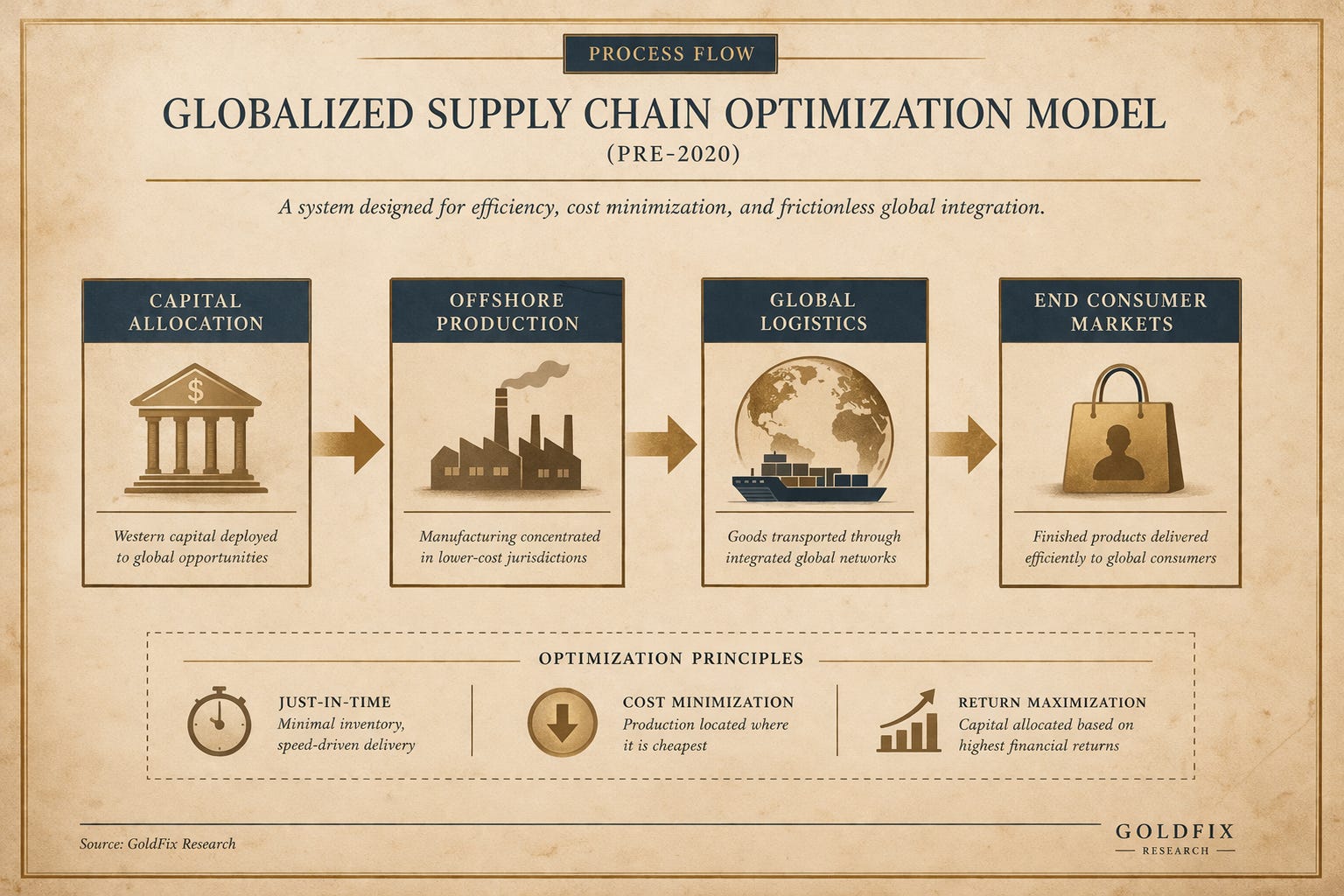
The result was a period characterized by declining marginal costs, disinflationary pressures, and expanding corporate margins. Consumers benefited from lower prices, while asset markets reflected the compounding effects of efficiency gains.
However, the system embedded a trade-off. Efficiency was achieved at the expense of redundancy. Redundancy, in turn, is the primary mechanism through which systems absorb shocks. By minimizing redundancy, the global economy increased its exposure to disruption.
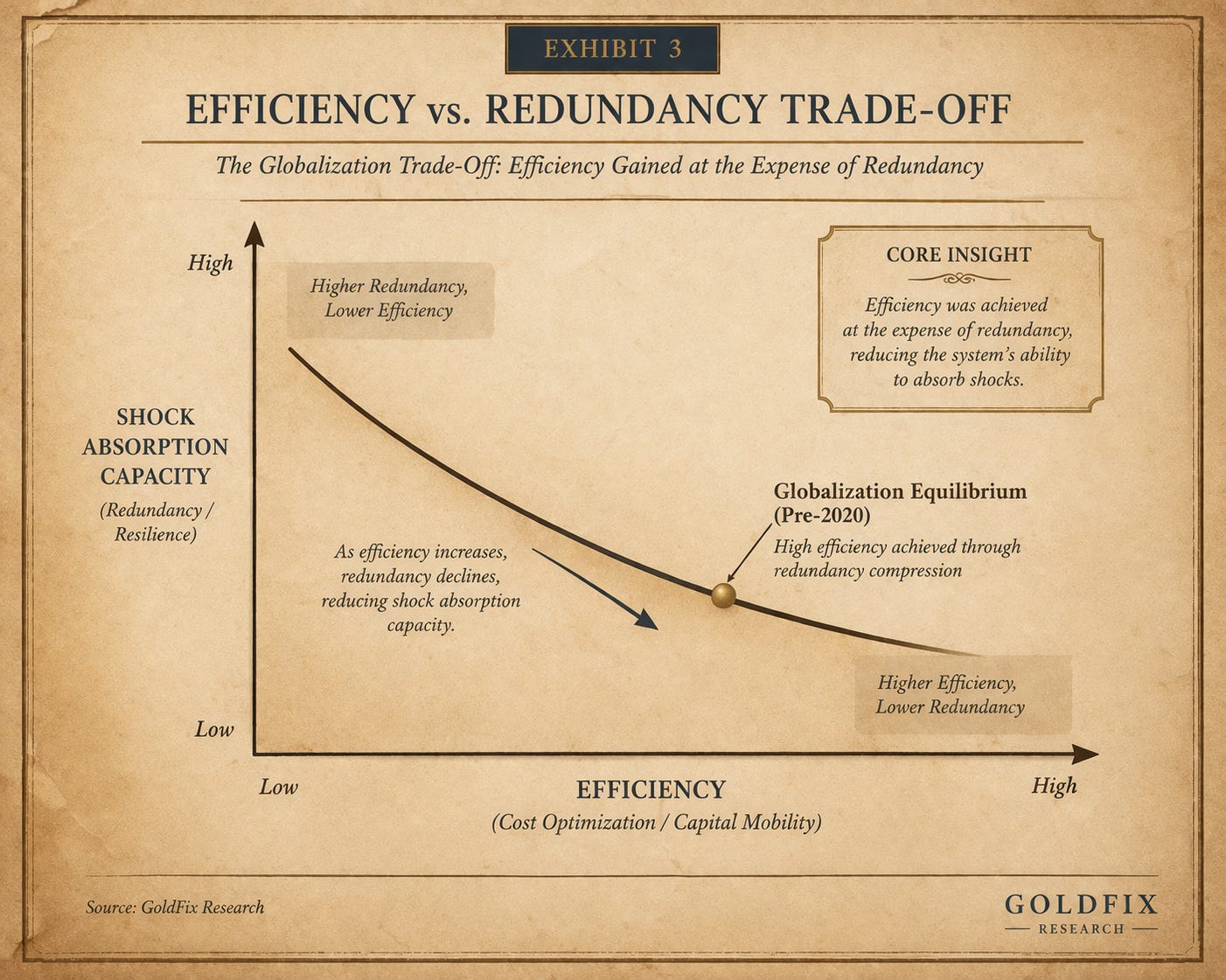
This vulnerability remained latent until the system was tested.
Stress Testing the System: Revealing Fragility
The transition away from globalization’s efficiency paradigm did not occur spontaneously. It was catalyzed by a sequence of events that exposed structural weaknesses.
The Global Financial Crisis demonstrated how tightly coupled financial systems could transmit instability across borders. The COVID-19 pandemic revealed the fragility of supply chains optimized for cost but not continuity. Disruptions in medical supplies, semiconductors, and industrial inputs highlighted the risks associated with concentrated production.
Subsequent geopolitical developments reinforced these lessons. The Russia-Ukraine conflict underscored the strategic importance of energy flows, while sanctions and the freezing of central bank reserves introduced a new dimension of political risk into financial assets previously considered neutral.
Trade disputes between major economies further eroded the assumption of cooperative interdependence. Export controls, tariffs, and investment restrictions became instruments of policy rather than anomalies.
These events share a common implication: interdependence without trust increases systemic vulnerability. When trust deteriorates, actors re-evaluate their exposure to external dependencies. This re-evaluation leads to structural change.
Free Posts To Your Mailbox
Contributor posts published on Zero Hedge do not necessarily represent the views and opinions of Zero Hedge, and are not selected, edited or screened by Zero Hedge editors.
Loading...